
16 products
Sort by:
16 products
16 products


What is Sinob's Juiced EAA?
Sinob Juiced EAA is a powdered drink that brings together all nine essential amino acids. A 15 g serving provides 12 g of amino acids for 50 kcal, including 3 g of leucine, and neither carbohydrates nor fat. The 450 g tub covers 30 servings.
The essential amino acids are the nine the body cannot make for itself: leucine, isoleucine, valine, lysine, threonine, phenylalanine, methionine, histidine and tryptophan. All of them must therefore come from the diet. The first three make up the BCAAs, far better known, but it really is the nine that count.
That is the fundamental difference with a BCAA product, and it is easy to state: you do not build a protein with three bricks out of nine. An EAA formula supplies the full set. The rest of the German range can be browsed in our Sinob aisle, and the other products in the category in our EAA aisle.
What does a serving of Juiced EAA contain?
| Nutritional values | Per 15 g serving | Detail |
|---|---|---|
| Energy | 50 kcal | — |
| Protein (amino acids) | 12 g | the nine essential amino acids |
| of which L-leucine | 3 g | the only amino acid quantified by the manufacturer |
| Carbohydrates | 0 g | of which sugars 0 g |
| Fat | 0 g | of which saturates 0 g |
| Salt | 0 g | — |
| Pack size | 450 g, i.e. 30 servings of 15 g | |
12 g of amino acids for 50 kcal is a ratio few products reach, and it is what justifies the price of this category. Relative to energy, protein here accounts for almost the whole of the calorie content. At that level an authorised claim becomes usable: protein contributes to a growth in and the maintenance of muscle mass, and to the maintenance of normal bones. These are the official wordings of the European framework, and they apply here because the product comfortably exceeds the required threshold.
It is, as it happens, the only solid regulatory argument in this entire aisle, and it is worth knowing: BCAAs on their own are not entitled to it. No claim is authorised for branched-chain amino acids taken in isolation. An EAA product with a proper protein content, on the other hand, falls within the scope of the protein claims. The difference is not commercial, it is regulatory.
The 3 g of leucine per serving is the second figure to look at. Leucine acts as a trigger in protein synthesis, and the research places the useful threshold at around 2.5 to 3 g per intake. You are there.
Data missing from the manufacturer's file: leucine alone is quantified. The amounts of the other eight essential amino acids are not disclosed, even though the order of the ingredients list allows their ranking to be guessed. We will not estimate them; the full profile appears on the packaging as supplied.
A small formulation curiosity: the list includes a black pepper extract, an ingredient usually employed as an absorption aid. Its amount is not disclosed either.
Ingredients list
Acidity regulator (citric acid), L-leucine, L-lysine, L-valine, L-isoleucine, L-lysine hydrochloride, L-threonine, L-phenylalanine, dextrose, flavouring, L-methionine, L-tryptophan, L-histidine, emulsifier (sunflower lecithins), maltodextrin, sweeteners (sucralose, acesulfame K), black pepper extract.
Manufactured in a facility that also handles MILK, EGGS, GLUTEN, SOYA, PEANUTS, NUTS, FISH and CRUSTACEANS.
How should Juiced EAA be taken?
Serving: 15 g, i.e. one scoop. Liquid: 300 to 500 ml of cold water. Timing: 30 minutes before the session, during training, or just after. Frequency: one serving around training; two during a calorie deficit. Duration: no set course.
Shake for around twenty seconds: it dissolves instantly and without lumps. Drink it straight away. The volume of water is your adjustment variable: 300 ml gives a drink with a strong taste, 500 ml a lighter one, better suited to a long session you sip your way through.
The most defensible time to take it is around training, and particularly if you train fasted in the morning or a long way from your last meal. In that case, a serving 30 minutes beforehand delivers the nine amino acids at the moment the body has nothing else available, and free amino acids reach the bloodstream quickly, faster than a protein that has to be digested.
During a calorie deficit, the manufacturer suggests two servings a day. That is consistent: when food intake drops, the 50 kcal of a serving represent a near-zero energy cost for a genuine amino acid intake.
If, on the other hand, you already take a protein shake straight after the session, adding an EAA one brings nothing. A whey contains the nine essential amino acids and the other eleven. Choose one or the other depending on the moment, not both one after the other. This product does, however, combine without redundancy with creatine monohydrate, with electrolytes on long sessions, or with a carbohydrate source during exercise.
Who is Juiced EAA for, and who is it not for?
It is aimed first and foremost at three profiles: those who train fasted, those in a calorie deficit who watch every calorie, and those who digest protein powder badly during exercise. In those three cases, a free amino acid drink at 50 kcal does a job that no whey does as well.
The manufacturer advises against it for pregnant and breastfeeding women, for children and for people on medical treatment, with prior medical advice in the latter case. The facility statement is broad — milk, eggs, gluten, soya, peanuts, nuts, fish and crustaceans — and should be read carefully by anyone with an allergy.
The formula contains sucralose and acesulfame K. If you avoid artificial sweeteners, look elsewhere.
What not to expect from it. It is not a meal replacement: 50 kcal feed nobody. It is not a stimulant, there is no caffeine and nothing else stimulating in it. And above all, it is not a protein replacement: 12 g of essential amino acids are useful, but 25 g of complete protein costs less and covers more needs. If your daily protein intake is already adequate and you do not train fasted, this product will mainly be a pleasant drink.
EAA or whey isolate?
This is the real comparison to make before buying, and it turns out differently depending on the time of day.
A whey isolate provides 25 g of complete protein per serving, with the nine essential amino acids and the eleven non-essential ones, at a markedly lower cost per gram of protein. On purely nutritional grounds, it wins every time. If your objective is to cover your daily protein needs, our whey isolate aisle is where to go, without hesitation.
EAAs have two precise advantages, and only two. The first is lightness: 50 kcal against 110 to 120 for a serving of whey, which genuinely counts when you are cutting. The second is digestion: free amino acids require no digestive work, which makes them drinkable during exercise where a milky shake sits heavily on the stomach.
When is whey clearly the better choice? After the session, at breakfast, in a yoghurt, or as soon as budget comes into play. And compared with a BCAA product, this one is more complete for a similar price: that is the comparison that turns most clearly in its favour.
Frequently asked questions
How many amino acids per serving?
12 g of essential amino acids in a 15 g serving, including 3 g of leucine, with 50 kcal, zero carbohydrate and zero fat. Leucine is the only amino acid quantified by the manufacturer; the amounts of the other eight are not disclosed.
What is the difference with BCAAs?
BCAAs provide only three essential amino acids out of nine. EAAs provide them all. The difference is regulatory too: no claim exists for BCAAs, whereas a product high in protein such as this one comes under the authorised protein claims.
Which flavours are available?
The flavours available: mango-passion fruit, lime, orange, iced peach tea, iced lemon tea, cherry and forest fruits. On a product consumed several times a week, being able to alternate avoids the tub abandoned half full.
Can EAAs replace your protein?
No, not on cost. A whey provides 25 g of complete protein at a far lower cost per gram. EAAs are justified by how light they are in calories and by their immediate digestion, not as a daily substitute for a protein powder.
Can they be taken fasted?
Yes, and it is even one of their best uses. Free amino acids require no digestive work and reach the bloodstream quickly. A serving 30 minutes before a fasted morning session is the most coherent use of this product.
How many servings in the tub?
30 servings of 15 g in the 450 g tub. At four sessions a week, that comes to a little under two months. It is a more modest pack than a tub of BCAAs, the serving here being twice as heavy.
Are there any calories or sugar?
50 kcal per serving, zero carbohydrate and zero fat declared. The powder is sweetened with sucralose and acesulfame K, with a small amount of dextrose and maltodextrin as carriers. It is compatible with a calorie deficit.
Where can you buy Sinob's Juiced EAA?
The 450 g tub can be ordered from this page, in one of the flavours available, and we ship anywhere in France and Europe. At the Vendargues shop, about ten minutes from Montpellier, it is the product we redirect most customers to when they come in looking for BCAAs: at a similar price, nine amino acids are worth more than three, and the question is settled in one sentence. The rest of the aisle can be browsed in our sports nutrition selection.


What is Applied Nutrition's Amino Fuel EAA?
Applied Nutrition Amino Fuel is a free-form amino acid powder to be mixed with water, dosed at 13 g per serving. It belongs to our EAA range: it contains the nine essential amino acids, that is, the ones the body cannot make itself and which must come from food. To these are added 2.5 g of L-glutamine, which is not an essential amino acid but is the most abundant one in muscle.
The point to grasp before anything else: these are free-form amino acids, not a protein. They are not bound to anything, they require no prior digestion, and they are drunk in a large volume of very cold water — the manufacturer advises 500 ml. That is what makes it a training drink rather than an end-of-session shake.
The ingredient list for the Fruit Burst version reads in descending order of weight: L-leucine, L-glutamine, L-valine, L-isoleucine, L-lysine, citric acid, natural flavouring, L-threonine, L-histidine, L-phenylalanine, salt, sucralose, L-methionine, natural beetroot colouring. The flavours listed: Icy Blue Raz, Fruit Salad, Fruit Burst, Candy Ice Blast and Millions Pineapple. The British brand's range can be found in our Applied Nutrition section.
What does a 13 g serving contain?
| Item | Per 13 g serving |
|---|---|
| Energy | 14 kJ / 3 kcal |
| Fat | 0 g |
| Carbohydrate | 0.49 g |
| of which sugars | 0 g |
| Protein (as declared) | 0 g |
| Salt | 0 g |
| L-leucine | 3,000 mg |
| L-glutamine | 2,500 mg |
| L-isoleucine | 1,500 mg |
| L-valine | 1,500 mg |
| L-lysine | 1,000 mg |
| L-threonine | 500 mg |
| L-histidine | 500 mg |
| L-phenylalanine | 335 mg |
| L-tryptophan | 100 mg |
| L-methionine | 50 mg |
No nutrient reference value is established for amino acids: a "% NRV" column would make no sense here, and we do not show one.
The total comes to almost 11 g of amino acids in a 13 g serving, including 6 g of BCAAs in the classic 2:1:1 ratio and 8.5 g of essential amino acids. It is a well-loaded product with very few excipients: the rest is citric acid, flavouring, sucralose and colouring.
Now for the honest reading of that table, the one you will not find elsewhere. The profile is heavily weighted towards the top of the list. Leucine, isoleucine and valine on their own account for 6 of the 8.5 g of essentials. At the other end, methionine is at 50 mg and tryptophan at 100 mg — token amounts. Saying that the product contains the nine essential amino acids is accurate; implying that it supplies useful quantities of each would be far less so. It is a BCAA product with extras, rather than a complete, balanced amino acid profile.
A second labelling curiosity: the line "Protein: 0 g" when the serving contains 11 g of amino acids. This is not a mistake. Free-form amino acids are not declared as protein under European nutrition labelling, which is based on a measurement of protein nitrogen. That has a practical consequence: these 11 g do not count as protein in your macros, even though they are its building blocks.
Finally, no health claim is authorised in Europe for BCAAs, EAAs or glutamine. So we describe a composition and doses, never a promised effect on recovery or muscle mass. As the net weight of the tub does not appear in the data supplied to us, we also cannot work out the number of servings: divide the weight printed on the packaging by 13 g.
How do you take Amino Fuel?
Serving: 1 scoop of 13 g. Liquid: 500 ml of cold water. Timing: 30 minutes before the session, during training, or straight afterwards. Frequency: 1 to 3 servings a day depending on training volume. Duration: no fixed course imposed by the manufacturer.
The 500 ml is not a suggestion for comfort. A free-form amino acid powder is acidic and very concentrated in flavour: with too little water it becomes frankly aggressive, and the flavours in this range are already very pronounced. Shake vigorously until fully dissolved.
The most sensible use is during the session. You are drinking anyway, the drink supplies only 3 kcal, and you are not left with a full stomach. That is also what sets it apart from a protein shake, which nobody drinks between two sets. With 3 kcal and 0.49 g of carbohydrate, it also remains compatible with a fasting window in the calorie sense of the term.
A common-sense note on frequency: three servings a day are only worthwhile if your training volume is genuinely high and your protein intake is already covered. If it is not, the money is better spent on a tub of protein. We come back to this further down, because it is the real question.
Who is Amino Fuel for, and who is it not for?
It suits anyone who trains for a long time and wants a drink to sip during the effort without anything sitting heavily on the stomach. It also suits anyone who digests protein poorly before or during a session, and anyone who trains fasted in the morning and wants to avoid calories.
The manufacturer restricts it to adults, advises against it for pregnant and breastfeeding women, and recommends consulting a healthcare professional if you are on any medical treatment. It notes that natural variations in colour may occur — the colouring is beetroot red, whose shade is not stable. The product is declared free from added sugar, gluten and lactose.
It is not for you if your daily protein intake is not already covered. That is the essential point: free-form amino acids are only worthwhile in addition to a diet that already hits its protein target, not as a replacement for it. Nor is it for you if you are looking for a balanced amino acid profile — 50 mg of methionine does not replace what is in an egg.
What you should not expect from it: it is neither an immediate performance product nor a stimulant — it contains no caffeine. Nor is it a source of protein as far as your macros are concerned, as explained above. And it will do nothing for you if you train for thirty minutes three times a week: in that case, a decent meal after the session does the same job for far less money.
Amino Fuel or a whey isolate?
This is the decisive comparison, and it is less favourable to amino acids than is usually claimed. Let us look at the figures rather than the arguments.
A 13 g serving of Amino Fuel supplies 8.5 g of essential amino acids. A 30 g serving of whey isolate supplies around 25 g of protein, roughly half of which is essential amino acids — a comparable order of magnitude, but with a complete, balanced profile, and generally at a lower cost per serving. Add to that the fact that whey does count towards your protein total. On quantity for the money, protein wins, and that needs saying.
Whey is therefore the better default choice: if you have to pick a single product, it is that one. Free-form amino acids keep three genuinely real situations for themselves. During the effort first of all: nobody drinks a milky shake between two sets, whereas a clear 3 kcal drink goes down very easily. Fasted next, if you are set on taking in no calories. And in cases of lactose intolerance or difficulty digesting dairy protein, where a free-form amino acid powder poses no problem at all. If your interest is mainly in BCAAs, do compare with our BCAA range; and if it is glutamine you are after, a pure glutamine will cost you less per gram.
Frequently asked questions
Why does the label say 0 g of protein?
Because free-form amino acids are not counted as protein under European nutrition labelling, which is based on a measurement of protein nitrogen. It is not a manufacturer's error. Practical consequence: do not count these 11 g in your protein macros, even though they are its components.
How many BCAAs in a serving?
Exactly 6 g: 3 g of leucine, 1.5 g of isoleucine and 1.5 g of valine, that is the 2:1:1 ratio. It is a straightforward dose, leucine being the most studied amino acid of the three. Those 6 g on their own make up more than half the amino acids in the serving.
Why so little methionine and tryptophan?
50 mg of methionine and 100 mg of tryptophan are token amounts, and it is a feature of the formula you need to be aware of. The product does contain the nine essential amino acids, but overwhelmingly in the form of BCAAs. If you are after a complete, balanced profile, what you need is a complete protein, not this powder.
Can you drink it while fasting?
In the calorie sense, yes: 3 kcal and 0.49 g of carbohydrate break practically nothing. It is in fact one of the uses proposed by the manufacturer. We should point out, though, that amino acids do trigger a metabolic response, which is nothing like a plain glass of water — it is up to you to decide what you want from your fast.
Do you really need 500 ml of water?
Yes, and it is not negotiable where palatability is concerned. Free-form amino acids are acidic and concentrated, and the flavours in this range are very pronounced. In 250 ml the drink becomes aggressive and hard to finish. Use properly cold water, and shake until fully dissolved.
Can it be combined with a whey or a booster?
Yes to both, no interaction is known. The question is rather one of usefulness: if you are already taking a whey that covers your intake, adding free-form amino acids brings little. With a pre-workout booster the combination is coherent — one stimulates, the other is drunk during the effort — provided you keep an eye on the booster's total caffeine.
Which flavour should you choose?
The flavours are frankly sweet and tangy, in a confectionery register: Icy Blue Raz and Candy Ice Blast are the most distinctive, Fruit Salad and Fruit Burst the most crowd-pleasing, Millions Pineapple the most fruity. If you drink it right through a session, go for a flavour you will not find sickly by the end of 500 ml.
Where can you buy Applied Nutrition Amino Fuel EAA?
The flavours can be ordered from this page, and we ship throughout France and Europe.
Amino acids are the range we sell least readily, and that is deliberate. At our Vendargues shop, about ten minutes from Montpellier, the first question we ask is how many grams of protein you get in a day. Until that figure is reached, a tub of EAAs is a comfort purchase; once it is, the product makes full sense during long sessions. The complete range can be browsed in our sports nutrition section.


What is Rule One 1Lytes?
Rule One 1Lytes is a sugar-free electrolyte powder to mix with water, from Rule One, an American brand. It is made up at a 5.5 g dose and drunk before, during or after a session that makes you sweat.
The formula works on three levels. Five minerals first: sodium, chloride, potassium, magnesium and calcium, supplied by sodium citrate, potassium chloride, magnesium oxide and calcium phosphate. Then three supporting ingredients — L-citrulline malate, taurine, coconut water powder and watermelon powder. Finally two vitamins, A and C, as retinyl palmitate and ascorbic acid.
The manufacturer offers 1Lytes in 165 g for 30 servings and in 220 g for 40 servings; the net weight is shown on the tub label. The flavours listed here, Blue Raspberry and Lemon Lime. The manufacturer also states that the product is third-party lab tested for banned substances — information we attribute to them, not having seen the reports.
What does one serving of 1Lytes contain?
A 5.5 g serving supplies 300 mg of sodium, 460 mg of chloride, 99 mg of potassium, 60 mg of magnesium and 50 mg of calcium, plus 1,000 mg of taurine, for 10 kcal and 1 g of carbohydrate of which 0 g sugars.
The decisive figure is the first one. Human sweat is essentially a dilute sodium chloride solution: sodium is what you lose, far ahead of everything else. It is also the mineral most consistently under-dosed in consumer products, because it gives a salty taste you do not expect from a flavoured drink. At 300 mg per serving, 1Lytes sits well above the formulas that line up eight minerals at token doses.
| Nutrient | Per 5.5 g serving | Per 100 g* | % NRV per serving |
|---|---|---|---|
| Energy | 10 kcal | 182 kcal | < 1% |
| Carbohydrate | 1 g | 18 g | < 1% |
| of which sugars | 0 g | 0 g | 0% |
| Sodium | 300 mg | 5,450 mg | ** |
| Salt (equivalent)*** | 0.75 g | 13.6 g | 12.5% |
| Chloride | 460 mg | 8,360 mg | 58% |
| Potassium | 99 mg | 1,800 mg | 5% |
| Magnesium | 60 mg | 1,090 mg | 16% |
| Calcium | 50 mg | 910 mg | 6% |
| Taurine | 1,000 mg | 18,180 mg | ** |
| L-citrulline malate | not quantified | not quantified | — |
| Vitamin A | not quantified | not quantified | — |
| Vitamin C | not quantified | not quantified | — |
* Column calculated from the 5.5 g serving, as the manufacturer publishes no per-100 g values; on a powder dosed by the half-scoop it serves as a comparison benchmark, not as a portion. ** No NRV is established for sodium or for taurine. *** Salt calculated using the regulatory conversion sodium × 2.5. The energy value in kilojoules is not disclosed. Nor are the amounts of citrulline malate, vitamin A and vitamin C: that is a genuine gap in the label and we do not fill the boxes with estimates.
A direct consequence of these gaps: we repeat no claim linked to vitamins A and C, since we cannot verify that they reach the required 15% of the NRV. Magnesium does cross that threshold at 16%: magnesium contributes to electrolyte balance, to normal muscle function and to a reduction of tiredness and fatigue. Calcium and potassium stay below it, so their claims cannot be used here. Sodium has none, and neither does taurine. If what you need is magnesium day to day, our magnesium aisle is far better suited than this powder.
How do you mix and dose 1Lytes?
The manufacturer specifies one 5.5 g scoop in 240 to 350 ml of cold water, shaken and then drunk within two hours of mixing.
Three timings are suggested, with stated intervals: 15 to 30 minutes before training, in small sips every 15 to 20 minutes during the session, and immediately after. How often depends on duration and heat, not on any universal figure. No course length is given and there is no reason to set one: this product is taken according to the session, not continuously.
The manufacturer adds an instruction few brands write down, and it is a good one: on prolonged efforts, alternate with plain water rather than stacking up servings. The risk on long outings is not only drinking too little — it is also loading up needlessly.
Who is 1Lytes for, and who is it not for?
The situations where this powder genuinely earns its place are easy to spot: heat and humidity, sessions running over an hour, the “heavy sweater” profile you recognise from the white marks on your kit, training fasted or on a low-carbohydrate diet, two sessions back to back in one day. For an hour of weight training in a temperate gym, water is enough and the day's food does the rest.
The product contains tree nuts (coconut) — an allergen that the words “coconut water” often make people overlook. It is made in a facility that also handles milk, soya, eggs, tree nuts, peanuts, wheat and crustaceans. The manufacturer advises against it for pregnant and breastfeeding women without medical advice and reminds you not to exceed the stated dose. A concentrated sodium intake calls for particular caution in cases of high blood pressure, kidney failure or diuretic treatment: put the question to your doctor beforehand, not afterwards.
What not to expect from it: this is not a pre-workout, it contains no caffeine and it does not give you energy. Nor is it an endurance drink in the regulatory sense — with 1 g of carbohydrate per serving, the formula does not meet the compositional conditions that would allow a claim about endurance performance or about water absorption. Finally, an electrolyte drink makes up for neither a calorie deficit nor a lack of sleep.
1Lytes or a cyclic dextrin on a long outing?
The two products address different problems, and confusing them costs you sessions.
On a two- or three-hour effort — trail running, cycling, triathlon — what limits you first is glycogen, not sodium. That is where cyclic dextrin is the better choice: it supplies the carbohydrate, it is well tolerated digestively, and sodium and glucose share a common transporter in the gut, so the presence of carbohydrate also speeds up water absorption. Maltodextrin does the same job for less money, with a less comfortable osmolarity.
1Lytes is the better choice when carbohydrate is not the issue: a strength session at 32 degrees, fasted training, a two-session day, a cutting phase with restricted salt. It is also the logical partner to a cyclic dextrin on a long event, since carbohydrate powders are generally low in sodium. Nothing stops you mixing the two in the same bottle. For a simply flavoured drink outside training, look instead at the Bolero sugar-free drinks.
Frequently asked questions
How many servings are there in a tub of 1Lytes?
Thirty 5.5 g servings in the 165 g size, forty in the 220 g size. At one serving per sweaty session, that covers one to two months depending on how you train. The net weight of the item you order is printed on the tub label.
How much water should a serving be mixed with?
From 240 to 350 ml of cold water, depending on the concentration you can tolerate. Diluting towards the upper end softens the salty taste and brings the drink closer to a concentration that sits comfortably in the stomach. Drink it within two hours of mixing.
Is 1Lytes an isotonic drink?
No, and the distinction has practical consequences. An isotonic drink in the regulatory sense combines carbohydrate and electrolytes in defined proportions — from 80 to 350 kcal per litre, of which at least 75% comes from carbohydrate. At 10 kcal per serving, 1Lytes does not fall into that category. It is a mineral powder, not a complete sports drink.
How much potassium does a serving supply?
99 mg, or around 5% of the nutrient reference value, which is 2,000 mg a day. That is not much, and it is consistent: sweat contains far less potassium than sodium, and the day's fruit and vegetables supply a great deal more. Do not count on this powder to cover a potassium requirement.
Can you drink it every day?
That is not what it is for. The logic of the product is to make up for real losses: with no sweaty session there is nothing to make up for, and a normal diet supplies sodium in abundance. Keep it for hot days, long sessions and back-to-back training. On ordinary days, water is enough.
Does it contain caffeine or sugar?
Neither. There is no caffeine in the formula: this is not a pre-workout. And the label shows 0 g of sugars for 1 g of carbohydrate per serving, the sweetener being sucralose. It can therefore be drunk in the evening with no effect on sleep, which is not the case with a booster.
What allergens does 1Lytes contain?
It contains tree nuts, in the form of coconut water powder — a point often missed, because coconut water does not spontaneously suggest an allergen. The production site also handles milk, soya, eggs, peanuts, wheat and crustaceans, hence a risk of traces.
Can it be mixed with a protein or with amino acids?
Yes, with no known interaction. Mixing it with a carbohydrate powder even makes sense on long efforts. With a protein, the acidity of the mix can change the texture depending on the formula used: try it on a half serving before committing a whole bottle. The citrulline in 1Lytes is not quantified, so bear that in mind if you already take some separately.
Where can you buy Rule One 1Lytes?
This page lets you order the flavours, and we ship throughout France and Europe. In the Languedoc climate the question is not a theoretical one: between June and September, the losses on an outing around Montpellier are nothing like those of a session in an air-conditioned gym. In our Vendargues shop, about ten minutes from Montpellier, we compare labels on the only line that really counts, the milligrams of sodium per made-up serving. The rest of the range is in our sports nutrition aisle.


What is TrainedByJP EAA + Hydration?
TrainedByJP EAA + Hydration is a powdered training drink that brings together two things usually sold separately: the nine essential amino acids and an electrolyte complex made up of magnesium, potassium and sodium. A 10 g serving is mixed into 300 to 400 ml of cold water. The 300 g tub covers 30 servings.
The thinking behind this combination is simple, and rarely put into practice properly. During exercise, two things are lost: water and mineral salts through sweat, and amino acids that the muscle draws on. Most drinks on the market address one or the other; this one takes both in the same scoop.
Sodium is the most frequently overlooked component of training drinks, and yet it is the first mineral lost in sweat. Here it is present in two forms, sodium bicarbonate and salt, alongside potassium and magnesium. The rest of the British range can be browsed in our TrainedByJP section, and the other products in this category in our EAA section.
What does a serving of EAA + Hydration contain?
| Composition | Per 10 g serving | Detail |
|---|---|---|
| Essential amino acid blend | amount not disclosed | the nine essential amino acids |
| Leucine, isoleucine, valine | amounts not disclosed | the three BCAAs |
| Lysine, threonine, phenylalanine | amounts not disclosed | — |
| Methionine, histidine, tryptophan | amounts not disclosed | — |
| Magnesium | amount not disclosed | magnesium oxide |
| Potassium | amount not disclosed | potassium chloride |
| Sodium | amount not disclosed | sodium bicarbonate and salt |
| Pack size | 300 g, i.e. 30 servings of 10 g | |
We have to be blunt: the manufacturer's documentation discloses no figures at all, neither for the amino acids nor for the electrolytes. We will not invent them, and we will not estimate them from a comparable product. On a drink of this type, the figures are precisely what allows a comparison to be made — the sodium per serving in particular, which determines how genuinely useful the product is on a long session. The values appear on the packaging you will receive, and this page will be updated as soon as the manufacturer sends them to us.
What we can state is the qualitative composition, and it holds up. All nine essential amino acids are indeed present: leucine, isoleucine, valine, lysine, threonine, phenylalanine, methionine, histidine and tryptophan. That is what sets an EAA formula apart from a BCAA product, which supplies only three of them.
On the electrolyte side, the three minerals that genuinely matter during exercise are there. Magnesium contributes to electrolyte balance, to normal muscle function and to the reduction of tiredness and fatigue; potassium contributes to the normal function of the nervous system and to normal muscle function. These are the authorised wordings, provided the amounts reach the required thresholds — which we cannot verify in the absence of figures.
One formulation caveat is worth flagging: the magnesium is supplied as the oxide, the least well absorbed form on the market. It is a common choice in exercise drinks, where magnesium is not the main active ingredient, but do not count on this product to cover a magnesium requirement. A dedicated magnesium, as citrate or bisglycinate, does an altogether different job.
Ingredients list
Essential amino acid blend (leucine, isoleucine, valine, lysine, threonine, phenylalanine, methionine, histidine, tryptophan), acidity regulator (citric acid), sodium bicarbonate, flavouring, magnesium oxide, potassium chloride, sweetener (sucralose), salt, colour. List given for the Fizzy Blue Bottles flavour; flavourings and colours vary slightly from one flavour to another.
Made in a facility that handles MILK, SOYA, EGG and GLUTEN. Colours may have an adverse effect on activity and attention in children.
How do you take EAA + Hydration?
Serving: 1 to 2 scoops, i.e. 10 to 20 g. Liquid: 300 to 400 ml of cold water. Timing: 15 to 20 minutes before the session, sipped during exercise, or immediately afterwards. Frequency: one serving per session; can be taken between meals on rest days. Duration: no set course required.
The use that gets the most out of this formula is taking it during exercise, in small sips. That is the only moment when both components are working at once: the amino acids and the minerals you are losing through sweat. On a session longer than sixty minutes, or in hot conditions, that is where this product sets itself apart from a plain tub of EAAs.
Start with one scoop. The manufacturer allows for two scoops during intense training, calorie-restricted diets or endurance sports, but there is no reason to start at that dose: assess tolerance and taste first. Then adjust the volume of water to suit how strong you like the flavour — 300 ml gives a bold drink, 400 ml a lighter version for sipping.
Shake vigorously until fully dissolved, and drink straight away. The sodium bicarbonate in the formula produces a slight fizz as it dissolves, which is normal.
A reminder that matters more than the product itself: an electrolyte drink is no substitute for drinking. Minerals are of no use without an adequate fluid intake across the day. This powder combines without any overlap with creatine monohydrate or, on very long efforts, with a carbohydrate source such as a cyclic dextrin.
Who is EAA + Hydration for, and who is it not for?
It is aimed at athletes who sweat heavily: long sessions, overheated gyms, summer training, endurance sports. It is also a good choice for anyone training fasted, since free amino acids require no digestive work.
The manufacturer advises against it for pregnant and breastfeeding women, and asks that medical advice be sought first if you are on any medication. The statement about colours — which may have an adverse effect on activity and attention in children — is a regulatory warning to be taken seriously: this product is not intended for children.
The formula contains sucralose and colours. If you avoid those ingredients, this is not the right product. Anyone with allergies should note that the facility handles milk, soya, egg and gluten.
What not to expect from it. It is not a pre-workout: there is no caffeine, no stimulant and no carbohydrate, and you will feel no kick from it. It is not a protein substitute: 10 g of powder does not replace 25 g of whey. Nor is it a meaningful source of magnesium, as the oxide is poorly absorbed. And it will not make up for inadequate hydration across the rest of the day.
EAAs on their own, or EAAs with electrolytes?
The two sit side by side on the shelf and the difference is not cosmetic.
A standard EAA product puts everything into the amino acids, often at higher doses — 12 to 15 g of amino acids per serving on the best-served formulas. If your goal is nutritional, if you train in an air-conditioned gym on hour-long sessions, and you sweat little, that route gives better value per gram of amino acid. Our BCAA section also lets you compare with the previous generation of these drinks.
This formula takes a different bet: less concentrated in amino acids, but rounded out with the minerals lost in sweat. It is intended for long efforts, for the heat, for sessions where you genuinely sweat. In that case, it saves buying and mixing two products.
When is an electrolyte product on its own enough? If you already comfortably cover your protein needs and your only problem is dehydration. Our electrolytes section then offers dedicated formulas, higher in sodium and often cheaper. And if your priority remains muscle mass, the answer is neither one nor the other but a complete protein.
Frequently asked questions
What are the exact amounts per serving?
The manufacturer does not disclose them, neither for the amino acids nor for the electrolytes, and we will not invent them. That is a genuine limitation of this page. The values appear on the packaging you will receive; we will update this page as soon as they are sent to us.
What is the difference from BCAAs?
BCAAs supply only three of the nine essential amino acids: leucine, isoleucine and valine. This formula supplies all nine, plus three electrolytes. On paper as in practice, that is a difference in kind and not merely in dosage.
Which flavours are available?
Sour Peach Ring, Fizzy Blue Bottles, Sour Watermelon and Fizzy Cola Bottles. These are confectionery flavours, bold and sharp, which go down well during exercise. The official ingredients list is given for the Fizzy Blue Bottles flavour; flavourings and colours vary slightly across the others.
When should you drink it?
The most coherent use is during the session, in small sips, since that is the only moment when amino acids and electrolytes are both working at once. Taking it 15 to 20 minutes beforehand works equally well, particularly for fasted training.
Is magnesium in the oxide form a good choice?
It is the least well absorbed form on the market. It is common in exercise drinks, where magnesium is not the main active ingredient, but do not count on this product to cover a magnesium requirement. A dedicated product as citrate or bisglycinate does an altogether different job.
How many servings are in the tub?
30 servings of 10 g in the 300 g tub. At four sessions a week and one scoop per session, that comes to close to two months. If you move up to two scoops, expect logically half as long.
Does it replace an isotonic drink?
Not entirely. An isotonic drink also supplies carbohydrate, which is absent here. This formula covers hydration and amino acids, not fuel. On a long effort, you therefore need to add a separate carbohydrate source.
Where can you buy TrainedByJP EAA + Hydration?
The 300 g tub can be ordered from this page, in whichever of the available flavours you prefer, and we ship throughout France and Europe. At the Vendargues shop, about ten minutes from Montpellier, it is a product that mainly moves in summer: when it is thirty degrees in the gym, the question of electrolytes stops being theoretical. The rest of the range can be browsed in our sports nutrition selection.

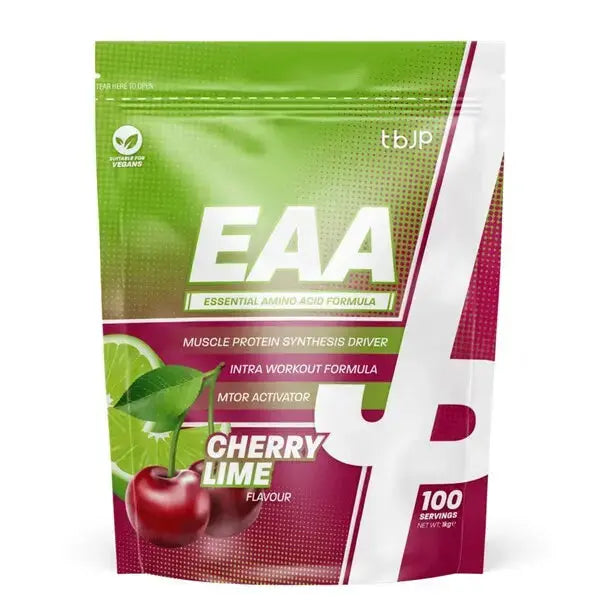
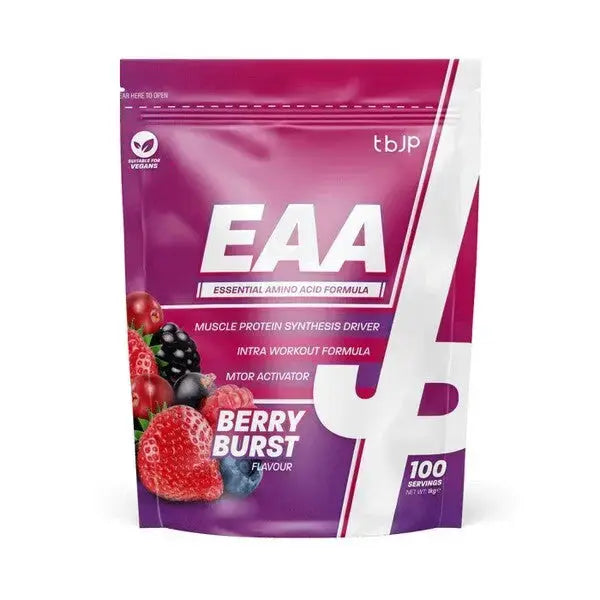
What is TrainedByJP EAA 1000 g?
TrainedByJP EAA is an essential amino acid powder to be mixed with water, sold in a 1 kg tub, i.e. 66 servings of 15 g. The flavours listed: Cherry Lime, Berry Burst, Orange & Mango, Tropical and Strawberry & Kiwi.
The essential amino acids are the nine the body cannot make and which must come from food. This formula provides all nine in free form, that is to say not bound together within a protein: that is what sets an EAA apart from a protein powder. The manufacturer states that they are derived from plant fermentation, which makes the formula suitable for a vegan diet.
Added to these are two electrolytes — magnesium oxide and potassium chloride — then the formulation ingredients: flavouring, citric acid, trisodium citrate, sucralose as a sweetener, and a colour that varies with the flavour. The British brand is stocked here in our TrainedByJP section.
What does a 15 g serving contain?
| Essential amino acid | Per 15 g serving | Per 100 g* |
|---|---|---|
| L-Leucine | 4,000 mg | 26.7 g |
| L-Isoleucine | 2,000 mg | 13.3 g |
| L-Valine | 2,000 mg | 13.3 g |
| L-Lysine | 2,000 mg | 13.3 g |
| L-Threonine | 1,000 mg | 6.7 g |
| L-Phenylalanine | 600 mg | 4 g |
| L-Methionine | 400 mg | 2.7 g |
| L-Histidine | 400 mg | 2.7 g |
| L-Tryptophan | 80 mg | 0.53 g |
| Total essential amino acids | 12,480 mg | 83.2 g |
* Column calculated from the values declared for 15 g. Three reservations, and we would rather put them in writing. The manufacturer does not publish the amounts of magnesium oxide and potassium chloride: without figures, no NRV percentage can be shown for these two electrolytes, and no regulatory wording can be used. Nor does it publish any macronutrient breakdown. Finally, it declares 3 kcal per serving, a value hard to reconcile with 12.5 g of amino acids: we reproduce it exactly as it is given to us, flagging the inconsistency rather than correcting it ourselves.
The figure that shapes this formula is 4 g of leucine per serving. Leucine alone accounts for a third of the blend, and that is a straightforward dose: many EAAs on the market stop at 2 or 2.5 g. The ratio between leucine, isoleucine and valine is 2:1:1, the classic BCAA pattern, but here built into a complete nine-amino-acid profile.
The second figure to look at is the tryptophan: 80 mg. That is little in absolute terms, and that is normal — it is the essential amino acid with the lowest requirement. But it is precisely its presence that sets an EAA apart from a BCAA, and that explains one of this product's contraindications.
A word of framing, and it is a necessary one: no health claim is authorised in Europe for free amino acids. The wording "protein contributes to a growth in muscle mass" applies to protein, not to a powdered blend of amino acids. So you will read here no promise of protein synthesis, no accelerated recovery, no protection against catabolism. What we are describing is a composition, a dose and a use.
How should TrainedByJP EAA be taken?
Dose: 15 g, i.e. one scoop. Liquid: 300 to 400 ml of cold water. Timing: during the session, sipped, or within the 30 minutes that follow; on rest days, between two meals. Frequency: one serving per day. Duration: ongoing, as the manufacturer gives no course length.
The volume of liquid is not a suggestion: 300 to 400 ml for 15 g is a minimum. A free amino acid powder is acidic and very concentrated in taste; short on water, it becomes frankly harsh, and the flavours in this range are already pronounced. If the first attempt puts you off, add 100 ml before concluding anything at all.
The most sensible use is during the session, sip by sip, with the added benefit of getting you to drink. That is the real argument for this kind of product against a protein shake: nobody downs a whey from a bottle between two sets, whereas a clear, fruity drink goes down without difficulty.
A practical note on the size: a one-kilo tub lasts a long time. Close it carefully and keep it dry — free amino acid powders are hygroscopic and clump into a solid block at the slightest damp. The formula is otherwise compatible with taking another product before or after training, with no particular interaction.
Who is this EAA for, and who is it not for?
It is aimed first at people who train fasted or a long way from a meal, those who cannot tolerate a milky shake during exercise, and vegans — since the amino acids come from plant fermentation, the formula contains no ingredient of animal origin.
The manufacturer does not advise it for children, or for pregnant and breastfeeding women. Two contraindications deserve careful reading: it is not recommended for people on antidepressant treatment — the presence of tryptophan and phenylalanine, two neurotransmitter precursors, explains this caution — nor for people with kidney failure. Antidepressant treatment is never altered on one's own initiative: if this concerns you, the question is one for your doctor or your pharmacist, not for a product page.
It is less suitable if you are trying to raise your daily protein total. Twelve and a half grams of amino acids do not replace 25 g of complete protein, and generally cost more per gram.
What you should not expect from it, and this is the most useful thing to say: if your protein intake across the day is already sufficient, this product will add nothing. An EAA makes sense when a meal is missing, not stacked on top of three shakes and 180 g of protein a day. Nobody in this category will tell you so, and yet it is the first question to ask.
EAA or a whey?
This is the comparison that decides the purchase, and it turns on use rather than on quality.
A protein powder provides 22 to 27 g of complete protein per serving, including roughly 2 to 2.7 g of leucine, at a far lower price per gram of protein. It is the better choice in the great majority of cases: to make up for a meal, for an inadequate breakfast, for the post-session snack. If you are only going to buy one product, buy that one, and our whey isolate section covers the cases where digestion is a problem.
The EAA wins in three specific situations. During exercise, because it drinks clear and light where a whey sits heavily on the stomach. On a vegan diet, where it provides a complete profile with no dairy. And at 4 g of leucine per serving, it exceeds what a standard whey shake supplies on that one amino acid. If your need is limited to the leucine-isoleucine-valine trio, our BCAA section works out cheaper — but an incomplete profile remains an incomplete profile, and that is precisely what an EAA corrects. Finally, if what you are mainly after is making up for losses through sweat, it is our electrolytes you should be looking at, since the amounts present here are not quantified.
Frequently asked questions
What is the difference between an EAA and a BCAA?
A BCAA provides only three amino acids: leucine, isoleucine and valine. An EAA provides all nine essentials, including lysine, threonine, methionine, histidine, phenylalanine and tryptophan. Here, the 4 g of leucine are built into a complete profile of 12.5 g, which is not comparable to a three-component product.
How many servings does the one-kilo tub contain?
66 servings of 15 g, a figure given by the manufacturer and consistent with the net weight. At one serving per training day, on four sessions a week, that comes to around four months. Close the tub properly: these powders take up moisture and harden.
Why only 3 kcal per serving?
That is the value declared by the manufacturer, and we have not changed it. Set against 12.5 g of amino acids, it seems to us hard to explain: we publish it as it stands and would rather flag the doubt. If the actual energy value matters for your tracking, go by the label on the tub you receive.
Is the formula suitable for vegans?
Yes. The manufacturer states that the amino acids come from plant fermentation, and no ingredient of animal origin goes into the composition. That is one of the genuine advantages of this kind of product on a dairy-free diet.
Can it be taken alongside antidepressant treatment?
The manufacturer does not recommend it in that case. The formula contains tryptophan and phenylalanine, two neurotransmitter precursors, which justifies the caution. This question is one for your doctor or your pharmacist, and ongoing treatment must never be stopped or altered on your own initiative.
Which flavour should I choose?
All are in a fruity, tangy register: Cherry Lime and Berry Burst are the sharpest, Orange & Mango and Tropical the mildest, Strawberry & Kiwi in between. All are sweetened with sucralose and coloured according to the flavour. The real adjustment is not the flavour but the volume of water: at 400 ml, they all become distinctly more drinkable.
Should it be taken during or after the session?
The manufacturer suggests both, and between meals on rest days. In practice, taking it during exercise is what makes the most sense: it gets you drinking, and a clear drink goes down where a milky shake would not. After the session, a complete protein will do the same job for less.
Where can I buy TrainedByJP EAA 1000 g?
The flavours can be ordered from this page, and we ship throughout France and Europe. The one-kilo tub is a regular user's size: if this is your first EAA, be aware that it will last you several months.
At the Vendargues shop, about ten minutes from Montpellier, the conversation about this product always starts with the same question, and it is not a sales one: how much protein do you eat per day? Until the answer is satisfactory, an EAA is of no use, and we would rather say so at the counter. The rest of the amino acids can be compared in our sports nutrition section.


What is Naughty Boy Amino EAA?
It is a mixable essential amino acid powder with an 11.5 g serving delivering 8.5 g of amino acids and only 10 kcal. The 350 g tub covers exactly 30 servings. The flavours listed: PickNMix, Fizzy Peach Sweets, Ultra Energy, Strawberry Mango and Cherry Mango.
What sets this product apart is the raw material: all nine amino acids come from plant fermentation, which makes the formula entirely vegan. The manufacturer also declares it gluten free, lactose free and with no added sugars.
The rest of the composition fits into four lines: malic acid, natural flavourings, sucralose and a colour that varies with the flavour. One clarification along the way, because the manufacturer's own sheet words it differently: sucralose is an artificial sweetener, not a natural one. The full British brand range sits in our Naughty Boy aisle, and the whole category in EAA.
What does an 11.5 g serving contain?
| Nutrient | Per 11.5 g serving | Per 100 g* |
|---|---|---|
| Energy | 42 kJ / 10 kcal | 365 kJ / 87 kcal |
| Essential amino acids (total) | 8,500 mg | 73.9 g |
| Carbohydrate | 0 g | 0 g |
| Fat | 0 g | 0 g |
| Fibre | 0 g | 0 g |
| Salt | less than 0.1 g | less than 0.87 g |
* Column calculated from the values declared for 11.5 g. No NRV is established for amino acids.
The figure worth remembering, and it is a good one: 8.5 g of amino acids out of 11.5 g of powder, that is 74% of the serving. In other words, only 3 grams go to the flavouring, the malic acid and the sweetener. That is an honest ratio for this category, where some heavily flavoured powders drop a good deal lower.
What is missing, on the other hand, has to be flagged, and it matters: the manufacturer does not publish the amount of each individual amino acid. The ingredients list names them in descending order — leucine, isoleucine, valine, lysine, threonine, phenylalanine, histidine, methionine, tryptophan — but no figure comes with that list. So you cannot know the leucine content, which is the first point of comparison for any EAA. We will not invent it; read the label on the tub you receive.
What the order of the list does tell you is that leucine is the dominant amino acid and that the three BCAAs take the top three places — a classic pattern, consistent with a 2:1:1 ratio across that fraction.
A regulatory note to close: no health claim is authorised in Europe for free amino acids. Not protein synthesis, not recovery, not endurance, not anti-catabolism. We describe a composition, a dose and a use — not an effect.
How do you take Naughty Boy Amino EAA?
Serving: 11.5 g, that is one scoop. Liquid: 400 ml of cold water. Timing: 15 to 30 minutes before the session, during exercise lasting more than 60 minutes, or straight after. Frequency: one serving a day, rest days included according to the manufacturer. Duration: 4 to 12 weeks of use, followed by a 1 to 2 week break.
Four hundred millilitres for 11.5 g is a generous dilution, and it is deliberate. Free amino acids are acidic; at 250 ml the drink becomes hard to finish. Use cold water: warm water dissolves it less well and the taste suffers. Shake until fully dissolved and drink once prepared.
The manufacturer allows for three windows. In practice they are not equally useful depending on your situation: before the session if you train fasted, during beyond an hour of exercise, after if your next meal is a long way off. If you have eaten a full meal two hours before, the extra intake is of little further interest.
The one to two week break after 4 to 12 weeks is a manufacturer recommendation. Nothing compels you to follow it on a product that is only an amino acid supply, but it does have one practical merit: it forces you to check that your diet stands up on its own.
Close the tub properly and store it in a dry place: free amino acid powders take up moisture and cake into a solid block, as the manufacturer points out itself. Stated shelf life: 24 months in the unopened original packaging.
Who is this EAA for, and who is it not for?
It is aimed first and foremost at vegans: the amino acids come from plant fermentation, with no animal raw material. It also suits anyone training fasted or a long way from a meal, and anyone who cannot stomach a milky shaker during exercise — at 10 kcal and with no fat, this drink weighs on nothing.
The manufacturer advises against it for children under 12, and asks pregnant and breastfeeding women as well as people on medication to seek professional advice. Mind the list of traces, which is a long one: the product is made in a facility that handles GLUTEN, MILK, EGGS, SOYA, FISH, CRUSTACEANS, PEANUTS and NUTS. If you are allergic to any of them, the “gluten free” claim made elsewhere is not enough to reassure you. Do not exceed 11.5 g a day.
It suits you less well if you want to compare precisely what you are buying: with no published leucine content, comparison with another EAA remains approximate. That is the real limitation of this product.
What you should not expect from it: 8.5 g of amino acids do not replace a protein intake. This is not a substitute for protein, and the cost per gram is far higher. If your daily intake is already adequate, this product will add nothing measurable — that is the first question to ask yourself, and rarely the one you hear asked in the aisle.
Naughty Boy EAA or Rule One Essential Amino 9?
We sell both, in the same 11.5 g serving size and the same number of servings. The comparison is therefore direct, and it is instructive.
Rule One Essential Amino 9 delivers 7.5 g of amino acids per serving, one gram less, but it publishes the content of each of the nine — 2,500 mg of leucine at the top — and it adds 500 mg of electrolytes. It is the better choice if you want to know exactly what you are drinking, and if the sodium and magnesium intake matters to you on long sessions.
Naughty Boy wins on two concrete points. The amount of amino acids per serving, at 8.5 g against 7.5 g. And the declared plant fermentation, which makes it a genuinely vegan option where not every competitor spells that out. It also offers a wider choice of flavours, in an unashamedly confectionery register.
What settles it, then, is what you value: one extra gram of amino acids, or full transparency on the detail. If your need is mainly mineral hydration, neither will replace a product from the electrolytes aisle. And if you are weighing up a cheaper option, be aware that our BCAA aisle supplies only three amino acids out of nine: the saving is paid for with an incomplete profile.
Frequently asked questions
How much leucine per serving?
The manufacturer does not publish it in the labelling data available to us, and we will not invent it. The ingredients list places leucine first, which indicates it is the dominant one of the nine, with no further precision. The label on the tub you receive is what counts.
Is the formula suitable for vegans?
Yes. The amino acids come from plant fermentation, with no animal raw material, and the manufacturer declares the formula lactose free and gluten free. One caveat, though: the production facility handles milk, eggs and fish, and traces are possible.
How many servings in the 350 g tub?
Thirty exactly, at 11.5 g per serving. At four sessions a week, that works out at around seven weeks; taken daily as the manufacturer suggests, one month. The stated shelf life is 24 months unopened.
Does the Ultra Energy flavour contain caffeine?
The ingredients list supplied to us mentions no stimulant, and no caffeine content has been communicated to us for this flavour. As the name may be misleading, check the label on the tub you receive if you are sensitive to caffeine or if you train in the evening.
Do you really need 400 ml of water?
That is what the manufacturer settles on, and it is a good setting. A free amino acid powder is acidic and concentrated in taste: at 250 ml the drink becomes unpleasant to finish. The generous volume has a second advantage, it makes you drink during the session.
Should you take a break between two periods of use?
The manufacturer advises 4 to 12 weeks of use then a 1 to 2 week break. Nothing requires it on a simple amino acid supply, but that break has one merit: it obliges you to check that your diet stands up on its own.
Can you take it on rest days?
The manufacturer allows it. We are more measured: if your protein intake is already sufficient, taking it on days without a session brings nothing demonstrated and halves how long the tub lasts. Save it for the days when a protein meal is genuinely missing.
Where can you buy Naughty Boy Amino EAA 350 g?
The flavours can be ordered from this page, and we ship throughout France and Europe. The 350 g tub with 30 servings is a sensible size to try for a first EAA.
At the Vendargues shop, about ten minutes from Montpellier, it is one of the few products we put straight up against a competitor on the counter, because the two tubs have exactly the same serving size. One extra gram of amino acids on one side, the full label detail on the other: it is up to the customer to say what matters most. The rest of the amino acids can be compared in our sports nutrition aisle.

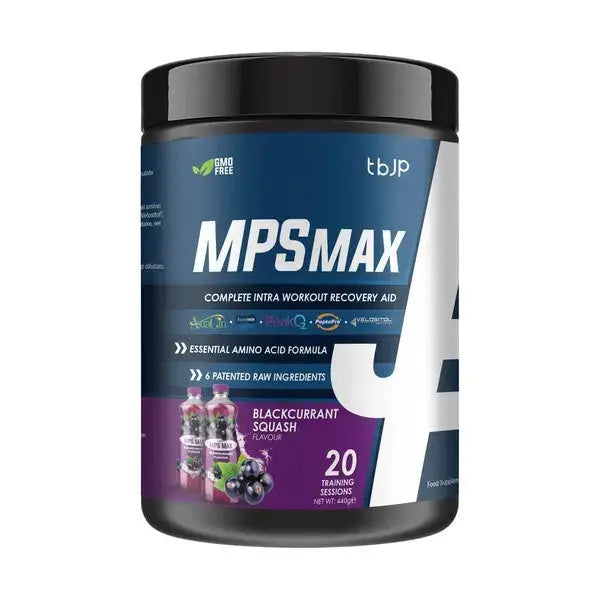
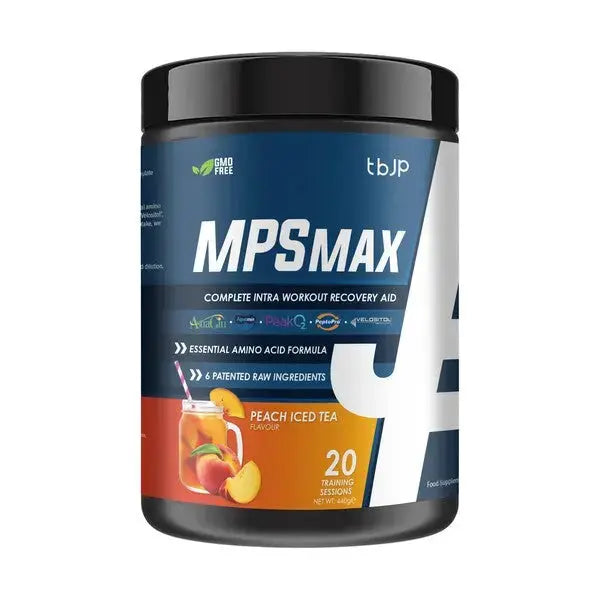
What is TrainedByJP MPS MAX?
MPS MAX is a powder to drink during training, with a serving of 22 g. It combines three things you rarely find together: 10 g of free essential amino acids, 2.5 g of PeptoPro® (hydrolysed casein) and 2.5 g of hydrolysed whey protein. The flavours listed: Blackcurrant Squash, Peached Ice Tea and Sunny Orange.
On top of that come four trademarked ingredients: Peak O2® at 1 g, a blend of five mushrooms (cordyceps, reishi, king trumpet, shiitake and lion's mane); Velositol®, an amylopectin-chromium complex; Aquamin®, minerals derived from marine algae; and AstraGin®, a blend of astragalus and Panax notoginseng extracts. The rest is maltodextrin, citric acid, trisodium citrate, flavouring, sucralose and beta-carotene as a colouring.
It is a dense formula, and it is also a formula you need to know how to read. Below we set out what the manufacturer puts a figure on and what it does not, because the gap matters. The full range sits in our TrainedByJP aisle, and the category as a whole in EAA.
What does a 22 g serving contain?
| Component | Per 22 g serving | Type |
|---|---|---|
| Essential amino acid blend | 10 g | All 9 EAAs in free form |
| PeptoPro® | 2.5 g | Hydrolysed casein |
| Hydrolysed whey protein | 2.5 g | Hydrolysed whey |
| Peak O2® | 1 g | Blend of 5 mushrooms |
| Velositol® | not disclosed | Amylopectin-chromium complex |
| Aquamin® MG and F | not disclosed | Marine algae minerals |
| AstraGin® | not disclosed | Astragalus and notoginseng extracts |
What is missing has to be said plainly, because it is substantial. The manufacturer publishes no energy value, no macronutrients and no salt figure for this product, and does not break the 10 g of essential amino acids down amino acid by amino acid: it states only that leucine is the largest share. Nor does it put a figure on the Velositol®, the Aquamin® or the AstraGin®. The direct consequence: no magnesium, calcium or chromium content can be declared, and so no regulatory wording can be used for those minerals. On a product positioned like this one, that is a shortcoming, and we will not fill it in with figures found elsewhere.
What can be said with confidence comes down to two points. The first: 15 g of protein material in 22 g of powder, between the free amino acids and the two hydrolysates. That is a straightforward dose for a training drink, and clearly above an ordinary EAA that stops at the amino acids alone.
The second: pairing free amino acids with hydrolysates is rare, and there is logic to it. Free amino acids have no digestion to go through; a hydrolysate is a protein already broken down into short peptides. Both therefore go through without sitting heavily on the stomach, which is exactly what you ask of a drink taken between two sets.
A regulatory framing to close, and it is a necessary one: no health claim is authorised in Europe for free amino acids, nor for the Peak O2® mushrooms, nor for astragalus. So you will read here no promise of amplified protein synthesis, no quantified performance, no percentage improvement. Those figures do circulate about this product; they cannot be repeated, and we will not repeat them.
How do you take MPS MAX?
Serving: 22 g, that is one scoop. Liquid: 200 to 600 ml of water depending on how concentrated you want the taste. Timing: from 15 minutes before the session, then throughout the session. Frequency: one serving per training session. Duration: continuous, as no cycling is required.
The liquid range is wide, and that is deliberate: at 200 ml you get a very concentrated drink, at 600 ml a light one you can sip over an hour and a half. Our advice is to aim for the top of the range: the point of a training drink is as much to get you drinking as to supply amino acids, and 500 ml worked through over a session beats 200 ml downed in one go.
The manufacturer's protocol is precise on one point: start 15 minutes before rather than at the first exercise, and keep going throughout. For a session longer than 90 minutes, it recommends saving the whole serving for intra-workout.
A common-sense remark that holds for this whole category: if you have eaten a full meal one to two hours before the session, an amino acid drink during the effort is of little use. The amino acids from that meal are still circulating. This product makes sense when you train fasted, early in the morning, or a long way from any meal — not stacked on top of an already well-filled day.
Who is MPS MAX for, and who is it not for?
It is intended for adults engaged in intense physical activity, those are the manufacturer's terms, and it targets long or fasted sessions in particular. The liquid, tangy, non-heavy format is its real argument: nobody downs a whey shake between two sets of squats.
It contains MILK, twice over: PeptoPro® is a hydrolysed casein and the second hydrolysate comes from whey. The product is made in a facility that handles MILK, SOYA, EGGS and GLUTEN, and traces of NUTS, CRUSTACEANS and PEANUTS are possible. It is not recommended for pregnant or breastfeeding women and must be kept out of reach of children. If you are on medical treatment, the manufacturer asks that you seek professional advice beforehand.
So it suits neither vegans nor people allergic to milk proteins — unlike a BCAA or an EAA made of free amino acids alone, which are often vegan. That is the price of the two hydrolysates.
What you should not expect from it: a shortcut. Fifteen grams of protein material during the session do not make up for a day at 90 g of protein, and no trademarked ingredient replaces a sound daily total. Nor can we assert anything about the mushrooms, the astragalus or the chromium in this formula: with no published contents and no authorised claim, there is nothing honest to say about them. What you are buying that can be verified is a training drink very well supplied with amino acids and easy to digest.
MPS MAX or a hydrolysed whey?
Both target the same moment of the day and are digested quickly. The choice comes down to texture and to price.
A hydrolysed whey supplies 22 to 25 g of complete protein per serving, at a far lower cost per gram of protein. It is the better choice if your aim is to add protein around training and you tolerate a milky shake. Its drawback lies in the taste, frankly bitter with a pure hydrolysate, and in the texture, which goes down badly mid-session.
MPS MAX wins on that precise point, and that is its reason for existing: it is a clear, fruity drink you can sip during the effort, where no shake would go down. It also wins on leucine, the largest share of the 10 g of free amino acids. It loses clearly on price per gram of protein, and on dosage transparency.
If your need is more about slow release outside training, it is the casein aisle that answers it, not this one. And if what you are after above all is replacing sweat losses on long sessions, our electrolytes will do it better and for far less — since the marine minerals in this formula carry no figures, they cannot be counted as an intake.
Frequently asked questions
How much of each amino acid is in the 10 g?
The manufacturer does not publish the breakdown in the data available to us: it states only that leucine is the predominant amino acid. We will not complete that table with unverified values. If the breakdown matters to you, the label on the tub you receive is what counts.
What is the difference from a standard EAA?
A standard EAA stops at free amino acids. This one adds 5 g of hydrolysates — casein and whey — that is, short peptides on top of the isolated amino acids. It is more complete and more expensive, and it brings milk into the formula, which rules out vegans.
How much water should you use?
From 200 to 600 ml, depending on how concentrated a taste you can handle. Our advice: aim for 500 ml. A training drink is there as much to get you drinking as to supply amino acids, and regular sips over an hour beat a concentrated glass downed at the start of the session.
What is PeptoPro®?
It is the trade name of a hydrolysed casein, that is, a milk protein pre-cut into short peptides. The stated benefit is faster digestion than an ordinary casein, which is consistent with use during effort. We are describing the ingredient, as no claim is authorised for it.
Does the product contain usable electrolytes?
The formula contains Aquamin®, minerals derived from marine algae, but the manufacturer does not publish the contents. Without figures, we can declare neither magnesium nor calcium, nor use any regulatory wording. If mineral hydration is your goal, take a dedicated electrolyte product.
Is it suitable for vegetarians or vegans?
For vegetarians yes, for vegans no: the formula contains two milk proteins. It is also made in a facility that handles soya, eggs and gluten, with possible traces of nuts, crustaceans and peanuts.
Should you take it on non-training days?
The manufacturer does not provide for that: the protocol is set around the session, from 15 minutes before. On rest days, ordinary protein intake does the same job for far less. This product answers a digestion constraint during effort, not a permanent need.
Where to buy TrainedByJP MPS MAX?
The flavours can be ordered from this page, and we ship throughout France and Europe. It is a product for the seasoned: it assumes the rest of your diet is already in place.
At the Vendargues shop, about ten minutes from Montpellier, this is the kind of label we read line by line with the customer, because it mixes very precise doses with trademarked ingredients whose quantity is not given. Knowing how to tell the two apart is what stops you paying for a name. The rest of the amino acids can be compared in our sports nutrition aisle.


What is IO Genix MAP EAA?
This is a powdered essential amino acid drink mix, with a serving of 12.6 g, or three scoops. The flavours we stock: Lemon, Raspberry, Pomme Verte and Ice The Peach.
What sets it apart is the sourcing of three of its amino acids: the leucine, valine and isoleucine are Kyowa Quality®, a designation from the Japanese manufacturer Kyowa Hakko, which produces its amino acids by fermentation. Naming the raw-material supplier rather than simply writing “amino acids” is something few brands in the EAA aisle bother to do, and it at least lets you know what you are buying.
Added to this are 35 mg of AstraGin®, a blend of astragalus and Panax notoginseng extracts, and 2.8 mg of vitamin B6. The rest is citric acid, silicon dioxide, flavouring, sucralose and acesulfame K. The manufacturer declares the formula sugar-free, fat-free and lactose-free, and of plant origin. The full Spanish range can be found in our IO Genix aisle.
What is in a 12.6 g serving?
| Amino acid or active | Per 12.6 g serving | % NRV |
|---|---|---|
| L-leucine (Kyowa Quality®) | 2,400 mg | no NRV |
| L-valine (Kyowa Quality®) | 1,600 mg | no NRV |
| L-isoleucine (Kyowa Quality®) | 1,334 mg | no NRV |
| L-phenylalanine | 1,200 mg | no NRV |
| L-threonine | 1,000 mg | no NRV |
| L-histidine | 466 mg | no NRV |
| L-methionine | 334 mg | no NRV |
| L-tryptophan | 134 mg | no NRV |
| L-lysine | present, amount not disclosed | no NRV |
| AstraGin® | 35 mg | no NRV |
| Vitamin B6 | 2.8 mg | 200% |
The manufacturer publishes neither an energy value, nor macronutrients, nor salt, nor the number of servings per tub — divide the weight printed on the packaging by 12.6 g to work it out.
One gap deserves to be flagged rather than glossed over: the lysine content is not quantified, even though it appears third in the ingredients list. Since descending order is mandatory, that means it weighs more than the isoleucine, so more than 1,334 mg — but we cannot give a precise figure. Adding up the eight quantified amino acids gives 8,468 mg; with the lysine, the total comfortably exceeds 9.8 g.
The headline figure remains 2,400 mg of leucine per serving, with a leucine-isoleucine-valine ratio close to 2:1:1.3. That is a sound dose, in the upper half of the category. Note that tryptophan is genuinely present at 134 mg and histidine at 466 mg: these are the two amino acids that budget formulas most often “forget”, because they are expensive.
As for what we can state, the framework is clear: no health claim is authorised in Europe for free amino acids, nor for astragalus, nor for notoginseng. The improved-absorption percentages that circulate about AstraGin® cannot be repeated, and we will not repeat them. The only usable wording comes from the vitamin B6, at 200% of the NRV: vitamin B6 contributes to normal protein and glycogen metabolism, to the reduction of tiredness and fatigue, and to normal energy-yielding metabolism. Our vitamin B aisle offers dedicated products if that is your main requirement.
How do you take MAP EAA?
Serving: 12.6 g, or three scoops. Liquid: 200 to 250 ml of cold water. Timing: 30 minutes before the session, or sipped during training. Frequency: one serving a day, without exceeding 12.6 g. Duration: ongoing, as no fixed course is set.
Two hundred and fifty millilitres for 12.6 g makes for a tight dilution. A free-form amino acid powder is acidic and concentrated; if your first attempt tastes harsh, go up to 400 ml before drawing any conclusions about the flavour. Use cold water: it dissolves less well when warm.
The manufacturer gives one unusual and relevant instruction: avoid taking it at the same time as complete proteins. The reasoning is competition between amino acids for intestinal transport — a whey shake taken at the same moment puts everything on the same transporters. Leave an hour between them if you take both.
The most relevant use remains during the session, sip by sip: that is where a clear drink beats a milky shake, and it gets you drinking at the same time. Thirty minutes beforehand also works if you train fasted.
Close the tub carefully and store it somewhere cool and dry: these powders draw in moisture and clump.
Who is this product for, and who is it not for?
It is aimed at people who train fasted or a long way from a meal, those who cannot handle a milky shake during exercise, and those who want an identified raw material rather than an anonymous “amino acid blend”. As the formula is of plant origin and lactose-free, it suits dairy-free diets.
The list of contraindications here is longer than on an ordinary EAA, and we reproduce it in full because it is surprising. The manufacturer rules the product out for pregnant or breastfeeding women, for under-18s, for women with a personal or family history of breast cancer, and for anyone on antidiabetic medication without medical advice. Those last two are unusual on an amino acid powder; if they apply to you, the question is one for your doctor, not for a product page.
Traces of NUTS, PEANUT, EGGS, MILK, FISH and SOYA are possible, as the product is made in a facility that handles these allergens. Do not exceed 12.6 g per day.
It is less suitable if you want to compare down to the gram: the missing lysine content makes it impossible to calculate the exact total. It also contains sucralose and acesulfame K.
What you should not expect from it: an EAA is not a replacement for a protein intake. Roughly 10 g of amino acids is not worth 25 g of complete protein, and the cost per gram is far higher. If your daily intake is already adequate, this product will add nothing measurable.
MAP EAA or a whey isolate?
This is the comparison that decides it, and it turns on use rather than quality.
A whey isolate delivers 25 to 27 g of complete protein per serving, of which roughly 2.5 to 3 g is leucine — as much as this EAA, if not more — at an incomparably lower cost per gram. It is the better choice in the vast majority of cases: a thin breakfast, a snack, after the session. If you are only going to buy one product, buy that one, and our protein aisle covers every variant.
MAP EAA wins on one specific front, and it is its own: the training drink. Clear, tart, free of lactose and fat, it goes down where no shake would. It also wins for those who train fasted early in the morning, when a complete protein sits heavily on the stomach.
One last option exists and costs less: our BCAA aisle delivers only three of the nine amino acids. The saving is real, and so is the trade-off — an incomplete profile stays incomplete, and that is precisely what a complete EAA like this one puts right.
Frequently asked questions
What is Kyowa Quality®?
It is the trade designation for amino acids produced by the Japanese manufacturer Kyowa Hakko, by fermentation. Here it applies to the leucine, valine and isoleucine. Mentioning it commits the brand to a specific origin rather than to an adjective: we report this information as the manufacturer publishes it.
How much lysine is in a serving?
The manufacturer does not quantify it, and we will not invent it. It appears third in the ingredients list, which is ordered by descending weight: it therefore weighs more than the isoleucine, so more than 1,334 mg. The label on the tub you receive is the authority.
Why avoid taking it with a protein?
This is a manufacturer's instruction, and it rests on competition between amino acids for intestinal transport: a whey shake taken at the same moment saturates the same pathways. In practice, leave an hour between them if you take both on the same day.
What is AstraGin® for?
It is a blend of astragalus and Panax notoginseng extracts, dosed at 35 mg. As no health claim is authorised in Europe for these plants, we cannot state anything about its effect. We mention it because it appears on the label, and because it partly explains this product's unusual contraindications.
Why so many contraindications on a simple EAA?
The manufacturer rules out, among others, women with a history of breast cancer and anyone on antidiabetic medication without medical advice. These do not appear on a conventional EAA and are probably linked to the plant extracts in the formula. We reproduce them as they stand: if they apply to you, seek advice before buying.
How many servings are in a tub?
The net weight of the packaging is not included in the labelling data supplied, so we cannot calculate it. Divide the weight printed on the packaging by 12.6 g, which is the reference serving behind every figure on this page.
Is the formula suitable for vegans?
The manufacturer states a plant origin for the amino acids and a lactose-free formula, which is consistent with production by fermentation. Do note, however, the possible traces of milk, eggs and fish declared on the label, as the facility handles these allergens.
Where can you buy IO Genix MAP EAA Kyowa?
The flavours can be ordered from this page, and we ship throughout France and Europe. This is a product for the seasoned user: it assumes the rest of your diet is already in place.
At the Vendargues shop, about ten minutes from Montpellier, this is a label we read line by line with the customer, because it is at once very detailed on eight amino acids and silent on the ninth. Knowing how to spot that sort of detail is what lets you genuinely compare two tubs. The rest of the amino acids can be compared in our sports nutrition aisle.
What are essential amino acids?
The proteins in your body are assembled from twenty amino acids. Your body can produce eleven of them from other molecules. The other nine, it cannot: it lacks the synthesis pathways for these, and they must therefore come from food. These are essential amino acids, or EAAs (Essential Amino Acids).
Here they are: leucine, isoleucine, valine, lysine, methionine, threonine, phenylalanine, tryptophan, histidine. The first three are branched-chain amino acids, better known as BCAAs.
The key principle is stated in one sentence: protein synthesis stops as soon as a single essential amino acid is missing. This is the limiting factor principle. Leucine may send the building signal—that's its role, and why it's highlighted everywhere—but if lysine or methionine are not available, the chain will not assemble. Building muscle requires all nine, together.
This is exactly what separates an EAA product from a BCAA product. BCAAs provide only three out of the nine. They trigger the signal without delivering the building blocks. We also state this on our BCAA page, where this point is elaborated: BCAAs alone are largely outmatched by EAAs physiologically, even if they retain legitimate uses for taste, cost, and comfort during workouts.
EAA or whey: which to choose?
This is an honest question, and the answer doesn't favor the average shopping cart. Whey is already a complete source of essential amino acids. This is not a marketing approximation: whey protein contains all nine EAAs, in good proportions, with a high leucine content. A dose of whey isolate or concentrated whey provides the full spectrum.
And it does so for less money. Free amino acids are produced by fermentation or extraction, purified one by one, then recombined: this is a costly process. Per gram of essential amino acids actually supplied, a tub of whey is significantly cheaper than a tub of EAAs. For most exercisers, a dose of whey already covers their EAA needs, at the best price. If you haven't sorted this basic need yet, start with our proteins before adding free amino acids.
Powdered EAAs have an advantage that whey does not: they are already broken down. There's nothing to digest, absorption is rapid, they contain almost no calories, and they mix into a clear drink rather than a thick shake. These characteristics—not inherent superiority for muscle building—define their true use cases.
When are EAAs truly useful?
Five situations genuinely justify them.
Fasted training
If you train in the morning without having eaten, your blood does not contain available essential amino acids. An EAA drink sipped during the session provides them without requiring digestion and without the heaviness of a meal in your stomach. This is the strongest use case, and one where BCAAs are, on the contrary, most unsuitable, as six out of nine amino acids would be missing.
Long sessions
Beyond 75 to 90 minutes of effort, intake during the session makes sense. A drink combining EAAs, electrolytes, and possibly fast-absorbing carbohydrates like maltodextrin or cyclic dextrin can be consumed without discomfort, unlike a protein shake.
Difficult digestion
Some people don't tolerate whey: poorly managed lactose intolerance, bloating, a feeling of heaviness during exercise. Free-form EAAs require no digestive effort. Clear whey is the other option to consider in this case.
Vegan diet
Plant proteins are often limiting in a specific amino acid: lysine for cereals, methionine for legumes. Fermented EAAs fill this deficit in a targeted way, without animal products.
Calorie deficit
During a cutting phase, the goal is to preserve muscle mass with few calories available. EAAs provide the full spectrum for almost zero caloric load, which is useful when every calorie counts. They remain a supplement: the priority in weight loss remains a high daily protein intake, from whole foods and protein powder.
Outside of these cases, if you eat well and have a shake after your workout, additional EAAs will provide no measurable benefit. We prefer to tell you this rather than sell you a product you don't need.
How to dose EAAs and read leucine content?
The reference dose is between 10 and 15 g of EAAs per serving. Below 8 g, the intake becomes anecdotal compared to needs; above 15 g, it is better to switch to a complete protein, which is cheaper and more satiating.
The number to check on the label is the amount of leucine per dose. Aim for at least 2.5 g. This is the commonly accepted benchmark for fully triggering protein synthesis, and it is also what a standard dose of whey provides. Many formulas proudly display "9 essential amino acids" without giving details: without a line-by-line breakdown, you don't know what you're buying. Some contain 500 mg of leucine and a lot of flavor fillers.
Second check: the actual presence of all nine. Some products sold in the EAA section contain only six or seven, omitting tryptophan or histidine, which are more expensive. The list must be complete.
For preparation, count 400 to 600 ml of cold water for 10 to 15 g. Drink during your workout, in small sips, or within 30 minutes before if you are fasted. On non-workout days, EAAs have no particular benefit if your meals cover your protein needs.
What taste and solubility to expect?
It's important to state upfront: essential amino acids have a challenging taste. Leucine is bitter, methionine and cysteine have sulfuric notes, and tryptophan has a persistent bitterness. It is precisely because they contain these amino acids that EAAs are harder to flavor than BCAAs. Manufacturers compensate with powerful, often acidic flavors—citrus, red berries, cola.
Practical consequences: prefer acidic flavors, which mask bitterness better than creamy flavors; use more water than the recommended dose if the taste bothers you; serve very cold. As for solubility, a slight residue and foam on the surface are normal and do not indicate a quality defect.
Finally, what not to expect from EAAs: they do not replace sufficient daily protein intake, do not cause weight loss, do not compensate for poorly structured training, and do not produce a perceptible effect during the session—no boost, no pump. Their action is structural, silent, and slow. In case of kidney or liver disease, pregnancy, breastfeeding, or ongoing treatment, ask your doctor's advice before any amino acid supplementation.
Frequently Asked Questions
What are EAAs?
The abbreviation for Essential Amino Acids: the nine amino acids your body cannot produce and must come from food. An EAA product provides them in free form, already separated, ready to be absorbed without digestion. It is not a protein: it is a protein already broken down, without the associated calories or satiety.
What is the role of leucine?
It is the trigger amino acid. Above a certain blood threshold, it activates the mTOR pathway, which signals the start of muscle protein synthesis—hence the 2.5 g leucine benchmark per serving, found in a standard dose of whey. But a signal alone builds nothing: if the other eight essential amino acids are missing, the chain will not assemble. This is the whole limitation of products that rely solely on leucine.
What are the 9 essential amino acids?
Leucine, isoleucine, valine, lysine, methionine, threonine, phenylalanine, tryptophan, and histidine. You still often read "the 8 essential amino acids": histidine was long considered essential only in children, before being recognized as essential at all ages. The first three on the list are branched-chain amino acids, sold separately as BCAAs. A product that claims "EAA" must contain all nine: some formulas omit tryptophan or histidine, which are more expensive, and therefore do not deserve the appellation.
What is an amino acid?
It is the basic building block of proteins: a small organic molecule with an amine group and an acid group, capable of linking to its neighbors by a peptide bond. Twenty amino acids make up human proteins, and the order in which they link determines what the protein becomes: muscle fiber, enzyme, antibody, transporter. Digesting a steak or a shake involves breaking down these chains into isolated amino acids, which the body then reassembles according to its own plans. Eleven of them can be made by the body; nine must come from food.
EAA or BCAA: which should I take?
EAAs, in almost all situations. They contain all nine essential amino acids; BCAAs only contain three. BCAAs retain an interest for taste, cost, and intra-training comfort for someone whose overall protein intake is already covered, but they cannot build a complete protein on their own.
When to take EAAs?
On training days, around your workout: 10 to 15 g in 400 to 600 ml of cold water, to sip during exercise, or in the 30 minutes before if you are starting fasted. For a very long session, a second intake can be considered. On rest days, if your meals cover your protein needs, they have no particular role. Timing remains secondary to total protein intake over 24 hours: a regular daily intake is better than a perfectly timed intake on an insufficient base.
What are EAAs used for in bodybuilding?
To provide all the building blocks needed for muscle protein synthesis, in situations where food does not provide them at the right time: fasted training, sessions longer than 90 minutes, difficult digestion, significant caloric deficit. Outside of these cases, their additional contribution is small: what determines muscle gain remains the total daily protein and calorie intake. An EAA is also not felt during the session—no boost, no pump. Its action is structural and silent.
What are the benefits of EAAs?
Three, provided we remain precise. They provide the full spectrum of essential amino acids for almost zero caloric load, which matters when every calorie counts. They are absorbed without digestive effort, in 15 to 30 minutes, whereas a whole protein requires digestion: useful when fasted or during intense effort. They are consumed in a clear and light drink, easier to swallow during a session than a thick shake. What they don't do: cause weight loss, replace meals, or compensate for poorly structured training.
Are EAAs dangerous?
They are the same amino acids as those found in meat, eggs, or fish, simply isolated and purified: a healthy adult finds nothing alien to their diet. At usual doses, reported effects are limited to digestive discomfort, especially with a large dose swallowed at once on an empty stomach. Real contraindications are medical: metabolic amino acid disorders, kidney failure, liver failure, pregnancy, breastfeeding, ongoing treatment. In these situations, only your doctor can advise, and self-medication has no place.
Where to find amino acids in food?
In all proteins, but not in the same proportions. Eggs, meats, fish, and dairy products provide all nine essentials in a profile close to human needs, with whey from milk being the most concentrated in leucine. On the plant side, soy, peas, and quinoa are complete; cereals tend to lack lysine and legumes methionine, hence the benefit of combining them throughout the day. The Ciqual database publishes the detailed composition of each food.
How to make up for a protein deficiency?
Start by measuring rather than assuming: record your intake over three typical days. The common benchmark for a regular exerciser is between 1.6 and 2.2 g of protein per kilogram of body weight per day. Then distribute this over three to four servings of 25 to 40 g rather than concentrating everything in the evening. If the gap persists, powder remains the simplest way to fill it: our proteins cover this need at a significantly lower cost per gram than free amino acids.
What EAAs do we offer?
This is our largest collection of amino acids, covering the different uses described above. For a complete and clear EAA: formulas from TrainedByJP, the twelve-amino-acid EAA+ from ESN, the vegan fermented EAA from Naughty Boy, and the Juiced EAA from Sinob. IO Genix offers Kyowa quality amino acids, and Strom Supplements an EAA combined with ActiGin.
For long sessions and training in hot weather, several references combine amino acids and minerals: hydration formulas from RAW Nutrition and Rule One, or electrolytes to be dosed separately. Applied Nutrition completes the selection for intra-training formats.
Advice at a store near Montpellier?
Our Vendargues store, about ten minutes from Montpellier, allows you to return two pots and compare the tables: number of amino acids actually present, leucine per dose, price per serving. We will also tell you when a simple whey will suffice. We ship everywhere in France and Europe.
Sources: ANSES for French recommendations on dietary supplements for athletes, Ciqual for the amino acid composition of foods, EFSA for European scientific opinions.
To go further: how to choose your essential amino acids well.


What is IO Genix AMINO 10?
IO Genix AMINO 10 is an essential amino acid powder to be mixed with liquid, whose 20 g serving — two scoops — provides 10 g of EAAs. All nine essential amino acids are present, each with its exact dose. That is the difference between an EAA product and a plain BCAA: BCAAs provide only three of them.
The list is short: instant EAA blend, maltodextrin, citric acid, flavouring, silicon dioxide, sucralose and acesulfame K as sweeteners, and pyridoxine hydrochloride for the vitamin B6. The word “instant” is not decorative — raw amino acids have a reputation for being hard to dissolve, and instantising genuinely changes how comfortable the product is to use.
The flavours available: Cranberry, Lime and Raspberry. The product joins our EAA and IO Genix sections.
What does a 20 g serving contain?
| Amino acid / nutrient | Per 20 g serving (2 scoops) | % NRV |
|---|---|---|
| Total EAA blend | 10,000 mg | NRV not established |
| L-leucine | 3,060 mg | NRV not established |
| L-valine | 2,000 mg | NRV not established |
| L-lysine HCl | 1,820 mg | NRV not established |
| L-isoleucine | 1,200 mg | NRV not established |
| L-threonine | 800 mg | NRV not established |
| L-phenylalanine | 280 mg | NRV not established |
| L-histidine HCl | 280 mg | NRV not established |
| L-methionine | 280 mg | NRV not established |
| L-tryptophan | 280 mg | NRV not established |
| Vitamin B6 | 1.6 mg | 114% |
The manufacturer publishes no energy value, no macronutrient breakdown and no net weight for the tub: we therefore cannot state the number of servings per pack, and we will not estimate it. The information is on the packaging.
What makes this table interesting is that it is complete — all nine amino acids are quantified individually, and the sum comes to exactly 10,000 mg. Many products in this category simply announce a total. Two figures deserve attention. The three BCAAs total 6,260 mg (leucine, valine, isoleucine), close to two thirds of the blend. And leucine alone accounts for 3,060 mg: it is the most studied amino acid for protein synthesis, and 3 g matches the amount found in the reference protocols.
As for claims, only one is authorised here, and it concerns the vitamin: vitamin B6 contributes to normal protein and glycogen metabolism, as well as to normal energy-yielding metabolism and to the reduction of tiredness and fatigue. For the amino acids themselves, no claim exists in European regulation — neither on muscle building nor on recovery. So what we describe is a composition and a use, not an effect.
How do you prepare AMINO 10?
Dose: 20 g, that is 2 scoops of roughly 20 cc. Liquid: 200 to 250 ml of water or juice. Timing: 30 minutes before training, or during the session; on rest days, in the morning on an empty stomach. Frequency: once a day. Duration: the manufacturer sets out neither a course nor a break — there is no reason to impose one on an amino acid product.
Shake vigorously: the powder is instantised and dissolves without lumps, but free amino acids need a little mechanical energy to get going. Made up with juice rather than water, the drink goes down better — EAAs are naturally bitter, and acidity helps mask it.
A word on timing. Drinking amino acids during a session makes sense in one specific situation: a fasted session, or a very long one, with no meal in the preceding hours. If you ate two hours beforehand and your daily protein intake is covered, an extra 10 g of EAAs does not add much. Better to say so plainly than to sell you one more shaker.
The product is compatible with creatine or a glutamine in the same shaker, if you want to simplify your routine.
Who is AMINO 10 for, and who is it not for?
It is aimed at those who train fasted in the morning, at those who do long sessions with no meal in between, and at those who want something to sip during training rather than plain water. It also suits people who struggle to digest protein powder during a session.
Two specific contraindications appear on the label, and they are more serious than average. This supplement must not be taken by people on antidepressant treatment — the presence of L-tryptophan, a serotonin precursor, is the reason. It must also not be taken in cases of kidney failure: an intake of free amino acids increases the nitrogen load to be cleared. It is not recommended for children or pregnant women. If you are on any medical treatment whatsoever, seek the advice of a healthcare professional before use.
On allergens, the product may contain traces of GLUTEN (wheat and oats), NUTS, PEANUT, EGGS, MILK, FISH and SOYA. Keep it tightly closed, in a cool, dry place.
What not to expect from it: a substitute for protein. 10 g of EAAs does not replace 25 g of whey, and it does not count the same way towards a daily protein total. Nor is it an energy product: no stimulant, no carbohydrate in any useful quantity. And if your diet already supplies enough protein, adding EAAs will make no measurable difference — that is the least saleable truth in this category.
AMINO 10 or BCAAs?
The question comes up constantly at the counter, and it deserves a clear answer.
BCAAs remain a defensible choice in two cases: price, generally lower per kilo, and habit — if you have been taking them for years and the product suits you, nothing obliges you to switch. They provide three amino acids, leucine, valine and isoleucine, often in a 2:1:1 or 8:1:1 ratio.
AMINO 10 provides all nine essential amino acids, including the three BCAAs at a level of 6,260 mg. The difference is not cosmetic: the other six — lysine, threonine, phenylalanine, histidine, methionine, tryptophan — cannot be made by the body either, and complete protein synthesis requires them all. A product that provides only three leaves the rest to your diet. In practice, if you eat enough protein it makes little difference; if you train fasted or in a substantial deficit, a complete EAA has the edge. To cover your basic needs it is, in any case, the protein section you should turn to first.
Frequently asked questions
What is the difference between EAAs and BCAAs?
BCAAs cover three branched-chain amino acids; EAAs cover nine, the BCAAs included. In this formula, the BCAAs account for 6,260 mg of the 10,000 mg total. The other six essentials complete the profile, which a BCAA on its own does not do.
How many servings are in a tub?
The net weight does not appear in the data supplied by the manufacturer, so we cannot work it out. Divide the weight shown on the packaging by 20 g to get the number of servings.
Can you take it on rest days?
The manufacturer suggests you can, in the morning on an empty stomach, to keep intake regular. Our view is more nuanced: if your diet covers your protein needs, a serving on rest days brings nothing measurable. Save the product for your sessions, that is where it earns its place.
Why is it contraindicated with antidepressants?
Because of the 280 mg of L-tryptophan per serving. Tryptophan is the precursor of serotonin, and supplementing may interact with treatments acting on that pathway. The manufacturer states it explicitly: if you are on that kind of treatment, this product is not for you.
Does the powder dissolve well?
Yes, the blend is instantised. Untreated free amino acids have a reputation for floating and forming lumps; here, a vigorously shaken shaker is enough. A slight deposit at the bottom of the glass is still possible, with no consequence.
Can it be mixed with creatine?
Yes, without difficulty. The manufacturer states it is compatible with creatine, glutamine or a protein in the same shaker. Just watch the taste: an unflavoured creatine goes down very well, a chocolate protein with a cranberry flavour, far less so.
Which flavour should you choose?
The three available are Cranberry, Lime and Raspberry, all in a tart register. That is a coherent choice: acidity covers the natural bitterness of amino acids. Lime is the most refreshing in very cold water, Cranberry the most widely liked.
Where can you buy IO Genix AMINO 10?
The flavours can be ordered from this page, and we ship throughout France and Europe. This is a product on which we readily ask one question before selling: when do you plan to drink it. The answer determines whether it will be useful to you or merely pleasant.
In our shop in Vendargues, about ten minutes from Montpellier, the IO Genix range is fully on the shelf, and comparing an EAA label with a BCAA label takes two minutes. The whole section can be browsed from sports nutrition.

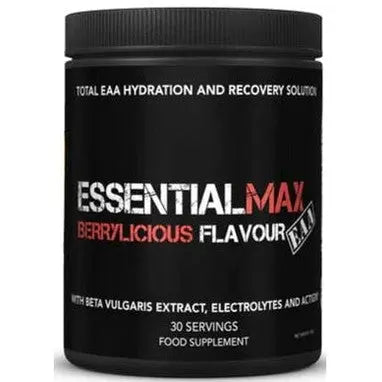
What is Strom EssentialMax EAA?
Strom EssentialMax is an essential amino acid powder to drink during training. One 15 g serving delivers 10.25 g of essential amino acids, 1,000 mg of beetroot extract and 250 mg of L-alanine, rounded out with electrolytes and three B vitamins. The flavours in the range: Cranberry, Berrylicious and Strawberry Kiwi.
Strom Sports Nutrition is a British brand that claims fully disclosed dosages. On this product the commitment is largely met: the main figures are published, which is not that common in this category.
One particularity is worth flagging straight away: the formula contains no tryptophan. It therefore brings together eight of the nine essential amino acids in the family. The manufacturer stands by that choice, and we discuss what it means further down. The rest of the brand can be browsed in our Strom Supplements range, and the other formulas in the category in our EAA selection.
What does a serving of EssentialMax contain?
| Per 15 g serving | Amount | Detail |
|---|---|---|
| Total essential amino acids | 10.25 g | 8 amino acids, no tryptophan |
| Beetroot extract (Beta vulgaris) | 1,000 mg | standardised to 97% |
| L-alanine | 250 mg | non-essential amino acid |
| ActiGin® | not disclosed | amount not published by the manufacturer |
| Electrolytes | not disclosed | sodium chloride, potassium chloride |
| Vitamins B1, B3, B6 | not disclosed | thiamine, niacin, pyridoxine |
10.25 g of amino acids in a 15 g scoop: that is a very high ratio, and it is this product's strongest argument. Two thirds of the powder is amino acids, the remainder being split between the beetroot extract, the electrolytes, the citric acid, the flavouring and the sweetener. Plenty of formulas in this category work at 6 or 7 g of amino acids for a scoop of comparable size.
The order of the ingredients list is instructive: leucine, isoleucine and valine come first. The three branched-chain amino acids therefore make up the bulk of the 10.25 g, with phenylalanine, lysine, histidine, methionine and threonine making up the total. The manufacturer does not publish the detailed amino-acid-by-amino-acid breakdown, and we are not going to reconstruct it on its behalf.
The absence of tryptophan is the point to understand before buying. The manufacturer removed it deliberately, tryptophan being a precursor of molecules associated with drowsiness — a consistent choice for a drink taken during exercise. The trade-off is that the panel is not complete in the strict sense: to build a protein, the body needs all nine. In practice this does not matter if your diet supplies enough protein elsewhere, and it does matter if you were counting on this drink as a protein source — which would be a bad idea in any case.
From a regulatory standpoint, only the vitamins allow a claim: vitamins B1, B3 and B6 contribute to normal energy-yielding metabolism, and both B3 and B6 contribute to the reduction of tiredness and fatigue. Those are the official wordings. No claim, on the other hand, is authorised for the essential amino acids, the beetroot extract or ActiGin®: not for recovery, not for performance, not for circulation. Nor does the manufacturer publish the vitamin and electrolyte contents, which makes it impossible to check the thresholds.
Ingredients list
Leucine, isoleucine, valine, Beta vulgaris (97%), L-phenylalanine, L-lysine, L-histidine, L-methionine, sodium chloride, L-alanine, L-threonine, potassium chloride, ActiGin®, vitamin B1 (thiamine), vitamin B3 (niacin), vitamin B6 (pyridoxine), citric acid, sweetener (sucralose), flavouring.
No allergens in the recipe. The manufacturer states that it is made in facilities that handle MILK, EGG, SOYA, GLUTEN and NUTS: traces are possible. The formula contains no ingredients of animal origin.
How do you take EssentialMax EAA?
Serving: 1 scoop of 15 g. Liquid: 500 to 700 ml of water. Timing: during training, sipped; a serving straight after the session is possible. Frequency: one serving per session. Duration: the manufacturer sets no course length, the product is used session after session.
500 to 700 ml is a lot, and it is deliberate. This drink is not designed to be downed in one go but to be sipped across the whole session. Concentrated into 300 ml it becomes very strong in taste and loses its purpose: electrolytes are no use if you do not drink.
Shake until fully dissolved. Free amino acids, leucine in particular, dissolve poorly and readily leave a film on the surface. That is not a fault of the product: it is the nature of these molecules. A shaker with a ball, or a few extra seconds, sorts the problem out.
On a long session, add carbohydrates. The manufacturer recommends 25 to 50 g, and it is good advice: an amino acid drink supplies virtually no energy. Maltodextrin or cyclic dextrin in the same shaker rounds the drink out without changing its taste.
The formula contains no stimulants: it can be drunk at any hour, including for a late session. If you are after energy before training, what you need is a pre-workout, not this product.
Who is EssentialMax for, and who is it not for?
It is aimed at someone who trains for a long time, who sweats a lot, and who wants a session drink combining amino acids and electrolytes rather than plain water. The high amino acid dosage and the absence of stimulants make it a versatile product, usable in the morning as well as the evening.
As the formula contains no ingredients of animal origin, it suits vegetarian and vegan diets. It is, however, made in facilities that handle milk, egg, soya, gluten and nuts: in the case of a severe allergy, that point is decisive.
The manufacturer recommends not exceeding the recommended dose, keeping the product out of reach of children, checking compatibility with other stimulant supplements and consulting a healthcare professional if you are undergoing medical treatment.
What you should not expect from it. No claim exists for essential amino acids in Europe: this product does not speed up recovery and does not improve performance, whatever the rest of the category may say. And the awkward remark has to be added: if you are already consuming 1.6 to 2 g of protein per kilo of body weight over the day, an amino acid drink during the session adds nothing measurable. It makes sense if you train fasted, if your protein intake is low, or if your session runs longer than an hour. Otherwise a serving of protein after training does better, for less money.
EAA or an electrolyte drink?
This is the most useful comparison to make on this product, because the two are drunk at the same moment and for different reasons.
If your problem is sweating, it is the electrolytes that count, and you need more of them than there are here. A dedicated electrolyte drink supplies several hundred milligrams of sodium per serving, an amount this product does not disclose. On a two-hour session in a hot gym, or in summer around here, that is the decisive parameter. Our electrolytes range answers that particular need, and for far less money.
If your problem is protein intake around training, EssentialMax is better placed. 10.25 g of amino acids in a pleasant drink is a real contribution, particularly for someone training in the morning without having had breakfast. That is where this product finds its place.
And comparing it with the neighbouring category: a classic BCAA supplies only three amino acids, which is markedly less relevant than eight. On that specific point, EssentialMax is right and half the market is wrong — and it is also the reason BCAAs are losing ground everywhere in favour of EAAs.
Frequently asked questions
How many amino acids per serving?
10.25 g of essential amino acids in a 15 g scoop, close to two thirds of the powder. On top of that come 250 mg of L-alanine, a non-essential amino acid. That is a high dosage for this category, where plenty of formulas top out at 6 or 7 g.
Why does the formula contain no tryptophan?
It is the manufacturer's choice: tryptophan is a precursor of molecules associated with drowsiness, which is not desirable in a drink taken during exercise. The consequence is that the panel counts eight essential amino acids out of nine, and is therefore not complete in the strict sense.
Is the breakdown between the amino acids known?
No, the manufacturer publishes the total but not the detail. The order of the ingredients list indicates that leucine, isoleucine and valine make up the bulk of the 10.25 g. The vitamin, electrolyte and ActiGin® contents are not disclosed either.
How much water per serving?
500 to 700 ml. That is deliberately a lot: the drink is made to be sipped throughout the session, not downed in one go. In a smaller volume the taste becomes very strong and the fluid intake, which is part of the point of the product, disappears.
Does the product contain caffeine?
No, no stimulant appears in the formula. You can therefore drink it at any hour, including for a late session, with no consequence for sleep. If you are after an energising effect before training, it is another type of product that you need.
Which flavours are available?
In the range: Cranberry, Berrylicious and Strawberry Kiwi. The composition is identical in all three, only the flavouring changes. The sweetness comes from sucralose, and the citric acid gives the tart edge that characterises these drinks.
Should carbohydrates be added?
On a long session, yes: the manufacturer recommends 25 to 50 g. This drink supplies virtually no energy, only amino acids and electrolytes. A maltodextrin or a cyclic dextrin in the same shaker rounds the drink out without altering its taste.
Where can you buy Strom EssentialMax EAA?
The tub can be ordered from this page in the available flavours, and we ship all over France and Europe. At the Vendargues shop, about ten minutes from Montpellier, this is the product we put forward to those who train early in the morning without having eaten — that is the situation where an amino acid drink makes the most sense. Everyone else, we first ask what they eat during the day, and the answer often points elsewhere. The rest of our selection can be browsed in the sports nutrition range.


What is ESN EAA+?
It is an essential amino acid powder to be mixed with water, with a serving of 20 g, or one and a half scoops. The 400 g tub covers 20 servings. The flavours listed: Peach Iced Tea and Green Apple.
What sets this formula apart from the other EAAs on our shelves is that it does not stop at the nine essential amino acids. It adds three non-essential amino acids — L-cysteine, L-tyrosine and L-glycine — twelve in all, plus the trademarked active AstraGin® (extracts of Panax notoginseng and Astragalus membranaceus) and vitamin B6.
An important point for some buyers: the formula is vegan, gluten-free and inulin-free. The amino acids are obtained without any animal-derived raw material, the emulsifier is a sunflower lecithin, and the “inulin-free” wording is aimed at those who find this fibre troublesome. The full German range is in our ESN section.
What does a 20 g serving contain?
| Amino acid | Per 20 g serving | % NRV |
|---|---|---|
| L-Leucine | 3,200 mg | no NRV |
| L-Isoleucine | 1,600 mg | no NRV |
| L-Valine | 1,600 mg | no NRV |
| L-Lysine, L-Threonine, L-Phenylalanine, L-Histidine, L-Methionine, L-Tryptophan | present, amounts not disclosed | no NRV |
| L-Cysteine, L-Tyrosine, L-Glycine | present, amounts not disclosed | no NRV |
| AstraGin® | present, amount not disclosed | no NRV |
| Vitamin B6 | present, amount not disclosed | not calculable |
Net weight: 400 g, or 20 servings of 20 g.
It has to be said plainly: the manufacturer publishes only the three BCAAs. The six other essential amino acids, the three added amino acids, AstraGin® and vitamin B6 are listed on the label with no quantity. Of the 20 g of powder, only 6.4 g are quantified; the remainder also includes citric acid, flavouring, sweeteners and colouring. We will not fill those gaps with unverified figures, and we invite you to read the label on the tub you receive.
A concrete and slightly frustrating consequence: vitamin B6 is indeed present, but we cannot use the regulatory wording attached to it. Such wording may only be used if the product provides at least 15% of the reference value per portion, that is 0.21 mg. With no declared amount, that threshold cannot be verified, so we refrain. The vitamin B section offers products with declared doses if that is what you need.
What is solid is the headline figure: 3,200 mg of leucine per serving. That is a generous dose, higher than most EAAs on the market, which sit between 2 and 2.5 g. The leucine-isoleucine-valine ratio is 2:1:1, the classic pattern. And histidine really is in the ingredient list, which is not always the case: it is the essential amino acid some formulas leave out because it is expensive.
To finish on the regulatory side: no health claim is authorised in Europe for free amino acids, nor for astragalus, nor for notoginseng. So you will read nothing here about improved absorption, focus or protein synthesis. We are describing a composition, not an effect.
How do you take ESN EAA+?
Serving: 20 g, or one and a half scoops. Liquid: 500 ml of cold water. Timing: 20 to 30 minutes before the session, during training, or within the 30 minutes that follow. Frequency: one serving a day, including rest days according to the manufacturer. Duration: ongoing, as no set course is specified.
Five hundred millilitres is a markedly more generous volume than the shelf average, and that is a good thing: a free-form amino acid powder is acidic and concentrated, and a drink that is too strong becomes unpleasant to finish. The manufacturer's tip is worth trying: let it stand for two minutes after mixing, or put the shaker in the freezer for fifteen minutes. On a summer session, it makes a real difference.
The powder dissolves just as well in cold water as in lukewarm, which is handy in winter — few EAAs can claim as much.
The manufacturer recommends a daily serving, including on days without training. We will be more measured: if your protein intake is already sufficient, a serving on rest days adds nothing that has been demonstrated. Save it for the days when you are genuinely short of a protein meal, and your tub will last twice as long.
The pairing advice it gives is, on the other hand, sound: after a long session, combining this drink with a carbohydrate source from the cyclic dextrin section makes sense in terms of refuelling.
Who is EAA+ for, and who is it not for?
It is aimed at three profiles. Vegans first, as the formula contains no ingredient of animal origin. Then those who train fasted or a long way from a meal, since a milky shake sits badly in that case. And those looking for a well-dosed leucine intake without swallowing a protein powder.
The manufacturer declares it unsuitable for minors, pregnant women and breastfeeding women. It contains an emulsifier based on sunflower lecithin, and it is declared gluten-free. Do not exceed the recommended daily serving; store in a dry place, away from heat and light.
It suits you less well if you want to compare precisely what you are buying: of 20 g of powder, only 6.4 g are quantified. That is the real limitation of this product, and it weighs against competitors who publish their full profile amino acid by amino acid. It also contains sucralose, acesulfame K and a colouring: this is not a neutral powder.
What you should not expect from it: an EAA does not replace a protein intake. Twenty grams of powder, part of which is flavouring, is not 25 g of complete protein, and the cost per gram is far higher. Nor can we say anything about cysteine, tyrosine, glycine or AstraGin®: with no published amounts and no authorised claim, there is nothing honest to write about them.
EAA+ or a plant protein?
For a vegan athlete, that is the real trade-off, and it deserves to be set out clearly.
A plant protein provides 20 to 25 g of complete protein per serving, at a cost per gram that bears no comparison. It is the better choice for building a daily protein total, and it is the product to buy first if you are only buying one. Its known weak point is the amino acid profile: pea or rice on its own is limiting in certain amino acids, which blends correct.
EAA+ is not playing in that category. Its place is the training drink: clear, tart, with no heaviness, and 3.2 g of leucine. That is something no plant protein does, its texture being thick and its taste earthy. The two complement each other rather than replace each other.
If your budget forces a choice, take the protein. And if you are instead torn between this EAA and a product three times cheaper, our BCAA section offers that option — bearing in mind that you will only find three amino acids out of nine there, which is a real sacrifice.
Frequently asked questions
Why are the amounts of all the amino acids not stated?
Because the manufacturer publishes only the three BCAAs in the labelling data available to us. The six other essentials, along with cysteine, tyrosine and glycine, appear in the ingredient list with no quantity. We will not invent them: the label on the tub you receive is what counts.
What is the difference between 9 and 12 amino acids?
The nine essentials are the ones the body does not make. Cysteine, tyrosine and glycine, for their part, are produced by the body — they are formulation additions, not nutrients that must be supplied. No claim is authorised for them, and their presence does not make this formula superior to a well-dosed nine-amino-acid EAA.
How many servings are in the 400 g tub?
Twenty, at 20 g per serving, or one and a half scoops. That is a small format compared with most EAAs on the shelf: at one serving a day, it lasts three weeks. Kept for training days only, expect a month to a month and a half.
Is the formula suitable for vegans?
Yes, the manufacturer declares it vegan. The amino acids are produced without any animal-derived raw material and the emulsifier is a sunflower lecithin. It is also declared gluten-free and inulin-free, that last point being aimed at those who find this fibre uncomfortable.
Why is 500 ml of water a lot?
Because 20 g of free-form amino acids in a small volume make for a very acidic drink that is hard to finish. Five hundred millilitres make the taste pleasant and get you drinking during the session, which is a benefit in its own right. The fifteen-minute trip to the freezer is genuinely worth it in summer.
Should you take it on rest days?
The manufacturer recommends it; we are more reserved. If your protein intake already covers your needs, an extra serving on days without training brings nothing that has been demonstrated and halves how long your tub lasts. Save it for the days when a protein meal is genuinely missing.
Peach Iced Tea or Green Apple?
Peach Iced Tea is the milder of the two and the easier to drink over 500 ml; Green Apple is distinctly tarter and more refreshing, but also more marked. Both contain sucralose, acesulfame K and a colouring. If you have to finish a large shaker mid-session, the first goes down more easily.
Where can you buy ESN EAA+?
The flavours can be ordered from this page, and we ship throughout France and Europe. The 400 g tub with 20 servings is a trial size: three weeks is enough to know whether this drink earns its place in your sessions.
At the Vendargues shop, about ten minutes from Montpellier, this is a product we use to show customers how to read an EAA label: look for the leucine, then check whether the other eight carry a figure. Here the leucine is generous and the rest is not — it is a trade-off, and it is for you to say whether it suits you. The rest of the amino acids can be compared in our sports nutrition section.


What is IO Genix Hydra Train?
IO Genix Hydra Train is a powder for dilution that combines two approaches rarely brought together: an electrolyte drink and an amino acid supply. A 6.5 g serving provides 2 g of alanyl-glutamine blend, 1 g of taurine, 1 g of D-ribose and 1 g of coconut water powder, with zinc, magnesium, sodium and chloride to round it off.
The daily amount set by the manufacturer is two servings, that is 13 g per day. This is worth noting straight away, because every figure on the label exists in two versions depending on whether you are talking about one serving or the full day.
The flavours listed: Mango and Cherry-Cola. The number of servings per tub is not published by the manufacturer in the information available to us. The rest of the Spanish range can be found in our IO Genix section.
What does a 6.5 g serving contain?
| Composition | Per 6.5 g serving | Per day (2 servings) | % NRV per day |
|---|---|---|---|
| Alanyl-glutamine blend | 2,000 mg | 4,000 mg | Not established |
| of which L-alanine | 1,000 mg | 2,000 mg | Not established |
| of which L-glutamine KYOWA QUALITY® | 1,000 mg | 2,000 mg | Not established |
| Taurine | 1,000 mg | 2,000 mg | Not established |
| D-RIBOSE® | 1,000 mg | 2,000 mg | Not established |
| Coconut water powder (Cocos nucifera L.) | 1,000 mg | 2,000 mg | Not established |
| Chloride | 200.4 mg | 400.8 mg | 50.1% |
| Sodium | 129.84 mg | 259.68 mg | — |
| Zinc | 7.5 mg | 15 mg | 150% |
| Magnesium | 50 mg | 100 mg | 26.6% |
The manufacturer does not publish the energy values or the macronutrients of its product in the information available to us.
The most important figure in this table is not an amino acid, it is the zinc. At two servings a day you reach 15 mg, which is 150% of the reference value — and that is exactly the daily ceiling set in France for food supplements. The direct and very practical consequence: if you already take a zinc supplement, a ZMA or a multivitamin, you will go over that ceiling without noticing. This is not a detail, and nobody flags it on this kind of product.
The alanyl-glutamine blend is where the formula is genuinely original. Free glutamine is not very stable in solution; combined with alanine, it forms a dipeptide that holds up better in a liquid and therefore lends itself to a drink prepared in advance. It is a technical choice consistent with the intended use — a bottle you sip over an hour — rather than a marketing argument. Our glutamine section offers the free form for those who prefer it.
The 100 mg of magnesium per day covers a quarter of the reference value, which allows an authorised claim: magnesium contributes to normal muscle function, to electrolyte balance and to a reduction of tiredness and fatigue. Zinc, at 15 mg, contributes to normal protein synthesis and to the normal function of the immune system. These are the only two ingredients in the formula that carry claims: neither taurine, nor glutamine, nor D-ribose, nor coconut water has any.
One point of composition to know before buying: the formula contains the colours E110 and E122, for which a regulatory statement applies — “may have an adverse effect on activity and attention in children”. The manufacturer displays it, and that is to its credit. If azo dyes bother you, that is a legitimate reason to choose otherwise.
Ingredients list
Taurine, D-RIBOSE® powder, coconut water powder (Cocos nucifera L.), alanyl-glutamine blend (L-alanine and L-glutamine KYOWA QUALITY®), anti-caking agent (silicon dioxide), sodium chloride, flavouring, acidity regulator (citric acid), zinc picolinate, magnesium DL-malate PAUL LOHMANN®, sweeteners (sucralose and acesulfame K) and colours (E110, E122). May contain traces of GLUTEN (WHEAT, OATS), NUTS, PEANUTS, EGGS, MILK, FISH and SOYA.
How do you take Hydra Train?
Serving: one scoop, that is 6.5 g. Liquid: around 400 ml of water. Timing: one serving in the morning, one during training. Frequency: two servings a day, without exceeding 13 g. Duration: the manufacturer explicitly limits consumption to a few weeks or a few months.
The stated 400 ml is not a suggestion: at that volume the drink stays light and is easy to sip without sitting heavily, which is exactly the use intended during a session. More concentrated, it turns acidic and becomes less pleasant to drink over time.
The two slots, morning and training, follow a logic. In the morning, the serving acts as a baseline intake; during the session, it makes up for sweat losses as they occur. If you are not training that day, a single serving is more than enough — and it halves your zinc intake, which is rather a good thing.
Never exceed 13 g per day. The manufacturer states this, and the reason is the zinc: at three servings you would be at 22.5 mg a day, well above the French ceiling for a food supplement. This is not a commercial constraint, it is a safety marker.
The drink can be prepared well in advance, which is precisely the point of the alanyl-glutamine dipeptide: a bottle filled in the morning will keep until the evening session without the glutamine degrading the way the free form would.
Who is Hydra Train for, and who is it not for?
It suits someone who trains for a long time or in the heat, and who wants a single drink rather than two: electrolytes and amino acids in the same shaker. That is a real gain in simplicity for anyone already stacking three products around a session.
The product is for adults only. Pregnant or breastfeeding women should consult a healthcare professional before any use. The manufacturer also specifies that consumption should be limited to a few weeks or a few months — a rare and honest statement, consistent with the daily zinc load.
It is not for you if you already take zinc elsewhere, for the reason explained above. Nor is it for you if you avoid azo dyes: E110 and E122 are present, along with the regulatory statement that goes with them. Finally, it is made in a facility handling gluten, nuts, peanuts, eggs, milk, fish and soya: in the case of a severe allergy, that alone rules it out.
What not to expect from it: this is not an energy drink. It does not provide carbohydrates in any useful amount, and over a long session you need to add a source of energy alongside it. Nor is it a substitute for EAA: 2 g of glutamine and 2 g of alanine a day do not cover the spectrum of essential amino acids and do not have the same effect on protein synthesis.
Hydra Train or a plain electrolyte drink?
The question comes up because the product costs more than a standard electrolyte formula.
A plain electrolyte drink focuses on sodium, potassium and magnesium. It is the better choice if your problem is strictly sweat: sessions in a hot gym, endurance sports, summer. It costs less per serving, it can be taken without any limit on duration, and it provides neither zinc nor amino acids that you may not need.
Hydra Train adds a layer: amino acids, D-ribose, zinc at a proper dose. It is the better choice if you are looking to consolidate several products into one, and if you accept the constraint of the zinc ceiling. Its other strength is the alanyl-glutamine dipeptide, more stable in solution than free glutamine — which genuinely matters for a drink prepared in advance.
If it is taurine alone that interests you, our taurine section offers it dosed separately, and pairing it with magnesium as a course often works out cheaper for a comparable result.
Frequently asked questions
How many servings per day?
Two, that is 13 g in total, and the manufacturer asks that you do not exceed this amount. The reason is the zinc: two servings provide 15 mg, which is the French daily ceiling for a food supplement. A third serving would take you above it.
Can it be taken alongside another zinc supplement?
No, not without doing the arithmetic. Two servings already take up all the available room. If you take a ZMA, a multivitamin or a standalone zinc, cut down to one serving a day or space the intakes out. Excess zinc over a long period ends up degrading copper status.
What is the alanyl-glutamine blend?
It is a dipeptide, that is two amino acids bonded together: L-alanine and L-glutamine. That bond makes glutamine far more stable in solution than its free form, which degrades in a liquid. It is what allows the drink to be prepared in advance without losing the ingredient.
Does the product contain carbohydrates?
The manufacturer does not publish energy values or macronutrients. Given the composition, the carbohydrate content is very low: this is not an energy drink. For a long session, you need to add a separate source of carbohydrates.
Why are there colours in the formula?
For the colour of the flavours. These are E110 and E122, two azo dyes authorised in Europe but subject to a mandatory statement regarding activity and attention in children. The manufacturer displays it. If these additives bother you, that is an entirely reasonable basis for choosing otherwise.
Can it be taken continuously all year round?
No, the manufacturer explicitly limits consumption to a few weeks or a few months. That is a rare and coherent statement: at 15 mg of zinc a day without a break, a regular pause is more sensible than permanent use.
Is it suitable for vegetarians?
No ingredient on the list is of animal origin, glutamine and alanine being obtained by fermentation. The manufacturer does not, however, explicitly claim vegetarian status, and the production facility handles milk, eggs and fish. The label on the tub you receive is what counts.
Where can you buy IO Genix Hydra Train?
The flavours can be ordered from this page, and we ship throughout France and Europe. At the Vendargues shop, about ten minutes from Montpellier, this is a product in front of which we always ask what else the customer is taking: with a formula providing 15 mg of zinc a day, the question is far from trivial, and it sometimes changes the answer. The rest of the range can be browsed in our sports nutrition section.


What is Raw Nutrition Hydration?
Raw Nutrition Hydration is an electrolyte powder to be mixed with water, designed to be drunk during or straight after exercise. One scoop of roughly 6.6 g provides 500 mg of sodium, 150 mg of potassium, 50 mg of magnesium and 500 mg of coconut water powder. There is nothing else in the formula beyond those four inputs, an acidity regulator, a flavouring, a sweetener and an anti-caking agent.
So this is a hydration drink, not an energy drink: it contains no caffeine, no carbohydrates in any meaningful amount and no amino acids. It does not replace water, it replaces what you lose in the water — that is, the minerals flushed out through sweat. The distinction looks obvious written down like that; it is far less obvious on the shelf, where the two families look much alike.
Raw Nutrition is an American brand whose remaining range appears in our Raw Nutrition section. This particular product sits in our electrolytes selection, alongside formulas with more or less sodium depending on the intended use.
What does a dose of Raw Nutrition Hydration contain?
| Composition | Per 6.6 g scoop | % NRV |
|---|---|---|
| Sodium | 500 mg | NRV not established |
| Potassium | 150 mg | about 7.5% |
| Magnesium | 50 mg | about 13% |
| Coconut water powder | 500 mg | NRV not established |
| Recommended volume of water | 300 to 450 ml per scoop | |
The NRV percentages are calculated from the European reference values: 2,000 mg for potassium, 375 mg for magnesium. Sodium has no reference value of that kind.
The figure that really matters in this formula is the sodium: 500 mg per scoop. It is the mineral you lose most through sweat, by a long way, and it is the one most people never think to replace. For scale, 500 mg of sodium corresponds to roughly 1.25 g of table salt. For an hour-long session in an air-conditioned gym, that is generous. For two hours of running in July in Montpellier, it is reasonable.
The other two minerals are dosed far more modestly, and it is better said plainly than glossed over: at 150 mg of potassium and 50 mg of magnesium, the product stays below the regulatory threshold that would allow it to be called a “source of” either one. They are there to accompany the sodium, not as the main contribution. If what you actually need is magnesium, our magnesium section is where to go, with dosages in an entirely different league.
The coconut water powder, at 500 mg, is a supporting and flavouring ingredient. You sometimes read that it amounts to an electrolyte source in its own right: at that quantity, no. The product's minerals come from the added salts — sodium chloride, potassium citrate, magnesium citrate — not from the coconut.
Data missing from the manufacturer's documentation: the energy value per scoop and the number of servings per tub are not disclosed. We will not invent them. The net content is shown on the packaging you receive.
Ingredients list
Coconut water powder, sodium chloride, potassium citrate, magnesium citrate, citric acid, flavourings, sweetener (sucralose), silicon dioxide.
No major allergen is declared as an ingredient. The manufacturer does, however, state that production takes place on equipment that also handles MILK, SOYA, EGGS, GLUTEN and TREE NUTS.
How should Raw Nutrition Hydration be taken?
Dose: 1 scoop, roughly 6.6 g. Liquid: 300 to 450 ml of water. Timing: during training, or immediately after exercise. Frequency: depending on the session, one dose per workout. Duration: the manufacturer sets no course length — this is not a product used as a course, but session by session.
Shake vigorously until fully dissolved: the salts settle at the bottom of the shaker if you merely stir. The amount of water is a matter of taste, and it changes the result a great deal. At 300 ml, the drink is decidedly salty; at 450 ml, it passes almost for flavoured water. If you are starting out, begin at 450 ml and tighten it up afterwards.
The best way to use it is regular sips through the session rather than a glass downed in one at the end. A bottle prepared in advance and drunk in small amounts does the job better — a shaker or a bottle within reach makes more difference than a dose measured to the tenth of a gram.
A common-sense remark, because we are often asked: in cool weather, for an hour of weight training without much sweating, this product is of little use. It comes into its own as soon as the session runs past the hour, the weather is hot, or you come out with a soaked T-shirt and white marks on your skin. Those marks are your 500 mg of sodium.
Who is Raw Nutrition Hydration for, and who is it not for?
It suits the endurance runner, the CrossFit athlete, the team-sport player in summer, the cyclist, and anyone who sweats heavily and complains of flat ends to their sessions even though their diet is in order. It also works very well for long fasted sessions, where you want nothing calorific added.
It is not for you if you follow a low-salt diet for medical reasons: 500 mg of sodium per dose is not a neutral amount, and that question is one for your doctor before you buy, not after. The same applies with treated high blood pressure or known kidney failure. Pregnant and breastfeeding women should seek the advice of a healthcare professional before taking any supplement.
Nor is it for you if what you are after is energy: there are no carbohydrates and no caffeine here. To sustain a long session energetically, carbohydrates are what you need, over on the side of cyclic dextrin or maltodextrin, and both mix with this powder in the same shaker without any trouble.
What not to expect from it: this product will not make you progress, will not burn fat and does not replace the act of drinking. It complements water, it is not a substitute for it. And it will not fix cramps whose cause lies elsewhere — short sleep, a badly judged session, insufficient overall fluid intake across the day. Mineral supplementation is only one of the factors in play.
Electrolyte powder or EAAs during exercise?
This is the real decision in this category, and it depends entirely on how long the session is and on what you ate beforehand.
An electrolyte powder like this one supplies only minerals and water. It is the better choice when the session is short to medium, when it is hot, when you have eaten within the previous three hours, and when you do not want to add any calories. It is also the simpler choice: one scoop, water, done.
EAAs provide the essential amino acids and, in many formulas, a little electrolyte content alongside. They are the better choice for a long fasted session, early in the morning, or when your last meal was five or six hours ago. Some formulas in fact combine both functions, and they save you stacking two powders.
If you are torn, the question to ask yourself is not “which is better” but “what am I short of during this particular session”. You are sweating and you are well fed: electrolytes. You have been training fasted for a long stretch: EAAs, or both together. And for very long efforts, neither one removes the need for carbohydrates, which are to be found over on the side of energy drinks and carbohydrate powders.
Frequently asked questions
How much sodium per dose, and is that a lot?
500 mg of sodium per 6.6 g scoop, the equivalent of roughly 1.25 g of salt. It is a solid dose, matched to genuine sweating. For a short session with little sweat, it is more than you need; for two hours in high summer, it is consistent with the losses.
Can you drink it outside of sessions?
The manufacturer positions the product during or after exercise. Nothing stops you drinking it in very hot weather outside of sport, but that is not its intended use, and your sodium intake still bears watching if you already get plenty of it from food.
Does it replace water?
No, and that is the most common confusion. The powder is diluted in water: it adds minerals to your hydration, it does not replace it. Your requirements in terms of volume of water stay exactly the same.
Are there any carbohydrates or caffeine?
Neither one. The formula consists of mineral salts, coconut water powder, an acidity regulator, a flavouring, sucralose and an anti-caking agent. No stimulant, which makes it usable in the evening with no consequences for sleep.
Is 50 mg of magnesium enough?
Not if your aim is a magnesium intake. At 50 mg, you are at about 13% of the nutrient reference value, below the threshold that would qualify the product as a source of magnesium. This magnesium accompanies the sodium, it does not replace it as a selling point.
Can it be mixed with other powders?
Yes, with no particular difficulty alongside carbohydrates or amino acids in the same shaker. Just avoid adding a protein to it: the mix turns thick and unpleasant to drink during exercise, and that is not the moment of the day for it.
Is it suitable for vegetarians and vegans?
No ingredient of animal origin appears in the list. The manufacturer does not, however, explicitly claim vegan status, and manufacturing takes place on equipment that handles milk and eggs among other things. If the requirement is strict, the label on the tub you receive is what counts.
Where can you buy Raw Nutrition Hydration?
The product can be ordered from this page, and we ship anywhere in France and Europe. At the Vendargues shop, around ten minutes from Montpellier, this is the powder we bring out as soon as the thermometer passes thirty degrees and a customer describes flat ends to their sessions for no apparent reason: nine times out of ten, the answer lies in sodium, not in another booster. The rest of the range can be browsed in our sports nutrition section.


What is TBJP Hydration?
TrainedByJP Hydration is a powdered electrolyte drink, to be diluted, dosed at 10 g per serving. It combines three mineral sources — potassium citrate, magnesium citrate and Himalayan pink salt — with 3 g of taurine, an unusually high amount for this type of product.
The principle behind an electrolyte drink is simple: sweat does not just make you lose water, it also carries away sodium, potassium, magnesium and chloride. Drinking plain water after a very sweaty session restores the volume but not the composition. That is what this type of formula sets out to put right.
The flavours listed: Melon & Apple, Pineapple & Strawberry and Pink Lemonade. The number of servings per tub is not published by the manufacturer in the information available to us; the packaging carries it. The rest of the range appears in our TrainedByJP aisle.
What does a 10 g serving contain?
| Ingredient | Per 10 g serving | Role in the formula |
|---|---|---|
| Taurine | 3,000 mg | Sulphur-containing amino acid, found in muscle and the nervous system |
| Tripotassium citrate | 1,160 mg | Potassium salt, citrate form |
| Fructo-oligosaccharides (FOS) | 1,000 mg | Soluble prebiotic fibre |
| Watermelon extract 5:1 | 500 mg | Concentrated fruit extract |
| Magnesium citrate | 465 mg | Magnesium salt, citrate form |
| Himalayan pink salt | 450 mg | Source of sodium and chloride |
| Sodium chloride | 100 mg | Additional sodium |
One important caveat has to be set out right away. The manufacturer declares the weight of the salts, not the amount of mineral they provide. 1,160 mg of potassium citrate is not 1,160 mg of potassium: the citrate accounts for most of the mass. The same goes for the magnesium and for the sodium. Yet on an electrolyte drink, it is precisely these elemental values that let you compare one product with another, and they are not published. We are not going to recalculate them in the manufacturer's place: it is a point we have raised, and the label on the tub you receive is what counts. Nor are the energy values disclosed.
That said, what is quantified is worth pausing over. 3 g of taurine per serving is a straightforward dose: that is three times what a can of energy drink contains, and more than most hydration drinks on the market, which often settle for 500 mg to 1 g. Taurine plays a part in the osmotic balance of the muscle cell, that is to say in how much water it holds — which is consistent with the product's positioning. The taurine aisle offers it on its own if you want to add some to another base.
The choice of citrate forms for the potassium and the magnesium is likewise sensible. Citrate is highly soluble, which is essential in a drink, and it is better tolerated digestively than the oxide. On a powder meant to be drunk during exercise, that is not a cosmetic detail.
The 1,000 mg of fructo-oligosaccharides are more debatable in this context: these are prebiotic fibres, which ferment in the colon. At 1 g per serving the effect stays mild, but it is an ingredient you would happily do without in a drink taken during an intense session, particularly if you have a sensitive stomach.
Lastly, no health claim is authorised for taurine, watermelon extract or FOS. Magnesium does have one, provided it is present in a significant amount — which the absence of an elemental value makes impossible to verify here.
Ingredients list
Taurine, acidity regulator (citric acid), tripotassium citrate, fructo-oligosaccharides, watermelon extract 5:1, magnesium citrate, Himalayan pink salt, acidity regulator (malic acid), flavouring, tricalcium phosphate, anti-caking agent (silicon dioxide), sweetener (sucralose). Suitable for vegetarians and vegans. Made in a factory that handles MILK, EGGS, SOYA and GLUTEN.
How do you take TBJP Hydration?
Dose: one scoop, i.e. 10 g. Liquid: 250 to 350 ml of cool water. Timing: before the session, during training, or straight afterwards. Frequency: one serving per session. Duration: there is no notion of a course here, use is tied to training.
The volume of liquid given produces a fairly concentrated, acidic drink, citric acid and malic acid being at the top of the list after taurine. If you drink it during exercise, go up to 500 ml instead: the drink goes down better, it hydrates more, and a less concentrated solution sits more lightly on the stomach when your heart is pounding.
The best slot depends on your situation. As a precaution, a diluted serving drunk in the hour before a session in a hot gym prepares you better than a glass of water downed in the changing room. During exercise, sip it across the whole session rather than swallowing it in one go. Afterwards, taking it mainly serves to restore what has been lost through sweat.
The product does not provide carbohydrate in any useful amount, which is a deliberate choice. For a long session you therefore need to add an energy source: a cream of rice beforehand, or a carbohydrate powder during. In the same way, if you are after an amino acid intake, it pairs happily with EAAs in the same shaker.
A practical point: the powder is hygroscopic, as all electrolyte salts are. Reseal the tub properly and keep it dry, otherwise it will set into a solid block within a few weeks.
Who is this formula suitable for, and who is it not suitable for?
It suits someone who sweats a lot: training in a gym without air conditioning, sessions of over an hour, endurance sports, or simply summer in the south of France. It is in these situations that mineral losses become real and that an electrolyte drink is of measurable use.
It also suits those looking for a sugar-free drink for training: the sweetness comes from sucralose, and the formula provides no carbohydrate.
It is compatible with vegetarian and vegan diets, which the manufacturer states explicitly. On the other hand, it is made in a factory that handles milk, eggs, soya and gluten: in the case of a severe allergy, that point alone rules it out.
It suits you less well if you have a sensitive stomach during exercise, because of the 1 g of fructo-oligosaccharides and the acidity of the drink. Nor is it suitable if you are on a low-potassium diet or taking a treatment that acts on blood potassium: in that case the question is one for your doctor, and the absence of published elemental values makes it all the more necessary to show him or her the label.
What not to expect from it: an electrolyte drink does not improve performance in someone who is properly hydrated. It makes up for losses, it does not create an advantage. If your sessions last forty minutes in an air-conditioned gym, a glass of water does the same job for nothing. And it does not rule out cramp in any guaranteed way: cramp has multiple causes, and putting it down to electrolytes alone is a convenient simplification that we will not be repeating.
Electrolyte drink or a course of magnesium?
Both contain magnesium and yet they are made for opposite situations.
A magnesium supplement is taken every day, at a known dose, over several weeks, to correct an insufficient intake. It is the better choice if you get night cramps, if your diet is low in magnesium, or if you are after an underlying effect. It carries an authorised claim: magnesium contributes to normal muscle function, to the normal functioning of the nervous system and to a reduction of tiredness and fatigue.
TBJP Hydration answers a different logic: a one-off serving, around the session, with sodium and potassium that the daily supplement does not provide. It is the better choice if your problem is sweat, heat or the length of your sessions. It is not a background product, and it does not replace a course.
There is nothing to stop you combining the two: magnesium in the evening, the electrolyte drink at training. They overlap only very partially. The full aisle can be compared in our sports nutrition section.
Frequently asked questions
How much sodium and potassium per serving?
The manufacturer does not publish the elemental mineral amounts, only the weight of the salts: 1,160 mg of potassium citrate, 465 mg of magnesium citrate, 450 mg of pink salt and 100 mg of sodium chloride. Yet it is the elemental values that let you compare two products. The label on the tub you receive is the only reference.
Why 3 g of taurine in a hydration drink?
Because taurine plays a part in the osmotic balance of the muscle cell, and therefore in the water it holds. That is consistent with the aim of the product. 3 g is a straightforward dose: three times what a can of energy drink contains, and well above most competing formulas.
Is there any caffeine?
No, none at all. The formula contains no stimulant and can therefore be used at any time of day, including for an evening session. Taurine has no stimulant effect in itself, contrary to a widespread idea born of its presence in energy drinks.
Does the product provide carbohydrate?
Not in any useful amount. This is an electrolyte formula, not an energy drink. For a long session you need to add a separate carbohydrate source. The sweetness comes from sucralose, with no significant calorie contribution.
Is it suitable for vegans?
Yes, the manufacturer states so explicitly, and no ingredient on the list is of animal origin. The point to watch concerns the production factory, which handles milk, eggs, soya and gluten — which is a matter of cross-contamination and not of the formula.
Does it prevent cramp?
Nobody can guarantee that, and no claim of that kind is authorised. Cramp during exercise has multiple causes: neuromuscular fatigue, dehydration, mineral losses, unsuitable training. Restoring lost electrolytes is reasonable; promising that cramp will disappear is not.
How much water should you use?
The manufacturer gives 250 to 350 ml for one scoop. In practice, 400 to 500 ml produce a less acidic drink, more pleasant to sip and more hydrating — which remains the primary aim. Adjust it to the length of the session and the ambient heat.
Where can you buy TBJP Hydration?
The flavours can be ordered from this page, and we ship throughout France and Europe. At the Vendargues shop, about ten minutes from Montpellier, this is a product with a very pronounced season: between June and September, in a region where people train at 30 degrees, it makes sense in a way nobody argues with. In January, in an air-conditioned gym, far less so. The other training drinks can be compared in our BCAA aisle.


What is Rule One Energized Amino?
Rule One Energized Amino is a caffeinated amino acid drink mix that provides 5.5 g of amino acids and 120 mg of caffeine per serving, for just 10 kcal. It sits halfway between a conventional BCAA and a light pre-workout booster: too low in caffeine to replace a pre-workout, too stimulating to drink in the evening.
The caffeine does not come from an anhydrous source but from green tea leaf and green coffee bean extracts. In practice the molecule is the same; what changes is what comes with it — the polyphenols in tea slow the rise slightly, and the sensation is less abrupt than with 120 mg of pure caffeine. The rest of the range appears in our Rule One section.
The flavours listed: Pineapple Passion Fruit, Orange Clementine, Grape, Blue Raspberry, Sour Candy, Peach Mango, Watermelon and Fruit Punch. The number of servings per tub is not published by the manufacturer in the information available to us.
What does a serving of Energized Amino contain?
| Composition | Per serving | Detail |
|---|---|---|
| Amino acid complex | 5,500 mg | See breakdown below |
| of which total BCAAs | 2,000 mg | L-leucine, L-isoleucine, L-valine |
| of which citrulline malate | 750 mg | Precursor of arginine, bound to malic acid |
| of which beta-alanine, taurine, L-glutamine | breakdown not disclosed | Proprietary blend |
| Energy complex | 120 mg of caffeine | Green tea leaf and green coffee bean extracts |
| Energy | 10 kcal | Value declared by the manufacturer |
| Carbohydrate, fat, protein | 0 g | Free amino acids are not counted as protein |
Two points about reading this table need making, and they are not trivial.
The first: the “protein: 0 g” line is not a mistake. Free amino acids are not protein in the sense used by nutrition labelling, which calculates protein from the nitrogen in whole proteins. You are indeed swallowing 5.5 g of amino acids, but they do not show up in the protein line. This throws a lot of buyers.
The second: the declared value of 10 kcal strikes us as low given the 5.5 g of amino acids stated, which would normally represent around twenty kilocalories. We will not settle the matter on the manufacturer's behalf, nor will we recalculate their label. Simply bear in mind that the intake stays low either way, and that nothing here weighs on a day of controlled intake.
2 g of BCAAs is modest. A dedicated product provides 5 to 7 g per serving. Here the amino acids act as a base for a training drink rather than a genuine intake: that is not a flaw if you buy the product for what it is, but it is one if you think you are buying a BCAA. Full EAAs answer a different need, and answer it better.
The 750 mg of citrulline malate is likewise below the amounts used in published protocols, which tend to be around 6 to 8 g. If the pump is what you are after, our citrulline section offers serious doses. The beta-alanine, whose amount is not published, does on the other hand explain the tingling some users feel a few minutes after taking it; the beta-alanine section offers it dosed in its own right.
One important regulatory point, and it concerns the colourings. The formula uses FD&C colourings depending on the flavour: Blue 1, Red 40, Yellow 5 and Yellow 6. The last three correspond in Europe to additives E129, E102 and E110, for which a mandatory statement applies: “may have an adverse effect on activity and attention in children”. That statement must appear on the label of the product sold in Europe. Check for it on the tub you receive, and know that it exists.
Finally, no health claim is authorised in Europe for BCAAs, citrulline, taurine or glutamine. Only caffeine has one: it helps to increase alertness and to improve concentration from 75 mg upwards.
Ingredients list
Performance complex: L-leucine, L-valine, L-isoleucine, beta-alanine, L-citrulline, taurine, L-glutamine. Energy complex: green tea leaf extract, green coffee bean extract. Other ingredients: natural and artificial flavourings, citric acid, malic acid, inulin, silicon dioxide, sucralose, acesulfame potassium, sunflower lecithin. Colourings depending on the flavour: FD&C Blue 1, Red 40, Yellow 5 and Yellow 6. No added sugar and no creatine.
How should you take Energized Amino?
Dose: one scoop. Liquid: 240 to 350 ml of cold water. Timing: in the morning in place of coffee, 20 to 30 minutes before a session, or during a long workout. Frequency: one to two servings a day, at least four hours apart. Duration: the manufacturer sets no course length.
The timing rule is the same as for any caffeinated product: nothing in the six hours before bed. The manufacturer states this explicitly. At 120 mg per serving, a shaker drunk at 18:00 still leaves enough to disturb falling asleep at 23:00 in sensitive people.
The manufacturer permits a double serving before the most intense sessions. That takes the intake to 240 mg of caffeine in one go, which exceeds the 200 mg threshold EFSA identifies as a single dose of no concern in adults. It is not prohibited, but it should be kept for someone who knows their tolerance well, and never on a day when you have already had two coffees.
The most interesting use is the one the manufacturer puts first and that you would not expect: replacing the morning coffee. 120 mg is a little more than an espresso, with water and amino acids thrown in, and without the acidity of coffee on an empty stomach. For someone training in the late morning, it is a sequence that works well.
During a long session, dilute it further — 500 to 700 ml — and sip rather than downing it in one. The drink then serves as much for fluid intake as for amino acids, much as an electrolyte drink would.
Who is Energized Amino for, and who is it not for?
It suits someone looking for a training drink with a little energy, without the 300 mg of caffeine in a full pre-workout. It also suits those who want to cut out the morning coffee without cutting out the caffeine, and those who train early.
The manufacturer is explicit about the exclusions: the product is for healthy active adults only, not intended for women who are pregnant, breastfeeding or trying to conceive, and medical advice is needed if you are on treatment or under medical supervision. Under-18s should not consume it.
It is not for you if you are after a genuine amino acid intake: 2 g of BCAAs replaces neither a protein shake nor a properly dosed EAA. Nor is it for an evening session, or alongside a caffeinated pre-workout — the total would quickly go beyond what is reasonable.
What you should not expect from it: this is not a product that builds muscle. At these amounts, the effect on protein synthesis is negligible if your diet already provides enough protein. What it really provides is alertness, a bit of flavour in your water, and a ritual. That is useful in itself, but it is what you should be buying it for.
Energized Amino or a full pre-workout?
The difference comes down to one figure: 120 mg of caffeine here, against 200 to 350 mg in a pre-workout.
A full pre-workout combines a high dose of caffeine, beta-alanine at a proper dose, often 6 g of citrulline and sometimes creatine. It is the better choice for a heavy session where focus is the limiting factor, or for a morning workout after a short night. Its drawback is the flip side of its strength: at 300 mg, your margin for the rest of the day disappears, and sleep suffers if you train late.
Energized Amino plays a quieter tune. At 120 mg you stay in coffee territory, with the option of another serving in the afternoon without going past the guideline figures. It is the better choice for medium-volume sessions, for daily training, and for anyone who finds pre-workouts too aggressive. It is also, let us say it, a better hydration product than a pre-workout, because you drink it more readily over time.
If your goal is recovery rather than energy, the right section is elsewhere: a complete protein after the session will do more than either of these two drinks. The full comparison is in our sports nutrition section.
Frequently asked questions
How much caffeine is there per serving?
120 mg, from green tea and green coffee extracts. That is the equivalent of a generous espresso, so markedly less than a conventional pre-workout. A double serving takes the total to 240 mg, beyond the 200 mg threshold EFSA identifies for a single intake in adults.
Why does the protein line say 0 g?
Because free amino acids are not counted as protein in nutrition labelling, which is based on measuring the nitrogen in whole proteins. You are indeed consuming 5.5 g of amino acids, but they do not appear on that line. It is neither an error nor a deception.
Can it be taken in the evening?
No, unless you train very early in the evening. The manufacturer recommends avoiding any intake in the six hours before bed. For a late session, a stimulant-free product is the only coherent choice.
Is it a genuine BCAA?
Not in the sense dedicated products mean. 2 g of BCAAs per serving is two to three times less than a conventional BCAA. This is a caffeinated training drink that contains amino acids, not an amino acid supplement that contains caffeine. The distinction changes the use entirely.
Does the product contain creatine?
No, and the manufacturer says so. It is a coherent choice: creatine is taken every day, rest days included, whereas this product is designed for training days. If you take it, buy it separately and keep the daily dose going.
Why are there colourings in the formula?
For the colour that goes with the flavour, nothing more. Three of them — E129, E102 and E110 under European nomenclature — require a regulatory statement about activity and attention in children, which must appear on the label. If colour additives bother you, that is a legitimate basis for choosing, and colouring-free formulas do exist.
Can you drink two servings a day?
Yes, keeping at least four hours between them, as the manufacturer states. That takes the total to 240 mg of caffeine across the day, which stays under the 400 mg guideline — provided you also count the coffees, teas and soft drinks you have during the day.
Where can you buy Rule One Energized Amino?
The flavours can be ordered from this page, and we ship throughout France and Europe. At the Vendargues shop, about ten minutes from Montpellier, this is the product we recommend to those who find pre-workouts too harsh and BCAAs too bland: it wins on neither front, but it occupies the middle ground well. The rest of the pre-session range can be compared in our creatine-free pre-workout section.

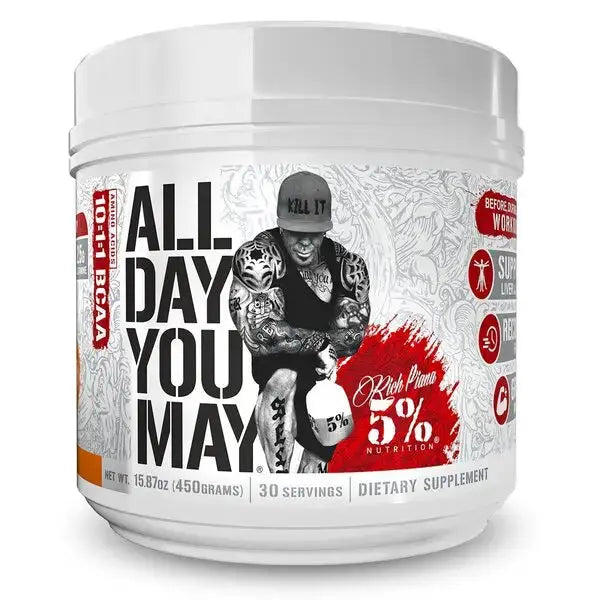

What is 5% Nutrition All Day You May?
All Day You May is a powdered amino acid drink, to be mixed with water, built around a BCAA complex of 6,000 mg per 12 g serving. It stands out for its 10:1:1 ratio, that is to say ten parts of leucine to one part of isoleucine and one of valine, where the market's historical standard is 2:1:1.
The product comes from 5% Nutrition, a brand whose formulas are recognisable by their length: here there are not three amino acids but seven families of ingredients, from the joint complex to the muscle buffer. The rest of the brand's catalogue is in our 5% Nutrition aisle.
The flavours listed: Push Pop, Blueberry Lemonade, Southern Sweet Tea, Lemon Lime, Fruit Punch, Blue Raspberry, Watermelon and Mango Pineapple. The number of servings per tub is not published by the manufacturer in the information available to us; the net weight shown on the packaging you receive lets you work it out by dividing by 12.
What does a 12 g serving contain?
| Complex | Per 12 g serving | Published detail |
|---|---|---|
| BCAA complex | 6,000 mg | L-leucine 5,000 mg, L-isoleucine 500 mg, L-valine 500 mg |
| Conditionally essential amino acids | 2,800 mg | L-glutamine and L-carnitine L-tartrate, split not disclosed |
| Intramuscular buffer | 1,500 mg | Beta-alanine and creatinol-O-phosphate, split not disclosed |
| Support complex | 960 mg | Taurine, coconut water concentrate, HICA, bromelain, blueberry powder |
| Joint complex | 600 mg | Potassium D-glucosamine sulphate and MSM, split not disclosed |
| N-acetyl-L-cysteine | 500 mg | Dosed on its own |
| Other essential amino acids | 200 mg | Histidine, lysine, methionine, phenylalanine, threonine, tryptophan |
No nutrient reference value exists for free amino acids: a percentage column would make no sense here, and we will not invent one.
5 g of leucine per serving is considerable, and it is the product's real selling point. Leucine is the amino acid that triggers the protein synthesis signal, and the threshold generally accepted sits between 2.5 and 3 g. One serving delivers almost double that.
What that ratio implies does need saying, though, because nobody says it. Triggering the signal is not enough: you also need the bricks. The other six essential amino acids are present here only to the tune of 200 mg in total, which is a trace. Put another way, this product fires the starting gun for construction without delivering the materials. That is perfectly coherent if you use it around a meal or a protein shake that supplies the rest. It is far less so if you rely on it on an empty stomach, thinking it replaces a complete protein. In that case, a complete EAA is the right product, not this one.
The rest of the formula deserves reading line by line. The 1,500 mg of intramuscular buffer combine beta-alanine and creatinol-O-phosphate; it is the beta-alanine that explains the tingling in the face and forearms that many users feel within a quarter of an hour of taking it. It is harmless and it fades with habit. If that is the ingredient you want at a proper dose, our beta-alanine aisle offers it on its own.
The 600 mg of joint complex combine glucosamine and MSM, with no published split. That is well below the quantities used in the work on glucosamine, around 1,500 mg a day. It is a touch, not a treatment. The same remark applies to the 500 mg of N-acetyl-cysteine and to the glutamine, whose exact share of the 2,800 mg is not disclosed.
A regulatory clarification, which belongs here: none of these ingredients holds a health claim authorised in Europe. Not the BCAAs, not glutamine, not carnitine, not beta-alanine. We can describe the quantities and compare them with the market; we cannot attribute an effect to them, and legally nobody can.
Ingredients list
BCAA complex (L-leucine, L-isoleucine, L-valine), conditionally essential amino acid complex (L-glutamine, L-carnitine L-tartrate), support complex (L-taurine, coconut water concentrate, HICA [alpha-hydroxyisocaproic acid], bromelain, blueberry fruit powder), intramuscular buffer (beta-alanine, creatinol-O-phosphate), joint complex (potassium D-glucosamine sulphate, MSM [methylsulfonylmethane]), N-acetyl-L-cysteine, essential amino acid complex (L-histidine, L-lysine, L-methionine, L-phenylalanine, L-threonine, L-tryptophan), natural and artificial flavourings, citric acid, sweeteners (sucralose, acesulfame potassium), colourings depending on the flavour. May contain traces of MILK, SOYA, EGG and GLUTEN depending on the flavour and the production conditions.
How do you take All Day You May?
Serving: one 12 g scoop. Liquid: 300 to 500 ml of cold water. Timing: 15 to 30 minutes before the session, or sipped during training, or between two meals. Frequency: one serving a day to begin with. Duration: the manufacturer sets no course length.
Start with a single daily serving for at least a week. The manufacturer allows up to four servings a day for the most highly trained athletes, but that is a ceiling, not a recommendation. At four servings you are swallowing 6 g of muscle buffer, 2 g of N-acetyl-cysteine and 2.4 g of joint complex over the day: those quantities deserve at the very least to be discussed with a healthcare professional before you go there.
The volume of water matters too. Below 300 ml the drink becomes very concentrated and acidic, and free amino acids irritate some people's stomachs. For a long session, go up to 700 or 800 ml and spread out your consumption.
A practical point: avoid taking it at the same time as a complete protein shake. It is not dangerous, simply redundant: the protein already supplies all the amino acids. The right slot is the one where you have nothing else: between two widely spaced meals, or during training.
Who is All Day You May for, and who is it not for?
It suits someone who trains fasted or a long way from their last meal and who is looking to limit catabolism over a long session. It also suits those who cannot tolerate a shake during exercise.
The manufacturer advises against it for pregnant and breastfeeding women and restricts it to adults over 18. It also asks for the advice of a healthcare professional in the event of liver or kidney disease, which is consistent with a high daily load of free amino acids.
Two points of caution that the manufacturer does not highlight and that we prefer to put in writing. First, the glucosamine: it is of shellfish origin in the vast majority of cases, the source is not specified here, and that is information which matters to anyone allergic to crustaceans. It also calls for a doctor's advice in the event of diabetes or anticoagulant treatment. Second, the creatinol-O-phosphate: this is a synthetic molecule whose regulatory status as a food supplement ingredient in the European Union is not clearly established. We flag it because a buyer has the right to know before buying.
What you should not expect from it: it is not a protein substitute. One serving supplies 12 g of ingredients including 6 g of BCAAs, which replaces neither a chicken breast nor a shake. Nor is it a product that "builds muscle" by itself: if your daily protein intake is already adequate, the measurable benefit of additional BCAAs is small, and the literature is fairly harsh on this point. Finally, if you are subject to anti-doping testing, check the batch status with your federation before taking any.
All Day You May or a complete EAA?
This is the central trade-off in this category, and it is settled fairly clearly.
A complete EAA supplies the nine essential amino acids in proportions close to those of muscle, generally with 2.5 to 3 g of leucine per serving. It is the better choice if you take the product on an empty stomach, if you are not eating within the following two hours, or if your daily protein intake is low. It provides both the signal and the materials, which is the only way to obtain a real effect on protein synthesis.
All Day You May follows a different logic: plenty of leucine, very little of the rest, but a whole series of comfort ingredients around it — joint, buffer, antioxidant, hydration. It is the better choice if you use it as a training drink alongside meals that are already protein-rich, if the beta-alanine tingling does not bother you, and if you like long formulas. It is also, let us say it, a product of habit rather than one with demonstrated efficacy on a specific point.
If your need is simply to have something to drink during a long session, without chasing performance, an electrolyte drink costs less and does the job.
Frequently asked questions
Is the 10:1:1 ratio better than 2:1:1?
It supplies more leucine for the same total quantity, which is verifiable. But a ratio says nothing about overall effectiveness: protein synthesis requires the nine essential amino acids, not just the trigger. A 10:1:1 taken around a protein-rich meal makes sense; taken on its own, it does half the work.
Why do I get tingling after taking it?
That is the beta-alanine in the buffer complex. The sensation affects the face, the scalp and the forearms, appears within fifteen minutes and lasts half an hour. It is harmless, well documented, and fades with repeated servings. If it bothers you, split the serving in two.
How many servings a day at most?
The manufacturer sets the ceiling at four. That is a lot, and that ceiling is designed for athletes with a very high training volume. One serving a day covers the use of the vast majority of people, and two already amount to sustained use.
Can it be taken on rest days?
Yes, between two widely spaced meals. The benefit remains modest: on a day without training, what counts for recovery is total protein intake and sleep, not the distribution of free amino acids.
Does this product contain creatine?
No. The creatinol-O-phosphate in the buffer complex has a name that looks similar but it is not creatine and does not have the same effects. If you are looking for creatine, you need to buy it separately.
Is it suitable for vegetarians?
The glucosamine in the joint complex is most often of shellfish origin, and the manufacturer does not specify the source in the information available to us. Without that detail, we cannot state that the product is suitable for a vegetarian diet. The label on the tub you receive is the only reliable reference.
Can it be mixed with a pre-workout?
Technically yes, but look at the labels first. Many pre-workouts already contain beta-alanine, taurine and tyrosine: the totals add up quickly, with no extra benefit. The one ingredient there is no point in doubling up is precisely the muscle buffer.
Where can you buy 5% Nutrition All Day You May?
The flavours can be ordered from this page, and we ship throughout France and Europe. At the Vendargues shop, about ten minutes from Montpellier, the first question we ask in front of this tub is "how much protein do you eat a day?" — because the answer determines whether this product is going to bring you something or simply add to an already full list. The rest of the aisle can be browsed in our sports nutrition section.
Retrait au magasin sous 2 h
À Vendargues, près de Montpellier. Vous êtes prévenu dès que la commande est prête.
Commandé avant 14 h, expédié le jour même
Du lundi au samedi. Le délai d'acheminement appartient ensuite au transporteur.
Livraison offerte dès 50 €
En France métropolitaine, et dès 100 € en Europe. Modes et délais.
Une question avant de commander ?
Écrivez-nous ou passez au magasin : on connaît les produits qu'on vend.
What are essential amino acids?
The proteins in your body are assembled from twenty amino acids. Your body can produce eleven of them from other molecules. The other nine, it cannot: it lacks the synthesis pathways for these, and they must therefore come from food. These are essential amino acids, or EAAs (Essential Amino Acids).
Here they are: leucine, isoleucine, valine, lysine, methionine, threonine, phenylalanine, tryptophan, histidine. The first three are branched-chain amino acids, better known as BCAAs.
The key principle is stated in one sentence: protein synthesis stops as soon as a single essential amino acid is missing. This is the limiting factor principle. Leucine may send the building signal—that's its role, and why it's highlighted everywhere—but if lysine or methionine are not available, the chain will not assemble. Building muscle requires all nine, together.
This is exactly what separates an EAA product from a BCAA product. BCAAs provide only three out of the nine. They trigger the signal without delivering the building blocks. We also state this on our BCAA page, where this point is elaborated: BCAAs alone are largely outmatched by EAAs physiologically, even if they retain legitimate uses for taste, cost, and comfort during workouts.
EAA or whey: which to choose?
This is an honest question, and the answer doesn't favor the average shopping cart. Whey is already a complete source of essential amino acids. This is not a marketing approximation: whey protein contains all nine EAAs, in good proportions, with a high leucine content. A dose of whey isolate or concentrated whey provides the full spectrum.
And it does so for less money. Free amino acids are produced by fermentation or extraction, purified one by one, then recombined: this is a costly process. Per gram of essential amino acids actually supplied, a tub of whey is significantly cheaper than a tub of EAAs. For most exercisers, a dose of whey already covers their EAA needs, at the best price. If you haven't sorted this basic need yet, start with our proteins before adding free amino acids.
Powdered EAAs have an advantage that whey does not: they are already broken down. There's nothing to digest, absorption is rapid, they contain almost no calories, and they mix into a clear drink rather than a thick shake. These characteristics—not inherent superiority for muscle building—define their true use cases.
When are EAAs truly useful?
Five situations genuinely justify them.
Fasted training
If you train in the morning without having eaten, your blood does not contain available essential amino acids. An EAA drink sipped during the session provides them without requiring digestion and without the heaviness of a meal in your stomach. This is the strongest use case, and one where BCAAs are, on the contrary, most unsuitable, as six out of nine amino acids would be missing.
Long sessions
Beyond 75 to 90 minutes of effort, intake during the session makes sense. A drink combining EAAs, electrolytes, and possibly fast-absorbing carbohydrates like maltodextrin or cyclic dextrin can be consumed without discomfort, unlike a protein shake.
Difficult digestion
Some people don't tolerate whey: poorly managed lactose intolerance, bloating, a feeling of heaviness during exercise. Free-form EAAs require no digestive effort. Clear whey is the other option to consider in this case.
Vegan diet
Plant proteins are often limiting in a specific amino acid: lysine for cereals, methionine for legumes. Fermented EAAs fill this deficit in a targeted way, without animal products.
Calorie deficit
During a cutting phase, the goal is to preserve muscle mass with few calories available. EAAs provide the full spectrum for almost zero caloric load, which is useful when every calorie counts. They remain a supplement: the priority in weight loss remains a high daily protein intake, from whole foods and protein powder.
Outside of these cases, if you eat well and have a shake after your workout, additional EAAs will provide no measurable benefit. We prefer to tell you this rather than sell you a product you don't need.
How to dose EAAs and read leucine content?
The reference dose is between 10 and 15 g of EAAs per serving. Below 8 g, the intake becomes anecdotal compared to needs; above 15 g, it is better to switch to a complete protein, which is cheaper and more satiating.
The number to check on the label is the amount of leucine per dose. Aim for at least 2.5 g. This is the commonly accepted benchmark for fully triggering protein synthesis, and it is also what a standard dose of whey provides. Many formulas proudly display "9 essential amino acids" without giving details: without a line-by-line breakdown, you don't know what you're buying. Some contain 500 mg of leucine and a lot of flavor fillers.
Second check: the actual presence of all nine. Some products sold in the EAA section contain only six or seven, omitting tryptophan or histidine, which are more expensive. The list must be complete.
For preparation, count 400 to 600 ml of cold water for 10 to 15 g. Drink during your workout, in small sips, or within 30 minutes before if you are fasted. On non-workout days, EAAs have no particular benefit if your meals cover your protein needs.
What taste and solubility to expect?
It's important to state upfront: essential amino acids have a challenging taste. Leucine is bitter, methionine and cysteine have sulfuric notes, and tryptophan has a persistent bitterness. It is precisely because they contain these amino acids that EAAs are harder to flavor than BCAAs. Manufacturers compensate with powerful, often acidic flavors—citrus, red berries, cola.
Practical consequences: prefer acidic flavors, which mask bitterness better than creamy flavors; use more water than the recommended dose if the taste bothers you; serve very cold. As for solubility, a slight residue and foam on the surface are normal and do not indicate a quality defect.
Finally, what not to expect from EAAs: they do not replace sufficient daily protein intake, do not cause weight loss, do not compensate for poorly structured training, and do not produce a perceptible effect during the session—no boost, no pump. Their action is structural, silent, and slow. In case of kidney or liver disease, pregnancy, breastfeeding, or ongoing treatment, ask your doctor's advice before any amino acid supplementation.
Frequently Asked Questions
What are EAAs?
The abbreviation for Essential Amino Acids: the nine amino acids your body cannot produce and must come from food. An EAA product provides them in free form, already separated, ready to be absorbed without digestion. It is not a protein: it is a protein already broken down, without the associated calories or satiety.
What is the role of leucine?
It is the trigger amino acid. Above a certain blood threshold, it activates the mTOR pathway, which signals the start of muscle protein synthesis—hence the 2.5 g leucine benchmark per serving, found in a standard dose of whey. But a signal alone builds nothing: if the other eight essential amino acids are missing, the chain will not assemble. This is the whole limitation of products that rely solely on leucine.
What are the 9 essential amino acids?
Leucine, isoleucine, valine, lysine, methionine, threonine, phenylalanine, tryptophan, and histidine. You still often read "the 8 essential amino acids": histidine was long considered essential only in children, before being recognized as essential at all ages. The first three on the list are branched-chain amino acids, sold separately as BCAAs. A product that claims "EAA" must contain all nine: some formulas omit tryptophan or histidine, which are more expensive, and therefore do not deserve the appellation.
What is an amino acid?
It is the basic building block of proteins: a small organic molecule with an amine group and an acid group, capable of linking to its neighbors by a peptide bond. Twenty amino acids make up human proteins, and the order in which they link determines what the protein becomes: muscle fiber, enzyme, antibody, transporter. Digesting a steak or a shake involves breaking down these chains into isolated amino acids, which the body then reassembles according to its own plans. Eleven of them can be made by the body; nine must come from food.
EAA or BCAA: which should I take?
EAAs, in almost all situations. They contain all nine essential amino acids; BCAAs only contain three. BCAAs retain an interest for taste, cost, and intra-training comfort for someone whose overall protein intake is already covered, but they cannot build a complete protein on their own.
When to take EAAs?
On training days, around your workout: 10 to 15 g in 400 to 600 ml of cold water, to sip during exercise, or in the 30 minutes before if you are starting fasted. For a very long session, a second intake can be considered. On rest days, if your meals cover your protein needs, they have no particular role. Timing remains secondary to total protein intake over 24 hours: a regular daily intake is better than a perfectly timed intake on an insufficient base.
What are EAAs used for in bodybuilding?
To provide all the building blocks needed for muscle protein synthesis, in situations where food does not provide them at the right time: fasted training, sessions longer than 90 minutes, difficult digestion, significant caloric deficit. Outside of these cases, their additional contribution is small: what determines muscle gain remains the total daily protein and calorie intake. An EAA is also not felt during the session—no boost, no pump. Its action is structural and silent.
What are the benefits of EAAs?
Three, provided we remain precise. They provide the full spectrum of essential amino acids for almost zero caloric load, which matters when every calorie counts. They are absorbed without digestive effort, in 15 to 30 minutes, whereas a whole protein requires digestion: useful when fasted or during intense effort. They are consumed in a clear and light drink, easier to swallow during a session than a thick shake. What they don't do: cause weight loss, replace meals, or compensate for poorly structured training.
Are EAAs dangerous?
They are the same amino acids as those found in meat, eggs, or fish, simply isolated and purified: a healthy adult finds nothing alien to their diet. At usual doses, reported effects are limited to digestive discomfort, especially with a large dose swallowed at once on an empty stomach. Real contraindications are medical: metabolic amino acid disorders, kidney failure, liver failure, pregnancy, breastfeeding, ongoing treatment. In these situations, only your doctor can advise, and self-medication has no place.
Where to find amino acids in food?
In all proteins, but not in the same proportions. Eggs, meats, fish, and dairy products provide all nine essentials in a profile close to human needs, with whey from milk being the most concentrated in leucine. On the plant side, soy, peas, and quinoa are complete; cereals tend to lack lysine and legumes methionine, hence the benefit of combining them throughout the day. The Ciqual database publishes the detailed composition of each food.
How to make up for a protein deficiency?
Start by measuring rather than assuming: record your intake over three typical days. The common benchmark for a regular exerciser is between 1.6 and 2.2 g of protein per kilogram of body weight per day. Then distribute this over three to four servings of 25 to 40 g rather than concentrating everything in the evening. If the gap persists, powder remains the simplest way to fill it: our proteins cover this need at a significantly lower cost per gram than free amino acids.
What EAAs do we offer?
This is our largest collection of amino acids, covering the different uses described above. For a complete and clear EAA: formulas from TrainedByJP, the twelve-amino-acid EAA+ from ESN, the vegan fermented EAA from Naughty Boy, and the Juiced EAA from Sinob. IO Genix offers Kyowa quality amino acids, and Strom Supplements an EAA combined with ActiGin.
For long sessions and training in hot weather, several references combine amino acids and minerals: hydration formulas from RAW Nutrition and Rule One, or electrolytes to be dosed separately. Applied Nutrition completes the selection for intra-training formats.
Advice at a store near Montpellier?
Our Vendargues store, about ten minutes from Montpellier, allows you to return two pots and compare the tables: number of amino acids actually present, leucine per dose, price per serving. We will also tell you when a simple whey will suffice. We ship everywhere in France and Europe.
Sources: ANSES for French recommendations on dietary supplements for athletes, Ciqual for the amino acid composition of foods, EFSA for European scientific opinions.
To go further: how to choose your essential amino acids well.
Questions fréquentes — EAA
Les EAA, c'est quoi ?
L'abréviation d'Essential Amino Acids : les neuf acides aminés que votre organisme ne sait pas fabriquer et qui doivent venir de l'alimentation. Un produit EAA les fournit sous forme libre, déjà séparés, prêts à être absorbés sans digestion. Ce n'est pas une protéine : c'est une protéine déjà démontée, sans les calories ni la satiété qui vont avec.
Quel est le rôle de la leucine ?
C'est l'acide aminé déclencheur. Au-delà d'un certain seuil sanguin, elle active la voie mTOR, qui donne le signal de démarrage de la synthèse protéique musculaire — d'où le repère de 2,5 g de leucine par prise, que l'on retrouve dans une dose standard de whey. Mais un signal ne construit rien tout seul : si les huit autres acides aminés essentiels manquent, la chaîne ne s'assemble pas. C'est toute la limite des produits qui misent sur la leucine seule.
Quels sont les 9 acides aminés essentiels ?
Leucine, isoleucine, valine, lysine, méthionine, thréonine, phénylalanine, tryptophane et histidine. On lit encore souvent « les 8 acides aminés essentiels » : l'histidine a longtemps été considérée comme essentielle uniquement chez l'enfant, avant d'être reconnue essentielle à tout âge. Les trois premiers de la liste sont les acides aminés ramifiés, vendus séparément sous le nom de BCAA. Un produit qui annonce « EAA » doit contenir les neuf : certaines formules omettent le tryptophane ou l'histidine, plus coûteux, et ne méritent alors pas l'appellation.
Qu'est-ce qu'un acide aminé ?
C'est la brique élémentaire des protéines : une petite molécule organique portant une fonction amine et une fonction acide, capable de s'enchaîner à ses voisines par une liaison peptidique. Vingt acides aminés composent les protéines humaines, et l'ordre dans lequel ils s'enchaînent détermine ce que la protéine devient : fibre musculaire, enzyme, anticorps, transporteur. Digérer un steak ou un shaker revient à démonter ces chaînes en acides aminés isolés, que l'organisme réassemble ensuite selon ses propres plans. Onze d'entre eux peuvent être fabriqués par le corps, neuf doivent venir de l'assiette.
EAA ou BCAA : que faut-il prendre ?
Les EAA, dans la quasi-totalité des situations. Ils contiennent les neuf acides aminés essentiels, les BCAA seulement trois. Les BCAA gardent un intérêt de goût, de coût et de confort intra-training chez quelqu'un dont l'apport protéique global est déjà couvert, mais ils ne peuvent pas construire une protéine complète à eux seuls.
Quand prendre les EAA ?
Les jours d'entraînement, autour de la séance : 10 à 15 g dans 400 à 600 ml d'eau froide, à siroter pendant l'effort, ou dans les 30 minutes qui précèdent si vous partez à jeun. Sur une séance très longue, une seconde prise se conçoit. Les jours de repos, si vos repas couvrent vos protéines, ils n'ont pas de rôle particulier. Le minutage reste secondaire face au total protéique sur 24 heures : mieux vaut un apport quotidien régulier qu'une prise parfaitement calée sur une base insuffisante.
À quoi servent les EAA en musculation ?
À fournir la totalité des briques dont la synthèse des protéines musculaires a besoin, dans les situations où l'alimentation ne les apporte pas au bon moment : entraînement à jeun, séance de plus de 90 minutes, digestion difficile, déficit calorique marqué. En dehors de ces cas, leur apport supplémentaire est faible : ce qui détermine la prise de masse reste le total protéique et calorique de la journée. Un EAA ne se ressent pas non plus pendant la séance — ni coup de fouet, ni congestion. Son action est structurelle et silencieuse.
Quels sont les bienfaits des EAA ?
Trois, à condition de rester précis. Ils apportent le spectre complet des acides aminés essentiels pour une charge calorique quasi nulle, ce qui compte lorsque chaque calorie est comptée. Ils sont absorbés sans travail digestif, en 15 à 30 minutes, là où une protéine entière demande une digestion : utile à jeun ou en plein effort. Ils se boivent dans une boisson claire et légère, plus facile à avaler pendant une séance qu'un shaker épais. Ce qu'ils ne font pas : faire maigrir, remplacer des repas, ou compenser un entraînement mal construit.
Les EAA sont-ils dangereux ?
Ce sont les mêmes acides aminés que ceux de la viande, des œufs ou du poisson, simplement isolés et purifiés : un adulte en bonne santé n'y trouve rien d'étranger à son alimentation. Aux doses usuelles, les effets rapportés se limitent à des désagréments digestifs, surtout sur une forte dose avalée d'un coup à jeun. Les vraies contre-indications sont médicales : maladies métaboliques des acides aminés, insuffisance rénale, insuffisance hépatique, grossesse, allaitement, traitement en cours. Dans ces situations, seul votre médecin peut se prononcer, et l'automédication n'a pas sa place.
Où trouver des acides aminés dans l'alimentation ?
Dans toutes les protéines, mais pas dans les mêmes proportions. Les œufs, les viandes, les poissons et les produits laitiers apportent les neuf essentiels dans un profil proche des besoins humains, la whey issue du petit-lait étant la plus concentrée en leucine. Côté végétal, le soja, le pois et le quinoa sont complets ; les céréales manquent plutôt de lysine et les légumineuses de méthionine, d'où l'intérêt de les associer sur la journée. La base Ciqual publie la composition détaillée de chaque aliment.
Comment combler un manque de protéines ?
Commencez par mesurer plutôt que supposer : notez vos apports sur trois jours ordinaires. Le repère courant chez un pratiquant régulier se situe entre 1,6 et 2,2 g de protéines par kilo de poids et par jour. Répartissez ensuite sur trois à quatre prises de 25 à 40 g plutôt que de tout concentrer le soir. Si l'écart persiste, une poudre reste le moyen le plus simple de le combler : nos protéines couvrent ce besoin pour un coût au gramme bien inférieur à celui des acides aminés libres.
