
7 products
Sort by:
7 products
7 products


What is Olimp Carbonox?
Olimp Carbonox is a carbohydrate powder to be mixed with water, intended for training, made by Olimp Sport Nutrition, a Polish brand. It is dosed at 50 g and drunk before, during or after a session.
The body of the formula is a blend of three carbohydrates: maltodextrins, glucose and isomaltulose. To these are added L-arginine hydrochloride, two acidity regulators (malic acid, citric acid), a set of vitamins and minerals, flavourings, two sweeteners (acesulfame K and sucralose) and colours depending on the flavour. The flavours listed: Strawberry, Lemon, Orange, Pineapple and Grapefruit.
A word on method before going further. This page repeats no promise of "two hours of stable blood sugar" and no stated duration of energy: those claims circulate about this product, they are not backed by any verifiable source and they no longer appear here. The net weight of the tub, for its part, does not appear in the product data we hold for this item: it is printed on the packaging, so we work in 50 g servings rather than in servings per tub.
What does a 50 g serving of Carbonox contain?
One serving provides 47.5 g of carbohydrate, of which 12.5 g sugars, for 816 kJ / 192 kcal, 0.5 g of protein, 0 g of fat and 0.025 g of salt. It also contains 500 mg of L-arginine hydrochloride, i.e. 410 mg of L-arginine.
What sets the product apart is its fortification. The vitamins are dosed at a consistent level: each of the ones that are quantified provides 20 % of the NRV per 50 g serving. On the mineral side, chromium reaches 94 % and manganese 50 %, while calcium and magnesium stay below the 15 % that any claim depends on.
| Nutrient | Per 100 g | Per 50 g serving | % NRV per serving |
|---|---|---|---|
| Energy | 1,632 kJ / 384 kcal | 816 kJ / 192 kcal | 10 % |
| Fat | 0 g | 0 g | 0 % |
| Carbohydrate | 95 g | 47.5 g | 18 % |
| of which sugars | 25 g | 12.5 g | 14 % |
| Protein | 1 g | 0.5 g | 1 % |
| Salt | 0.05 g | 0.025 g | < 1 % |
| L-arginine (from the hydrochloride) | 820 mg | 410 mg | * |
| Vitamin C | 32 mg | 16 mg | 20 % |
| Vitamin E | 4.8 mg | 2.4 mg | 20 % |
| Vitamin A | 320 µg | 160 µg | 20 % |
| Niacin | 6.4 mg | 3.2 mg | 20 % |
| Vitamin B1 | 0.44 mg | 0.22 mg | 20 % |
| Vitamin B2 | 0.56 mg | 0.28 mg | 20 % |
| Vitamin B6 | 0.56 mg | 0.28 mg | 20 % |
| Vitamin B12 | 1 µg | 0.5 µg | 20 % |
| Folic acid | 80 µg | 40 µg | 20 % |
| Biotin | 20 µg | 10 µg | 20 % |
| Calcium | 176 mg | 88 mg | 11 % |
| Magnesium | 82.5 mg | 41.25 mg | 11 % |
| Iron | 12 mg | 6 mg | 43 % |
| Manganese | 2 mg | 1 mg | 50 % |
| Chromium | 75 µg | 37.5 µg | 94 % |
| Selenium | 8 µg | 4 µg | 7 % |
* No NRV is established for L-arginine, and no health claim is authorised for it: it appears in the composition, it is not an argument for effectiveness. Two reservations about the table, which we would rather write down than round off. The ingredients list mentions twelve vitamins, but only ten are quantified: vitamin D and pantothenic acid appear in the composition with no content declared. Likewise, the list mentions eight minerals — iodine and molybdenum being added to the six in the table — but only six are quantified. We are not inventing the four missing rows.
The verified levels permit the following European wordings, and only those: vitamin C, B1, B2, B6, B12, niacin, biotin, iron and manganese contribute to normal energy-yielding metabolism; vitamin C, B2, B6, B12, niacin, folate and iron contribute to the reduction of tiredness and fatigue; vitamin E contributes to the protection of cells from oxidative stress; vitamin A contributes to the normal function of the immune system and to the maintenance of normal vision; chromium contributes to normal macronutrient metabolism. The multivitamins department covers the same ground outside a training context.
On the carbohydrates themselves, a European claim does exist, but its conditions of use require an intake of the order of 4 g of carbohydrate per kilogram of body weight after exercise. For a person of 75 kg, that comes to 300 g of carbohydrate, or six servings. A 50 g serving does not meet that condition: we therefore claim nothing on that front.
How do you take Olimp Carbonox?
The manufacturer specifies one 50 g scoop in 100 to 200 ml of water, to be mixed vigorously for at least 10 seconds. The recommended amount is 2 to 4 servings a day depending on training intensity and body weight — that is 95 to 190 g of carbohydrate a day from this product alone.
Three timings are proposed: 30 minutes before training, during the session in small sips, and immediately after. No course length is given by the manufacturer, and there is no reason to set one: a carbohydrate powder is taken according to training load, not as a course.
A practical note on dilution. Fifty grams in 100 ml gives a very concentrated solution, which slows gastric emptying and troubles a lot of athletes during exercise. If you are drinking the mix while running or cycling, go beyond the 200 ml stated and dilute in 500 to 700 ml. The manufacturer's range suits a single drink after the session better.
Who is Carbonox for, and who is it not for?
The product is aimed at adults whose training load is genuine: long sessions, back-to-back workouts, endurance sports, or bulking where calorie intake from solid food becomes hard to sustain. If you train for an hour three times a week, a 192 kcal serving of fast carbohydrate serves no purpose and simply adds to your calorie balance.
The manufacturer states clearly that the product is not suitable for people with diabetes. It advises against it for pregnant and breastfeeding women as well as for the under-18s, and reminds you not to exceed the daily serving. It is made in a factory that handles milk, eggs, soya, nuts, peanuts, gluten, fish, crustaceans and molluscs: traces are possible. Any question relating to a medical treatment or condition belongs with your doctor or your pharmacist.
What you should not expect from it: this is not a weight loss product, quite the opposite. Nor is it a meal replacement, despite the vitamins: 0.5 g of protein per serving feeds nothing. And it is not a pre-workout, it contains no caffeine. Finally, no promise about how long the energy lasts can be kept: the rate at which you empty your stores depends on intensity, on what you have eaten that day and on your training, not on the composition of a powder.
Carbonox or a plain maltodextrin?
The question is a genuine one, because the price gap per kilo of carbohydrate is significant.
A plain maltodextrin is the better choice when you are consuming large volumes of carbohydrate, when you want to control your intake precisely, or when you are already taking vitamins elsewhere — Carbonox's 20 % of the NRV then adds to what you are swallowing on the other side, and the benefit melts away. It is also preferable if you are mixing your carbohydrate with a protein or with amino acids in the same bottle: the fewer flavourings and acidifiers there are, the better the mix behaves.
Carbonox holds its own when you want a ready-to-use drink that is pleasant to swallow, and when the vitamin content replaces a multivitamin you are not taking. If it is digestive comfort on very long efforts that concerns you, look instead at cyclodextrin, whose osmolarity is more favourable, or at waxy maize. And to cover the calories of a weight gain phase, carbohydrate combined with protein works better than carbohydrate on its own.
Frequently asked questions
What proportion of Carbonox is maltodextrin?
The manufacturer does not publish the split between the three sources. The ingredients list puts the carbohydrate blend first, with the maltodextrins named before glucose and then isomaltulose, which indicates descending order of quantity without giving weights. We are not going to estimate them.
How many 50 g servings can you take a day?
Two to four depending on training intensity and body weight, according to the manufacturer. That comes to 95 to 190 g of carbohydrate and 384 to 768 kcal from this product alone. Count them in your daily balance: this is energy, not a neutral supplement.
Is Carbonox suitable for people with diabetes?
No. The manufacturer says so explicitly, and the composition confirms it: 47.5 g of carbohydrate per serving, of which 12.5 g sugars. No multi-source formulation changes that figure. If this concerns you, the question is one for your doctor, not for a product page.
Does the nutrition table change with the flavour?
The published values apply to the range; only the colours vary with the flavour, as the ingredients list indicates. The flavours listed are Strawberry, Lemon, Orange, Pineapple and Grapefruit. The two sweeteners, acesulfame K and sucralose, are common to all of them.
Does Carbonox contain gluten?
No gluten-containing ingredient appears in the composition, but the factory also handles gluten, as well as milk, eggs, soya, nuts, peanuts, fish, crustaceans and molluscs. If you have coeliac disease, this risk of traces should be taken seriously.
How many vitamins and minerals are actually quantified?
Ten vitamins out of the twelve present in the ingredients list, and six minerals out of the eight. Vitamin D, pantothenic acid, iodine and molybdenum appear in the composition with no content declared. That is a shortcoming of the label, not an omission on our part, and it makes any claim for those four nutrients impossible to use.
Can it be mixed with a protein?
Yes, with no known interaction, and combining carbohydrate with protein makes sense after a long session. Just be aware that Carbonox's acidifiers, malic acid and citric acid, can alter the texture of a whey. A neutral maltodextrin mixes more cleanly if that is your main use.
Should it be taken during or after exercise?
Both are proposed by the manufacturer. During exercise, dilute generously — 500 to 700 ml rather than the 200 ml stated — to avoid the digestive discomfort of an over-concentrated solution. After exercise, the tighter dilution poses no problem since the drink is swallowed in one go.
Where can you buy Olimp Carbonox?
This page lets you order the flavours, and we ship throughout France and Europe. In our Vendargues shop, about ten minutes from Montpellier, this is the kind of product that is better discussed before being bought: the first question we ask is how many hours of training a week, because below a certain volume a carbohydrate powder has nothing to offer. The rest of the department is in our sports nutrition section.


What is IO Genix Cyclic Dextrin?
IO Genix Cyclic Dextrin is a carbohydrate powder designed to be drunk during exercise. A 25 g serving provides 24 g of carbohydrate for 95 kcal, with zero sugar. It is mixed into 400 to 500 ml of water and sipped steadily.
Highly branched cyclic dextrin, often sold under the Cluster Dextrin name, is a carbohydrate made from maize starch by an enzymatic process that yields very large, heavily branched molecules. It is not a sugar: the “of which sugars” line in the table reads 0 g, which is rare for a fast-acting carbohydrate source.
Its interesting property is a physical one. A cyclic dextrin solution has a low osmolality despite a high carbohydrate concentration, because the molecules are few in number but very large. In practice, it leaves the stomach quickly and feels less heavy than a drink loaded with simple sugars. The rest of the Spanish range is in our IO Genix aisle, and the other products in the category in our cyclic dextrin aisle.
What is in a serving of Cyclic Dextrin?
| Values | Per 100 g | Per 25 g serving |
|---|---|---|
| Energy | 380 kcal | 95 kcal |
| Fat | 0 g | 0 g |
| Carbohydrate | 96 g | 24 g |
| of which sugars | 0 g | 0 g |
| Protein | 0 g | 0 g |
| Salt | less than 0.4 g | less than 0.1 g |
| Cluster Dextrin | 96 g | 24 g |
The per 100 g column is calculated from the per-serving values published by the manufacturer.
24 g of carbohydrate without a single gram of sugar is the figure that justifies the price of this kind of powder. A conventional sports drink based on simple sugars would give you the same energy with 20 g of sugars and, for a great many people, a heavy stomach after forty minutes. Here that line of the table reads zero, and that is what changes the experience on long sessions.
One point about the composition has to be flagged plainly, because the manufacturer's documentation contradicts itself. Some of its material presents the product as a single-ingredient powder; its ingredient list, however, declares two sweeteners, sucralose and acesulfame K. We go by the ingredient list, which is the reference document where composition is concerned. The powder is therefore slightly sweet to the taste, without providing sugars in the nutritional sense. If a complete absence of sweeteners matters to you, the label on the tub you receive is the authority.
Missing from the manufacturer's file: the net weight of the tub and the number of servings are not disclosed. We will not infer them. No health claim is authorised in Europe for cyclic dextrin either: we describe its physical properties and its composition, without attributing any quantified performance effect to it.
Ingredient list
Cluster Dextrin (highly branched dextrin), sweeteners (sucralose, acesulfame K).
May contain traces of GLUTEN, EGGS, MILK, FISH and SOYA.
How do you take Cyclic Dextrin?
Serving: 25 g. Liquid: 400 to 500 ml of cool water. Timing: 15 to 30 minutes before exercise, during exercise, or within the 30 minutes that follow. Frequency: one serving per hour of exercise in endurance sports. Duration: as needed, with no course to complete.
The volume of water is the parameter that decides everything here. 25 g in 500 ml gives a light drink that goes down effortlessly. The same 25 g in 250 ml gives a solution twice as concentrated, which cancels out the very advantage of the product and causes exactly the heaviness you were trying to avoid. If you take away only one instruction from this page, make it that one.
Sip small amounts every fifteen to twenty minutes rather than drinking it in one go. That holds for every sports drink, and particularly for this one, whose point is to deliver a steady supply over time.
The powder dissolves very easily, even in cold water, with no lumps and no foam. A simple shaker is enough; make your bottle up before you set off rather than attempting to mix it on the move.
It combines perfectly with an electrolyte powder in the same bottle — carbohydrate and minerals then cover both needs of a long session — and with EAAs if your last meal was a while ago. After exercise, it pairs without difficulty with a protein.
A word on the hourly amount, because the question comes up often: the manufacturer allows for one serving per hour of exercise in endurance sports, which puts the intake at around 24 g of carbohydrate per hour. That is a cautious, well-tolerated level. Experienced cyclists and trail runners often go higher, but that is built up gradually in training, never on race day: the stomach is trained like everything else.
Finally, cool water is preferable to lukewarm water, not for any physiological reason but because a lukewarm drink quickly becomes sickly after an hour of exercise. It is the kind of detail that decides whether the bottle is finished or abandoned half full.
Who is Cyclic Dextrin for, and who is it not for?
It is aimed first at efforts that last: cycling, trail running, long-distance running, swimming, combat sports, back-to-back CrossFit sessions, weight training sessions running well beyond the hour. Below sixty minutes of exercise, taking carbohydrate during the session does little for someone who has eaten normally beforehand.
It suits stomachs that are sensitive during exercise particularly well, the ones that tolerate neither gels nor very sweet drinks. That is in fact its whole reason for existing, and the only argument on which it genuinely stands apart from an ordinary maltodextrin.
The manufacturer advises against it for children, adolescents and pregnant or breastfeeding women, and asks that the recommended daily dose not be exceeded. The product may contain traces of gluten, eggs, milk, fish and soya.
What not to expect from it: this is carbohydrate, nothing else. It has no stimulant effect, does not replace electrolytes in a sweaty session, and provides no amino acids. Nor does it make you lose weight — it adds 95 kcal to your day, which is its function. If you are in a calorie deficit and your session lasts forty minutes, this product is working against you.
Cyclic dextrin or maltodextrin, which should you choose?
Both are carbohydrates derived from starch, both serve the same purpose, and there is a real difference between them — a more modest one, however, than the market would have you believe.
Maltodextrin is markedly cheaper per kilo and perfectly effective at rebuilding stores after exercise. If your use is recovery, or if you are adding carbohydrate to a mass gainer, it does the job and there is no reason to pay more.
Cyclic dextrin stands out during exercise, thanks to its low osmolality: it leaves the stomach faster and sits more lightly. It is the better choice if you have already experienced heaviness or digestive discomfort with a carbohydrate drink, and on efforts lasting several hours where you have to drink regularly.
There is a third route, waxy maize, halfway between the two in price as in behaviour. And for a short session, the most honest answer is that none of the three is necessary: a decent meal two hours beforehand is enough.
One last criterion often settles the matter between them, and it has nothing technical about it: taste. Pure maltodextrin is slightly sweet and neutral; this cyclic dextrin, sweetened, goes down better for many people over the course of a long ride. Over three hours on the bike, drinking something you can stomach counts for more than the finer points of the molecule.
Frequently asked questions
How much carbohydrate is in a serving?
24 g of carbohydrate for 95 kcal, in a 25 g serving. What makes it distinctive is the “of which sugars” line, which reads 0 g: the energy comes from a complex carbohydrate rather than from simple sugars, which changes how the drink is tolerated during exercise.
Why mix it into 400 to 500 ml?
Because that is the volume that gives the drink a concentration close to that of the body's own fluids, the condition for it to leave the stomach quickly. One serving in 250 ml cancels out that advantage and brings the product back down to the level of an ordinary sugary drink.
Does it contain sweeteners?
Yes. The ingredient list declares sucralose and acesulfame K, even though other parts of the manufacturer's documentation present the powder as a single-ingredient product. We go by the ingredient list. Neither of these two sweeteners provides calories or appears in the sugars line.
Can you take it after training?
Yes, within the 30 minutes that follow, as the manufacturer allows. For that particular use, however, a far cheaper maltodextrin will do the same job: the advantage of cyclic dextrin plays out during exercise, not after it.
Is it suitable for weight training sessions?
On long, intense sessions, yes, drunk during the session. On an hour-long session for someone who ate two hours beforehand, the intake is superfluous and simply adds 95 kcal. The criterion is how long the effort actually lasts, not the discipline.
Is it suitable for vegans?
No ingredient of animal origin appears in the list: the dextrin comes from maize starch and both sweeteners are synthetic. The manufacturer does not, however, claim vegan status, and the product may contain traces of milk and eggs from the production facility.
Can it be mixed with other powders?
Without difficulty, with electrolytes or amino acids in the same bottle. Just avoid adding a protein to it if you intend to drink it during exercise: the mixture becomes thick and loses the whole digestive tolerance advantage that justifies the purchase.
Where can you buy IO Genix Cyclic Dextrin?
The powder can be ordered from this page, and we ship throughout France and Europe. At the Vendargues shop, about ten minutes from Montpellier, we always ask the same question before recommending it: how long does your session last? Under an hour, we point the customer back towards their plate rather than towards this tub. The rest of the aisle can be browsed in our sports nutrition section.


What is IO Genix WaxyMaze?
IO Genix WaxyMaze is a carbohydrate powder for mixing with water, made from waxy maize starch. A 75 g serving provides 74 g of carbohydrate for 297 kcal, of which 0 g sugars, and 0.5 mg of vitamin B1. It dissolves in 500 to 700 ml of water and is drunk during or after exercise.
Waxy maize — waxy maize in English — is a variety of maize whose starch consists almost entirely of amylopectin, the branched fraction of starch. Ordinary starch contains around a quarter amylose, the linear fraction, which digests more slowly. It is this botanical peculiarity, and nothing else, that explains how the product behaves in the body.
In concrete terms, you are dealing with a high-glycaemic-index carbohydrate source, with no sugar in the nutritional sense of the word, and no pronounced sweet taste. It is fuel, not a drink for pleasure. The rest of the Spanish range can be browsed in our IO Genix aisle, and the other products in the category in our waxy maize aisle.
What does a serving of WaxyMaze contain?
| Nutritional values | Per 75 g serving | % NRV |
|---|---|---|
| Energy | 297 kcal | — |
| Fat | 0 g | — |
| Carbohydrate | 74 g | — |
| of which sugars | 0 g | — |
| Protein | 0.3 g | — |
| Salt | 0 g | — |
| Amylopectin (WaxyMaze) | 72.2 g | NRV not established |
| Vitamin B1 (thiamine) | 0.5 mg | 45% |
The line to look at is the sugars: 74 g of carbohydrate, of which 0 g sugars. That is what sets a starch powder apart from a conventional energy drink, where most of the carbohydrate is sucrose or glucose. Here, it all comes from a branched starch. The energy arrives quickly, but it does not arrive as sugar, and the cloying feeling typical of very sweet drinks does not occur.
The vitamin B1 is not there for show: it is the vitamin involved in carbohydrate metabolism, and thiamine contributes to normal energy-yielding metabolism — that is the authorised wording. At 0.5 mg per serving, i.e. 45% of the reference value, the amount is enough to be declared.
One point we want to state plainly, because it changes how this product should be used: it contains no sodium. The table shows 0 g of salt. So this is not a complete sports drink: on a long ride or in hot weather, you will be short of the electrolytes you lose through sweat. Plan for those separately — our electrolytes aisle exists for that. A carbohydrate powder on its own is no substitute for a properly formulated isotonic drink.
Something else that cannot be asserted is that this powder clears the stomach faster than any other: that is the classic marketing argument for waxy maize, it has not been validated at European level and we will not repeat it. What is true and verifiable is the composition: a branched starch, high glycaemic index, no sugar.
Data missing from the manufacturer's file: the net weight of the tub, and therefore the number of servings, is not disclosed, any more than the stated origin of the flavouring. We will not infer them; the net content is shown on the packaging you receive.
Ingredients list
Modified starch, flavouring, acidity regulator (citric acid), sweeteners (sucralose, acesulfame K), vitamin B1 (thiamine hydrochloride).
May contain traces of GLUTEN, MILK, EGG and SOYA.
How do you take WaxyMaze?
Serving: 75 g. Liquid: 500 to 700 ml of water. Timing: 30 minutes before exercise, sipped during exercise, or immediately afterwards. Frequency: one serving per session, depending on duration and intensity. Duration: no course to follow, it is a product used occasionally around training.
The dilution volume is the most important parameter, and it is the one people get wrong most often. A 75 g serving in 300 ml gives a very concentrated drink, hard to swallow during exercise and sometimes heavy on the stomach. The 500 to 700 ml specified by the manufacturer are not a suggestion: they correspond to a concentration the digestive tract will accept under exertion. If you have to carry less liquid, cut the powder, not the water.
Adjust the concentration to the outside temperature — an endurance habit that few people apply. In cold weather you sweat less and can go more concentrated: the manufacturer mentions 60 to 80 g per litre. In hot weather, what you mainly need is to drink: drop to 20 to 40 g per litre and increase the volume.
In weight training, the 75 g serving in 500 ml during the session makes sense on long, high-volume workouts. On an hour of strength work it is probably superfluous: over that duration your glycogen stores are enough, and another 297 kcal in the day is not neutral if you are watching your weight.
For recovery, the classic combination remains carbohydrate plus protein. A serving of WaxyMaze with a scoop of protein within the thirty minutes after the session covers both needs at once, and it is also the basis of a self-made mass gain shake, often cheaper than a ready-made gainer.
Who is WaxyMaze for, and who is it not for?
It suits an endurance athlete on efforts of more than an hour, a weight trainer on long sessions, and anyone looking to increase their daily calorie intake without going through bulky foods.
It is not for you if your goal is weight loss. This is the point on which we regularly turn down sales in the shop: 297 kcal in a drink is the equivalent of a light meal, and drinking your calories is the quickest way to derail a deficit. During a cutting phase, this product only makes sense on very long sessions, and even then.
It is not recommended for children, adolescents, pregnant women or breastfeeding women. People with diabetes or with a blood-sugar regulation disorder should seek their doctor's advice before using a high-glycaemic-index powder: that is not a token precaution.
The formula contains sucralose and acesulfame K. If you avoid artificial sweeteners, this product is not for you. Anyone with allergies should take account of the traces of gluten, milk, egg and soya.
What not to expect from it: this is not a performance product with an immediate effect. You will not be stronger after drinking it. It supplies fuel, which is only of interest if the effort actually consumes it. On an hour-long session for someone who eats properly, the usefulness is slight.
WaxyMaze or cyclic dextrin?
The two powders occupy the same place in the carbohydrate aisle, and the choice comes down to two simple criteria.
WaxyMaze is an amylopectin derived from waxy maize. It is the most economical option per gram of carbohydrate, it mixes properly and it suits the majority of uses: post-session refuelling, a drink for long training sessions, extra calories during mass gain.
Cyclic dextrin is a starch processed differently, whose main quality is digestive comfort at high concentration. If you have ever had a heavy stomach from a carbohydrate powder during exercise, that is the parameter that matters to you, and our cyclic dextrin aisle is the right place. The trade-off is that it costs considerably more.
That leaves maltodextrin, the oldest and cheapest of the three, perfectly valid for recovery when digestive tolerance is not an issue. To sum up: maltodextrin if budget comes first, WaxyMaze for a good compromise, cyclic dextrin if your stomach has already let you down mid-race.
Frequently asked questions
How much carbohydrate in a serving?
74 g of carbohydrate for 297 kcal, of which 0 g sugars. All of it comes from waxy maize starch, rich in amylopectin. That is the carbohydrate equivalent of roughly 100 g of dry pasta, in liquid form and with no bulk in the stomach.
Does it taste sweet?
Not very. The product contains no sugars, only sucralose and acesulfame K in small amounts, plus an acidity regulator. The resulting drink stays light in taste, which is an advantage on long efforts where very sweet drinks end up becoming sickly.
Do you need to add electrolytes?
Yes, as soon as the effort drags on and you are sweating. The nutrition table shows 0 g of salt: this powder supplies fuel, not minerals. On a long ride or in hot weather, add an electrolyte product or a pinch of salt to your bottle.
Before, during or after training?
All three are provided for, but the most worthwhile use is during efforts of more than sixty minutes and immediately after an intense session. Before exercise, taking it 30 minutes beforehand works; on a short session, by contrast, the intake is of little interest.
Can it be mixed with a protein?
Yes, and it is in fact the most common pairing for recovery: carbohydrate and protein in the same shaker after the session. It is also the basis of a home-made gainer, generally cheaper and more adjustable than a ready-made mass gain product.
How much water per serving?
500 to 700 ml for 75 g of powder. Below 500 ml, the drink becomes concentrated and sits heavily on the stomach during exercise. In hot weather, increase the volume further or cut the powder: it is digestive comfort that decides, not the theoretical serving.
Does this product make you put on weight?
It provides 297 kcal per serving, so yes, if you add it to a diet that already covers your needs. That is precisely its value during mass gain and its main drawback during a cutting phase. Use it according to your goal, not out of habit.
Where can you buy IO Genix WaxyMaze?
The tub can be ordered from this page, and we ship throughout France and Europe. At the Vendargues shop, about ten minutes from Montpellier, it is a product we recommend mainly to cyclists and trail runners, and one we frankly advise against for anyone trying to lose weight: drinking 300 kcal is the most discreet way of sabotaging a deficit. The full aisle can be browsed in our sports nutrition selection.


What is Sinob Maltodextrin?
Sinob Maltodextrin is a neutral carbohydrate powder, with no flavouring or sweetener, made of 100% maltodextrin obtained from hydrolysed maize starch. It supplies 96 g of carbohydrate per 100 g of powder, of which less than 1 g is sugars.
Maltodextrin is produced by cutting starch into shorter chains. How far that cutting has gone is measured by an index, the dextrose equivalent, and here it is DE19. It is a technical figure that few brands publish, yet it is the decisive one: the higher the DE, the shorter the chains and the faster the absorption, but the sweeter and more osmotic the drink becomes. A DE19 sits in the middle zone, the one that stays fast without weighing on the stomach. The rest of the German range is listed in our Sinob aisle.
The net weight of the pack is not published by the manufacturer in the information available to us; the packaging you receive carries it.
What does a 30 g serving contain?
| Values | Per 100 g | Per 30 g serving |
|---|---|---|
| Energy | 1,634 kJ / 384 kcal | 115 kcal |
| Protein | 0 g | 0 g |
| Carbohydrate | 96 g | 29 g |
| of which sugars | less than 1 g | less than 0.3 g |
| Fat | 0 g | 0 g |
| Fibre | 0 g | 0 g |
| Salt | less than 0.01 g | negligible amount |
| Dextrose equivalent | DE19 | |
The manufacturer states a glycaemic index of around 95 and an absorption time of 15 to 30 minutes. Those values are consistent with a DE19: this is a fast carbohydrate, designed to arrive quickly, not to last.
96 g of carbohydrate for less than 1 g of sugars is the point that confuses people most. How can a powder be almost entirely carbohydrate without containing sugars? Because maltodextrin is a polymer: its chains are too long to fall within the regulatory definition of sugars, which counts only mono- and disaccharides. In glycaemic terms, on the other hand, it behaves like glucose, with an index higher than that of table sugar. That is worth knowing before presenting it as a “sugar free” product: nutritionally, it has all the metabolic effects of sugar.
The second point that counts is the complete neutrality. No flavouring, no sweetener, no additive, no preservative. That means two things in practice. First, it does not disturb the taste of any preparation, which lets you add it to a whey, a porridge or a training drink without changing anything. Second, it is very faintly sweet on the palate but stays bland on its own: drinking it in water with nothing else is a fairly thankless experience.
No health claim exists for maltodextrin, and there is nothing to expect from it beyond what it is: a supply of fast carbohydrate, clean, with no fat and no protein. It is an ingredient, not a product with an effect.
Ingredients list
Maltodextrin 100% (hydrolysed maize starch), dextrose equivalent DE19. No additive, no preservative. Plant origin. Suitable for halal, vegan, lactose free and gluten free diets. No allergen in the composition. Possible traces of GLUTEN, MILK, SOYA and EGGS from the production environment — a nuance to be aware of if you are coeliac, the formula itself being gluten free.
How do you use Maltodextrin?
Serving: 30 g per intake, 30 to 60 g a day when bulking, split into two or three intakes. Liquid: 300 to 500 ml of water. Timing: during training, straight after, or between two meals. Frequency: according to your calorie needs. Duration: no notion of a course, this is a food.
Dilute generously. That is the most important rule with a maltodextrin: too concentrated a solution is hyperosmotic, it draws water into the gut and causes cramps and diarrhoea during exercise. A concentration of 6% to 8%, that is 30 g in 400 to 500 ml, is the comfortable zone. It is precisely the mistake made by those who tip three scoops into a 500 ml shaker and are then surprised by the result.
During a long session, sip rather than swallow it in one go: the aim is to supply a steady flow of carbohydrate, not a spike. After training, on the other hand, taking it quickly does make sense and combines very well with a protein in the same shaker.
When bulking, the most effective use is not the shaker but the discreet addition: 30 g in a porridge, in a rice cream, in a fruit purée. That adds 115 kcal without adding volume or satiety, which is exactly the problem to solve when you can no longer manage to eat.
Who is Maltodextrin for, and who is it not for?
It suits someone bulking who cannot reach their calorie quota, an endurance athlete who needs carbohydrate during exercise, and anyone who wants to build their own training drink rather than buy a ready-made formula.
It also suits those who avoid additives: a single ingredient, nothing else, about as short as a label can be.
It does not suit you if you are in a calorie deficit or cutting: 115 kcal of fast carbohydrate per serving is exactly what you are trying to reduce. Nor does it suit you if you have blood sugar to keep an eye on — with a glycaemic index close to 95 it produces a rapid rise, and that question is one for your doctor before you buy.
A clarification on gluten: the maltodextrin here comes from maize, so it is naturally gluten free, and the manufacturer says so. It does, however, flag possible traces from the production environment. For coeliac disease, that nuance counts.
What you should not expect from it: it is not a performance product in itself. It improves nothing in someone whose glycogen stores are full, and it does not replace a meal — no protein, no fat, no micronutrients. It is pure fuel, useful when fuel is short, pointless when there is enough.
Maltodextrin, cyclodextrin or waxy maize?
The three families share the same aisle and differ in how fast they leave the stomach.
Maltodextrin is the simplest and the cheapest per gram. With a DE19 it leaves the stomach quickly and suits the great majority of uses: bulking, a moderate training drink, refuelling after exercise. Its weakness is its osmolarity: badly diluted, it weighs on the gut.
Cyclodextrin has a much higher molecular weight and a lower osmolarity, which lets it leave the stomach faster still without drawing in water. It is the better choice for long, intense sessions, for endurance sports, and for anyone with a delicate stomach during exercise. It costs considerably more.
Waxy maize sits between the two: unhydrolysed waxy maize starch, slightly more gradual to digest, often chosen for snacks around training rather than during it.
If your aim is purely a calorie one and not tied to the session, a rice flour or a complete gainer gives you more than a maltodextrin on its own, because they add protein and micronutrients that it does not have.
Frequently asked questions
What does DE19 mean?
DE stands for dextrose equivalent: it measures how far the starch has been hydrolysed. The higher the index, the shorter the chains, the faster the absorption and the more osmotic the solution becomes. DE19 corresponds to an intermediate maltodextrin, fast without being harsh on the stomach. Few brands publish this figure.
Why 96 g of carbohydrate but less than 1 g of sugars?
Because the regulations count only mono- and disaccharides as sugars. Maltodextrin is made of longer chains, which do not fall within that definition. In metabolic terms, on the other hand, it behaves like a fast carbohydrate, with a glycaemic index higher than that of table sugar.
How much should you dilute it?
30 g in 400 to 500 ml of water, that is a concentration of 6% to 8%. Beyond that, the solution becomes hyperosmotic and causes digestive trouble during exercise. It is by far the most frequent cause of bad experiences with this kind of product.
Does it contain gluten?
No, the maltodextrin here comes from maize starch, naturally gluten free, and the manufacturer says so. It does, however, flag possible traces of gluten from the production environment. For coeliac disease, that nuance is worth checking on the packaging you receive.
Can you mix it with a whey?
Yes, and that is the most common use after training. The mix alters neither the taste nor the texture of the protein, maltodextrin being neutral. Allow 30 g of maltodextrin for 30 g of protein if your aim is to rebuild your stores after an intense session.
Is it suitable while cutting?
Rarely. It is 115 kcal of fast carbohydrate per serving, with no satiety and no micronutrients, that is to say exactly what a calorie deficit is trying to reduce. The one exception is very long sessions, where an intake during exercise remains justified despite the deficit.
Does it have a taste?
Very little. The powder is faintly sweet on the palate but stays broadly neutral, with no added flavouring or sweetener. That is what makes it a good ingredient to mix in, and a fairly bland product to drink on its own in water.
Where can you buy Sinob Maltodextrin?
It can be ordered from this page, and we ship throughout France and Europe. At the Vendargues shop, about ten minutes from Montpellier, it is the simplest product in the aisle and yet the one we give the most advice on: almost every problem people run into with a maltodextrin comes from too concentrated a shaker, never from the powder. The rest of the carbohydrate aisle can be browsed in our sports nutrition section.

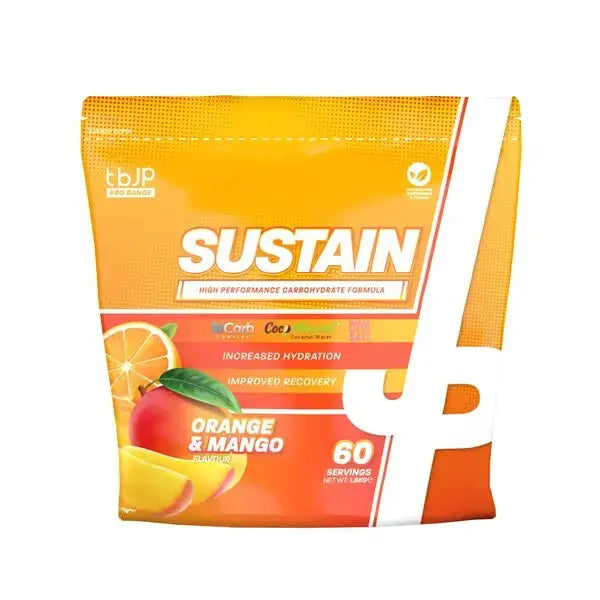
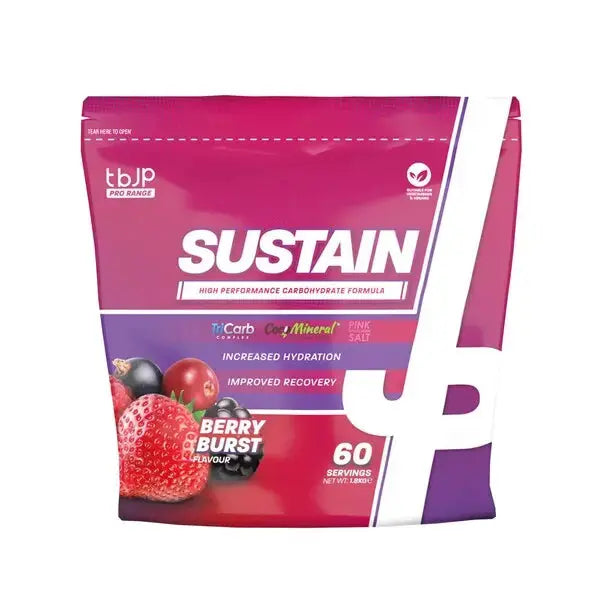
What is TrainedByJP Sustain?
Sustain is a powdered exercise drink, to be sipped during training, supplied in a 1.8 kg tub, or 60 servings of 30 g. The flavours we stock: Orange & Mango and Berry Burst.
What sets it apart is the carbohydrate make-up, which the manufacturer calls the Tri-Carb Complex: 25 g of carbohydrate per serving, split across three sources with different absorption rates — cyclic dextrin, palatinose and fructose. The idea is to spread the intake over time rather than concentrate it on a single pathway.
Added to this are a coconut water powder, glycerol monostearate and Himalayan pink salt. The product contains no stimulants: this is not a pre-workout, it is fuel. The rest of the British range can be found in our TrainedByJP aisle.
What is in a 30 g serving?
| Component | Per 30 g serving | Per 100 g* | Stated role |
|---|---|---|---|
| Energy | around 100 kcal | around 333 kcal | — |
| Tri-Carb Complex, total | 25 g | 83.3 g | Carbohydrate intake |
| of which cyclic dextrin (barley starch) | 10 g | 33.3 g | Fast-absorbing carbohydrate |
| of which palatinose | 10 g | 33.3 g | Slow-absorbing carbohydrate |
| of which fructose | 5 g | 16.7 g | Absorption pathway distinct from glucose |
| CocoMineral, coconut water powder | amount not disclosed | — | Electrolyte intake |
| Glycerol monostearate | amount not disclosed | — | Hydration |
| Himalayan pink salt | amount not disclosed | — | Sodium intake |
| Fat, protein, salt | not declared | not declared | — |
* Column calculated from the 30 g serving declared by the manufacturer. The energy value is given only in kilocalories and only approximately, and the full nutrition table — fat, protein, salt, sugars — is not published. We will not invent it.
The figure that shapes the product is the 25 g of carbohydrate per 30 g of powder. In other words, more than 83% of the sachet is fuel, which leaves little room for anything else — flavouring, citric acid, beetroot colouring, sucralose. That is consistent with an exercise product.
The split is worth pausing on, because it is what you are buying. Cyclic dextrin empties from the stomach quickly and supplies energy without heaviness. Palatinose, or isomaltulose, is a slow-absorbing sugar that spreads the intake out. Fructose, finally, uses a different intestinal transporter from glucose: combining the two makes it possible in practice to absorb more carbohydrate per hour than with a single source. That is the real technical argument behind this formula, and it stands up.
What we cannot assess: the amounts of coconut water, glycerol and pink salt are not published. On an exercise drink, sodium content is nonetheless the second most important piece of information after the carbohydrate — it is what decides whether the product covers your sweat losses. Without that figure, we cannot tell you whether you need to add electrolytes alongside it. The manufacturer suggests as much itself, depending on the heat and how heavily you sweat, which suggests the intake stays modest.
How do you use Sustain?
Serving: 30 g. Liquid: 750 ml of cold water. Timing: during the session, starting 15 to 20 minutes after it begins. Frequency: one bottle per long session. Duration: none, this is an exercise food.
The 750 ml volume is not merely indicative: it is what makes this product a bottle rather than a shake. You sip it in small mouthfuls across the whole session, and it is that way of drinking it that lets you take on 25 g of carbohydrate without digestive discomfort. Downed in one go, the same liquid would cause problems.
The manufacturer gives three specific protocols. Sessions of more than 90 minutes: continuous consumption in small sips. High-intensity training: start 15 to 20 minutes after the session begins. Endurance sports: spread it across the full duration of the effort.
One instruction to respect: take Sustain separately from your EAAs or your protein. The manufacturer says so, and it is justified — a carbohydrate drink and an amino acid drink in the same bottle do not digest as well as you would hope. If you take EAAs during exercise, alternate rather than mix.
The 1.8 kg tub covers 60 servings. At three long sessions a week, that works out at around five months. Store dry, and close it properly.
Who is Sustain for, and who is it not for?
It suits efforts that last, first and foremost: a long bike ride, a run of more than an hour and a half, trail running, a high-volume strength session, a team sport with two training slots. That is where 25 g of carbohydrate during exercise genuinely changes something. The fact that it contains no stimulants also makes it usable in the evening, unlike a pre-workout.
It contains GLUTEN, the barley starch being the source. That is a decisive piece of information and one rarely highlighted in this category: people with coeliac disease must avoid it. The product is also made in a facility that handles milk, soya and eggs.
It is not recommended for children, or for pregnant and breastfeeding women. The manufacturer also urges caution in cases of diabetes or disordered carbohydrate metabolism: that makes sense for a drink delivering 25 g of carbohydrate in one go, and this question is one for your doctor.
It is not for a session of less than an hour. For an ordinary weights session, your glycogen stores are more than enough, and drinking 100 kcal during training simply adds 100 kcal to your day. Nor is it for you if you are in a strict calorie deficit, for the same reason.
What you should not expect from it: any kick. With no caffeine and no stimulants, you will feel nothing immediate — what you should notice is not falling apart in the second hour. This is a product judged on the end of the effort, not on the first ten minutes.
Sustain or cyclic dextrin on its own?
That is the real trade-off, and it turns on price as much as on the formula.
Cyclic dextrin bought on its own costs distinctly less per gram of carbohydrate, and it is the best-established exercise carbohydrate in the category: rapid gastric emptying, very good digestive tolerance, no pronounced sweetness. It is the better choice if you want to control your own dose, if you prefer a single-ingredient product, or if budget matters — you can add your own salt and your own electrolytes for a few pence.
Sustain brings two things a dextrin on its own does not have. The first: fructose, which uses a separate intestinal transporter and allows more carbohydrate to be absorbed per hour over a long effort. The second: palatinose, which spreads the intake and avoids the spike-then-slump. Add the taste, the coconut water and the salt, and you have a ready-made drink, which a plain powder is not.
If your effort lasts less than an hour and a half, the gap between the two will not show, and maltodextrin or waxy maize will do the job for far less. Beyond two hours, the multi-source formula comes into its own.
Frequently asked questions
Why three different carbohydrate sources?
Because they do not use the same pathways. Glucose and fructose travel via separate intestinal transporters, which means combining the two allows more carbohydrate to be absorbed per hour than relying on a single source. Palatinose, being slower, spreads the intake over time. Over a two-hour effort, that split has a real benefit.
Do you really need 750 ml of water?
Yes, and that is what separates an exercise drink from a shake. At 750 ml sipped across the session, the carbohydrate concentration stays low and the stomach copes. In 300 ml downed in one go, the same 25 g becomes uncomfortable during exercise.
Does it contain gluten?
Yes. The barley starch that forms the base of the cyclic dextrin supplies it, and the manufacturer declares it as an allergen. People with coeliac disease must avoid it. This is a point on which this formula differs from most cyclic dextrins in the aisle, which are usually made from maize or tapioca starch.
How many servings are in the tub?
Sixty servings of 30 g for 1.8 kg. At three long sessions a week, that covers around five months. It is a size that only makes sense if you regularly string together efforts of more than an hour and a half.
Can it be mixed with EAAs or with protein?
The manufacturer advises taking them separately. Mixing a carbohydrate drink and an amino acid source in the same bottle slows gastric emptying and increases the risk of discomfort during exercise. If you take both, alternate the mouthfuls rather than the bottles.
Does it contain enough electrolytes for a session in summer?
We cannot say: the amounts of coconut water and pink salt are not published. The manufacturer suggests adding electrolytes itself, depending on weather conditions and how heavily you sweat, which suggests the baseline intake stays modest. On a long effort in real heat, plan for a supplement.
Is it suitable for an hour-long weights session?
Not really. Over an hour of weights, your glycogen stores comfortably cover the effort, and drinking an extra 100 kcal brings nothing beyond 100 kcal. This product comes into its own beyond 90 minutes, or on continuous endurance efforts.
Where can you buy TrainedByJP Sustain?
The flavours can be ordered from this page, and we ship throughout France and Europe. On a 60-serving tub, you had better be sure of the flavour: at 750 ml per session, a taste you tire of quickly becomes a problem.
At the Vendargues shop, about ten minutes from Montpellier, this is a product we discuss by starting with one simple question: how long does your session last? Under an hour and a half, we recommend something else, and often something cheaper. The rest of the exercise carbohydrates can be compared in our sports nutrition aisle.


What is Sinob Core Cluster Dextrine 1 kg?
Sinob Core Cluster Dextrine is a carbohydrate powder to be mixed with liquid, with no flavouring, no sweetener and no colouring. Per 100 g it provides 97.5 g of carbohydrate and 390 kcal; a 50 g serving represents 48.75 g of carbohydrate for 195 kcal. The one-kilogram tub covers 20 servings.
The raw material is a highly branched cyclic dextrin, sold under the name Cluster Dextrin®. It is obtained by an enzymatic cyclisation reaction applied to maize starch, a process that preserves the branched structure of amylopectin while producing very large molecules.
The figure that really sets this product apart from an ordinary maltodextrin is its molecular weight: around 400,000 g/mol, against 400 to 2,000 g/mol for a standard maltodextrin. That sounds abstract, but the consequence is very concrete and we come back to it below. The rest of the German range can be browsed in our Sinob aisle, and the other products in the category in our cyclic dextrin aisle.
What is in a serving of Cluster Dextrine?
| Nutritional values | Per 100 g | Per 50 g serving |
|---|---|---|
| Energy | 390 kcal | 195 kcal |
| Carbohydrate | 97.5 g | 48.75 g |
| Protein | less than 0.1 g | less than 0.05 g |
| Fat | less than 0.1 g | less than 0.05 g |
| Fibre | less than 0.1 g | less than 0.05 g |
| Salt | less than 0.01 g | less than 0.005 g |
| Pack size | 1 kg, that is 20 servings of 50 g | |
Let us come back to the molecular weight, because it is the central argument for this product and it is rarely explained well. A very large molecule takes up little “osmotic space” in the stomach: the osmotic pressure of this powder is stated at between 59 and 160 mOsm, which is very low. In practice, that means a concentrated drink leaves the stomach without drawing water into it or causing the bloated feeling that very sweet drinks produce. That is the real benefit of this raw material, and it is a digestive one.
The trade-off is the price: cyclic dextrin is markedly more expensive per kilo than a maltodextrin or a waxy maize. You are paying for digestive comfort, not for extra fuel. A gram of carbohydrate is still a gram of carbohydrate, wherever it comes from.
The powder is neutral in taste and dissolves completely, cold or warm, in fifteen to twenty seconds. That is a real advantage on long efforts, where a drink that is too sweet ends up becoming sickly and stops being drunk — and a drink you do not drink is of no use at all.
Worth knowing: this powder provides no sodium, the salt line being under 0.01 g per 100 g. It is therefore not a complete sports drink. On a long ride or in hot weather, plan for separate electrolytes.
Missing from the manufacturer's file: the “of which sugars” line, although mandatory in a nutrition table, is not disclosed. We will not estimate it; it appears on the packaging you receive.
Ingredient list
Maltodextrin (100%), from the patented Cluster Dextrin® raw material — a highly branched cyclic dextrin obtained by enzymatic processing of maize starch.
No allergen declared in the formulation. Naturally gluten free. Suitable for vegetarian and vegan diets. The manufacturer does not specify any possible traces from the production facility.
How do you take Cluster Dextrine?
Serving: 50 g, that is about four tablespoons. Liquid: 300 ml of cold or lukewarm water. Timing: 30 to 60 minutes before exercise, during efforts lasting more than 90 minutes, or immediately after the session. Frequency: according to your sessions, with no daily intake required. Duration: no course to complete, this is a product for occasional use.
Shake vigorously for fifteen to twenty seconds: the solution becomes perfectly clear, with no sediment at the bottom of the shaker. That is a good indicator of complete dissolution, and one of the rare cases where you can see with the naked eye that the product has mixed.
We have to be straight about one point in the manufacturer's protocol. For endurance sports, it mentions 100 to 150 g of carbohydrate per hour of exercise. That is a lot, and we will not endorse it. Beyond roughly 60 g per hour from a single carbohydrate source, the body no longer oxidises the surplus and the excess stays in the digestive tract: that is the recipe for gastric trouble in a race. The protocols that go higher combine several sugars using different transporters, which is not the case here. Stay in the 40 to 60 g per hour range and you will already be well served.
For a weight training session, 50 g before or after is more than enough. For an effort of more than 90 minutes, the manufacturer suggests 15 to 30 g every 45 minutes, which is sensible. In recovery, the classic carbohydrate plus protein combination applies here as elsewhere: one serving with a scoop of protein, within the hour after the session.
Since the powder is neutral, it mixes without difficulty with EAAs, with a flavoured drink or with a pre-workout.
Who is Cluster Dextrine for, and who is it not for?
It is aimed first at endurance athletes and at those who have already run into digestive problems with a carbohydrate drink. That is exactly the profile this raw material was developed for, and it is the only case in which the extra cost is clearly justified.
It is not suitable if your goal is weight loss. One serving represents 195 kcal, the equivalent of a generous slice of bread with a little butter, in liquid form and with no satiating effect. In a period of deficit, that is exactly the sort of thing you should avoid adding out of habit.
Nor is it of much interest in an hour-long weight training session for someone who eats normally: your glycogen stores comfortably cover that effort. People with diabetes or with a blood sugar regulation disorder should seek their doctor's advice before using a carbohydrate powder.
What not to expect from it. This is not a performance product with an immediate effect: you will not be stronger after drinking it. Nor is it a complete isotonic drink, for want of sodium. And the digestive comfort it delivers, real though it is, does not replace sensible dosing: drinking 120 g of any carbohydrate in an hour of racing will end badly, whatever the molecule.
Cluster dextrin or maltodextrin?
This is the comparison that decides the purchase, and it comes down to a question of budget against comfort.
Conventional maltodextrin does the same job in energy terms: it is a glucose polymer, with a high glycaemic index, that reloads glycogen just as effectively. It costs two to three times less per kilo. If you use it in recovery, after the session, at home, with no particular digestive constraint, there is no objective reason to pay more: our maltodextrin aisle is the rational choice.
Cyclic dextrin makes sense when digestion is the limiting factor: during exercise, at high concentration, on long rides, or simply when your stomach has already let you down once in a race. There, the difference in molecular weight and osmotic pressure translates into something you can feel, and the extra cost becomes an investment rather than an expense.
That leaves a third route, in between on price as on comfort: waxy maize, a waxy maize amylopectin. To sum up plainly: maltodextrin for recovery at home, waxy maize for a good compromise, cluster dextrin if you drink during exercise and your stomach is difficult. If your goal is extra calories, our mass gainer aisle offers formulas that are already complete.
Frequently asked questions
How much carbohydrate is in a serving?
48.75 g of carbohydrate for 195 kcal, in a 50 g serving. The powder contains 97.5 g of carbohydrate per 100 g, which makes it an almost pure source: less than 0.1 g of protein, of fat and of fibre, and practically no salt.
What does the high molecular weight bring?
Around 400,000 g/mol against 400 to 2,000 for a standard maltodextrin, with a very low osmotic pressure stated at between 59 and 160 mOsm. In practice: a concentrated drink that leaves the stomach without causing the heaviness of sugary drinks. That is a digestive benefit, not an energy one.
How much carbohydrate per hour on a long effort?
The manufacturer mentions 100 to 150 g per hour in endurance. We do not endorse that figure: beyond roughly 60 g per hour from a single source, the excess is no longer oxidised and stays in the digestive tract. Keep to between 40 and 60 g per hour.
Should you add electrolytes?
Yes, as soon as the effort lasts and you are sweating. The salt line in the table is under 0.01 g per 100 g: this powder provides fuel, not minerals. Add an electrolyte product or a pinch of salt to the bottle.
Does it really dissolve without lumps?
Yes, cold or warm, in fifteen to twenty seconds of shaking. The solution turns clear, which is a useful visual marker. It is one of the points most consistently praised about this raw material, and you can check it from the very first shaker.
How many servings are in the one-kilo tub?
20 servings of 50 g. If you use it only during long efforts, at a rate of two rides a week, one tub therefore covers about two months. In weight training with one serving before and one after the session, it goes much faster.
Is this powder suitable for vegans?
Yes. It comes from maize starch processed enzymatically, with no raw material of animal origin, and the manufacturer states that it is suitable for vegetarian and vegan diets. It is also naturally gluten free.
Where can you buy Sinob Core Cluster Dextrine?
The one-kilogram tub can be ordered from this page, and we ship throughout France and Europe. At the Vendargues shop, about ten minutes from Montpellier, this is the product we keep for cyclists and trail runners: for a simple top-up after a weight training session, we steer people towards a maltodextrin, which does the same job for far less. The rest of the aisle can be browsed in our sports nutrition selection.


Qu'est-ce que le Karbolyn Fuel ?
Une source de glucides d'effort. Une dose apporte 50 g de glucides pour 200 kcal, et le sac de 1,95 kg donne 35 à 39 doses selon le goût.
Le Karbolyn n'est ni du sucre, ni de la maltodextrine, ni de la dextrine cyclique. L'étiquette le décrit comme un homopolysaccharide dérivé de la pomme de terre, du riz et du maïs. C'est un glucide propriétaire à la marque, qui le fabrique dans sa propre usine.
Certifié Informed-Sport — et ça compte
C'est la raison principale pour laquelle cette référence est chez nous. EFX Sports annonce le Karbolyn comme « 100 % exempt de substances interdites, certifié par Informed-Sport ».
Informed-Sport n'est pas un logo auto-décerné : c'est un programme de contrôle lot par lot par un laboratoire indépendant, avec une base de résultats consultable publiquement. Si vous êtes soumis au contrôle antidopage — fédération, compétition, sélection — c'est le seul niveau de garantie qui vaille quelque chose, et il est rare dans ce rayon.
Le goût nature est remarquable
Son étiquette porte la mention « Other Ingredients: None » — aucun autre ingrédient. C'est du Karbolyn à 100 %, sans arôme, sans édulcorant, sans acidifiant, sans colorant.
Les six autres goûts n'ajoutent que trois choses : de l'acide citrique, des arômes et du sucralose. La marque annonce par ailleurs le produit sans sucre, sans gluten, sans stimulant et compatible avec un régime végétalien.
À quoi ça sert concrètement
À faire entrer des glucides utilisables autour de l'effort, sans volume alimentaire et sans travail de digestion. Trois usages, tirés du mode d'emploi de l'étiquette :
- Avant la séance — une dose 30 minutes avant, pour partir avec du carburant disponible
- Pendant la séance — une dose sirotée, sur les séances longues ou les compétitions
- Après la séance — une dose, pour reconstituer les réserves
C'est aussi un outil de prise de masse pour les gabarits qui saturent avant d'atteindre leurs calories : 50 g de glucides dans un shaker d'eau passent là où une assiette de riz ne passe plus.
Parlons du prix
Autant être direct : c'est cher pour des glucides. Le sac revient à environ 36 € le kilo, là où une maltodextrine se trouve pour une fraction de ce prix. Notre rayon maltodextrine et notre rayon dextrine cyclique permettent de comparer.
Ce que vous payez ici, ce n'est pas la calorie : c'est le glucide propriétaire, la fabrication en interne, et surtout la certification Informed-Sport. Si vous n'êtes pas contrôlé et que vous cherchez des glucides au meilleur prix, prenez de la maltodextrine et gardez la différence. Si vous êtes contrôlé, cette certification est précisément ce qui n'a pas de substitut.
La seule marque de notre catalogue certifiée Informed-Sport sur cette gamme
Karbolyn est annoncé par EFX Sports comme « 100 % exempt de substances interdites, certifié par Informed-Sport ». C'est une information qui change la nature de la réponse qu'on peut vous faire si vous êtes soumis au contrôle antidopage.
Informed-Sport n'est pas un label déclaratif : c'est un programme de test lot par lot par un laboratoire tiers, dont les résultats sont consultables publiquement. Jusqu'ici, à la question « est-ce que je peux en prendre si je suis contrôlé ? », notre réponse honnête était « rien ne permet de l'affirmer ». Sur cette gamme, elle change.
EFX Sports fabrique par ailleurs ses produits dans sa propre usine, ce qui est l'exception et non la règle dans ce rayon.
Comment le préparer ?
Une dose dans un shaker avec environ 475 ml d'eau (16 oz), 30 minutes avant l'effort. La dose varie légèrement selon le goût — de 50 g pour la version nature à 54,7 g pour la Fraise — parce que l'arôme s'ajoute aux 50 g de Karbolyn. La quantité de glucides, elle, reste de 50 g dans tous les cas.
Questions fréquentes
Qu'est-ce que le Karbolyn ?
Un glucide propriétaire d'EFX Sports, décrit sur l'étiquette comme un homopolysaccharide dérivé de pomme de terre, de riz et de maïs. Ce n'est ni du sucre, ni de la maltodextrine, ni de la dextrine cyclique.
Combien de glucides par dose ?
50 g de glucides pour 200 kcal, sur tous les goûts sauf le Citron glacé qui monte à 53 g et 210 kcal.
Le produit est-il certifié antidopage ?
Oui : EFX Sports l'annonce certifié Informed-Sport, un programme de contrôle lot par lot par un laboratoire indépendant avec base de résultats publique. C'est la seule référence de notre catalogue EFX à porter cette mention.
Quand le prendre ?
L'étiquette prévoit une dose 30 minutes avant l'effort. Sur une séance longue ou une compétition : une dose avant, une sirotée pendant, une après.
Y a-t-il du sucre ?
Non, la marque l'annonce sans sucre. Les versions aromatisées sont édulcorées au sucralose ; la version nature ne contient aucun édulcorant.
Convient-il à un régime végétalien ?
La marque annonce le produit compatible avec un régime végétalien, et sans gluten.
Pourquoi est-ce plus cher qu'une maltodextrine ?
Parce que vous payez le glucide propriétaire, la fabrication en interne et la certification Informed-Sport, pas la calorie. Si vous n'êtes pas soumis au contrôle antidopage, une maltodextrine fait le même travail calorique pour beaucoup moins cher.
Combien de doses par sac ?
35 à 39 selon le goût, la dose variant de 50 à 54,7 g à cause de l'arôme.
Où acheter le Karbolyn Fuel ?
Vous pouvez le commander sur cette page, et nous expédions partout en France et en Europe. Toute la gamme est réunie sur notre page EFX Sports, et notre rayon Glucides permet de comparer les étiquettes.
Ces références sont également présentées en rayon dans notre boutique de Vendargues, à une dizaine de minutes de Montpellier.
Les compléments alimentaires s'intègrent dans une alimentation variée et équilibrée et un mode de vie sain. Ces informations ne remplacent pas un avis médical.
Les glucides en musculation : à quoi servent-ils ?
Parler de glucides en musculation, c'est parler de deux choses distinctes. Il y a les glucides des repas — riz, pâtes, pain, crème de riz — qui remplissent les réserves de glycogène et constituent l'essentiel de l'apport de la journée. Et il y a les glucides d'effort, pris en poudre diluée autour de la séance ou pendant, quand il faut de l'énergie disponible vite et sans alourdir l'estomac. C'est ce second usage que couvre ce rayon.
Sur le plan énergétique, toutes ces poudres apportent la même chose : environ 4 kcal par gramme, sans protéines ni lipides. Ce qui les différencie n'est pas leur valeur calorique mais leur comportement dans l'estomac et dans l'intestin — et, accessoirement, leur prix au kilo, qui varie du simple au multiple selon la famille.
Maltodextrine, waxy maize, dextrine cyclique, Karbolyn : les quatre familles
Les quatre viennent d'un amidon. Ce qui change, c'est la façon dont cet amidon a été transformé.
- Maltodextrine — l'amidon est découpé en fragments courts. Résultat : beaucoup de petites molécules, une osmolalité élevée, une poudre très peu sucrée, bon marché et polyvalente. C'est la référence pour qui veut simplement ajouter des glucides, en intra-training modéré ou dans un shaker de prise de masse. Au-delà de 8 g pour 100 ml, elle devient généralement inconfortable à boire en bougeant.
- Waxy maize — de l'amidon de maïs cireux peu transformé, donc des molécules plus longues que la maltodextrine. Osmolalité plus basse, texture un peu plus épaisse. Un intermédiaire utile, souvent le meilleur rapport entre confort digestif et prix.
- Dextrine cyclique — une enzyme de branchement réorganise l'amidon en très grosses molécules refermées sur elles-mêmes, de taille homogène. Peu de particules en solution, donc l'osmolalité la plus basse de la catégorie, une vidange gastrique rapide et la possibilité de concentrer davantage le bidon. C'est le choix du confort digestif sur les efforts longs, et le plus cher au kilo.
- Karbolyn — un glucide propriétaire de la marque EFX Sports, décrit sur son étiquette comme un homopolysaccharide dérivé de pomme de terre, de riz et de maïs. Il se situe donc du côté des glucides à longue chaîne, dans la même logique que la dextrine cyclique : peu de particules, boisson facile à boire. Sa particularité est sa composition en trois amidons, propre à la marque.
Deux précisions de vocabulaire. « Cluster dextrin » est un nom commercial déposé désignant une dextrine cyclique produite par un fabricant spécialisé : le principe est celui décrit ci-dessus, et l'étiquette reste la ligne à lire. Et l'expression « glucide rapide », en musculation, ne veut pas dire grand-chose ici : ces quatre poudres sont toutes assimilées rapidement, et ce qui les sépare est la vitesse à laquelle elles quittent l'estomac, pas leur index glycémique.
L'osmolalité : le critère qui départage ces familles
L'osmolalité d'une boisson dépend du nombre de particules dissoutes, pas de leur taille. Une même quantité de glucides découpée en petites molécules donne beaucoup de particules et une osmolalité élevée ; assemblée en très grosses molécules, elle en donne peu, et l'osmolalité reste basse.
Cela a trois conséquences concrètes :
- La vidange gastrique. Une boisson hypertonique séjourne plus longtemps dans l'estomac ; une boisson proche de l'isotonie le quitte plus vite, et les glucides deviennent disponibles plus tôt.
- L'appel d'eau dans l'intestin. C'est lui qui provoque ballonnements, crampes abdominales et transit accéléré sur une boisson trop concentrée.
- La concentration possible. À confort égal, une dextrine cyclique ou un glucide à longue chaîne se boit plus concentré qu'une maltodextrine — utile quand il faut faire passer beaucoup de glucides dans peu de liquide.
C'est aussi ce paramètre qui définit une boisson isotonique : une concentration de 4 à 8 % de glucides, soit 40 à 80 g par litre, qui place la boisson à l'osmolalité du plasma. À énergie égale, dextrine cyclique et maltodextrine apportent exactement la même chose : l'écart porte sur le confort, pas sur les calories.
Combien de glucides par heure, et dans quel volume ?
- Quantité : les repères de la nutrition d'endurance situent l'apport utile entre 30 et 60 g de glucides par heure d'effort. Commencez par 30 g et montez progressivement : la tolérance digestive s'éduque sur plusieurs semaines.
- Dilution : ces 30 à 60 g dans 500 à 750 ml d'eau, à siroter régulièrement plutôt qu'en une fois.
- Au-delà de 60 g par heure : l'apport passe par l'association de plusieurs types de sucres aux voies d'absorption distinctes, ce qui relève d'une stratégie de compétition à construire avec un professionnel.
- Hors effort : pour un simple apport calorique, une poudre de glucides se mélange au shaker de prise de masse ou s'ajoute à une crème de riz. Il n'y a là ni dose horaire ni dilution à respecter, juste un total calorique à tenir.
- Sur l'effort long : ajoutez du sodium. Une poudre de glucides seule n'en contient pas, et c'est ce qui sépare une boisson isotonique complète d'un simple bidon sucré.
Comme toute stratégie de boisson d'effort, celle-ci se teste à l'entraînement, jamais le jour d'une course.
Ce que coûte vraiment le confort digestif
Autant le dire franchement : l'écart de prix entre une maltodextrine et un glucide de spécialité est important. À quantité de glucides égale, la maltodextrine est de loin la moins chère du rayon ; une dextrine cyclique ou un glucide propriétaire coûte plusieurs fois plus cher au kilo, pour le même nombre de calories. Le waxy maize se place entre les deux.
Ce surcoût achète une chose, et une seule : du confort digestif à concentration élevée. Il se justifie si vous roulez trois heures, si vous courez un trail, si vous enchaînez deux séances dans la journée, ou si la maltodextrine vous pèse sur l'estomac en fin d'effort. Dans ces cas-là, c'est ce qui vous permet de tenir votre plan de ravitaillement jusqu'au bout, et l'argent est bien dépensé.
Il ne se justifie pas si vous faites de la musculation trois à cinq fois par semaine, une heure par séance : l'eau suffit généralement pendant la séance et vos glucides ont leur place dans les repas. Il ne se justifie pas davantage si votre objectif est d'ajouter des calories : dans ce cas, maltodextrine, crème de riz ou farine d'avoine font le même travail pour beaucoup moins cher. Le test est simple : si votre boisson de maltodextrine à 6-8 % passe sans problème, gardez-la.
Questions fréquentes
Quels glucides prendre en musculation ?
Pour une séance d'une heure, aucun n'est nécessaire : l'eau suffit et les glucides se prennent dans les repas. Pour un effort long ou une double séance, une poudre diluée dans le bidon prend tout son sens, et la maltodextrine couvre déjà l'essentiel du besoin. La dextrine cyclique et les glucides à longue chaîne deviennent intéressants quand la digestion devient votre facteur limitant.
Maltodextrine ou dextrine cyclique ?
Les deux apportent la même énergie au gramme, environ 4 kcal. La dextrine cyclique devient le meilleur choix dès que la digestion est votre facteur limitant sur des efforts de plus de 90 minutes, ou quand il faut faire passer beaucoup de glucides dans peu de liquide. La maltodextrine reste le choix du bon sens pour tout le reste, et coûte nettement moins cher.
Qu'est-ce que le waxy maize ?
De l'amidon de maïs cireux peu transformé. Ses molécules sont plus longues que celles d'une maltodextrine, ce qui lui donne une osmolalité plus basse et une texture légèrement plus épaisse. C'est l'intermédiaire du rayon : plus confortable qu'une maltodextrine, moins cher qu'une dextrine cyclique.
Qu'est-ce que le Karbolyn ?
Un glucide propriétaire de la marque EFX Sports. Son étiquette le décrit comme un homopolysaccharide dérivé de pomme de terre, de riz et de maïs. Il appartient donc à la famille des glucides à longue chaîne, dans la même logique que la dextrine cyclique : peu de particules en solution, boisson facile à boire pendant l'effort. Les quantités exactes par dose figurent sur la fiche de chaque produit.
Cluster dextrin et dextrine cyclique, est-ce la même chose ?
Le principe est le même. « Cluster Dextrin » est un nom commercial déposé correspondant à une dextrine cyclique produite par un fabricant spécialisé ; d'autres dextrines cycliques existent sous d'autres appellations. L'étiquette précise l'ingrédient exact, et c'est la ligne à lire.
Combien de glucides par heure d'effort ?
Entre 30 et 60 g par heure, la fourchette de référence en nutrition d'endurance. Commencez par 30 g et montez progressivement. Au-delà de 60 g par heure, l'apport passe par l'association de plusieurs types de sucres, ce qui relève d'une stratégie de compétition à construire avec un professionnel.
Dans quel volume d'eau faut-il diluer ?
30 à 60 g dans 500 à 750 ml pour une boisson d'effort, ce qui place la concentration dans la plage isotonique de 4 à 8 %. Si vous buvez la préparation en une fois après la séance, la dilution importe beaucoup moins.
Qu'appelle-t-on un glucide rapide en musculation ?
L'expression désigne un glucide assimilé vite, par opposition à un féculent pris au repas. Les quatre familles de ce rayon entrent toutes dans cette catégorie : ce qui les sépare n'est pas leur vitesse d'assimilation mais la vitesse à laquelle elles quittent l'estomac, c'est-à-dire leur osmolalité.
Faut-il des glucides pendant une séance d'une heure ?
Généralement non. Sur une heure de musculation, les réserves de glycogène couvrent l'effort et l'eau suffit. C'est à partir des formats longs, au-delà d'environ 90 minutes, que la boisson glucidique change quelque chose.
Les glucides en poudre font-ils grossir ?
Comme tout glucide, ils ne font prendre du poids que s'ils créent un excédent calorique sur la journée. Consommés pendant un effort long, ils sont utilisés pour cet effort. Intégrés à un shaker de prise de masse, l'excédent est précisément l'objectif recherché.
Peut-on les mélanger à de la whey ?
Dans un shaker après la séance, oui, et l'association a tout son sens. Pendant l'effort, mieux vaut s'en tenir aux glucides et éventuellement aux acides aminés essentiels : une protéine complète ralentit la vidange gastrique.
Poudre de glucides ou riz et pain ?
Pour les repas, riz, pâtes, pain et fruits font le travail, coûtent moins cher et rassasient. La poudre n'a d'avantage que dans deux cas : pendant l'effort, où un aliment solide ne passe pas, et quand il faut faire monter un total calorique que l'alimentation solide ne suffit plus à tenir.
Ces poudres contiennent-elles du gluten ?
Cela dépend de l'amidon de départ. Les poudres issues de maïs, de pomme de terre ou de riz n'en contiennent pas ; certaines dextrines cycliques sont fabriquées à partir d'amidon d'orge et en apportent. L'étiquette et l'onglet des allergènes de chaque fiche produit donnent la réponse.
Sont-elles adaptées aux personnes diabétiques ?
Ce sont des glucides à assimilation rapide. Toute utilisation doit être validée par le médecin qui suit le traitement, et certains fabricants déconseillent expressément leur produit dans ce cas : la fiche de chaque référence le précise.
Où acheter des glucides pour la musculation ?
En magasin spécialisé en nutrition sportive et en ligne. Le point à vérifier est toujours le même : que l'ingrédient soit nommé clairement sur l'étiquette — maltodextrine, amidon de maïs cireux, dextrine cyclique hautement ramifiée — et que la quantité de glucides par dose soit chiffrée. Nos références sont expédiées partout en France et en Europe, et disponibles en rayon à Vendargues, à une dizaine de minutes de Montpellier, avec retrait sous deux heures.
Que trouve-t-on en rayon ?
Ce rayon rassemble les quatre familles pour les comparer au même endroit, avec les gammes IO Genix, Sinob, TrainedByJP, Olimp et EFX Sports : poudres à un seul ingrédient à doser vous-même, et formules multi-sources déjà prêtes. Les sous-rayons détaillent chaque famille — maltodextrine, waxy maize, dextrine cyclique — et les poudres qui associent glucides et électrolytes dans la même dose se trouvent dans boisson isotonique. Pour les glucides du quotidien, voyez crème de riz et prise de masse.
Un conseil sur mesure à Vendargues, près de Montpellier
Choisir un glucide d'effort tient à deux questions : combien de temps durent vos séances, et comment votre estomac se comporte à la fin. Posez-les-nous dans notre boutique de Vendargues, à une dizaine de minutes de Montpellier : nous vous dirons aussi quand une maltodextrine suffit, ce qui est le cas le plus fréquent. La page magasin de nutrition sportive autour de moi indique les horaires et le temps de route depuis chez vous. Nous expédions également partout en France et en Europe.
Le fonctionnement d'une dextrine cyclique hautement ramifiée, ses dosages et ses usages sont détaillés dans notre article sur la Cluster Dextrin à l'effort.
Sources
- ANSES — Avis relatif à l'actualisation des apports nutritionnels conseillés pour les glucides
- ANSES — Table Ciqual de composition nutritionnelle des aliments
À intégrer dans une alimentation variée et équilibrée et un mode de vie sain.
Retrait au magasin sous 2 h
À Vendargues, près de Montpellier. Vous êtes prévenu dès que la commande est prête.
Commandé avant 14 h, expédié le jour même
Du lundi au samedi. Le délai d'acheminement appartient ensuite au transporteur.
Livraison offerte dès 50 €
En France métropolitaine, et dès 100 € en Europe. Modes et délais.
Une question avant de commander ?
Écrivez-nous ou passez au magasin : on connaît les produits qu'on vend.
Les glucides en musculation : à quoi servent-ils ?
Parler de glucides en musculation, c'est parler de deux choses distinctes. Il y a les glucides des repas — riz, pâtes, pain, crème de riz — qui remplissent les réserves de glycogène et constituent l'essentiel de l'apport de la journée. Et il y a les glucides d'effort, pris en poudre diluée autour de la séance ou pendant, quand il faut de l'énergie disponible vite et sans alourdir l'estomac. C'est ce second usage que couvre ce rayon.
Sur le plan énergétique, toutes ces poudres apportent la même chose : environ 4 kcal par gramme, sans protéines ni lipides. Ce qui les différencie n'est pas leur valeur calorique mais leur comportement dans l'estomac et dans l'intestin — et, accessoirement, leur prix au kilo, qui varie du simple au multiple selon la famille.
Maltodextrine, waxy maize, dextrine cyclique, Karbolyn : les quatre familles
Les quatre viennent d'un amidon. Ce qui change, c'est la façon dont cet amidon a été transformé.
- Maltodextrine — l'amidon est découpé en fragments courts. Résultat : beaucoup de petites molécules, une osmolalité élevée, une poudre très peu sucrée, bon marché et polyvalente. C'est la référence pour qui veut simplement ajouter des glucides, en intra-training modéré ou dans un shaker de prise de masse. Au-delà de 8 g pour 100 ml, elle devient généralement inconfortable à boire en bougeant.
- Waxy maize — de l'amidon de maïs cireux peu transformé, donc des molécules plus longues que la maltodextrine. Osmolalité plus basse, texture un peu plus épaisse. Un intermédiaire utile, souvent le meilleur rapport entre confort digestif et prix.
- Dextrine cyclique — une enzyme de branchement réorganise l'amidon en très grosses molécules refermées sur elles-mêmes, de taille homogène. Peu de particules en solution, donc l'osmolalité la plus basse de la catégorie, une vidange gastrique rapide et la possibilité de concentrer davantage le bidon. C'est le choix du confort digestif sur les efforts longs, et le plus cher au kilo.
- Karbolyn — un glucide propriétaire de la marque EFX Sports, décrit sur son étiquette comme un homopolysaccharide dérivé de pomme de terre, de riz et de maïs. Il se situe donc du côté des glucides à longue chaîne, dans la même logique que la dextrine cyclique : peu de particules, boisson facile à boire. Sa particularité est sa composition en trois amidons, propre à la marque.
Deux précisions de vocabulaire. « Cluster dextrin » est un nom commercial déposé désignant une dextrine cyclique produite par un fabricant spécialisé : le principe est celui décrit ci-dessus, et l'étiquette reste la ligne à lire. Et l'expression « glucide rapide », en musculation, ne veut pas dire grand-chose ici : ces quatre poudres sont toutes assimilées rapidement, et ce qui les sépare est la vitesse à laquelle elles quittent l'estomac, pas leur index glycémique.
L'osmolalité : le critère qui départage ces familles
L'osmolalité d'une boisson dépend du nombre de particules dissoutes, pas de leur taille. Une même quantité de glucides découpée en petites molécules donne beaucoup de particules et une osmolalité élevée ; assemblée en très grosses molécules, elle en donne peu, et l'osmolalité reste basse.
Cela a trois conséquences concrètes :
- La vidange gastrique. Une boisson hypertonique séjourne plus longtemps dans l'estomac ; une boisson proche de l'isotonie le quitte plus vite, et les glucides deviennent disponibles plus tôt.
- L'appel d'eau dans l'intestin. C'est lui qui provoque ballonnements, crampes abdominales et transit accéléré sur une boisson trop concentrée.
- La concentration possible. À confort égal, une dextrine cyclique ou un glucide à longue chaîne se boit plus concentré qu'une maltodextrine — utile quand il faut faire passer beaucoup de glucides dans peu de liquide.
C'est aussi ce paramètre qui définit une boisson isotonique : une concentration de 4 à 8 % de glucides, soit 40 à 80 g par litre, qui place la boisson à l'osmolalité du plasma. À énergie égale, dextrine cyclique et maltodextrine apportent exactement la même chose : l'écart porte sur le confort, pas sur les calories.
Combien de glucides par heure, et dans quel volume ?
- Quantité : les repères de la nutrition d'endurance situent l'apport utile entre 30 et 60 g de glucides par heure d'effort. Commencez par 30 g et montez progressivement : la tolérance digestive s'éduque sur plusieurs semaines.
- Dilution : ces 30 à 60 g dans 500 à 750 ml d'eau, à siroter régulièrement plutôt qu'en une fois.
- Au-delà de 60 g par heure : l'apport passe par l'association de plusieurs types de sucres aux voies d'absorption distinctes, ce qui relève d'une stratégie de compétition à construire avec un professionnel.
- Hors effort : pour un simple apport calorique, une poudre de glucides se mélange au shaker de prise de masse ou s'ajoute à une crème de riz. Il n'y a là ni dose horaire ni dilution à respecter, juste un total calorique à tenir.
- Sur l'effort long : ajoutez du sodium. Une poudre de glucides seule n'en contient pas, et c'est ce qui sépare une boisson isotonique complète d'un simple bidon sucré.
Comme toute stratégie de boisson d'effort, celle-ci se teste à l'entraînement, jamais le jour d'une course.
Ce que coûte vraiment le confort digestif
Autant le dire franchement : l'écart de prix entre une maltodextrine et un glucide de spécialité est important. À quantité de glucides égale, la maltodextrine est de loin la moins chère du rayon ; une dextrine cyclique ou un glucide propriétaire coûte plusieurs fois plus cher au kilo, pour le même nombre de calories. Le waxy maize se place entre les deux.
Ce surcoût achète une chose, et une seule : du confort digestif à concentration élevée. Il se justifie si vous roulez trois heures, si vous courez un trail, si vous enchaînez deux séances dans la journée, ou si la maltodextrine vous pèse sur l'estomac en fin d'effort. Dans ces cas-là, c'est ce qui vous permet de tenir votre plan de ravitaillement jusqu'au bout, et l'argent est bien dépensé.
Il ne se justifie pas si vous faites de la musculation trois à cinq fois par semaine, une heure par séance : l'eau suffit généralement pendant la séance et vos glucides ont leur place dans les repas. Il ne se justifie pas davantage si votre objectif est d'ajouter des calories : dans ce cas, maltodextrine, crème de riz ou farine d'avoine font le même travail pour beaucoup moins cher. Le test est simple : si votre boisson de maltodextrine à 6-8 % passe sans problème, gardez-la.
Questions fréquentes
Quels glucides prendre en musculation ?
Pour une séance d'une heure, aucun n'est nécessaire : l'eau suffit et les glucides se prennent dans les repas. Pour un effort long ou une double séance, une poudre diluée dans le bidon prend tout son sens, et la maltodextrine couvre déjà l'essentiel du besoin. La dextrine cyclique et les glucides à longue chaîne deviennent intéressants quand la digestion devient votre facteur limitant.
Maltodextrine ou dextrine cyclique ?
Les deux apportent la même énergie au gramme, environ 4 kcal. La dextrine cyclique devient le meilleur choix dès que la digestion est votre facteur limitant sur des efforts de plus de 90 minutes, ou quand il faut faire passer beaucoup de glucides dans peu de liquide. La maltodextrine reste le choix du bon sens pour tout le reste, et coûte nettement moins cher.
Qu'est-ce que le waxy maize ?
De l'amidon de maïs cireux peu transformé. Ses molécules sont plus longues que celles d'une maltodextrine, ce qui lui donne une osmolalité plus basse et une texture légèrement plus épaisse. C'est l'intermédiaire du rayon : plus confortable qu'une maltodextrine, moins cher qu'une dextrine cyclique.
Qu'est-ce que le Karbolyn ?
Un glucide propriétaire de la marque EFX Sports. Son étiquette le décrit comme un homopolysaccharide dérivé de pomme de terre, de riz et de maïs. Il appartient donc à la famille des glucides à longue chaîne, dans la même logique que la dextrine cyclique : peu de particules en solution, boisson facile à boire pendant l'effort. Les quantités exactes par dose figurent sur la fiche de chaque produit.
Cluster dextrin et dextrine cyclique, est-ce la même chose ?
Le principe est le même. « Cluster Dextrin » est un nom commercial déposé correspondant à une dextrine cyclique produite par un fabricant spécialisé ; d'autres dextrines cycliques existent sous d'autres appellations. L'étiquette précise l'ingrédient exact, et c'est la ligne à lire.
Combien de glucides par heure d'effort ?
Entre 30 et 60 g par heure, la fourchette de référence en nutrition d'endurance. Commencez par 30 g et montez progressivement. Au-delà de 60 g par heure, l'apport passe par l'association de plusieurs types de sucres, ce qui relève d'une stratégie de compétition à construire avec un professionnel.
Dans quel volume d'eau faut-il diluer ?
30 à 60 g dans 500 à 750 ml pour une boisson d'effort, ce qui place la concentration dans la plage isotonique de 4 à 8 %. Si vous buvez la préparation en une fois après la séance, la dilution importe beaucoup moins.
Qu'appelle-t-on un glucide rapide en musculation ?
L'expression désigne un glucide assimilé vite, par opposition à un féculent pris au repas. Les quatre familles de ce rayon entrent toutes dans cette catégorie : ce qui les sépare n'est pas leur vitesse d'assimilation mais la vitesse à laquelle elles quittent l'estomac, c'est-à-dire leur osmolalité.
Faut-il des glucides pendant une séance d'une heure ?
Généralement non. Sur une heure de musculation, les réserves de glycogène couvrent l'effort et l'eau suffit. C'est à partir des formats longs, au-delà d'environ 90 minutes, que la boisson glucidique change quelque chose.
Les glucides en poudre font-ils grossir ?
Comme tout glucide, ils ne font prendre du poids que s'ils créent un excédent calorique sur la journée. Consommés pendant un effort long, ils sont utilisés pour cet effort. Intégrés à un shaker de prise de masse, l'excédent est précisément l'objectif recherché.
Peut-on les mélanger à de la whey ?
Dans un shaker après la séance, oui, et l'association a tout son sens. Pendant l'effort, mieux vaut s'en tenir aux glucides et éventuellement aux acides aminés essentiels : une protéine complète ralentit la vidange gastrique.
Poudre de glucides ou riz et pain ?
Pour les repas, riz, pâtes, pain et fruits font le travail, coûtent moins cher et rassasient. La poudre n'a d'avantage que dans deux cas : pendant l'effort, où un aliment solide ne passe pas, et quand il faut faire monter un total calorique que l'alimentation solide ne suffit plus à tenir.
Ces poudres contiennent-elles du gluten ?
Cela dépend de l'amidon de départ. Les poudres issues de maïs, de pomme de terre ou de riz n'en contiennent pas ; certaines dextrines cycliques sont fabriquées à partir d'amidon d'orge et en apportent. L'étiquette et l'onglet des allergènes de chaque fiche produit donnent la réponse.
Sont-elles adaptées aux personnes diabétiques ?
Ce sont des glucides à assimilation rapide. Toute utilisation doit être validée par le médecin qui suit le traitement, et certains fabricants déconseillent expressément leur produit dans ce cas : la fiche de chaque référence le précise.
Où acheter des glucides pour la musculation ?
En magasin spécialisé en nutrition sportive et en ligne. Le point à vérifier est toujours le même : que l'ingrédient soit nommé clairement sur l'étiquette — maltodextrine, amidon de maïs cireux, dextrine cyclique hautement ramifiée — et que la quantité de glucides par dose soit chiffrée. Nos références sont expédiées partout en France et en Europe, et disponibles en rayon à Vendargues, à une dizaine de minutes de Montpellier, avec retrait sous deux heures.
Que trouve-t-on en rayon ?
Ce rayon rassemble les quatre familles pour les comparer au même endroit, avec les gammes IO Genix, Sinob, TrainedByJP, Olimp et EFX Sports : poudres à un seul ingrédient à doser vous-même, et formules multi-sources déjà prêtes. Les sous-rayons détaillent chaque famille — maltodextrine, waxy maize, dextrine cyclique — et les poudres qui associent glucides et électrolytes dans la même dose se trouvent dans boisson isotonique. Pour les glucides du quotidien, voyez crème de riz et prise de masse.
Un conseil sur mesure à Vendargues, près de Montpellier
Choisir un glucide d'effort tient à deux questions : combien de temps durent vos séances, et comment votre estomac se comporte à la fin. Posez-les-nous dans notre boutique de Vendargues, à une dizaine de minutes de Montpellier : nous vous dirons aussi quand une maltodextrine suffit, ce qui est le cas le plus fréquent. La page magasin de nutrition sportive autour de moi indique les horaires et le temps de route depuis chez vous. Nous expédions également partout en France et en Europe.
Le fonctionnement d'une dextrine cyclique hautement ramifiée, ses dosages et ses usages sont détaillés dans notre article sur la Cluster Dextrin à l'effort.
Sources
- ANSES — Avis relatif à l'actualisation des apports nutritionnels conseillés pour les glucides
- ANSES — Table Ciqual de composition nutritionnelle des aliments
À intégrer dans une alimentation variée et équilibrée et un mode de vie sain.
