
10 products
Sort by:
10 products
10 products


What is IO Genix Isolate Professional?
IO Genix Isolate Professional is a powdered whey isolate, available in 1 kg and 2 kg, from intense chocolate to pistachio. It is produced by IO Genix, a Spanish brand.
Its raw material is a whey protein isolate obtained by cross-flow microfiltration, the process the acronym CFM refers to, sold under the ingredient brand PROMIKO®. This is a mechanical membrane filtration carried out cold, not an ion exchange. In the Chocolat intense flavour, this isolate accounts for 86.91% of the recipe according to the manufacturer's ingredient list.
One point deserves to be settled straight away, because the confusion appeared on this page and is found elsewhere in the sector: 86.91% is the share of the isolate ingredient in the formula, not the protein content of the powder. The latter is declared at 83.1%. Both figures are correct; they simply do not measure the same thing.
The formula is completed with milk proteins, fat-reduced cocoa powder in the chocolate flavours, yoghurt powder, flavourings, two sweeteners (sucralose and acesulfame K), vitamin B6, soya lecithin as an emulsifier and a complex of five enzymes sold under the name DigeZyme®: amylase, protease, lactase, lipase, cellulase.
What does a 30 g serving of Isolate Professional contain?
The reference serving is 30 g. In the Chocolat intense flavour, it provides 25 g of protein for 114 kcal, 1.9 g of carbohydrate of which 0.6 g sugars, 0.6 g of fat of which 0.3 g saturates and 0.03 g of salt. To this are added 0.5 mg of vitamin B6, or 36% of the nutrient reference value, and 30 mg of DigeZyme® complex. The details appear in the nutritional values tab, which takes precedence over everything this page says.
The declared protein content is 83.1%, the level expected of a flavoured isolate: the cocoa, the yoghurt powder and the flavourings take up space in the powder and bring the percentage down. It is the 0.6 g of fat and the 0.6 g of sugars per serving that stand out, and that is precisely what you are buying when you pay for an isolate rather than a concentrate.
The 1 kg tub covers 33 servings and the 2 kg one 66 servings. These are divisions we make here: the manufacturer does not publish a number of servings.
What we cannot give you, for want of having it: the value in kilojoules, the regulatory "per 100 g" column, the fibre content, the residual lactose content and a detailed amino acid profile. None of these data are passed on to us, and we will not reconstruct them from literature averages: an estimate presented as a measurement remains an invention.
Two regulatory wordings can be used here, and they are the only ones. Proteins contribute to a growth in and the maintenance of muscle mass. And, as the vitamin B6 content exceeds 15% of the NRV per serving, vitamin B6 contributes to normal protein and glycogen metabolism. The enzyme complex, for its part, can be described but nothing can be promised of it: no digestive claim is authorised in Europe for this type of ingredient, and you will read none here.
How do you prepare IO Genix Isolate Professional?
The manufacturer indicates 30 g of powder, that is one scoop, in 250 to 300 ml of cold water or plant-based drink, shaken for about fifteen seconds. Only one volume figure is given, and that is the one.
Allow one to three servings per day, depending on the gap between what your meals already cover and your protein target. No course duration is indicated by the manufacturer, and there is no reason to set one: a protein powder is a food, not an active ingredient to be cycled.
The timing is a matter of convenience: after the session, at breakfast or as a snack. There is no thirty-minute window to respect — it is the twenty-four-hour protein total that determines the result, not the timing of the shaker.
An isolate dissolves quickly and gives a more fluid drink than a concentrate. It can be cooked with, but withstands long cooking less well, where it tends to dry out: add it at the end of preparation. A wide-mouth shaker, in our accessories, limits lumps; for a more substantial snack, pair it with a carbohydrate source such as cream of rice.
Who is this isolate suitable for, and who is it not suitable for?
It is aimed at three profiles. Those who digest a whey concentrate poorly and are looking for a more filtered powder. Those counting carbohydrates and fat at the end of a cutting phase, where 1.9 g and 0.6 g per serving change the day's calculation. And those taking two to three servings daily, for whom the 2 kg format brings down the price per gram of protein.
The product contains MILK and SOYA. It may contain traces of EGGS, GLUTEN and NUTS owing to shared manufacturing methods. A diagnosed allergy to cow's milk proteins contraindicates it: filtration removes lactose, never the proteins. The manufacturer advises against it for pregnant and breastfeeding women. In the event of medical treatment or kidney or liver disorder, the question is one for your doctor or your pharmacist, not for a product page.
What should not be expected of it. It is not a lactose-free product: the residual content is not quantified by the manufacturer, and the presence of lactase in the enzyme complex does not change the composition of the powder. Nor is it a weight loss product: it provides a lot of protein for few calories, which helps to maintain a deficit, but it is the deficit that produces the result. Finally, it does not build muscle on its own, without training or sufficient calorie intake.
Isolate Professional or IO Genix Whey 80 Professional?
This is the trade-off that matters on this page, and it is settled in favour of the concentrate more often than one might think.
The Whey 80 Professional, from the same brand, contains 82% protein and provides 24.6 g per 30 g serving, against 25 g and 83.1% here. The gap comes down to four tenths of a gram of protein per serving. The concentrate, on the other hand, provides 7.2 g of BCAAs at an 8:1:1 ratio, obtained by directly adding L-leucine, which the isolate does not do. On the price per gram of protein, it wins almost every time.
The isolate retains three real advantages, and at least one of them must apply to you to justify the price difference. First, the fat: 0.6 g per serving against 1.0 g. Then a more thorough filtration, hence less residual lactose — the point that matters if shakers sit heavily with you. Finally the 2 kg format, which the Whey 80 does not offer. Note in passing that on carbohydrates the ranking is reversed: 1.9 g here against 1.3 g for the concentrate, because of the cocoa and the yoghurt powder.
If none of these three points speaks to you, take the concentrate. That is what our protein section already says, and we are not changing our minds because the isolate sells for more.
Frequently asked questions
Why 83.1% protein and not 86.91%?
Because the two figures do not measure the same thing. 86.91% is the proportion of the PROMIKO® isolate ingredient in the recipe for the Chocolat intense flavour, as it appears in the ingredient list. 83.1% is the protein content of the finished powder, that is 25 g for a 30 g serving. It is this second figure that is used to compare two proteins with one another.
Should you take the 1 kg or the 2 kg?
The 1 kg covers 33 servings of 30 g, the 2 kg covers 66. At one serving a day, the first lasts a month; at two servings daily, the second lasts barely longer. The 2 kg format lowers the price per gram of protein, provided you keep the same flavour to the end — which not everyone can put up with.
What is the DigeZyme® complex in the formula for?
It brings together five enzymes: amylase, protease, lactase, lipase and cellulase, at 30 mg per serving. We limit ourselves to this description. No digestive claim is authorised in Europe for an enzyme complex in a food, and we will therefore attribute no effect to it, whatever other product pages may say.
How much lactose is left in a serving?
We do not know: the manufacturer does not quantify the residual lactose content, and we will not put forward an invented value. What can be said is that the serving provides 1.9 g of carbohydrate in total, of which 0.6 g sugars. In case of severe intolerance, ask for the batch's technical data sheet before buying.
Which flavours are available?
Chocolat intense, Milkshake Vanille, Strawberry Cream, Original Black Cookies, Cookies & Cream, Bombon Rocher, Chocolate Amazonico, ChokoKrac, Peanut Butter & Cookies and Salted Caramel. The register is that of the milk dessert. Each exists in 1 kg and in 2 kg.
Are the nutritional values identical across all flavours?
No. The figures published here correspond to the Chocolat intense flavour, whose recipe contains fat-reduced cocoa. Flavours without cocoa show slightly different values, particularly on carbohydrates. The label on the tub you receive takes precedence over the one on this page.
Do you have an isolate without sweeteners?
Yes. This one contains sucralose and acesulfame K. If you are looking for an ingredient list without sweeteners or emulsifiers, look at the whey from Protéalpes, produced in France: three ingredients per flavour, a lower protein level for that very reason, and a smaller format. It is not the same product nor the same price per kilo.
Where to buy IO Genix Isolate Professional?
The flavours can be ordered from this page, in 1 kg as well as 2 kg, and we ship throughout France and Europe. The choice of format is rarely made well on a screen: in our shop in Vendargues, about ten minutes from Montpellier, we set the 1 kg and the 2 kg side by side and we work out the price per gram of protein in front of you, isolate against concentrate.
The rest of the section can be browsed from our sports nutrition.


What is Sinob Honest Whey 1 kg?
Sinob Honest Whey is a whey concentrate in a 1 kg pouch, supplemented with a share of isolate. The composition stated by the manufacturer is precise: 81.9% whey protein concentrate and 12.5% isolate, the remainder being the flavouring, the sweeteners and the colouring. It is an everyday whey.
What sets the German brand Sinob apart comes down to two points, and they are the only verifiable ones. The first: the manufacturer names its raw material supplier, the Irish dairy company Volac, where almost the whole of the category simply writes "whey". The second: it states that it prints on each pack a serial number specific to the batch. A claim that a buyer can trace back to a specific batch is no longer a marketing statement — it is the difference between the two that makes the product interesting.
The flavours listed here, from Vanilla Ice Cream to Cinnamon Rice Pudding, including an Unflavoured version with no flavouring or sweetener.
What does a 30 g serving of Honest Whey contain?
The reference serving is 30 g, that is two scoops. It provides 22 to 23 g of protein depending on the flavour, for 110 to 120 kcal, 1 to 2 g of carbohydrate and 1 to 1.5 g of fat. The 1 kg pouch covers about 33 servings.
Related to 100 g of powder, that places the product at around 74 to 77 g of protein. That is less than a pure isolate, and that is normal: a concentrate retains a share of lactose and fat, which gives it its texture and its price. A level shown as 90% on a whey at this price should raise doubts, not reassure.
The manufacturer also states more than 6 g of BCAAs and more than 13 g of essential amino acids per 30 g serving. We report these while attributing them to the manufacturer. We do not, however, publish a detailed amino acid profile, a "per 100 g" column, or a line for "of which sugars", "fibre" or "salt": these data do not appear in what has been passed on to us. The applicable regulatory wording is this one: proteins contribute to a growth in and the maintenance of muscle mass.
How do you prepare Sinob Honest Whey?
The manufacturer indicates 30 g in 250 to 300 ml of cold water or milk, shaken for 20 seconds in a shaker. One to three servings per day depending on the gap between your dietary intake and your target. No course duration is indicated, and there is no reason to set one.
Water gives a light drink, milk a denser texture and a higher calorie contribution — useful during mass gain, to be avoided if you are watching your calories. The timing of the serving is secondary: after the session, at breakfast or between two meals, it is the day's protein total that determines the result.
The powder withstands cooking and works in a porridge, in pancakes or in fromage blanc. The Unflavoured version lends itself best to this: with no flavouring or sweetener, it is the only one you can sweeten yourself or add to a savoury preparation.
Who is Honest Whey suitable for, and who is it not suitable for?
It suits anyone who wants to know where what they are buying comes from without paying the price of an isolate, and anyone who quickly tires of a flavour: the choice of flavours here is wider than with most brands.
The product contains MILK, and therefore lactose, and SOYA in the form of lecithin. Traces of GLUTEN, EGGS, CRUSTACEANS, NUTS and LUPIN are possible. The manufacturer advises against it for pregnant and breastfeeding women, children, adolescents and people under medical treatment, and refers you to a doctor in case of doubt.
It is not suitable if you digest lactose poorly: the 12.5% of isolate changes almost nothing, the bulk of the formula remains a concentrate. In that case, turn to a whey isolate. Nor is it suitable if you are looking for as much protein as possible per serving, or if you are sensitive to soya. Finally, it is neither a weight loss product nor a meal replacement: it provides protein, and nothing else.
Sinob Honest Whey or ESN Designer Whey?
Both are German blends of concentrate and isolate, in the same price range. The choice comes down to three concrete points.
Density: 22 to 23 g of protein per 30 g serving with Sinob, against 23 to 25 g with ESN. The gap is real but modest — about two grams, that is less than a mouthful of chicken breast. Traceability: Sinob names its raw material supplier and numbers its batches, ESN does not. If this criterion matters to you, there is no debate. The choice of flavours: broader with Sinob, with an Unflavoured version that the ESN range does not offer here.
ESN remains the better choice if you count your grams as closely as possible and if you prefer a distinctly dessert-like profile. Sinob wins on transparency, on the number of flavours and on the 1 kg pouch format, easier to store than a rigid tub. In both cases, do the calculation that settles it: price, divided by the weight in kilos, divided by the protein level per 100 g.
Frequently asked questions
What is the serial number printed on the pouch for?
It identifies the production batch your pouch belongs to, and makes it possible to link a specific pack to a specific production run — which makes a check or a complaint possible. Few brands in the category go that far.
How many servings does the 1 kg pouch contain?
About 33 servings of 30 g. At one serving a day, that covers a month. At two servings on training days, reckon on three weeks. The pouch reseals and should be kept dry, away from heat and light.
Why is the protein level lower than on an isolate?
Because the formula is 81.9% based on a concentrate, which keeps a share of lactose and fat. An isolate takes filtration further and exceeds 85 g of protein per 100 g, but costs more. At 74-77 g per 100 g, Honest Whey sits within the normal range for a well-made concentrate.
What is the Unflavoured version like?
It contains neither flavouring nor sweetener: it is whey powder, with the slightly milky taste that goes with it. It appeals to two profiles, those who cannot tolerate sweeteners and those who cook with their whey and want to control the sugar or the cocoa themselves.
Can it be mixed with milk?
Yes, unlike a clear whey. Milk gives a thicker texture and adds calories, which is useful during a weight gain period and a nuisance during a restriction period. With water, reckon on 250 to 300 ml; with milk, stay closer to 250 ml, as the drink is already dense.
What is Volac, and why mention it?
It is the whey supplier named by the manufacturer, an Irish dairy company. Mentioning it does not mechanically improve the product, but it commits the brand to a specific origin rather than to an adjective. We report this information as the manufacturer publishes it.
Does it contain gluten?
Gluten is not an ingredient, but traces are possible owing to manufacture in a shared facility, in the same way as eggs, crustaceans, nuts and lupin. In case of coeliac disease, this product is not indicated.
Where to buy Sinob Honest Whey 1 kg?
The flavours can be ordered on this page, and we ship throughout France and Europe. In our shop in Vendargues, about ten minutes from Montpellier, you can see the pouch, read the label and the batch number before buying — it is the only way to check for yourself what this page states.
The rest of the protein section can be compared in our sports nutrition, and the supplements taken alongside in the creatine monohydrate collection.


What is IO Genix Isoluxe CFM?
IO Genix Isoluxe CFM is a whey isolate sold in 500 g and 1.5 kg tubs, with a 30 g serving size. Its base is not a single isolate but a pairing of two raw materials the manufacturer names explicitly: Isolac®, a microfiltered whey isolate, and Optipep®, a hydrolysed isolate. The manufacturer states that Isolac® comes from grass-fed cows' milk; we report that claim exactly as it publishes it, without verifying it ourselves.
Three ingredients round out the formula, and each deserves a sentence. A DigeZyme® enzyme complex combining amylase, protease, lactase, lipase and cellulase. A strain of Bacillus coagulans, marketed under the name LactoSpore®. And a natural sweetener, steviol glycosides from stevia — a rare choice in this category, where sucralose dominates.
The flavours listed in 500 g, including an unflavoured Natural version: Chocolate Hazelnut, Strawberry, Bourbon Vanilla, Greek Yoghurt and Blueberry, Dark Chocolate-Coconut, Banana-Pineapple, Peanut Butter, Intense Chocolate and Natural. The 1.5 kg format carries the same list. The rest of the range sits in the IO Genix section.
What does a 30 g serving contain?
| Nutrient | Per 100 g | Per 30 g serving* |
|---|---|---|
| Energy | roughly 370 to 380 kcal | roughly 111 to 114 kcal |
| Protein | > 85 g | > 25.5 g |
| Carbohydrate | < 5 g | < 1.5 g |
| Fat | < 1 g | < 0.3 g |
| Fibre | < 1 g | < 0.3 g |
| Salt | < 0.5 g | < 0.15 g |
* Column calculated from the per-100 g values, as the manufacturer publishes no per-serving column.
Let us be blunt: this table is not precise enough for a product positioned this way. The manufacturer publishes thresholds and a range — "more than 85 g", "less than 5 g", "370 to 380 kcal" — where the labelling on a premium isolate ought to give exact figures. It publishes no "of which saturates" line, no "of which sugars" line and no kilojoule equivalent. And it advertises a full amino acid profile without publishing a single figure from it, which is especially unfortunate on an isolate: that is precisely the data that would justify the price gap with a concentrate. We will not fill any of those boxes with an estimate.
That said, what the threshold guarantees remains solid. More than 85 g of protein per 100 g is squarely isolate territory: a concentrate tops out at around 75 to 80 g. Translated into a serving, that works out at more than 25.5 g of protein for roughly 112 kcal, with less than a gram and a half of carbohydrate and three tenths of a gram of fat. Protein here supplies more than 90% of the product's energy, which qualifies it for the "high protein" nutrition claim, and the applicable regulatory wording is this one: protein contributes to the growth and maintenance of muscle mass.
On the two "bonus" ingredients, let us be clear. No digestive claim is authorised in Europe for an enzyme complex such as DigeZyme®, and no health claim is authorised for a culture such as Bacillus coagulans — the very term "probiotic" is regulated. So we describe their presence, not an effect. Factually: the lactase in the complex is the enzyme that breaks down lactose, which makes sense in a dairy protein. What difference that makes for you, only trying it will tell.
How do you prepare Isoluxe CFM?
Dose: 30 g, i.e. one scoop. Liquid: 200 to 250 ml, ideally very cold water. Timing: after training, on waking, between meals, or at bedtime in a reduced serving. Frequency: 1 to 3 servings a day depending on your needs. Duration: ongoing, no course is required.
Shake vigorously for 20 to 30 seconds in a shaker. The tip that makes the biggest difference to the result: use very cold water, or add two ice cubes. An isolate dissolves better cold, and the fine texture that is its whole appeal disappears in a lukewarm liquid.
The powder also blends very well into pancakes, porridge or a smoothie bowl. The Natural flavour, with no flavouring or sweetener, is the one best suited to that: it imposes nothing on your recipes and leaves you in control of the sweetening. If you are cooking with heat, add the powder at the end — poured into a boiling liquid, protein coagulates.
On format: the 500 g tub covers roughly 16 servings, the 1.5 kg one covers 50. The small format is the right choice for trying a flavour; the large one becomes worthwhile once you have made up your mind, and it brings the cost per serving down. As for when to take it, do not overthink it: what counts is your protein total across the twenty-four hours, not the quarter of an hour after your last set.
Who is this isolate for, and who is it not for?
It targets three specific situations. A strict cutting phase, where every gram of carbohydrate and fat counts. Difficulty digesting dairy proteins, an isolate containing markedly less lactose than a concentrate. And a demand for texture: an isolate gives a thin, fluid drink, where a concentrate stays thicker.
The product contains MILK proteins, and traces of SOYA are possible — the emulsifier is sunflower or soya lecithin depending on the batch. The manufacturer declares it gluten free, advises against it for anyone allergic to milk proteins, and asks pregnant or breastfeeding women to consult a healthcare professional.
It is not for you if your budget is tight: at comparable protein quality, a whey concentrate costs appreciably less per serving, and we set out that trade-off just below. Nor is it for you if you are allergic — rather than merely intolerant — to milk proteins: filtration removes the lactose, not the proteins. Finally, if you want to know precisely what your leucine or BCAA intake is, the absence of a published amino acid profile is a real obstacle.
What not to expect from it: this is neither a weight-loss product, nor a meal replacement, nor a performance product. It is a very clean protein source, and the word "luxury" in the trade name denotes a positioning, not a nutritional property.
Isoluxe CFM or a whey concentrate?
This is the central trade-off in the protein category, and it comes down to three grams.
Here, more than 25.5 g of protein per 30 g serving, less than 1.5 g of carbohydrate, less than 0.3 g of fat. On a decent whey concentrate, reckon on 22 to 23 g of protein, 4 to 5 g of carbohydrate and roughly 1 g of fat for the same serving. The real gap is therefore two to three grams of protein per shake — the equivalent of half an egg white — for an appreciably higher price per serving.
Whey concentrate is the better choice for most people: if your aim is to hit your daily protein total and you digest lactose without trouble, it does the same job for less. We say so plainly, even though it is not the product on this page.
Isoluxe is the better choice in three cases where the gap genuinely pays off. In a strict cutting phase, where 3 g of carbohydrate saved per shake, multiplied by three servings a day, eventually adds up. In cases of digestive discomfort with a concentrate, where the reduced lactose content makes a tangible difference. And if texture matters to you — an isolate is drunk, a concentrate is almost chewed. If you want to go further still on absorption speed, look at the hydrolysed wheys, of which the Optipep® present here is precisely an example.
Frequently asked questions
What is the difference between Isolac® and Optipep®?
They are two distinct raw materials. Isolac® is a whey isolate obtained by microfiltration; Optipep® is a hydrolysed isolate, whose protein chains have been pre-cut. The manufacturer does not publish the proportion of each in the formula, which makes any numerical conclusion impossible. We report their presence, not a ranking.
How many servings in each format?
Roughly 16 servings of 30 g in the 500 g tub, and 50 in the 1.5 kg one. The small format is the right choice for trying a flavour without committing; the large one brings the cost per serving down once you know which one suits you. Note that the 1.5 kg is not available in every flavour.
Why are the nutritional values given as thresholds?
Because the manufacturer publishes "more than 85 g of protein", "less than 5 g of carbohydrate" rather than exact figures. It is a common practice but a poor one on a product of this standing, and we would rather flag it than gloss over it. The values printed on the tub you receive are the ones that apply.
Is the sweetener stevia?
Yes, these are steviol glycosides from stevia, not sucralose or acesulfame K. It is a rare choice in this category. Be aware that stevia leaves a liquorice note on the finish, very noticeable on mild flavours such as vanilla and much less so on chocolate ones.
Is this isolate suitable for people who are lactose intolerant?
An isolate contains markedly less lactose than a concentrate, which is enough for most mild intolerances. The manufacturer does not, however, publish a figure for lactose content, and the lactase in the DigeZyme® complex allows no promises: no digestive claim is authorised for this type of ingredient. If you are allergic to milk proteins, the product should be ruled out.
What is the Natural flavour like?
It contains neither flavouring nor sweetener: it is raw isolate, with a faintly milky, neutral taste. It appeals to two profiles — those who cannot tolerate stevia, and those who cook with their protein and want to control the sweetening themselves. It is only available in the 500 g format.
What is the Bacillus coagulans in the formula for?
It is a spore-forming bacterial strain, added under the name LactoSpore®. As no health claim is authorised in Europe for this type of culture, we will not attribute one to it. If cultures interest you in their own right, our probiotic section offers dedicated products, dosed and presented for that purpose.
Where to buy IO Genix Isoluxe CFM?
Both formats and the full flavour line-up can be ordered from this page, and we ship throughout France and Europe.
A 1.5 kg tub of isolate is a real outlay, and it is exactly the kind of purchase where two minutes of conversation heads off a disappointment. At our Vendargues shop, about ten minutes from Montpellier, the question we ask is not "isolate or concentrate?" but "what brought you to isolate in the first place?". Depending on whether the answer is about digestion, about a cutting phase or about plain habit, the product we recommend is not the same. The full category can be compared in our proteins and in our sports nutrition sections.


What is Protéalpes Whey Protéine 750 g?
Protéalpes Whey Protéine is a whey isolate in a 750 g tub, whose distinctive feature has less to do with what it contains than with what it does not. A typical flavour comes down to three lines: whey protein isolate, natural flavouring, organically grown coconut flour. No sweeteners, no emulsifiers, no colourings, no added sugar.
This is a French whey, and that is not a cosmetic selling point. Protéalpes processes and packs in Albertville, in the Savoie, from milk collected from the Union des Producteurs de Beaufort — herds that follow the Beaufort PDO specification. Few protein powders sold in France allow you to name both the factory and the dairy catchment; here it is possible.
The flavours stocked: Vanilla, Cocoa, Strawberry, Caramel, Decaffeinated Coffee, Cocoa Red Berry and Mint. The manufacturer describes cold microfiltration and ultrafiltration, and publishes the exact proportion of isolate in each flavour — a figure almost no brand discloses.
What does a 30 g serving of Protéalpes Whey contain?
The reference serving is 30 g, that is one scoop. In the Strawberry flavour, it provides 23 g of protein for 114 kcal (481 kJ), 2.1 g of carbohydrate of which 1.4 g naturally occurring sugars, 1.6 g of fat of which 1.0 g saturates, and 0.12 g of salt. The 750 g tub covers 25 servings.
Per 100 g of powder, that gives 76 g of protein, 379 kcal (1,603 kJ), 6.9 g of carbohydrate of which 4.7 g sugars, 5.3 g of fat of which 3.3 g saturates and 0.40 g of salt. That figure of 76 g is surprising for an isolate, and deserves an explanation: the flavouring and the coconut flour take up room in the powder. A whey loaded with intense sweeteners mechanically shows a higher percentage, since the sweetener weighs almost nothing. The headline percentage is therefore not comparable from one brand to another without reading the ingredient list.
The proportion of isolate varies by flavour, and the manufacturer publishes it: 95 % in Mint, 92 % in Decaffeinated Coffee, 91 % in Vanilla, 88 % in Strawberry, 86 % in Cocoa Red Berry, 85.5 % in Cocoa. The lactose content is stated as below 5 %. The product is gluten free.
What we do not publish: no detailed amino acid profile has been supplied to us, and we display no certification — neither an anti-doping label nor a production certification — because we have seen none. The applicable regulatory wording remains: protein contributes to a growth in muscle mass and to the maintenance of muscle mass.
How do you prepare Protéalpes Whey?
The manufacturer states one 30 g scoop in 200 to 300 ml of liquid — water, milk or a plant-based drink. One to three servings a day, on an ongoing basis, with no fixed course length.
The timing of the serving matters little: after the session, between meals or at breakfast. What determines the result is the day's total protein intake.
Two points specific to this powder. First, it foams more than others: without lecithin, nothing breaks the surface tension. Let it stand for thirty seconds after shaking. Second, it can be cooked with without reservation — the absence of synthetic sweetener avoids bitter aftertastes on cooking, and you can sweeten it yourself to your own taste. Our flavourings and sweeteners let you adjust it, and a porridge made with oat flour turns it into a complete breakfast.
Who is this whey for, and who is it not for?
It is aimed first at those who are bothered by sweeteners, whether for digestive reasons or by choice, and at those who want a short ingredient list. Then at those for whom the origin of the milk matters: a French whey, processed in Albertville, with an identified dairy catchment, barely exists anywhere else.
The product contains MILK and is gluten free. An allergy to cow's milk protein rules it out. Its lactose content remains below 5 %, which suits most sensitive people, but tolerance is individual. Any medical question is a matter for your doctor or your pharmacist.
It is not for you if you want a very sweet flavour: with no sweetener, the taste is understated, markedly less dessert-like than a conventional flavoured whey. That is the trade-off, and it is better known before ordering. Nor is it for you if the price per kilo of protein is your first criterion: 750 g for 25 servings is a smaller format than most tubs on the shelf, and the arithmetic works against it. Finally, if you are subject to anti-doping testing, check the status of the batch with the manufacturer.
Protéalpes or IO Genix Isolate Professional?
Both are whey isolates, and yet they are not aimed at the same buyers.
The IO Genix isolate is the better choice in three clear cases: if you are looking for the lowest price per kilo of protein among isolates, since it comes in 1 kg and 2 kg; if you want a frankly dessert-like taste and a wide choice of flavours; and if you are aiming for the highest protein percentage per gram of powder, namely 25 g of protein per 30 g against 23 g for Protéalpes.
Protéalpes wins on three other points, every bit as concrete: an ingredient list cut down to three lines against around ten opposite, sweeteners and emulsifier included; an origin documented right down to the dairy catchment; and the proportion of isolate published flavour by flavour. If none of those three points matters to you, logic says take the other one — and if your budget is the real issue, a concentrated whey is enough for most people.
Frequently asked questions
Where does the milk in Protéalpes Whey come from?
From Savoyard herds, collected from the Union des Producteurs de Beaufort, whose farms follow the Beaufort PDO specification. Processing and packing take place in Albertville. Few protein powders sold in France can name both their factory and their dairy catchment.
Why only 76 g of protein per 100 g for an isolate?
Because the natural flavouring and the coconut flour take up room in the powder. A whey sweetened with sucralose shows a higher percentage for a purely arithmetical reason: the intense sweetener weighs virtually nothing. Always compare the headline percentage with the ingredient list in front of you.
Does it contain sweeteners?
No. No sucralose, no aspartame, no acesulfame K, no stevia. Nor is there any emulsifier, colouring or added sugar. The 1.4 g of sugars per serving are those naturally present in the whey and in the flavour ingredients.
Which flavour contains the most isolate?
Mint, at 95 %, followed by Decaffeinated Coffee at 92 % and Vanilla at 91 %. The Cocoa flavours are at the bottom of the ranking, at 85.5 %, because low-fat cocoa powder accounts for up to 13 % of the formula. The manufacturer publishes these percentages for each flavour.
How many servings does the 750 g tub contain?
Twenty-five 30 g servings. That is a smaller format than most tubs on the shelf, which are often sold in 900 g or 1 kg. Work out the price per kilo of protein before comparing: the difference in size distorts the first impression.
Is it suitable in cases of lactose intolerance?
In most cases: the lactose content is stated as below 5 %, a level that sensitive people generally tolerate. That does not make it a lactose-free product. In cases of allergy to cow's milk protein, it is contraindicated.
Is it suitable for athletes subject to anti-doping testing?
We disclose no anti-doping certification for this reference, and we will not invent one. If you are subject to testing, check the status of your batch directly with the manufacturer before consuming any. That is the only honest answer we can give.
Where to buy Protéalpes Whey Protéine 750 g?
The flavours can be ordered from this page, and we ship throughout France and Europe. In our shop in Vendargues, about ten minutes from Montpellier, we can have you read the ingredient list next to that of a conventional whey: it is the most telling comparison, and it takes thirty seconds.
The rest of the range can be compared in our protein collection, and the whole line-up in our sports nutrition section.


What is ESN Clear Whey Isolate?
ESN Clear Whey Isolate is a clear whey: a whey protein isolate formulated to stay dissolved in an acidic medium and give a translucent, fruity drink rather than a creamy shake. The list is short: whey isolate, citric acid, flavourings, sweeteners (sucralose, acesulfame K), colours depending on the flavour.
It is produced by ESN, a German brand, and stands out from most clear wheys on the market by how much it is diluted: the manufacturer recommends 500 ml of water for a single serving, where the average across the category sits between 300 and 400 ml. The result is closer to a thirst-quenching drink than to a shake.
The flavours listed, two of them built on an iced tea profile — which remains rare in the category.
What does a serving of ESN Clear Whey Isolate contain?
The reference serving is 30 g. It provides 25 g of protein for around 100 kcal, less than 0.5 g of carbohydrate of which as much again in sugars, less than 0.1 g of fat and less than 0.1 g of lactose per 100 ml of the prepared drink once diluted.
Twenty-five grams of protein in thirty grams of powder puts the product very high on density, where many clear wheys top out at 18 or 20 g per serving. The manufacturer states a purity of 90 to 95% on the raw material, as well as 48.9% essential amino acids and 22.7% BCAAs in the protein fraction — figures we pass on while attributing them to it, in the absence of a detailed amino acid profile.
Three pieces of data are missing and we are not inventing them: the manufacturer publishes neither a "per 100 g" column, nor a value in kilojoules, nor a salt content — it states only that the salt varies according to the flavour. The net weight of the tub and the number of servings it contains have not been communicated to us; we would rather write that than put forward a figure. The detail that is available appears in the nutritional values tab.
Protein here accounts for virtually all of the energy provided. The only usable health wording remains the one in Regulation 432/2012: proteins contribute to a growth in and the maintenance of muscle mass.
How do you prepare ESN Clear Whey Isolate?
The manufacturer states 30 g of powder in 500 ml of very cold water, shaken for 10 to 15 seconds. One to three servings a day, with no course duration: it is a protein food, not a treatment. You can go down to 400 ml for a more concentrated drink, but below that the taste turns acidic and the foam lingers longer.
Two instructions apply specifically to this type of product. Do not mix it with milk: the acidity makes the casein flocculate and the drink turns grainy. And do not heat it — a clear whey coagulates when cooked, so it is unusable in baking.
Timing is not decisive: during the session in small sips, straight afterwards, or elsewhere in the day. What matters is the total protein over 24 hours. A shaker with a wide neck and no metal whisk keeps the foam down; the accessories section has some.
Who is this clear whey for, and who is it not for?
It is aimed at three profiles. Those who can no longer face a milky shake, whether from heaviness or from weariness. Those who train in summer and for whom nothing creamy goes down at the end of a session. And those who digest lactose poorly: less than 0.1 g per 100 ml of drink is one of the best tolerated forms of whey.
The product contains MILK and may contain traces of SOYA, EGG and NUTS owing to manufacture in a shared facility. An allergy to cow's milk protein rules it out: filtration removes the lactose, never the proteins. The manufacturer invites pregnant or breastfeeding women to seek professional advice and refers you to your doctor in the event of kidney trouble.
It does not suit you if you cook with your powder, if you are looking for a drink that keeps you going between meals, or if you take two or three servings a day: at that rate, the price per kilo of protein becomes the deciding criterion and a conventional isolate wins out. Nor is it a drink for during exercise: it provides neither carbohydrate nor electrolytes in useful amounts. For that, see our electrolytes or our EAAs.
ESN Clear Whey Isolate or Rule One Clear Isolate?
We sell both, and they are not separated by quality but by three figures.
The serving: 30 g at ESN for 25 g of protein, against 25 g at Rule One for 20 g of protein. If you are aiming for a high intake in a single serving, ESN comes out ahead. The volume: 500 ml against 350 to 400 ml. The ESN version takes longer to drink and is more thirst-quenching; the Rule One one is closer to a conventional shaker format. The formula: Rule One adds 300 mg of an electrolyte complex per serving, ESN adds none.
Rule One is therefore the better choice if you want a reasonable drink volume and a touch of sodium after a sweaty session. ESN wins if you are after the maximum protein per serving and a drink that lasts the whole session. And if the main criterion is budget, then neither: a whey concentrate is enough for most people, and an isolate is only justified by lactose intolerance, a tight cutting phase or a genuine digestive problem.
Frequently asked questions
What exactly is a clear whey?
A whey isolate formulated to stay clear in an acidic medium. Where a conventional whey gives an opaque, milky drink, a clear whey gives a transparent, tangy drink, close to a juice. The raw material is the same; it is the formula that changes.
Why 500 ml of water and not 250?
Because the formula is acidic and very concentrated in protein. Below 400 ml, the acidity dominates, the foam persists and the drink becomes hard to finish. The 500 ml recommended by ESN make it a drink to sip during exercise rather than a shake to down in one.
Which flavours are available?
Fresh Cherry, Iced Tea Peach, Iced Tea Peach-Mango, Green Apple, Blackberry and Cactus Fruit. The salt varies according to the flavour, as the manufacturer does not publish a single value.
How many servings does the tub contain?
We do not know for certain: the net weight of the pack does not appear in the data passed on by the manufacturer, and we do not publish a number of servings calculated on an assumption. Ask us before ordering and we will check on the tub.
Can it be mixed with milk?
No, and it is not a question of taste. The acidity of the formula destabilises the casein in milk: the mixture curdles and turns grainy. Use very cold water. Crushed ice improves the result further, especially on the iced tea flavours.
Is it suitable in cases of lactose intolerance?
In most cases, yes: less than 0.1 g of lactose per 100 ml of prepared drink is very low. Take care not to confuse lactose intolerance with an allergy to cow's milk protein: in the second case, the product is contraindicated, whatever the degree of filtration.
What is the difference from ESN Designer Whey?
Designer Whey is a blend of concentrate and isolate, to be drunk in 200 ml, with a milkshake texture and milky flavours. Clear Whey Isolate is an isolate on its own, to be drunk in 500 ml, translucent and fruity. The first can be cooked with, the second cannot. They are not aimed at the same moment of the day.
Where can you buy ESN Clear Whey Isolate?
The flavours can be ordered here, and we ship throughout France and Europe. On a tangy drink, the flavour is the one criterion a product sheet cannot settle: in our shop in Vendargues, about ten minutes from Montpellier, we will tell you which ones come up most often in the regulars' baskets — and which ones rarely leave a second time.
The rest of the range can be compared in our proteins collection.


What is IO Genix Milk Protein Isolate 100?
It is a powdered milk protein isolate, providing 23.64 g of protein per 30 g serving for 102 kcal. The sizes listed here: 1 kg, around 33 servings, and 2 kg, around 66 servings.
A milk protein isolate is neither a whey nor a casein: it is whole milk stripped of its fat and its lactose, with its two protein fractions kept in their natural proportions — around 80% casein and 20% whey. That is what really sets it apart from the rest of the aisle: you get both digestion speeds in the same shaker, without having to buy two tubs. The raw material chosen is Solmiko HD MPI, and naming the supplier rather than writing “milk proteins” is something few brands in the proteins aisle take the trouble to do.
Added to this are the DigeZyme® enzyme complex and vitamin B6, then the ingredients that make up the formulation: fat-reduced alkalised cocoa in the chocolate flavours, potassium carbonate as an acidity regulator, flavouring, sodium chloride, sucralose and acesulfame K. The full Spanish range can be found in our IO Genix aisle.
What does a 30 g serving contain?
| Nutrient | Per 30 g serving | Per 100 g | % NRV per serving |
|---|---|---|---|
| Energy | 433 kJ / 102 kcal | 1,445 kJ / 341 kcal | — |
| Fat | 0.21 g | 0.7 g | — |
| of which saturates | 0.15 g | 0.5 g | — |
| Carbohydrate | 1.26 g | 4.2 g | — |
| of which sugars | 0.57 g | 1.9 g | — |
| Protein | 23.64 g | 78.8 g | — |
| Salt | 0.084 g | 0.28 g | — |
| Vitamin B6 | 0.5 mg | 1.67 mg | 35% |
This is one of the most complete tables in the aisle: two columns, the kilojoules, the saturates, the sugars and the salt are all there, which many brands do not publish. Missing are the full amino acid breakdown, the fibre and the DigeZyme® content, which is not quantified.
The figure that defines this product is 102 kcal for 23.64 g of protein. Per serving, that means 93% of the calories in the shaker come from protein. It is hard to get any cleaner: 0.21 g of fat and 0.57 g of sugars per serving are amounts that count for nothing in any food diary, however strict.
The second figure is the protein content: 78.8 g per 100 g. That is the level of a good premium concentrate, below a whey isolate at 85-90 g. It is not a shortcoming, it is the nature of a milk protein isolate — and a gap of two or three grams per serving does not weigh heavily against what you get in return: a complete casein-whey profile.
Third point, the one the manufacturer does not put forward: 0.5 mg of vitamin B6 per serving, that is 35% of the NRV. That is above the 15% threshold that permits a regulatory wording, and it is therefore the only micronutrient we can say anything about: vitamin B6 contributes to normal protein and glycogen metabolism, as well as to normal energy-yielding metabolism. As for the protein itself: protein contributes to a growth in and the maintenance of muscle mass. On DigeZyme®, by contrast, nothing can be asserted — no digestive claim is authorised in Europe for an enzyme complex. We mention it because it appears on the label.
How do you prepare Milk Protein Isolate 100?
Dose: 30 g, roughly one scoop. Liquid: 200 to 250 ml of water, skimmed milk or plant drink. Timing: on waking, between meals, or in a recipe. Frequency: 1 to 2 servings a day depending on your needs. Duration: continuous, as the manufacturer sets no course length.
The detail that matters with this kind of protein: casein thickens. At 200 ml the texture is dense, almost creamy; at 250 ml it stays fluid. It is a personal preference, but if you are coming from a whey, expect something thicker — and do not read it as a failure to dissolve. Pour the liquid in before the powder and shake for twenty seconds.
The manufacturer settles on three moments, and they are well chosen. On waking, when the previous meal is a long way behind. Between two main meals, as a snack. And in a recipe that is low in protein — porridge, fromage frais, pancakes — where the thick texture becomes an advantage rather than a drawback.
On the timing of the serving, let us stay sober: the twenty-four-hour protein total weighs far more heavily than the hour at which you drink the shaker. This product simply lends itself better than others to the moments when the intake has to last, thanks to its casein share.
Keep the tub tightly closed, in a cool, dry place.
Who is this isolate for, and who is it not for?
It suits anyone who wants a single protein for the whole day rather than a whey in the morning and a casein in the evening. It also suits anyone watching their calories closely: 102 kcal for 23.6 g of protein is one of the best ratios in the aisle. And the 2 kg size will interest those getting through two shakers a day.
The product contains MILK and SOYA — worth noting in passing that soya appears among the declared allergens without appearing in the ingredient list supplied to us; if you have an allergy, work on the most cautious assumption and check the packaging. Traces of NUTS, EGG, GLUTEN, FISH, SULPHITES and CELERY are possible. The manufacturer reserves it for healthy adults and asks that it not be given to children or to pregnant women.
It is not suitable if you are allergic to milk proteins: “isolate” does not mean “free from milk proteins”, quite the opposite — that is precisely what you are buying. Nor is it suitable for vegans. And if your digestive discomfort is pronounced, be aware that the residual lactose, though low — the carbohydrates top out at 1.26 g per serving — is not nil.
What not to expect from it: an effect tied to digestion speed. Casein's reputation as the “night-time protein” dies hard; no claim allows it to be stated, and we will not write it. What you are buying that can be verified is a complete protein profile, very little fat and very few sugars.
Milk protein isolate or casein?
This is the comparison that counts, and it is subtler than the one between a whey and a casein.
A pure casein, generally micellar, contains only the slow fraction of milk proteins. It is the better choice if you are specifically after a very thick texture that can be eaten with a spoon, or if you already round out your day with a fast whey around training. It is often denser in the mouth and more filling.
The milk protein isolate supplies both fractions in their natural proportions. It is the better choice if you want a single tub for the whole day, and that is a genuine economic argument: one product instead of two, with a profile that works on waking as well as for a snack. Its values are excellent besides — 0.7 g of fat per 100 g.
If your priority is the highest protein content per serving and fast digestion around training, a whey isolate is where you should go: 85 to 92 g per 100 g, against 78.8 here. And if your difficulty is purely digestive, the digestive enzymes aisle offers dedicated products you dose yourself, rather than an unquantified complex built into a powder.
Frequently asked questions
What is the difference from a whey?
A whey contains only the fast fraction of milk proteins. A milk protein isolate keeps both fractions, casein and whey, in their natural proportions — around 80% and 20%. In practice, the texture is thicker and the intake lasts longer, for a slightly lower protein content.
How many servings per tub?
Around 33 for the 1 kg size and 66 for the 2 kg, at 30 g per serving. At one shaker a day, that comes to a month and a little over two months respectively. The 2 kg does not exist in the Meringue Milk flavour: check availability before ordering.
78.8 g of protein per 100 g, is that low?
It is the level of a good concentrate, below a whey isolate at 85-90 g. Look instead at how the calories break down: 93% of those in the shaker come from protein, with 0.21 g of fat and 0.57 g of sugars per serving. On that criterion, the formula is very clean.
Is it suitable for people who are lactose intolerant?
The carbohydrates top out at 1.26 g per serving, of which 0.57 g are sugars: the residual lactose is therefore very low, but not nil, and the manufacturer does not publish the exact figure. Most intolerant people tolerate it well. If you are allergic to milk proteins, however, this product is ruled out.
Why is the shaker so thick?
Because casein accounts for around 80% of the protein, and casein gels on contact with liquid. It is not a failure to dissolve. If the texture bothers you, go up to 250 ml rather than 200; if you like it, stay at 200 ml and eat it with a spoon.
What is the vitamin B6 in the formula for?
At 0.5 mg per serving, that is 35% of the reference value, it goes beyond the regulatory threshold of 15% and allows an authorised wording to be used: vitamin B6 contributes to normal protein and glycogen metabolism. That is consistent with a protein product, and rarely done in the aisle.
Can it be used in cooking?
Yes, and that is in fact one of its most interesting uses. The manufacturer suggests it in low-protein recipes: porridge, fromage frais, pancakes. The thick texture of casein, which can be a nuisance in a shaker, becomes an advantage here — it binds the mixture without adding any fat.
Where can you buy IO Genix Milk Protein Isolate 100?
Both sizes and the full range of flavours can be ordered from this page, and we ship anywhere in France and in Europe. If this type of protein is new to you, start with the 1 kg: the texture is frankly different from a whey, and you either like it or you do not.
At the Vendargues shop, about ten minutes from Montpellier, this is the product we bring out when a customer is torn between buying a whey and a casein. Nine times out of ten, a single tub is enough to cover both uses, and the saving is immediate. The rest of the aisle can be compared in our sports nutrition section, and the associated vitamins in vitamin B.


What is Per4m Egg White Protein?
It is an egg white protein powder, with a reference serving of 30 g providing 21 g of protein and 116 to 118 kcal. The 900 g tub covers 30 servings. The flavours listed: Double Chocolate, Cookies and Cream and White Chocolate-Hazelnut.
The main ingredient is egg albumin, in other words dehydrated egg white. It is the only genuine alternative to dairy proteins that remains of animal origin: no milk, no lactose, no curd. The manufacturer states that the albumin comes from free-range hens' eggs; we report that statement as it publishes it, without having verified it.
The formula adds coconut oil powder and medium-chain triglyceride (MCT) powder, a flavouring, a thickener (sodium carboxymethylcellulose) and sucralose. The product joins our egg protein and Per4m ranges.
What does a 30 g serving contain?
| Nutrient | Per 30 g serving | Per 100 g* |
|---|---|---|
| Energy | 116 to 118 kcal | 387 to 393 kcal |
| Protein | 21 g | 70 g |
| Carbohydrate | less than 2 g | less than 6.7 g |
| of which sugars | less than 2 g | less than 6.7 g |
| Fat | not disclosed | not disclosed |
| Salt | not disclosed | not disclosed |
* Column calculated from the values declared for 30 g.
A remark is called for on the two missing lines, and it is not a trivial one. The manufacturer does not declare the fat content, even though the formula contains coconut oil powder and MCT powder — two fatty ingredients. A quick calculation confirms it: 21 g of protein and less than 2 g of carbohydrate cannot on their own account for 116 kcal, so there is necessarily fat in that serving. We cannot give the amount, and we will not invent it: read the label on the tub you receive, particularly if you are cutting and counting your fats. Salt is not declared either, even though egg white naturally contains some.
The solid figure is 70 g of protein per 100 g of powder. That is the level of a good whey concentrate, below an isolate, and it is normal for an egg albumin. Brought back to the plate: 21 g of protein per serving is the equivalent of six to seven egg whites, without having to crack or cook them.
The second point is the product's real argument: no trace of milk or lactose in the composition. This is not a claim, it is a reading of the ingredients list. If dairy shakes bother you and plant proteins do not appeal to you, this is more or less the only option left.
Egg white supplies the nine essential amino acids, BCAAs included. The manufacturer does not publish a detailed amino acid profile, so we cannot give a leucine content. The applicable regulatory wording is the only one authorised for a protein: protein contributes to a growth in and the maintenance of muscle mass.
How do you prepare this egg white protein?
Serving: 30 g. Liquid: 200 ml of water, plant milk or dairy milk. Timing: after training, as a snack or in the evening. Frequency: 1 to 2 servings a day depending on your needs. Duration: ongoing, as no course is prescribed.
The directions come with a quirk no whey has, and it is the leading cause of disappointment with this type of product: egg white foams. That is normal, it is exactly what it does in a mixing bowl. The method that works: pour the liquid in first, then the powder, shake gently for a few seconds and then more vigorously, and let it stand for a minute or two before drinking. Twenty to thirty seconds of shaking is enough.
Second practical point: the powder can clump slightly if it is poorly mixed, again just like fresh egg white. This is not a manufacturing fault. A blender gives a noticeably smoother result than a shaker if texture matters to you.
It is in the kitchen that this product pulls ahead of a whey: albumin behaves like fresh egg white when cooked. It makes things rise, it adds softness, and it does not curdle the way a dairy protein does. In pancakes, muffins or a protein bread, it is easier to work with than a whey.
On timing, let us stay sober: your total protein over the day counts for more than the slot. Take this shake wherever you are genuinely short of protein.
Who is this protein for, and who is it not for?
It is aimed precisely at those who are bothered by milk: lactose intolerance, milk protein allergy, or simply digestive discomfort after a dairy shake. It also appeals to those who cook with their protein, for the reason explained above.
It contains EGG, which is self-evident, and it is made in a factory handling MILK, GLUTEN (oats and wheat), SOYA, CELERY, MUSTARD, SULPHITES, FISH, CRUSTACEANS, PEANUTS and NUTS. The list of possible traces is one of the longest in the range: if you are allergic to any of these ingredients, this product is not for you. The manufacturer naturally rules it out in case of egg allergy.
So it is not suitable for vegans — albumin is of animal origin — nor, despite the absence of milk in the composition, for people whose allergy involves one of the allergens listed as traces. It suits you less well if you count your fats precisely: the manufacturer does not declare them, and the formula contains some.
What you should not expect from it. This is not a weight-loss product, and it is not an appetite suppressant: no satiety or appetite control claim is authorised, whatever the category may suggest. Nor is it a “slow-release” protein in the sense used for a casein: no claim allows an effect linked to digestion speed to be asserted, and we will not write one. What you are buying is 21 g of complete protein without milk.
Egg white protein or whey isolate?
Both answer the same need — protein without digestive trouble — by two different routes.
A whey isolate supplies 25 to 27 g of protein per 30 g of powder, with residual lactose generally below 0.5 g. It is the better choice if your problem is lactose intolerance: the amount left is so small that most intolerant people cope with it, and the protein content is higher. It generally costs less per gram of protein.
Egg white protein becomes the right choice in two cases where an isolate is not enough: a milk protein allergy, where even an isolate is ruled out, and a severe intolerance that resists any dairy product. It also wins in the kitchen, for the reasons already given. If you want the same thing in unprocessed form, our liquid egg white range offers the raw product, cheaper per gram of protein but far less convenient.
And if your aim is simply to avoid animal products, this is not where to look: only the plant proteins range answers that demand.
Frequently asked questions
Why does the shake foam so much?
Because it is egg white, and egg white whips up: that is a natural property of albumin, not a fault. Pour the liquid in before the powder, shake gently then harder, and let it stand for a minute or two. The foam partly subsides, and the taste is not affected.
Is it suitable in case of lactose intolerance?
Yes, the composition contains neither milk nor lactose. One caveat, though: the product is made in a factory handling milk, and traces are possible. For simple intolerance this is not a problem; for a confirmed milk protein allergy, the question is worth putting to your doctor.
How much fat is there in a serving?
The manufacturer does not declare it in the labelling data available to us, and we will not invent it. The formula does however contain coconut oil powder and MCT powder, two fatty ingredients. If you track your fats closely, read the label on the tub you receive.
How many servings are there in the 900 g tub?
Thirty, at 30 g per serving. At one shake a day that is a month; at two, a fortnight. Reseal tightly after use and store in a dry place: an albumin powder picks up moisture.
Can it be used in baking?
That is precisely where it stands apart from a whey. Albumin behaves like fresh egg white: it makes things rise, adds softness and does not curdle when cooked. Stir it straight into a pancake, muffin or protein bread batter.
What does an egg white protein taste like?
Less rounded than a whey, with a lighter texture and a slight foam on the surface. The flavours on offer — Double Chocolate, Cookies and Cream and White Chocolate-Hazelnut — are frankly indulgent, which makes up for it. With plant milk rather than water, the result is much more pleasant.
Is it more filling than a whey?
We cannot state that: no satiety claim is authorised in Europe for a protein, whatever its origin. What we can say is that the nutritional profile is close to that of a whey concentrate, at 70 g of protein per 100 g of powder.
Where to buy Per4m Egg White Protein?
The flavours can be ordered from this page, and we ship throughout France and Europe. It is an unashamedly niche product: you buy it for one precise reason, almost always digestive.
At the Vendargues shop, about ten minutes from Montpellier, the first question we ask in front of this tub is whether the problem lies with lactose or with milk proteins. In the first case an isolate is often enough and costs less; in the second, this is where you need to come. The rest of the proteins can be compared in our sports nutrition range.

What is Applied Nutrition Beef XP?
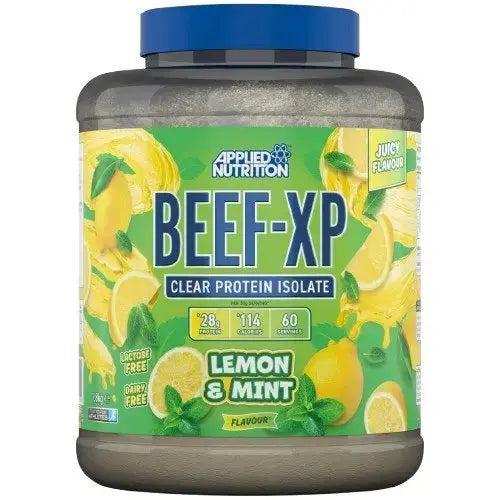
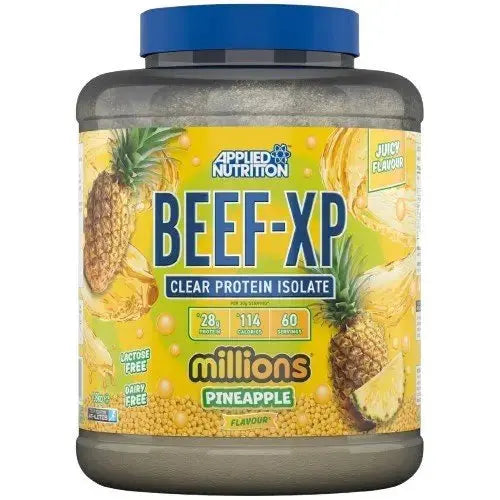
Applied Nutrition Beef XP is a powdered beef protein, sold in a 1.8 kg tub and dosed at 30 g per serving. What sets it apart is its texture: this is not a milky shake but a clear drink, transparent and fruity, from the same family as clear whey. You drink it ice-cold, like a juice, not like a milk.
The formula is a short one: 92% beef protein isolate, citric acid, xanthan gum as a thickener, flavouring, sucralose, and a colouring that varies with the flavour. It is that 92% figure that defines the product — the rest is the few grams needed for taste and consistency.
The appeal of a bovine source is above all a matter of what it leaves out: no milk, no lactose, no soya in the formula. That is why this category exists at all. The flavours listed: Lemon & Mint, Millions Pineapple, Millions Blackcurrant, Blue Raspberry, Orange & Mango, Mixed Berry, Tropical Vibes, Strawberry & Raspberry, Citrus Twist and Cherry & Apple. The British brand's full range can be found in the Applied Nutrition section.
What does a 30 g serving contain?
| Nutrient | Per 30 g serving | Per 100 g* |
|---|---|---|
| Energy | 114 kcal | 380 kcal |
| Fat | 0.5 g | 1.7 g |
| Carbohydrate | 0 g | 0 g |
| Protein | 27.7 g | 92.3 g |
| Salt | negligible amount | — |
* Column calculated from the values declared per serving, as the manufacturer does not publish a per-100 g column. Let us point out what is missing, because it matters: no kilojoule equivalent, no “of which saturates” line, no “of which sugars” line, no “fibre” line, and no figure for salt. “Negligible amount” is the wording the regulations provide for very low levels, but it is not a number, and we will not replace it with an estimate.
27.7 g of protein for 114 kcal is a remarkable ratio. Protein supplies virtually all of the product's energy here, which makes the “high protein” nutrition claim beyond dispute. And the applicable regulatory wording is this one: protein contributes to a growth in and the maintenance of muscle mass.
Do the maths with us all the same: 27.7 g of protein in 30 g of powder works out at 92.3 g per 100 g — exactly the isolate content stated in the formula. In other words, that figure assumes a beef isolate that is almost pure protein. It is theoretically possible, it is very much top of the range, and it is a line we would encourage you to check on the label of the tub you receive.
Zero carbohydrate and 0.5 g of fat per serving: on paper, that is the leanest profile in the protein category, leaner still than a whey isolate. During a strict cutting phase, that is a genuine argument.
There is one point on which we will be cautious, however: the manufacturer states that the product contains all the essential amino acids, but publishes no amino acid profile. Yet that is precisely the data that would allow a beef protein to be compared with a whey. Without it, we can neither assert nor dispute any equivalence — we simply note that the figure is missing.
How do you prepare Beef XP?
Dose: 30 g, i.e. one scoop. Liquid: 300 ml of cold water. Timing: after your session, between meals, or in the morning. Frequency: 1 to 3 servings a day depending on your protein needs. Duration: continuous, no course of treatment is indicated.
Shake for 15 to 20 seconds until fully dissolved. Use really cold water, and water only. That is the rule that makes all the difference with a clear protein: with milk, the mix curdles and the result is frankly unpleasant. Ice-cold, on the other hand, it drinks like a fruit drink, which makes it considerably easier to face after a hard session than a creamy shake.
The manufacturer notes that the doses provided by the scoop are approximate and recommends precision scales if you are counting to the gram. That is a piece of honesty you do not often see, and it is useful: between a level scoop and a heaped one, the gap easily exceeds 5 g.
The powder also takes well to being added to porridge, to cereal or to a baking mix to enrich a lactose-free recipe. The result will be fruity — bear that in mind before folding it into a chocolate cake. The 1.8 kg tub covers 60 servings, i.e. two months at one shake a day.
Who is Beef XP for, and who is it not for?
It is aimed at two very specific profiles. The first: people who are lactose intolerant or who digest dairy proteins poorly, and for whom even a whey isolate remains uncomfortable. The second: those who can no longer stand the milky texture of shakes, particularly straight after training, and who would rather drink something clear and cool.
The formula contains no milk and no soya. The product is, however, made in a facility that handles MILK, EGG, SOYA, FISH, CELERY and CEREALS CONTAINING GLUTEN: in the event of a severe allergy to any of these, cross-contamination remains possible and caution is called for.
As the source is bovine, it is suitable for neither vegetarians nor vegans, nor for anyone who excludes beef for religious or personal reasons. In those cases, look instead at our egg proteins or our plant proteins. The manufacturer does not recommend it for the under-18s and asks pregnant or breastfeeding women, as well as anyone under medical treatment, to seek medical advice.
A word on the colourings, because it is rarely said: they vary with the flavour. Most are of natural origin — beetroot red, turmeric, beta-carotene — but the Blue Raspberry version contains brilliant blue FCF, a synthetic colouring. If you avoid those on principle, choose another flavour.
What you should not expect from it: it is not a miracle product just because it comes from beef. It is a protein source, like a whey, with a very clean nutritional profile and a different texture. It is not a gainer, not a weight-loss product and not a meal replacement — 114 kcal replaces no meal.
Beef XP or a whey isolate?
This is the comparison that decides the matter, and it comes down to just two criteria: your digestion and your budget.
A whey isolate is the better choice for the vast majority of people. It provides 24 to 26 g of protein for 105 to 115 kcal, in the same ballpark, and it has two solid advantages: its amino acid profile is published and documented — which is not the case here — and its cost per serving is generally lower. If you digest whey without any trouble, there is no reason to pay more for a bovine source.
Beef XP is the better choice in three concrete situations. If lactose genuinely causes you problems, including with an isolate. If you need the leanest possible profile — zero carbohydrate, 0.5 g of fat — at the end of a prep. And if the milky texture puts you off: drinking 300 ml of an ice-cold fruit drink after a session of thirty sets is nothing like swallowing a creamy shake, and plenty of people give up on their protein for that reason alone. The best product is still the one you actually drink. The rest of the sources can be compared in our protein section.
Frequently asked questions
Can it be mixed with milk?
No. This is a clear protein, designed for cold water only. With milk, the mix curdles, the texture becomes unpleasant and the fruity taste sits badly with the dairy. Stick to 300 ml of really cold water, that is where the product is at its best.
Is it really free of any meaty aftertaste?
There is no beef taste: the isolate is deodorised and given fruit flavouring. Expect something tart instead, close to a diluted juice. Some people notice a slight bitterness at the finish, more marked on the citrus flavours than on the berry ones.
How many servings are in the 1.8 kg tub?
Sixty 30 g servings. At one shake a day, that covers two months; at two shakes on training days, reckon on six weeks. The manufacturer notes that the scoop doses are approximate: weigh them out if you are counting precisely.
Is this product suitable for people who are lactose intolerant?
The formula contains neither milk nor lactose — that is its very reason for existing. One caveat, though: the product is made in a facility that handles milk, which makes cross-contamination possible. In the event of an allergy to milk proteins — which is not the same thing as lactose intolerance — caution is called for.
Why is there no amino acid profile?
The manufacturer states that the product contains all the essential amino acids, without publishing the detail. That is a shame, because it is exactly the data that would allow an objective comparison with a whey. We will not fill that gap with an estimate: if you need that information, ask the manufacturer for it.
Zero grams of carbohydrate — is that believable?
Yes, on a protein isolate flavoured with sucralose: the sweetness comes from an intense sweetener, used at doses of the order of a milligram, not from sugar. The citric acid and xanthan gum in the formula are likewise present in quantities far too small to register on the carbohydrate line.
Which flavour should you start with?
On a clear protein, go for the sharply tart profiles, which work best ice-cold: Citrus Twist, Lemon & Mint or Blue Raspberry. Berry flavours such as Mixed Berry or Strawberry & Raspberry are gentler and more universally liked. Avoid Blue Raspberry if you rule out synthetic colourings.
Where can you buy Applied Nutrition Beef XP 1.8 kg?
The flavours can be ordered from this page, and we ship throughout France and Europe.
A clear protein is not judged on a label but on the first mouthful: either the texture suits you and you will never go back to a milky shake, or it throws you and the 1.8 kg tub takes a long time to finish. That is exactly the kind of trade-off we talk through at the counter of our Vendargues shop, about ten minutes from Montpellier, before letting you leave with two months' supply. The full range can be browsed in our sports nutrition section.
What exactly is whey isolate?
Whey isolate is not a different protein from whey concentrate: it is the same whey, purified further. Each filtration step removes some of what is not protein—lactose, fat, minerals.
The result is visible on the nutritional label: a concentrate contains 70 to 80% protein per 100g of powder, while an isolate generally exceeds 85% and the best ones go beyond 90%. What disappears is primarily lactose, reduced to trace amounts. So, you're not paying for a "superior" protein, but a cleaner protein: less residual sugar, less fat, and a smoother texture in a shaker. The amino acid profile, however, does not change.
Isolate, Concentrate or Hydrolyzed: Which one do you need?
The honest answer is often disappointing: for the majority of users, whey concentrate is more than sufficient. If you digest dairy well and train three to five times a week without competitive goals, the difference between 75% and 90% protein amounts to a few grams per serving—which can be made up with a yogurt or two eggs. Whey concentrate therefore remains the rational choice when on a tight budget and experiencing no digestive discomfort; for mass gain, its extra calories even work in your favor.
Three situations truly justify its higher cost: a lactose intolerance, even moderate, leading to bloating after a shake; a cutting phase where every gram of carbohydrates and fats is meticulously counted; or high consumption, two to three doses per day, where the cumulative digestive load eventually becomes an issue.
Hydrolyzed whey goes a step further: the protein chains are pre-digested into short peptides by enzymatic action. Absorption is faster, but the price increases and the taste becomes bitter, for an imperceptible gain—we reserve it for very sensitive stomachs. If thick shakes put you off, clear whey is an isolate that produces a clear drink; and if dairy is excluded from your diet, consider plant-based proteins.
What does the filtration process change?
Cold microfiltration (CFM, for cross-flow microfiltration) separates components using a membrane, without excessive heat or solvents: it preserves native protein fractions and results in a milkier taste. Ion exchange captures proteins by their electrical charge; the resulting protein content is very high, sometimes even higher, but the process is more selective and preferentially retains certain fractions—very pure in terms of percentage, but slightly less complete in terms of profile.
Choose ion exchange for the raw protein content at the best price, CFM for the taste: the difference in your training results remains marginal.
How to read a whey isolate label?
Look at the "per 100g" column, never the "per serving" column. One brand advertises 25g of protein per serving, another 24g: it's impossible to compare if the first serving weighs 33g and the second 27g. When scaled to 100g, the difference ranges from 75% to 89%.
Check the position of amino acids in the ingredients list. Some formulas add glycine, taurine, or glutamine to the powder. These isolated amino acids count in the regulated nitrogen analysis and therefore inflate the advertised protein content, without providing the complete profile of a whole protein: this is amino spiking. Placed high in the list, right after the isolate, they raise suspicion; at the end of the list, they are inconsequential.
Check carbohydrates and fats. A powder showing 4g of carbohydrates per 100g is not a true isolate. Below 2g of carbohydrates and 1.5g of fats, the product is consistent with its name.
Calculate the price per kilogram of protein, not per kilogram of powder. This is the only honest metric: price of the tub, divided by weight in kilograms, divided by protein percentage. A product at €30 per kilogram with 75% protein comes to €40 per kilogram of protein; a product at €36 per kilogram with 90% protein also comes to €40. The actual price is the same, and the second one is more digestible. This calculation tells you if the extra cost is truly an extra cost.
What dosage, at what time?
Whey isolate is a supplemental intake, not a trigger: what determines your progress is your total protein intake over the day, not the time of your shake. A standard dose provides 25 to 30g of protein, a quantity generally considered to fully stimulate protein synthesis in a meal; beyond that, the surplus is used like any other food intake.
For the daily total, ANSES recommends 0.83g of protein per kilogram of body weight per day for healthy adults; usual guidelines in sports nutrition place bodybuilders significantly higher, around 1.6 to 2g per kilo. A 75kg individual would therefore aim for 120 to 150g per day, including food: the powder only serves to fill what's missing, i.e., one to two doses.
Post-workout is convenient, not magical: the "anabolic window" of thirty minutes has been largely debunked, the main thing is to spread your intake throughout the day. Isolate is well-suited for post-workout and breakfast, because it's easy to digest; for a slow-release protein in the evening, casein is more appropriate. Dilute in 250 to 350 ml of water. For mass gain, adding a carbohydrate source like rice cream makes more sense than choosing a fattier powder.
What should you not expect from an isolate?
It doesn't build muscle on its own: without progressive resistance training and sufficient caloric intake, no powder will build anything. Nor does it cause weight loss: it helps maintain a caloric deficit by providing a lot of protein for few calories, but it's the deficit that does the work.
It is also not a solution for a cow's milk protein allergy: filtration removes lactose, not milk proteins. In case of a diagnosed allergy, it is contraindicated. Finally, high protein intake requires medical advice in cases of known kidney or liver insufficiency, pregnancy, breastfeeding, or chronic illness.
Frequently Asked Questions
What is whey isolate?
It's whey—whey protein—filtered further. The process removes lactose, fats, and some minerals, increasing the protein content to over 85g per 100g of powder. It's not a different molecule: it's the same protein, more concentrated and cleaner.
What's the difference between whey and isolate?
The degree of purification, nothing else. Whey concentrate contains 70 to 80% protein and retains lactose and fats; isolate exceeds 85%, often 90%, with trace amounts of lactose. The amino acid profile is the same, as is leucine. What concretely changes is digestion and the number of calories per serving.
Which whey is the most effective?
None is more effective with equal protein intake: concentrate, isolate, and hydrolyzed all trigger the same protein synthesis. The most effective is therefore the one you digest well, take regularly, and whose price per kilogram of protein fits your budget. The rest is marketing.
Why take whey isolate?
For three concrete reasons, and not because it is "superior" to other whey. First, digestibility: lactose is only present in trace amounts, which resolves bloating after a shake. Then, density: over 85g of protein per 100g of powder compared to 70 to 80 for a concentrate, meaning very few carbohydrates and lipids per serving, which really matters during cutting phases. Finally, the texture, which is smoother when mixed with water. If none of these three points concern you, a concentrate will do the same job for less money.
Which whey should I choose?
Start with your digestion and budget, not marketing. If you digest dairy well and are budget-conscious: concentrate. If you experience discomfort after a shake or are cutting: isolate. If you have a very sensitive stomach and price is not an issue: hydrolyzed. If dairy is excluded from your diet: plant-based proteins. Then, within each category, choose based on three lines of the label—protein percentage per 100g, residual carbohydrates, position of added amino acids in the list of ingredients—then calculate the price per kilogram of protein, the only honest comparison between two tubs.
When should I take whey isolate?
When you need more protein, not at a specific time. Post-workout and breakfast are the two most practical times because isolate is easy to digest. In the evening, casein is more suitable. A dose of 25 to 30g in 250 to 350 ml of water is sufficient.
Which whey for mass gain?
A concentrate, in most cases. Its residual carbohydrates and fats provide additional calories, which is precisely the goal when seeking a surplus, and it costs less per kilogram of protein. Isolate is only necessary for mass gain if you have trouble digesting other types. The decisive factor is elsewhere: total caloric surplus and progressive overload. To boost a shake, add carbohydrates like rice cream or oat flakes, and take your creatine monohydrate every day, in your shake or elsewhere.
Which whey for weight loss?
No whey causes weight loss: it's the caloric deficit that does the work. What an isolate provides in this context is a very favorable protein/calorie ratio—around 100 kcal for 25g of protein—thus decent satiety for few calories, which helps maintain the deficit and limit muscle mass loss. Place it where your protein intake is lacking: breakfast, afternoon snack, or after a workout. The time matters little; the daily total, around 1.6 to 2g per kg of body weight, matters a lot.
Whey: how long after training?
Within two hours, without rushing. The thirty-minute anabolic window has been largely relativized: what determines muscle building is the total protein intake over the day, divided into 25 to 30g servings. If your last meal was five or six hours ago, a shake right after the session makes sense; if you ate an hour before, there's no rush and the next meal will suffice. EAAs taken during the session are not a substitute: they are a stopgap, they don't provide 25g of complete protein.
Can you take whey without exercising?
Yes, without particular danger for a healthy adult: whey is a food, a milk protein concentrate, just like cottage cheese. It helps when diet doesn't cover protein needs, for example, in an elderly person or someone in convalescence. However, it offers no muscle benefits without progressive resistance training: without stimulus, the surplus is used like any other food intake. In case of kidney or liver insufficiency, pregnancy, or chronic illness, consult your doctor.
Is whey isolate suitable for lactose intolerant individuals?
In most cases, yes: filtration removes most of it, and people bothered by a concentrate generally tolerate it without difficulty. Very pronounced intolerances may still be sensitive to residual traces; only a small test will tell. Digestive enzymes help in borderline cases.
Does it build more muscle than concentrate?
No, not with an equivalent total protein intake: the amino acid profile is comparable and leucine, which triggers protein synthesis, is present in both. The difference lies in digestibility and density, not in muscle-building potential.
What isolate brands do we offer?
Our selection prioritizes legible labels: protein percentage per 100g displayed, short ingredient list, indicated origin of whey. This includes Protéalpes, whose isolate is produced in France, the ESN range, Applied Nutrition, and Rule One. All our powders are grouped in the protein section.
Where to compare isolates near Montpellier?
Our store in Vendargues, about ten minutes from Montpellier, allows you to turn over the tubs and compare nutritional labels side by side. For an isolate, the decision hinges on three lines: protein percentage per 100g, residual carbohydrates, and the position of amino acids in the list. We also ship everywhere in France—and if you hesitate between two references, write to us: the answer is sometimes that a concentrate will do just as well, for less.
If you are still comparing several brands before choosing, our whey protein comparison reviews the criteria one by one, from actual protein content to price per kilogram of protein.
Sources: ANSES for protein nutritional references, Ciqual for food composition.
To go further: our iso whey guide.


What is Rule One Whey Blend?
It is a whey protein powder that combines three forms of whey — concentrate, isolate and hydrolysate — in a single formula. The reference serving is 32 g for 24 g of protein and 130 kcal.
The sizes listed: the 900 g tub, around 28 servings, and the 2.2 kg tub, around 68 servings. Not every flavour is offered in each size: Cookies & Creme and Chocolate Peanut Butter come only in 2.2 kg, while Strawberry Banana, Toasted Cinnamon Cereal, Lightly Salted Caramel and Fruity Cereal come only in 900 g.
The idea behind a blend is simple: concentrate costs less and gives body to the texture, isolate lifts the protein content, hydrolysate brings peptides that are already broken down. The manufacturer does not publish the split between the three, which is the limit of the exercise: you know all three are in there, but not in what proportions. We flag that rather than ignore it. The full American brand can be found in our Rule One section, and the complete range under proteins.
What does a 32 g serving contain?
| Nutrient | Per 32 g serving | Per 100 g* |
|---|---|---|
| Energy | 130 kcal | 406 kcal |
| Protein | 24 g | 75 g |
| Carbohydrate | 4 g | 12.5 g |
| Fat | 2 g | 6.25 g |
| Sodium | 125 mg | 391 mg |
| Salt (equivalent)** | 0.31 g | 0.98 g |
| BCAAs | 5 g | 15.6 g |
| Essential amino acids | 11 g | 34.4 g |
* Column calculated from the values declared for 32 g. ** Salt equivalent obtained by multiplying sodium by 2.5, following the conversion in Regulation 1169/2011 — the manufacturer, being American, declares sodium where a European label shows salt. Missing from the data supplied: kilojoules, the “of which saturates”, “of which sugars” and “fibre” lines, and the detailed amino acid profile.
The figure to hold on to is 75 g of protein per 100 g of powder. That is a good level for a blend, higher than a whey concentrate on its own, which often tops out at 70-72 g, and logically below a pure isolate at 85-90 g. Put on a plate: 24 g of protein is the equivalent of about four eggs, for 130 kcal.
The second figure is the 5 g of BCAAs. It is not an addition at all: those BCAAs occur naturally in whey, and 5 g per 24 g of protein is exactly what you expect from a decent whey. Be wary of labels that present this figure as fortification: it is ordinary whey.
Two things to watch, because they are not put forward. First, 0.31 g of salt per serving: nothing alarming, but at three shakers a day that comes to nearly a gram, and it counts if you track your intake. Second, the formula contains sucralose and acesulfame potassium, along with natural and artificial flavourings: this is not a plain powder. The manufacturer also states that third-party laboratory testing is carried out; we report that statement as they publish it, without having verified it ourselves.
The applicable regulatory wording is the only one authorised for this type of product: protein contributes to a growth in and the maintenance of muscle mass.
How do you prepare Rule One Whey Blend?
Dose: 32 g, one scoop. Liquid: 200 to 250 ml of cold water or plant-based drink. Timing: after training, on waking or between meals. Frequency: 1 to 3 servings a day depending on your protein needs. Duration: continuous, as no course is intended.
Thirty seconds of vigorous shaking is enough, pouring the liquid in before the powder. Two hundred and fifty millilitres gives a lighter texture than two hundred; that is a matter of taste, and the flavours in this range are frankly dessert-like — Birthday Cake and Campfire S’mores are names that deliver on their promise.
The tip the manufacturer gives, and it is worth the detour: put the mix through a blender with ice cubes. The texture turns creamy, close to a milkshake, and that completely transforms a shake you have been drinking every day for six months.
On timing, let us be honest: there is no thirty-minute window to hit after training. What determines the result is your total protein across the day. Take this shake at the point where your intake is genuinely falling short — often breakfast or the afternoon, rarely the changing rooms.
The powder combines well with fruit, a nut butter or oats, which turns a shake into a full snack. It also stands up to baking.
Who is this whey for, and who is it not for?
It suits most situations: it is an everyday whey, at a decent protein content, with a choice of flavours few brands offer. The 2.2 kg size appeals to those taking two or three shakes a day who would rather not reorder every month.
It contains MILK and SOYA (lecithin, sometimes replaced by sunflower lecithin depending on the batch). Traces of EGG, PEANUTS and NUTS are possible depending on the production line. The manufacturer advises against it for people allergic to milk proteins and for under-15s without medical advice. In cases of kidney or liver failure, consult a healthcare professional before use.
A word on gluten: the manufacturer writes that the formula is free of it “for most flavours”. That wording does not settle the question flavour by flavour. If you have coeliac disease, check the label on the tub you receive rather than relying on this page.
It suits you less well if you digest lactose poorly: a blend containing a share of concentrate retains more of it than a pure isolate, and the manufacturer does not publish the content. In that case, look instead at our whey isolate section. Nor is it for you if you want a powder without sweeteners: sucralose and acesulfame K are present in every flavour.
What you should not expect from it: anything a good protein source does not do. A whey does not build muscle on its own, it tops up an intake. If your diet does not already supply the bulk of your protein, no 2.2 kg tub will make up for it.
Whey Blend or pure isolate?
That is the choice facing you at every purchase, and it comes down to three lines.
An isolate supplies 85 to 92 g of protein per 100 g, against 75 g here, with far less lactose and fat. It is the better choice in two specific cases: if milky shakes bother you, and if you are in a strict cutting phase where every gram counts. Its drawback is the price, appreciably higher per kilo, and a texture that is often thinner, which some find less pleasant.
The blend wins on balance. At 24 g of protein per serving, you are within a gram or two of an isolate at a lower cost, with a rounder texture and a far wider choice of flavours. On a product you will take every day for months, those last two points carry real weight — a tub you no longer want to open is no use to anyone.
The hydrolysate share, for its part, should not swing the decision: pure hydrolysed whey exists in our range if that is what you are after, with a markedly more bitter taste and a much higher price. Here it is present in an undisclosed proportion, which rules out making an argument of it. If your goal is strength rather than protein intake, the creatine monohydrate section delivers more for far less money, and the two combine without any problem.
Frequently asked questions
What is the split between concentrate, isolate and hydrolysate?
The manufacturer does not publish it in the data available to us, and we are not going to invent it. That is the genuine limitation of every blend on the market: you know what is in there, not in what proportions. The only verifiable figure remains the 24 g of protein per 32 g serving.
How many servings per tub?
Around 28 for the 900 g size and 68 for the 2.2 kg, at 32 g per serving. At one shake a day, that comes to one month and a little over two months respectively; at two shakes, halve it.
Is every flavour available in each size?
No, and it is a common source of disappointment. Cookies & Creme and Chocolate Peanut Butter are offered only in 2.2 kg; Strawberry Banana, Toasted Cinnamon Cereal, Lightly Salted Caramel and Fruity Cereal only in 900 g. Check that your flavour is available in the size you want before ordering.
Does the powder contain gluten?
The manufacturer states that the formula is free of it “for most flavours”, without specifying which ones are the exception. If you have coeliac disease, that wording is not enough: read the label on the tub you receive, as it alone is authoritative.
Why sodium and not salt on the label?
Because the manufacturer is American and follows the convention of its market. To convert, multiply sodium by 2.5: 125 mg of sodium corresponds to 0.31 g of salt per serving. It is the calculation to make every time you compare an American label with a European one.
Can you make it with milk?
Yes, even though the manufacturer specifies water or a plant-based drink. Milk thickens the texture and adds 100 to 130 kcal depending on the volume: useful when gaining weight, and to be worked into your total if you are counting calories. A run through the blender with ice cubes gives the best result.
Which flavour should you choose for a first tub?
Vanilla Ice Cream and Chocolate Fudge are the two safe bets: neutral in the sense that you do not tire of them and they go with oats or fruit. Birthday Cake, Fruity Cereal and Campfire S’mores are far more pronounced — enjoyable on the first shake, harder to stay with over a 2.2 kg tub.
Where can you buy Rule One Whey Blend?
The sizes and the full set of flavours can be ordered from this page, and we ship throughout France and Europe. If this is your first tub of this brand, take the 900 g: three weeks will tell you whether the flavour suits you.
At the Vendargues shop, about ten minutes from Montpellier, this is the sum we work through with the customer, pen and paper on the counter: price of the tub divided by the weight, divided by the protein content per 100 g. On a whey at 75 g per 100 g, the comparison with an isolate at 90 g sometimes gives an unexpected result — and often one that favours the blend. The full range can be browsed in our sports nutrition section.


What is Rule One Clear Isolate 689 g?
Rule One Clear Isolate is a clear whey in a 689 g tub, that is to say a whey protein isolate formulated to stay dissolved in an acidic medium and give a translucent, fruity drink rather than a creamy shake. It is made by Rule One, an American brand.
The base is a whey isolate, never a concentrate: only that degree of filtration allows the clarity. The rest of the list is short — natural and artificial flavourings, malic acid and citric acid for the tartness, salt, sucralose and acesulfame potassium as sweeteners, silicon dioxide as an anti-foaming agent, potassium chloride, and blue spirulina as a colouring in the relevant flavours.
The flavours on offer: Blue Raspberry, Cherry Limeade, Peach Mango and Strawberry Lemonade. The register is that of a lemonade, not of a milky dessert. The manufacturer states that its batches undergo third-party laboratory testing for banned substances; we report that information and attribute it to them, not having seen the reports.
What does a serving of Clear Isolate contain?
The reference serving is 25 g. It provides 20 g of protein for 90 kcal (377 kJ), 1 g of carbohydrate, 0 g of fat, 0.3 g of salt and 120 mg of sodium. The 689 g tub covers 27 servings.
Two figures deserve to be looked at together. First the protein density: 20 g of protein in 25 g of powder, that is 80 g per 100 g. Then the size of the serving. Clear wheys are generally dosed at around 20 to 25 g against 30 to 35 g for a conventional whey, because beyond that the drink turns syrupy. This one therefore sits at the top of its category for the amount of protein actually delivered per serving, which is not that common.
| Nutrient | Per 100 g* | Per 25 g serving | % RI** per serving |
|---|---|---|---|
| Energy | 1,508 kJ / 360 kcal | 377 kJ / 90 kcal | 4.5% |
| Fat | 0 g | 0 g | 0% |
| of which saturates | not disclosed | not disclosed | — |
| Carbohydrate | 4 g | 1 g | < 1% |
| of which sugars | not disclosed | not disclosed | — |
| Fibre | 0 g | 0 g | — |
| Protein | 80 g | 20 g | 40% |
| Salt | 1.2 g | 0.3 g | 5% |
| Sodium | 480 mg | 120 mg | — |
| Essential amino acids | > 36 g | > 9 g | — |
| Electrolyte complex | 1,200 mg | 300 mg | — |
* Column calculated from the values declared for 25 g, the manufacturer not publishing a per 100 g column. ** Reference intake of an average adult (8,400 kJ / 2,000 kcal, 50 g of protein, 6 g of salt). Two pieces of data are missing and we are not inventing them: the “of which saturates” line and the “of which sugars” line do not appear in the data supplied by the manufacturer. Nor is the mineral-by-mineral breakdown of the electrolyte complex published: only the sodium is quantified. The values correspond to the Blue Raspberry flavour and may vary slightly from one flavour to another.
The product comfortably exceeds the regulatory threshold allowing the “high protein” nutrition claim — protein accounts for close to 90% of the serving's energy. As for health claims, the authorised wordings are these: protein contributes to a growth in muscle mass, to the maintenance of muscle mass and to the maintenance of normal bones. No recovery claim exists for protein, and we shall not write one.
How do you prepare Rule One Clear Isolate?
The manufacturer specifies a 25 g serving in 350 to 400 ml of ice-cold water, to be shaken vigorously and then left to stand for 30 seconds while the foam subsides. One or two servings a day are enough for most uses; no course length is given, and there is no reason for one with a protein.
The timing: 30 minutes before the session, or immediately after, or at any point in the day to top up an intake. The timing matters less than the total protein over 24 hours — that is the point on which most labels mislead you.
Two instructions apply specifically to this type of product. Do not mix it with milk: the acidity makes the casein flocculate and the drink turns grainy. And do not heat it, do not use it in baking: a clear whey coagulates when cooked. For cooking, keep a whey concentrate.
Who is Clear Isolate for, and who is it not for?
It is aimed first of all at those who can no longer stomach the milky shake format — heaviness on digestion, the taste of vanilla every day, or simply a summer session after which nothing creamy will go down. A protein you do not drink is of no use: that is the soundest use case.
The product contains MILK. It is made in a facility that also handles SOYA, EGG and FISH, and may contain traces of them. In the case of a diagnosed allergy to cow's milk proteins, it is contraindicated: filtration removes the lactose, not the proteins. The manufacturer advises against it for children under 12 and invites pregnant or breastfeeding women, as well as people on medication, to seek advice before use. Any kidney or liver condition is a matter for your doctor.
What not to expect from it: the 300 mg of electrolytes per serving do not make it a sports drink. With 1 g of carbohydrate, the formula meets none of the European conditions that would allow a claim on hydration or on endurance. If that is what you are after, look instead at our electrolytes. Nor does it make you lose weight: it supplies a lot of protein for few calories, which helps you hold a deficit, but it is the deficit that does the work.
Clear Isolate or a conventional whey isolate?
Both rest on the same raw material. The difference lies in the formulation and, above all, in what you will do with it.
A conventional whey isolate is the better choice in three clear cases: you have a high protein requirement to cover and you take two or three servings a day, in which case the price per kilo of protein becomes decisive; you cook with your powder; or you prefer a creamy drink that keeps you going between two meals. On those three points, Clear Isolate loses.
Clear Isolate wins when the drink itself is the problem: milky shakes that are hard to digest, weariness of the milky taste, the urge for a cold, tart drink at the end of a session. It also wins on density, with 20 g of protein in a 25 g serving where many clear wheys stop at 18 g. The calculation that settles it remains the same: price of the tub, divided by its weight in kilos, divided by the protein content per 100 g. Do it on both sides before buying. The protein aisle lets you compare every family.
Frequently asked questions
How many servings does a 689 g tub contain?
Twenty-seven 25 g servings. At one serving a day, that covers almost a month; at two servings on training days only, count on longer. The manufacturer states a shelf life of 24 months in the unopened original packaging, kept away from moisture.
Do the nutritional values change with the flavour?
Slightly. The published figures correspond to the Blue Raspberry flavour, and the manufacturer notes that the others may vary a little. The flavours available are Blue Raspberry, Cherry Limeade, Peach Mango and Strawberry Lemonade. The blue colouring is spirulina, present only in the relevant flavours.
When should Clear Isolate be taken during the day?
Thirty minutes before the session, just after, or at any time to make up a shortfall in intake. The thirty-minute window people talked about fifteen years ago no longer holds: what determines the result is the day's total protein. In practice, take it at the moment you will actually drink it.
Can it be mixed with milk?
No, and that is a manufacturer's instruction, not a preference. The acidity of the formula destabilises the casein in milk: the mixture curdles and turns grainy. Use very cold water, 350 to 400 ml per serving. Crushed ice improves the result further.
Do the 300 mg of electrolytes replace a sports drink?
No. Set against the volume of the preparation, the 120 mg of sodium per serving remain well below the levels that characterise a carbohydrate-electrolyte solution within the meaning of European regulation, and the formula supplies only one gram of carbohydrate. Those minerals improve the drink's profile; they do not turn it into an endurance drink.
Does it contain lactose?
Traces only: this is an isolate, filtered to the point of removing most of the lactose and the fat. Many people troubled by a whey concentrate tolerate it without difficulty. Take care not to confuse this with an allergy to cow's milk proteins, which rules the product out — filtration does not remove the proteins.
How do you avoid the foam?
Pour the water in first, the powder second, shake, then leave it to stand for 30 seconds as the manufacturer indicates. Whey proteins are surface-active and stabilise bubbles: the harder you shake, the longer the foam holds. Taking the metal whisk out of the shaker and diluting generously settles the matter. Made in advance and left to chill, the drink is better.
Where to buy Rule One Clear Isolate 689 g?
This page lets you order the flavours, and we ship throughout France and Europe. With a tart drink, the flavour is the one criterion no product page can replace: in our Vendargues shop, around ten minutes from Montpellier, we talk them through with people who have actually drunk them, and we work out the price per kilo of protein against a conventional isolate in front of you.
If what you are after is instead an amino acid drink to sip during exercise, see our EAA; the whole aisle can be found in our sports nutrition section.
Retrait au magasin sous 2 h
À Vendargues, près de Montpellier. Vous êtes prévenu dès que la commande est prête.
Commandé avant 14 h, expédié le jour même
Du lundi au samedi. Le délai d'acheminement appartient ensuite au transporteur.
Livraison offerte dès 50 €
En France métropolitaine, et dès 100 € en Europe. Modes et délais.
Une question avant de commander ?
Écrivez-nous ou passez au magasin : on connaît les produits qu'on vend.
What exactly is whey isolate?
Whey isolate is not a different protein from whey concentrate: it is the same whey, purified further. Each filtration step removes some of what is not protein—lactose, fat, minerals.
The result is visible on the nutritional label: a concentrate contains 70 to 80% protein per 100g of powder, while an isolate generally exceeds 85% and the best ones go beyond 90%. What disappears is primarily lactose, reduced to trace amounts. So, you're not paying for a "superior" protein, but a cleaner protein: less residual sugar, less fat, and a smoother texture in a shaker. The amino acid profile, however, does not change.
Isolate, Concentrate or Hydrolyzed: Which one do you need?
The honest answer is often disappointing: for the majority of users, whey concentrate is more than sufficient. If you digest dairy well and train three to five times a week without competitive goals, the difference between 75% and 90% protein amounts to a few grams per serving—which can be made up with a yogurt or two eggs. Whey concentrate therefore remains the rational choice when on a tight budget and experiencing no digestive discomfort; for mass gain, its extra calories even work in your favor.
Three situations truly justify its higher cost: a lactose intolerance, even moderate, leading to bloating after a shake; a cutting phase where every gram of carbohydrates and fats is meticulously counted; or high consumption, two to three doses per day, where the cumulative digestive load eventually becomes an issue.
Hydrolyzed whey goes a step further: the protein chains are pre-digested into short peptides by enzymatic action. Absorption is faster, but the price increases and the taste becomes bitter, for an imperceptible gain—we reserve it for very sensitive stomachs. If thick shakes put you off, clear whey is an isolate that produces a clear drink; and if dairy is excluded from your diet, consider plant-based proteins.
What does the filtration process change?
Cold microfiltration (CFM, for cross-flow microfiltration) separates components using a membrane, without excessive heat or solvents: it preserves native protein fractions and results in a milkier taste. Ion exchange captures proteins by their electrical charge; the resulting protein content is very high, sometimes even higher, but the process is more selective and preferentially retains certain fractions—very pure in terms of percentage, but slightly less complete in terms of profile.
Choose ion exchange for the raw protein content at the best price, CFM for the taste: the difference in your training results remains marginal.
How to read a whey isolate label?
Look at the "per 100g" column, never the "per serving" column. One brand advertises 25g of protein per serving, another 24g: it's impossible to compare if the first serving weighs 33g and the second 27g. When scaled to 100g, the difference ranges from 75% to 89%.
Check the position of amino acids in the ingredients list. Some formulas add glycine, taurine, or glutamine to the powder. These isolated amino acids count in the regulated nitrogen analysis and therefore inflate the advertised protein content, without providing the complete profile of a whole protein: this is amino spiking. Placed high in the list, right after the isolate, they raise suspicion; at the end of the list, they are inconsequential.
Check carbohydrates and fats. A powder showing 4g of carbohydrates per 100g is not a true isolate. Below 2g of carbohydrates and 1.5g of fats, the product is consistent with its name.
Calculate the price per kilogram of protein, not per kilogram of powder. This is the only honest metric: price of the tub, divided by weight in kilograms, divided by protein percentage. A product at €30 per kilogram with 75% protein comes to €40 per kilogram of protein; a product at €36 per kilogram with 90% protein also comes to €40. The actual price is the same, and the second one is more digestible. This calculation tells you if the extra cost is truly an extra cost.
What dosage, at what time?
Whey isolate is a supplemental intake, not a trigger: what determines your progress is your total protein intake over the day, not the time of your shake. A standard dose provides 25 to 30g of protein, a quantity generally considered to fully stimulate protein synthesis in a meal; beyond that, the surplus is used like any other food intake.
For the daily total, ANSES recommends 0.83g of protein per kilogram of body weight per day for healthy adults; usual guidelines in sports nutrition place bodybuilders significantly higher, around 1.6 to 2g per kilo. A 75kg individual would therefore aim for 120 to 150g per day, including food: the powder only serves to fill what's missing, i.e., one to two doses.
Post-workout is convenient, not magical: the "anabolic window" of thirty minutes has been largely debunked, the main thing is to spread your intake throughout the day. Isolate is well-suited for post-workout and breakfast, because it's easy to digest; for a slow-release protein in the evening, casein is more appropriate. Dilute in 250 to 350 ml of water. For mass gain, adding a carbohydrate source like rice cream makes more sense than choosing a fattier powder.
What should you not expect from an isolate?
It doesn't build muscle on its own: without progressive resistance training and sufficient caloric intake, no powder will build anything. Nor does it cause weight loss: it helps maintain a caloric deficit by providing a lot of protein for few calories, but it's the deficit that does the work.
It is also not a solution for a cow's milk protein allergy: filtration removes lactose, not milk proteins. In case of a diagnosed allergy, it is contraindicated. Finally, high protein intake requires medical advice in cases of known kidney or liver insufficiency, pregnancy, breastfeeding, or chronic illness.
Frequently Asked Questions
What is whey isolate?
It's whey—whey protein—filtered further. The process removes lactose, fats, and some minerals, increasing the protein content to over 85g per 100g of powder. It's not a different molecule: it's the same protein, more concentrated and cleaner.
What's the difference between whey and isolate?
The degree of purification, nothing else. Whey concentrate contains 70 to 80% protein and retains lactose and fats; isolate exceeds 85%, often 90%, with trace amounts of lactose. The amino acid profile is the same, as is leucine. What concretely changes is digestion and the number of calories per serving.
Which whey is the most effective?
None is more effective with equal protein intake: concentrate, isolate, and hydrolyzed all trigger the same protein synthesis. The most effective is therefore the one you digest well, take regularly, and whose price per kilogram of protein fits your budget. The rest is marketing.
Why take whey isolate?
For three concrete reasons, and not because it is "superior" to other whey. First, digestibility: lactose is only present in trace amounts, which resolves bloating after a shake. Then, density: over 85g of protein per 100g of powder compared to 70 to 80 for a concentrate, meaning very few carbohydrates and lipids per serving, which really matters during cutting phases. Finally, the texture, which is smoother when mixed with water. If none of these three points concern you, a concentrate will do the same job for less money.
Which whey should I choose?
Start with your digestion and budget, not marketing. If you digest dairy well and are budget-conscious: concentrate. If you experience discomfort after a shake or are cutting: isolate. If you have a very sensitive stomach and price is not an issue: hydrolyzed. If dairy is excluded from your diet: plant-based proteins. Then, within each category, choose based on three lines of the label—protein percentage per 100g, residual carbohydrates, position of added amino acids in the list of ingredients—then calculate the price per kilogram of protein, the only honest comparison between two tubs.
When should I take whey isolate?
When you need more protein, not at a specific time. Post-workout and breakfast are the two most practical times because isolate is easy to digest. In the evening, casein is more suitable. A dose of 25 to 30g in 250 to 350 ml of water is sufficient.
Which whey for mass gain?
A concentrate, in most cases. Its residual carbohydrates and fats provide additional calories, which is precisely the goal when seeking a surplus, and it costs less per kilogram of protein. Isolate is only necessary for mass gain if you have trouble digesting other types. The decisive factor is elsewhere: total caloric surplus and progressive overload. To boost a shake, add carbohydrates like rice cream or oat flakes, and take your creatine monohydrate every day, in your shake or elsewhere.
Which whey for weight loss?
No whey causes weight loss: it's the caloric deficit that does the work. What an isolate provides in this context is a very favorable protein/calorie ratio—around 100 kcal for 25g of protein—thus decent satiety for few calories, which helps maintain the deficit and limit muscle mass loss. Place it where your protein intake is lacking: breakfast, afternoon snack, or after a workout. The time matters little; the daily total, around 1.6 to 2g per kg of body weight, matters a lot.
Whey: how long after training?
Within two hours, without rushing. The thirty-minute anabolic window has been largely relativized: what determines muscle building is the total protein intake over the day, divided into 25 to 30g servings. If your last meal was five or six hours ago, a shake right after the session makes sense; if you ate an hour before, there's no rush and the next meal will suffice. EAAs taken during the session are not a substitute: they are a stopgap, they don't provide 25g of complete protein.
Can you take whey without exercising?
Yes, without particular danger for a healthy adult: whey is a food, a milk protein concentrate, just like cottage cheese. It helps when diet doesn't cover protein needs, for example, in an elderly person or someone in convalescence. However, it offers no muscle benefits without progressive resistance training: without stimulus, the surplus is used like any other food intake. In case of kidney or liver insufficiency, pregnancy, or chronic illness, consult your doctor.
Is whey isolate suitable for lactose intolerant individuals?
In most cases, yes: filtration removes most of it, and people bothered by a concentrate generally tolerate it without difficulty. Very pronounced intolerances may still be sensitive to residual traces; only a small test will tell. Digestive enzymes help in borderline cases.
Does it build more muscle than concentrate?
No, not with an equivalent total protein intake: the amino acid profile is comparable and leucine, which triggers protein synthesis, is present in both. The difference lies in digestibility and density, not in muscle-building potential.
What isolate brands do we offer?
Our selection prioritizes legible labels: protein percentage per 100g displayed, short ingredient list, indicated origin of whey. This includes Protéalpes, whose isolate is produced in France, the ESN range, Applied Nutrition, and Rule One. All our powders are grouped in the protein section.
Where to compare isolates near Montpellier?
Our store in Vendargues, about ten minutes from Montpellier, allows you to turn over the tubs and compare nutritional labels side by side. For an isolate, the decision hinges on three lines: protein percentage per 100g, residual carbohydrates, and the position of amino acids in the list. We also ship everywhere in France—and if you hesitate between two references, write to us: the answer is sometimes that a concentrate will do just as well, for less.
If you are still comparing several brands before choosing, our whey protein comparison reviews the criteria one by one, from actual protein content to price per kilogram of protein.
Sources: ANSES for protein nutritional references, Ciqual for food composition.
To go further: our iso whey guide.
Questions fréquentes — Whey Isolate
La whey isolate, c'est quoi ?
C'est de la whey — de la protéine de lactosérum — poussée plus loin dans la filtration. Le procédé retire le lactose, les matières grasses et une partie des minéraux, ce qui fait monter la teneur en protéines au-dessus de 85 g pour 100 g de poudre. Ce n'est pas une autre molécule : c'est la même protéine, plus concentrée et plus propre.
Quelle différence entre whey et isolate ?
Le degré de purification, rien d'autre. Une whey concentrée titre 70 à 80 % de protéines et garde du lactose et des graisses ; une isolate dépasse 85 %, souvent 90 %, avec du lactose à l'état de traces. Le profil en acides aminés est le même, la leucine aussi. Ce qui change concrètement, c'est la digestion et le nombre de calories par dose.
Quelle est la whey la plus efficace ?
Aucune ne l'est davantage à apport protéique égal : concentrée, isolate et hydrolysée déclenchent la même synthèse protéique. La plus efficace est donc celle que vous digérez bien, que vous prenez régulièrement, et dont le prix au kilo de protéine tient dans votre budget. Le reste relève du marketing.
Pourquoi prendre de la whey isolate ?
Pour trois raisons concrètes, et pas parce qu'elle serait « supérieure » aux autres whey. D'abord la digestibilité : le lactose n'est plus qu'à l'état de traces, ce qui règle les ballonnements après shaker. Ensuite la densité : plus de 85 g de protéines pour 100 g de poudre contre 70 à 80 pour une concentrée, donc très peu de glucides et de lipides par dose, ce qui compte réellement en sèche. Enfin la texture, plus fluide à l'eau. Si aucun de ces trois points ne vous concerne, une concentrée fera le même travail pour moins cher.
Quelle whey choisir ?
Partez de votre digestion et de votre budget, pas du marketing. Vous digérez bien le lait et vous surveillez le prix : concentrée. Vous êtes gêné après un shaker ou vous êtes en sèche : isolate. Vous avez un estomac très sensible et le prix vous importe peu : hydrolysée. Le lait est exclu de votre alimentation : protéines végétales. Ensuite, dans chaque catégorie, tranchez sur trois lignes de l'étiquette — taux protéique pour 100 g, glucides résiduels, place des acides aminés ajoutés dans la liste d'ingrédients — puis calculez le prix au kilo de protéine, seule comparaison honnête entre deux pots.
Quand prendre l'isolat de whey ?
Quand il vous manque des protéines, pas à une heure précise. Le post-entraînement et le petit-déjeuner sont les deux moments les plus pratiques parce que l'isolate est légère à digérer. Le soir, une caséine est plus adaptée. Une dose de 25 à 30 g dans 250 à 350 ml d'eau suffit.
Quelle whey pour la prise de masse ?
Une concentrée, dans la majorité des cas. Ses glucides et lipides résiduels apportent des calories supplémentaires, ce qui est précisément l'objectif quand on cherche un surplus, et elle coûte moins cher au kilo de protéine. L'isolate ne s'impose en prise de masse que si vous digérez mal le reste. Le levier décisif est ailleurs : le surplus calorique total et la progression des charges. Pour densifier un shaker, ajoutez plutôt des glucides comme de la crème de riz ou des flocons d'avoine, et prenez votre créatine monohydrate chaque jour, dans le shaker ou ailleurs.
Quelle whey pour maigrir ?
Aucune whey ne fait maigrir : c'est le déficit calorique qui travaille. Ce qu'une isolate apporte dans ce contexte, c'est un rapport protéines / calories très favorable — de l'ordre de 100 kcal pour 25 g de protéines — donc une satiété correcte pour peu de calories, ce qui aide à tenir le déficit et à limiter la perte de masse musculaire. Placez-la là où vos protéines manquent : petit-déjeuner, collation de l'après-midi, ou après la séance. L'heure importe peu ; le total de la journée, autour de 1,6 à 2 g par kilo de poids de corps, importe beaucoup.
Whey : combien de temps après l'entraînement ?
Dans les deux heures qui suivent, sans précipitation. La fenêtre anabolique de trente minutes a été largement relativisée : ce qui détermine la construction musculaire, c'est le total de protéines sur la journée, réparti en prises de 25 à 30 g. Si votre dernier repas remonte à cinq ou six heures, le shaker juste après la séance a du sens ; si vous avez mangé une heure avant, rien ne presse et le repas suivant fera l'affaire. Les EAA pris pendant la séance ne s'y substituent pas : ils dépannent, ils n'apportent pas 25 g de protéines complètes.
Peut-on prendre de la whey sans faire de sport ?
Oui, sans danger particulier chez un adulte en bonne santé : la whey est un aliment, un concentré de protéines de lait, au même titre qu'un fromage blanc. Elle dépanne quand l'alimentation ne couvre pas les besoins en protéines, par exemple chez une personne âgée ou en convalescence. Elle n'apporte en revanche aucun bénéfice musculaire sans entraînement en résistance : sans stimulus, le surplus est utilisé comme n'importe quel apport alimentaire. En cas d'insuffisance rénale ou hépatique, de grossesse ou de pathologie chronique, demandez l'avis de votre médecin.
La whey isolate convient-elle aux intolérants au lactose ?
Dans la plupart des cas, oui : la filtration en retire l'essentiel, et les personnes gênées par une concentrée la tolèrent généralement sans difficulté. Les intolérances très marquées peuvent rester sensibles aux traces résiduelles ; seul un essai sur une petite quantité le dira. Des enzymes digestives aident dans les cas limites.
Fait-elle prendre plus de muscle que la concentrée ?
Non, pas à apport protéique total équivalent : le profil en acides aminés est comparable et la leucine, qui déclenche la synthèse protéique, est présente dans les deux. La différence porte sur la digestibilité et la densité, pas sur le potentiel de construction musculaire.
