
9 products
Sort by:
9 products
9 products


What is the PhD Nutrition Smart Bar?
PhD Smart Bar is a three-layer protein bar: a soft protein core, a caramel layer and crunchy soya crispies, the whole thing coated in chocolate. A 64 g bar provides 20 g of protein, 9 g of fibre and 245 kcal, for 12 g of carbohydrate and 12 g of fat.
PhD Nutrition is a British brand. The Smart Bar is its best-selling line, and its reputation rests not on its label but on its texture: it is one of the few bars in this aisle that you genuinely chew, instead of it sticking to your teeth or crumbling apart.
The flavours in the range: Chocolate Brownie, Cookies n Cream, Salted Fudge Brownie, Caramel Crunch, Birthday Cake, White Blondie, Milk Choc Hazelnut, Chocolat Peanut Butter and Chocolat Noir-Framboise. The rest of the brand can be browsed in our PhD Nutrition aisle, and the other lines in our protein bars selection.
What does a Smart Bar contain?
| Composition | Per 64 g bar | Per 100 g |
|---|---|---|
| Energy | 245 kcal | 383 kcal |
| Protein | 20 g | 31.3 g |
| Carbohydrate | 12 g | 18.8 g |
| Fat | 12 g | 18.8 g |
| Fibre | 9 g | 14 g |
| Salt | 0.4 g | 0.6 g |
| Coating | 31% chocolate, dark or milk depending on the flavour | |
20 g of protein for 245 kcal: that is one of the best ratios in the aisle, and it is this bar's whole reason for being. A third of the calories comes from protein. Compare it with an ordinary chocolate bar of the same weight — around 300 kcal and 4 g of protein — and you understand how the product is positioned.
The 9 g of fibre explain the dense texture, and they have a practical consequence. This is a bar you chew and that fills you up, not a confectionery item you swallow in three bites. The downside is flagged by the manufacturer itself: excessive consumption may have laxative effects, because of the fibre and above all the maltitol. The limit is set at two bars a day, and it is a sensible limit.
One point deserves a frank discussion: the protein blend combines milk protein, collagen hydrolysate and soya isolate. Milk protein and soya isolate are complete proteins. Collagen is not: it contains no tryptophan and it is low in several essential amino acids. It is used here for texture as much as to push up the “protein” line on the label. This is not a deception — the declared quantity is accurate — but 20 g of protein part of which is collagen is not worth 20 g of whey, and it is honest to say so.
From a regulatory standpoint, two authorised claims genuinely apply: protein contributes to a growth in and the maintenance of muscle mass, and the “source of fibre” statement is justified by the 14 g per 100 g. On the other hand, no joint claim is authorised for collagen, and no promise of satiety or weight control is permitted on this type of product. The manufacturer does not disclose the “of which sugars” line in the data available to us: refer to the packaging if that point matters to you.
Ingredients list
Protein blend (MILK protein, collagen hydrolysate, SOYA protein isolate), caramel layer [sweetener: maltitol, condensed MILK, cocoa butter, water, humectant: sorbitol, emulsifier: mono- and diglycerides of fatty acids, natural flavourings, salt], sweeteners (maltitol, sucralose), cocoa butter, cocoa SOYA crispies (7.8%) [soya protein, tapioca starch, cocoa powder], whole MILK powder, humectant (glycerol), coconut oil, natural flavourings, emulsifier (lecithins), bulking agent (microcrystalline cellulose), natural Bourbon vanilla flavouring. Coating: 31% dark or milk chocolate depending on the flavour.
Allergens: MILK and SOYA. May contain traces of GLUTEN, NUTS and EGGS. No palm oil, no preservative, no gelatine, natural colours only. Contains sweeteners: excessive consumption may have laxative effects.
How should the Smart Bar be eaten?
Portion: 1 bar, or half a bar if you are new to polyols. Drink: a glass of water, the fibre needs it. Timing: as a snack between meals, after training, or in place of a confectionery item. Frequency: two bars a day at most. Duration: no notion of a course, this is a food.
If you have never eaten a maltitol-based bar, start with half. That is not excessive caution: tolerance to polyols varies enormously from one person to another, and a whole bar can be enough to cause bloating and discomfort in someone sensitive. Half a bar already represents 10 g of protein.
Chew it, do not swallow it. It is a dense bar, designed to last: that is precisely what makes it useful as a mid-afternoon snack, when the aim is to hold out until the next meal rather than to fill a gap in thirty seconds.
Take it out of the fridge a quarter of an hour beforehand. Cold, the caramel layer turns hard and the chocolate snaps. At room temperature, the three-layer texture makes full sense. Conversely, in summer, do not leave it in a car: the coating melts and the bar loses its shape.
A bar tops up what you take in over the day, it does not replace a meal. If your aim is to cover a substantial protein intake, a serving of protein powder remains more effective and less expensive; the bar, for its part, wins on fitting into a bag.
Who is the Smart Bar for, and who is it not for?
It suits someone looking for a portable, indulgent snack with a real protein content and a controlled calorie profile. It is the typical gym-bag or desk-drawer product, and it is also an honest alternative to something from a vending machine.
It is not suitable for people allergic to milk or soya, both present in quantity in the recipe. Traces of gluten, nuts and eggs are possible. Nor is it suitable for vegan diets, because of the milk protein and the collagen hydrolysate, the latter being of animal origin.
It is to be avoided if you digest polyols poorly. Maltitol and sorbitol both appear in the list. If sugar-free chewing gum or “light” products usually upset you, this bar will upset you too. People with diabetes should also keep an eye on their blood sugar despite the low sugar content: polyols are not neutral.
What you should not expect from it. It does not make you lose weight, it does not replace a meal and it does not build muscle on its own. And the collagen it contains has no authorised joint effect: it is an ingredient for texture and protein content, nothing more. What you are buying is a practical snack with 20 g of protein — which is already a good reason.
Protein bar or protein cookie?
The two go in the same place in a bag, but they do not play the same role and the choice comes down to calories.
The bar is the format with the most protein per calorie: 20 g for 245 kcal here. That is what makes it suited to a period when you are watching your intake, or to a post-training snack when the next meal is still a long way off. It slips in anywhere and keeps for weeks.
A protein cookie plays on enjoyment and on satiety, in a far bigger format. Expect often twice the calories for an equivalent, or even lower, protein content. Our protein cookies aisle answers that particular need: the need for a real bit of baking, not a supplement.
And if what you are after above all is energy for a long effort rather than protein, neither really fits: an oat-based bar will provide more carbohydrate. Our protein snack aisle brings all these formats together for comparison, and the collagen aisle offers the dedicated products for those who really are looking for that protein.
Frequently asked questions
How much protein per bar?
20 g for a 64 g bar, i.e. 31.3 g per 100 g, and 245 kcal. The blend combines milk protein, collagen hydrolysate and soya isolate. Since collagen is not a complete protein, those 20 g are not strictly equivalent to 20 g of whey.
Which flavours are available?
In the range: Chocolate Brownie, Cookies n Cream, Salted Fudge Brownie, Caramel Crunch, Birthday Cake, White Blondie, Milk Choc Hazelnut, Chocolat Peanut Butter and Chocolat Noir-Framboise. The base is identical, the coating being dark or milk chocolate depending on the flavour.
Why can this bar cause bloating?
Because of the maltitol and the sorbitol, two polyols present in the caramel layer, and the 9 g of fibre. The manufacturer itself flags a possible laxative effect in the event of excessive consumption. If you are sensitive, start with half a bar and do not go beyond two a day.
Is the bar suitable for vegetarians?
No, because of the collagen hydrolysate, which is of animal origin. It also contains milk protein and whole milk powder, which likewise rules it out of vegan diets. The manufacturer does state, however, that it contains no gelatine.
What is the sugar content?
The manufacturer does not disclose the “of which sugars” line in the data available to us. We are not going to invent it: refer to the nutrition table printed on the packaging. What we do know is that the sweetness comes mainly from the maltitol and the sucralose.
Can you eat two in one day?
That is the limit set by the manufacturer, and it is a sensible one. Two bars represent 490 kcal and 40 g of protein, but also an amount of polyols that many people do not tolerate. Beyond that, digestive discomfort is predictable.
Does it contain palm oil?
No. The fats in the recipe are cocoa butter and coconut oil. The manufacturer also states the absence of preservative and gelatine, and the exclusive use of natural colours.
Where can you buy the PhD Nutrition Smart Bar?
The bar can be ordered individually from this page, in the available flavours, and we ship throughout France and Europe. At the Vendargues shop, about ten minutes from Montpellier, this is the bar we recommend first to anyone who has never eaten one: the texture is as close as this aisle gets to real confectionery. We simply give a warning about the maltitol, the first time. The rest of our selection can be browsed in the sports nutrition aisle.


What is the Grenade Carb Killa bar?
The Grenade Carb Killa is a single 60 g protein bar, built in three layers and coated in sweetened milk chocolate. It provides 23.2 g of protein and 214 kcal, which places it among the highest-protein bars in our protein bars range.
The protein comes from three milk fractions: calcium caseinate, milk protein isolate and whey protein isolate. The bar also contains 18.3% hydrolysed bovine gelatine, a figure declared by the manufacturer and one that has a direct consequence: this is not a vegetarian product. The rest of the list comprises polydextrose, glycerol, soya crispies, cocoa butter, skimmed milk powder, palm oil, three sweeteners (maltitol, xylitol, sucralose), flavourings, fat-reduced cocoa and soya lecithin. The flavours stocked: White Chocolat, Caramel, Cookie Dough, Peanut Nutter, Salted Peanut, Caramel Salé, Fudged Up, Oreo and Oreo White. The rest of the line-up is gathered in the Grenade collection.
What does a 60 g Carb Killa bar contain?
| Nutrient | Per 100 g* | Per 60 g bar | % NRV |
|---|---|---|---|
| Energy | 1,513 kJ / 357 kcal* | 908 kJ / 214 kcal | ** |
| Fat | 13.2 g* | 7.9 g | ** |
| of which saturates | not disclosed | not disclosed | ** |
| Carbohydrate | 22.7 g* | 13.6 g | ** |
| of which sugars | not broken down*** | not broken down*** | ** |
| Fibre | 11.2 g* | 6.7 g | ** |
| Protein | 38.7 g* | 23.2 g | ** |
| Salt | 0.72 g* | 0.43 g | ** |
* Column recalculated from the declaration per 60 g bar. ** No nutrient reference value is established for these nutrients. *** The “of which sugars” line is not broken down in the manufacturer data we hold, and we will not be reconstructing it. The packaging carries a reduced sugar content: refer to the label of the flavour you buy.
Two nutrition claims can be verified against these figures. Protein accounts for around 43% of the bar's energy value, which comfortably clears the regulatory threshold for the “high protein” claim. And at 11.2 g of fibre per 100 g, the bar clears the 6 g per 100 g threshold for the “high fibre” claim. Those are the only two statements of that kind we make on this page, because they are the only two the figures support.
When and how should you eat a Carb Killa?
- Serving: 1 bar of 60 g.
- Volume of liquid: the manufacturer prescribes none.
- Timing: within the 30 minutes after training, or as a snack between meals when the next meal is still a long way off.
- Frequency: 1 bar a day at most, following the manufacturer's recommendation.
- Duration: no course length is stated. A protein bar is a food, not a course.
Two practical points. If you digest polyols poorly, start with half a bar: the manufacturer explicitly recommends it. And once opened, the bar should be eaten within 48 hours; the chocolate coating copes badly with heat, which makes it a poor fit for a gym bag left in a car in summer. Our other snack formats can be found in our protein snacks range.
Who is the Carb Killa for, and who is it not for?
It suits you if you are after a portable protein hit, with no shaker and no water, for a working day, a trip or a late finish at the gym.
It is not suitable in four specific situations. If you are vegetarian or vegan: the 18.3% hydrolysed bovine gelatine rules it out, unambiguously. If you are allergic to milk or soya: both are declared as allergens, and the facility also handles gluten, tree nuts, peanuts, wheat and eggs. If you tolerate polyols poorly: the bar contains more than 10 g per 100 g, which triggers the regulatory statement “excessive consumption may produce laxative effects”. If you are diabetic: the manufacturer asks you to monitor your blood sugar despite the reduced sugar content, and that question is settled with your doctor, not with a product page.
The manufacturer also advises against it for under-18s and asks women who are pregnant or breastfeeding to consult a healthcare professional.
What you should not expect from it: at 214 kcal, a Carb Killa is a snack, not a meal replacement, and it will not make you lose weight. It usefully replaces a confectionery bar; it does not replace a dinner.
Carb Killa bar or a whey shake?
Both provide a comparable amount of protein, but they do not solve the same problem.
The bar wins on convenience. Nothing to measure out, nothing to wash, nothing to mix, and you can eat it on a train. It is the only format that fits in a pocket.
The shake wins on density and on cost. A serving of whey isolate provides an equivalent amount of protein for markedly fewer calories, with no fat and no polyols, and the price per gram of protein is in another league. If you are in a calorie deficit, the shake is mathematically the better choice, and our weight loss range starts from the same reasoning.
If it is the indulgent side that appeals to you rather than the bar format, protein cookies play on the same ground with different textures. And to build your baseline intake, the protein range is the one to look at first.
Frequently asked questions
Is the Grenade Carb Killa vegetarian?
No. It contains 18.3% hydrolysed bovine gelatine, an ingredient of animal origin. This is the most common question about this product and the answer is no, whatever the flavour.
How much sugar does a Carb Killa contain?
The “of which sugars” line is not broken down in the data the manufacturer has sent us, and we are not going to invent it. What we can state: 13.6 g of carbohydrate and 6.7 g of fibre per bar. The exact sugar figure is on the wrapper of each flavour.
Why can the bar cause bloating?
It contains more than 10 g of polyols per 100 g, which triggers the regulatory statement about the laxative effects of excessive consumption. Starting with half a bar is the manufacturer's recommendation for sensitive individuals.
Which flavour should you try first?
The caramel and peanut profiles are the fullest in flavour, the white chocolate and Oreo profiles the sweetest on the palate. If you cannot decide, take two different ones: at 60 g apiece, trying them costs little.
Can you eat several a day?
The manufacturer sets the limit at one bar a day. Beyond that, you are stacking up polyols, fat and calories with no extra protein benefit compared with a less processed protein source.
Does the bar contain palm oil?
Yes, palm oil appears in the ingredients list. We hold no verified information about its origin or its supply chain, and so we will write nothing further about it.
Does it keep well in summer?
Badly. The chocolate coating melts, and the manufacturer asks for storage in a cool, dry place, away from heat and moisture. A bar forgotten in a car in the sun will be inedible.
Where can you buy Grenade Carb Killa bars?
Carb Killa bars are available individually on this page, in the flavours stocked, and in our Vendargues shop, about ten minutes from Montpellier. It is the kind of product that is better bought in store the first time: you leave with two different flavours rather than a whole box of one you do not like.
We ship throughout France and Europe.


What is Lenny & Larry's The Complete Cookie?
Lenny & Larry's The Complete Cookie is a vegan protein cookie in a generous format. A 113 g cookie provides 16 g of plant protein and 10 g of fibre, for 400 to 420 kcal depending on the flavour. It can be eaten in one go or shared between two.
The brand is American and it is the one that launched this format in the United States. The thinking behind it is simple: rather than making a protein bar and giving it a round shape, make a real cookie — soft texture, thickness, size — and build a plant protein blend into it. The result has little in common with a bar.
The flavours in the range: Chocolat Chip, Chocolat Donut, Peanut Butter, Peanut Butter Chocolat, Salted Caramel, White Chocolat, Otmeal Raisin, Birthday Cake and Big Time Brownie. The rest of the brand can be browsed in our Lenny & Larry's category, and the other products in the range in our protein cookies selection.
What does one Complete Cookie contain?
| Composition | Per 113 g cookie | Per half cookie |
|---|---|---|
| Energy | 400 to 420 kcal depending on the flavour | 200 to 210 kcal |
| Plant protein | 16 g | 8 g |
| Dietary fibre | 10 g | 5 g |
| Carbohydrate | varies with the flavour | — |
| Protein sources | Vital wheat gluten, pea protein, rice protein | |
| Format | Individual 113 g cookie | |
The figure that really matters is not 16, it is 113. This cookie weighs 113 g, where a typical protein bar weighs 55 to 65. The 16 g of protein and 10 g of fibre therefore relate to a product twice the size — and at 400 to 420 kcal, that is the calorie equivalent of a light meal, not of a snack. It is the most useful thing we can tell you before you buy, and it is the one thing product pages in this category systematically forget to mention.
The protein blend rests on three plant sources: vital wheat gluten, pea protein and rice protein. The pea-rice pairing is a classic and a coherent one, the two complementing each other on their amino acid profile. Vital wheat gluten provides the structure and a good share of the protein — it is also why this product contains wheat, despite its vegan positioning.
The 10 g of fibre come largely from inulin. It is a soluble fibre widely used in reformulated products, and it has a practical consequence you should know about: the manufacturer itself points out that excessive consumption can have a laxative effect. Ten grams of fibre in a single product is a lot, and for someone not used to it, a whole cookie eaten in one go can make itself felt during the afternoon.
On the regulatory side, the wording “source of fibre” is a regulated nutrition claim, and the protein content justifies the authorised claim that protein contributes to a growth in and the maintenance of muscle mass. No promise of satiety, digestion or weight control, on the other hand, is authorised for this type of product: we are describing a composition, not an effect.
List of ingredients
Chocolate Chip flavour: enriched WHEAT flour (wheat flour, niacin, reduced iron, thiamine mononitrate, riboflavin, folic acid), protein blend (vital WHEAT gluten, pea protein, rice protein), dark chocolate chips (unsweetened chocolate, sugar, cocoa butter, dextrose, natural vanilla extract), inulin, cane sugar, invert sugar, vegetable glycerine, palm fruit oil, sunflower or rapeseed lecithin, natural flavouring, bicarbonate of soda, salt, xanthan gum, guar gum.
Allergen: WHEAT (gluten). The manufacturer states a recipe with no soya, no dairy, no egg, no high-fructose corn syrup, no artificial sweetener and no polyol. Made in a facility that also handles peanuts, tree nuts, soya, milk and eggs: traces are possible. The composition varies with the flavour — the Peanut Butter versions contain peanuts. Check the packaging of the flavour you receive.
How should the Complete Cookie be eaten?
Portion: half a cookie, or a whole cookie. Drink: a large glass of water, the fibre needs it. Timing: as a snack 30 to 60 minutes before a session, after training, or during the day. Frequency: one portion a day is plenty. Duration: there is no notion of a course here, it is a food.
Start with half. That is not a precaution for the sake of it: 113 g in one go, with 10 g of fibre, is a lot for someone discovering the product. Half a cookie already represents 8 g of protein and around 200 kcal, which amounts to a proper snack. You can keep the other half for the next day, as the wrapper reseals very well.
A few seconds in the microwave completely change the texture. The cookie becomes soft, almost molten, and the chocolate softens. It is the tip we give most often over the counter, and it is the one that wins people over when they found the product dry.
Before a session, allow 30 to 60 minutes. With 10 g of fibre and a dense texture, a whole cookie swallowed ten minutes before training will not sit comfortably. After training, on the other hand, it does the job of a snack very well, particularly alongside a piece of fruit.
As for storage, there is nothing special to it: reseal the wrapper, keep it dry and away from heat. It keeps for several weeks at room temperature, which makes it a useful standby to keep in a bag or a desk drawer — much like protein bars, in a far more substantial format.
Who is the Complete Cookie for, and who is it not for?
It suits someone looking for an indulgent, filling snack with a decent protein contribution, and who is not working to a tight calorie budget. It is particularly well suited to people on a vegan diet: in this category, genuinely vegan and genuinely enjoyable options remain rare.
It is not suitable for people who are gluten-intolerant or coeliac, as wheat flour and vital wheat gluten are two of the first ingredients. This is the most counter-intuitive point about the product: vegan does not mean gluten-free, and a lot of people confuse the two.
Nor is it suitable if you digest soluble fibre badly. Inulin causes bloating and intestinal discomfort in some people, and 10 g in a single product is a high dose. The manufacturer does in fact flag a possible laxative effect in the event of excessive consumption. Start with half, drink water, and you will quickly see how well you tolerate it.
What you should not expect from it. It is not a slimming product: at 400 to 420 kcal, it weighs on a day's intake. It does not replace a balanced meal and it does not build muscle by itself. And if your goal is purely protein intake, 16 g for 410 kcal remains a modest ratio — a serving of protein powder provides more for four times fewer calories. This cookie is bought for the pleasure of it, with a better nutritional profile than an ordinary biscuit: that is honest enough, and it is enough.
Protein cookie or protein bar?
The two take up the same place in a bag, but they do not answer the same need, and the format settles the question.
A protein bar is denser in protein and much lighter in calories. Reckon on 20 g of protein for 200 to 230 kcal in a 60 g bar, against 16 g for 400 to 420 kcal here. If your goal is to cover a protein intake without blowing up the day, our protein bars category is more efficient, no question.
The cookie wins on pleasure and on satiety. It is a real biscuit, soft, eaten slowly, and it fills you up — the 10 g of fibre have a lot to do with that. For a mid-afternoon snack, or for someone who struggles to hit their calories, it does the job better than a bar swallowed in thirty seconds.
Two other options depending on your goal: if you are after a plant-based, low-calorie snack, our plant protein category opens up other possibilities; and if it is the indulgence that counts, a slice of wholemeal bread with peanut butter works out far cheaper for a fairly similar profile.
Frequently asked questions
How much protein is there in one cookie?
16 g of plant protein for a 113 g cookie, from a blend of vital wheat gluten, pea protein and rice protein. Half a cookie provides 8 g. The energy value ranges from 400 to 420 kcal depending on the flavour.
Is the cookie really vegan?
Yes, the manufacturer states a recipe with no dairy, no egg and no soya. Be careful not to confuse vegan with gluten-free: wheat flour and vital wheat gluten are among the first ingredients, so this product does contain gluten.
Can you eat it if you are coeliac?
No. The recipe contains enriched wheat flour and vital wheat gluten. This product is to be avoided in cases of coeliac disease or gluten intolerance, whichever flavour you choose.
Why can 10 g of fibre be a problem?
Because a large part of it comes from inulin, a soluble fibre that ferments in the gut. The manufacturer flags a possible laxative effect in the event of excessive consumption. Start with half a cookie and drink a large glass of water: in most cases, that is enough.
Which flavours are available?
In the range: Chocolat Chip, Chocolat Donut, Peanut Butter, Peanut Butter Chocolat, Salted Caramel, White Chocolat, Otmeal Raisin, Birthday Cake and Big Time Brownie. The composition varies slightly from one flavour to another, particularly on allergens: the Peanut Butter versions contain peanuts.
Should it be eaten in one sitting or two?
As you please, but the manufacturer itself sets the portion at half a cookie. At 400 to 420 kcal each, half already amounts to a complete snack. The wrapper reseals easily and the product keeps for several weeks in a dry place.
Is it suitable before training?
Yes, provided you allow 30 to 60 minutes and stick to half a cookie. The density and the 10 g of fibre make it uncomfortable if you eat it just before you start. After a session, on the other hand, there is no waiting time to observe.
Where can you buy Lenny & Larry's The Complete Cookie?
The cookie can be ordered individually from this page, in the flavours available, and we ship throughout France and Europe. At our Vendargues shop, about ten minutes from Montpellier, this is the product we recommend when someone asks us for a vegan snack that will keep them going — but we always warn about two things: it contains gluten, and 113 g is a real mouthful. The rest of our snack ideas can be browsed in the protein snack category.


What is the Warrior Crunch Bar?
The Warrior Crunch Bar is a 64 g protein bar, built in three layers: a soft centre based on milk proteins, a caramel layer, and a milk chocolate coating sweetened with maltitol that on its own accounts for 31 % of the bar's weight. Between the two, soy crispies provide the crunch that gives the product its name.
It is made by Warrior, a British brand whose other products you will find in our Warrior category. The positioning is clear and unapologetic: this is a confectionery bar, not an austere athlete's bar. It plays on texture and on sweetness, where many rivals make do with a dry coating and a compact centre.
The flavours we stock, from Cookies & Cream to Raspberry Lemon Cheesecake, taking in Fudge Brownie, Banoffee Pie, Peanut Butter Cup and Birthday Cake. The nutritional base is identical from one flavour to another; what changes is the flavouring and sometimes the presence of a colouring. The list of variants available on this page is the definitive one.
What does a 64 g bar contain?
Here is the label, including the per-100 g column, because that is the only one that lets you honestly compare two bars of different weights.
| Values | Per 100 g | Per 64 g bar |
|---|---|---|
| Energy | around 373 kcal | 239 kcal |
| Fat | around 17.2 g | 11 g |
| of which saturates | around 9.5 g | 6.1 g |
| Carbohydrate | around 37.5 g | 24 g |
| of which sugars | around 3.6 g | 2.3 g |
| of which polyols | around 31.3 g | 20 g |
| Protein | around 31.3 g | 20 g |
| Salt | around 0.56 g | 0.36 g |
The per-100 g values are calculated from the manufacturer's label, which declares per whole bar. Warrior also states that the bar is high in fibre, without publishing a figure for the content: we will not reconstruct it.
20 g of protein is the top of the range for this category, and above all it really is 20 g: the blend combines milk proteins and hydrolysed collagen. That second source is worth flagging, because it is common in bars and rarely explained. Collagen is an incomplete protein, low in tryptophan, less effective than a milk protein for building muscle. If your priority is protein synthesis after a strength session, a shaker of whey isolate remains more effective gram for gram.
The most interesting point is the 20 g of polyols for only 2.3 g of sugars. Maltitol replaces sugar in the coating as well as in the centre. It provides around 2.4 kcal per gram instead of 4, and above all it does not raise blood glucose the way sucrose does. That is what explains how a bar this indulgent stays at 239 kcal.
The trade-off is on the fat side: 11 g, of which 6.1 g are saturates. That is a lot, and it comes from the chocolate and the palm fat. A single bar covers close to a third of the daily reference intake for saturates. It is not a manufacturing flaw, it is the price of that melting texture.
Ingredients list
Maltitol milk chocolate coating (31 %), sweetener maltitol, MILK proteins, hydrolysed collagen, SOYA crispies (SOYA protein isolate, rice flour, malted BARLEY extract, salt), humectants (glycerol, sorbitol), SOYA protein isolate, water, palm fat, condensed MILK, flavouring, emulsifiers (mono- and diglycerides of fatty acids), thickener (microcrystalline cellulose), salt, colours (plain caramel, beta-carotene). The flavourings and colours vary with the flavour.
How do you fit the Warrior Crunch Bar into your day?
Serving: one 64 g bar. Frequency: one a day, two at most if your fibre intake is already high and well tolerated. Timing: as an afternoon snack, or within the hour after training. Drink: a large glass of water, 250 to 300 ml, because polyols draw water into the gut. Duration: no notion of a course here, this is a food.
Its best use is the 16:00 slot or the journey home, when dinner is still a long way off and the real alternative is not a chicken breast but a pastry. Compared with a classic chocolate bar of the same weight, you gain a good twenty grams of protein and you divide the sugars by ten.
Before a session it is less suitable: the 11 g of fat and the polyols slow gastric emptying, and nobody enjoys lifting heavy on a full stomach. If you are looking for a quick intake before exercise, go for an easily digested simple carbohydrate such as cream of rice. After training, on the other hand, it does the job of a stopgap snack before the real meal very well.
A word on texture: the bar hardens in the cold. Straight out of the fridge it turns very hard and loses its appeal. Twenty minutes at room temperature, or ten seconds in the microwave, and the caramel runs again.
Who is the Warrior Crunch Bar for, and who is it not for?
It suits someone who struggles to hit their protein target over the day and has neither the time nor the inclination to make up a shaker. It also suits those keeping an eye on their sugars, since 2.3 g per bar is a very low figure for a product that tastes this sweet.
Declared allergens: milk, soya, gluten — the gluten comes from the malted barley extract in the crispies. The manufacturer also flags possible traces of nuts, eggs and peanuts. It is therefore unsuitable for people with coeliac disease, and for anyone allergic to soya or to milk proteins. Nor is it vegetarian in the strict sense, since the hydrolysed collagen is of animal origin.
The real point to watch remains digestive. 20 g of polyols in a single bar is a high dose, and the regulatory wording “excessive consumption may produce laxative effects” is not a turn of phrase. If you have never had maltitol, start with half a bar. Some people tolerate three bars a day without feeling a thing, others regret the first.
What you should not expect from it: this is not a meal replacement, and it is not a cutting product. At 239 kcal and 6.1 g of saturates, it fits into a calorie budget, it does not reduce one. Nor does it replace a complete protein source across the day. If you have any doubt related to medication, to diabetes or to a known digestive disorder, ask your doctor or pharmacist for advice.
Warrior Crunch or a protein cookie?
This is the comparison that comes up most often over the counter, because the two products occupy the same afternoon slot and cost roughly the same.
A protein cookie generally weighs 60 to 75 g, provides 15 to 20 g of protein, but keeps real sugar rather than polyols. The result: it goes higher in calories, it sits better digestively, and it can be eaten in one go without wondering whether you will regret it. It is the better choice if you have a sensitive stomach, if you are bulking and the calories are working for you, or if you dislike the aftertaste of sweeteners.
The Warrior Crunch, for its part, keeps the advantage as soon as the calorie budget is tight and sugar has to stay low. At 2.3 g of sugars and 239 kcal, it slips into a cutting day without doing any damage, which a 350 kcal cookie does not always allow. And on the enjoyment front, the triple layer clearly beats a dry compressed bar.
If neither of the two suits you, the protein snack category brings together the other formats: crisps, wafers, bake-at-home mixes.
Frequently asked questions
How much sugar does the Warrior Crunch Bar actually contain?
2.3 g per 64 g bar, or around 3.6 g per 100 g. The 20 g of polyols shown on the “carbohydrate” line are not sugars: they are bulk sweeteners, maltitol in this case, which provide less energy and do not raise blood glucose in the same way.
Do polyols cause stomach upset?
In some people, yes, especially beyond 20 g over the day. It is a well-known and harmless reaction: polyols are not completely absorbed and draw water into the gut. Start with half a bar to gauge your tolerance, and drink normally.
Does the bar contain gluten?
Yes. The soy crispies contain a malted barley extract, which makes the bar unsuitable for people with coeliac disease or gluten intolerance. The manufacturer also declares milk and soya as allergens, with possible traces of nuts, eggs and peanuts.
What is the difference between milk proteins and hydrolysed collagen?
Milk proteins provide the full set of essential amino acids. Hydrolysed collagen does not: it is very low in tryptophan and unbalanced in several others. Here it plays a role in texture as much as in content. In practical terms, the 20 g stated are not worth 20 g of protein powder for building muscle.
Can you eat one every day?
One a day poses no problem if the rest of your diet is balanced. Two start to weigh on the saturates: 12.2 g in total is more than half the daily reference intake. The limiting factor is not the protein, it is the fat.
Which flavour should you choose for a first try?
The chocolate flavours — Fudge Brownie, Dark Chocolate Peanut Butter, Chocolate Chip Cookie Dough — are the closest to classic confectionery and the least divisive. The fruity flavours, Raspberry Lemon Cheesecake above all, split opinion more: the acidity stands out more because of the sweeteners.
Does it replace a meal?
No, and it should not be used that way. One bar provides 239 kcal and no portion of vegetables, complex fibre or micronutrients in any useful amount. It replaces a snack, or a pastry. Lunch, no.
Where can you buy the Warrior Crunch Bar?
The flavours can be ordered from this page, and we ship throughout France and Europe. At the Vendargues shop, about ten minutes from Montpellier, this is the product we hand out to taste most often: with a bar, the label never tells the whole story, and two people will not have the same opinion of the same maltitol. The rest of our sweet range can be browsed in our sports nutrition category.


What is the Oat King bar by LSP Nutrition?
Oat King is an oat-flake bar in a distinctly more generous format than the aisle average. Each bar weighs 95 g, contains at least 42% oat flakes and provides 393 to 448 kcal depending on the flavour. The manufacturer states that the bars are made by hand, using traditional methods.
This is not a protein bar, and that is the first thing to understand before buying. A protein bar is built around an isolate, with 20 g of protein for 200 kcal. Here the logic is the opposite: oats are the first ingredient, the bar is dense in carbohydrate, and it exists to supply energy over time rather than to cover a protein intake.
The flavours in the catalogue: Big Tasty Chocolate, Chocolat Caramel, Chocolate Coconut, Carrot Cake, Apricot Yogurt, Red Fruits Yogurt, Super Banana, Cherry Almond, Maple Walnut, Peanut Butter and Lemon Poppy, the last of these being the vegan version. The rest of the brand can be browsed in our LSP Sports aisle, and the other snack formats in our protein bars aisle.
What does an Oat King bar contain?
| Composition | Per 95 g bar | Detail |
|---|---|---|
| Energy | 393 to 448 kcal | depending on the flavour |
| Oat flakes | 42% minimum | first ingredient in the recipe |
| Protein, carbohydrate, fat | not disclosed | varies with the flavour |
| Format | Individual 95 g bar | |
95 g and up to 448 kcal: that is the figure to keep in mind, and it changes how the product is used entirely. A typical bar on this aisle weighs 55 to 65 g for 200 to 230 kcal. Here you are at double that, which is to say the equivalent of a light meal. That is neither a flaw nor a virtue in itself: it is simply a product made for long efforts, not for filling the 16:00 slump.
42% oat flakes is a high proportion, and you can feel it as you chew. The texture is that of a dense cereal bar, not a soft coating around a protein dough. That is why it stays with you better than most of its competitors, and also why it needs to be eaten with water within reach.
We should flag what we do not have: the manufacturer does not publish the nutritional breakdown — protein, carbohydrate, fat, fibre, salt — for each flavour. We will not fill those boxes with approximate values, all the more so as the composition varies appreciably from one flavour to another. The full table appears on the wrapper of the bar you receive, and that is the only reliable source if you count your intake precisely.
In regulatory terms there is nothing to claim, and that is perfectly fine: no health claim is authorised for oats in the area of energy or endurance. Complex carbohydrates act as fuel for exercise, which is basic physiology. Be wary of phrases such as “sustained energy with no blood-sugar spike” that turn up all over this aisle: those are slogans, not authorised claims.
Ingredients list
The full ingredients list is not disclosed by the manufacturer in the data available to us, and it varies with the flavour. It appears on the wrapper of the bar you receive. What we do know: oat flakes account for at least 42% of the recipe and are its first ingredient.
May contain traces of PEANUTS, SOYA and NUTS. Some flavours also contain nuts or peanuts as an ingredient in their own right — that is the case with the Peanut Butter, Cherry Almond and Maple Walnut versions. Oats are among the gluten-containing cereals as defined by European regulation: this product is therefore not suitable for anyone with coeliac disease.
How do you eat the Oat King bar?
Portion: 1 bar, or half a bar as a snack. Drink: a large glass of water, as the bar is dense. Timing: 30 to 60 minutes before exercise, during a long activity, or straight after the session. Frequency: one bar a day is plenty. Duration: there is no notion of a course here, it is a food.
Its best use is long outdoor effort. A bike ride, a hike, a trail run, a day's skiing: this format exists for exactly that. 400 kcal in a jacket pocket, eaten on the move and not melting the way a chocolate bar does, is hard to match.
Before a gym session, reckon on half a bar and 30 to 60 minutes instead. A whole 95 g bar swallowed just before lifting is heavy to digest, and the oats do not help. Cut it in two and keep the rest for afterwards.
During a long effort, eat it in pieces and drink. This is a dry, dense bar; without water it goes down badly and gives that blocked-up feeling cyclists know well. Spread it over thirty minutes rather than swallowing it in one go.
Finally, keep it away from heat: dry and at room temperature. In a southern summer, a bar left in a car turns sticky and holds together far less well. If what you are after is a protein-oriented snack instead, our protein snack aisle answers a different need.
Who is the Oat King bar for, and who is it not for?
It suits someone who does an endurance sport, who is out for long stretches, or who struggles to meet their calorie needs across the day. It also works as a stopgap breakfast: 95 g of oats and dried fruit beats a croissant eaten standing up.
It is not suitable for anyone with coeliac disease, oats being one of the gluten-containing cereals as defined by the regulation. Nor is it suitable in cases of allergy to peanuts, soya or nuts: traces are possible across the whole range, and some flavours contain them outright.
It is poorly suited to a low-calorie diet. At 393-448 kcal a unit, one bar represents a significant share of a day in deficit. This is not a cutting product, and selling it as one would be dishonest. If your goal is weight loss, our weight loss aisle brings together products designed for that.
What not to expect from it. It is not a protein source: it does contain some, naturally present in the oats, but in modest and undisclosed amounts. It does not build muscle, does not improve performance by itself and does not replace a proper meal. What it provides is easily portable energy — and on that ground it is excellent.
Oat bar or protein bar?
This is the real choice facing anyone buying from this aisle, and it depends only on what you are looking for.
A protein bar is made for protein intake: around 20 g for 200 to 230 kcal, in a format half the size. It is the right product after a weights session, or as a snack when you need to hit a protein target without sending the calories through the roof. Our protein bars aisle covers those references.
The oat bar is made for energy: plenty of carbohydrate, enough mass to fill you up, and it holds up well in a pocket. For a long effort it wins hands down — a protein bar over three hours on a bike will not give you the fuel you need, whatever its protein content.
And if your need is purely for carbohydrate, to be prepared at home rather than carried with you, an oat flour or a rice cream works out far cheaper per gram. You pay for the bar's format, not for its composition — worth knowing.
Frequently asked questions
How many calories are in one bar?
From 393 to 448 kcal depending on the flavour, for a 95 g bar. That is roughly double a classic protein bar, which puts it closer to a light meal. It is deliberate: the bar is designed for long efforts, not for filling a small gap.
Which flavours are available?
In the catalogue: Big Tasty Chocolate, Chocolat Caramel, Chocolate Coconut, Carrot Cake, Apricot Yogurt, Red Fruits Yogurt, Super Banana, Cherry Almond, Maple Walnut, Peanut Butter and Lemon Poppy. The last of these is the vegan version of the range.
Does the bar contain gluten?
Yes. Oats, which account for at least 42% of the recipe, are one of the gluten-containing cereals as defined by European regulation. This product is therefore not suitable for anyone with coeliac disease or gluten intolerance.
What is the protein content?
The manufacturer does not disclose the full nutritional breakdown, and it varies with the flavour. We are not going to invent it. Bear in mind that this is not a protein bar: the protein it does contain comes from the oats and the dried fruit, in modest amounts.
Is it suitable before a weights session?
Half a bar, 30 to 60 minutes beforehand, yes. A whole bar right before you start will be heavy to digest: 95 g of dense oats is a lot to carry. For a long outdoor outing, on the other hand, the whole bar makes complete sense.
Is there a vegan version?
Yes, the Lemon Poppy flavour. The other flavours in the range are vegetarian, several of them containing dairy, notably the yogurt-based versions. Check the wrapper of the flavour you choose.
How should it be stored?
Dry and at room temperature, with the wrapper closed again if you do not finish it. Avoid leaving it in a car in full sun: the heat softens the binders and the bar holds together far less well. Check the best-before date before eating.
Where can you buy the Oat King bar by LSP Nutrition?
The bar can be ordered individually from this page, in the available flavours, and we ship throughout France and Europe. At the Vendargues shop, about ten minutes from Montpellier, this is the bar we put into the hands of cyclists and hikers: on the back-country roads, a 95 g bar does more for your outing than a sugary gel. The rest of our selection can be browsed in the sports nutrition aisle.


What is the ESN Designer Protein Bar?
The ESN Designer Protein Bar is a 45 g protein bar, coated and filled, designed to deliver protein in a format that fits in a pocket. What sets it apart is the way it is sweetened: sugar is very largely replaced here by maltitol, a polyol. That choice explains both its appeal and its main limitation, and we will go into both.
The protein base is a blend of milk proteins and soy protein isolate. Then come maltitol, cocoa butter, glycerol as a humectant — it is what stops the bar from going hard — whole milk powder, and finally the elements specific to each flavour. The list above is the one for the Almond Coconut version; the composition changes from one flavour to another, particularly where nuts are concerned.
The flavours listed: Almond Coconut, Cinnamon Cereal, Dark Chocolate Salted Almond, Dark Cookie White Choc, Fudge Brownie, Hazelnut Nougat, Peanut Caramel, White Chocolate Pistachio, Strawberry Yogurt, Dark Chocolate Raspberry, Strawberry White Chocolate and White Chocolate Raspberry. The German brand is stocked here in our ESN section.
What does a 45 g bar contain?
| Nutrient | Per 100 g | Per 45 g bar |
|---|---|---|
| Energy | 1,537 kJ / 368 kcal | 692 kJ / 166 kcal |
| Fat | 16 g | 7.2 g |
| of which saturates | 8.4 g | 3.8 g |
| Carbohydrate | 30 g | 14 g |
| of which sugars | 3.2 g | 1.4 g |
| of which polyols | 25 g | 11 g |
| Fibre | 1.4 g | 0.6 g |
| Protein | 31 g | 14 g |
| Salt | 0.40 g | 0.18 g |
Figures taken from the Almond Coconut flavour. They vary from one flavour to another — a white chocolate pistachio version does not have the same fat profile as a raspberry one. Read the label on the bar you are buying if you are counting to the gram.
14 g of protein for 166 kcal is the figure that justifies the purchase. Protein here supplies around a third of the bar's energy, which allows the nutrition claim “high protein” within the meaning of the European regulation. In practical terms, you are roughly halfway between a Greek yoghurt and a shake: it is not a serving of whey, but it is well above what a supermarket cereal bar provides.
1.4 g of sugars per bar — that is 3.2 g per 100 g — allows the claim “low sugars”. Let us be plain about it, because the confusion is common: this is not a “sugars-free” bar. That particular wording would require less than 0.5 g per 100 g, and we will not be using it. The sugar has been replaced by 11 g of maltitol per bar, a polyol that provides sweetness and around 2.4 kcal per gram instead of 4.
The line to watch, on the other hand, is the 7.2 g of fat, of which 3.8 g is saturates. That is what sets this bar apart from a shake: it is richer, more filling, and more calorific for the same protein. That is neither good nor bad in itself — it is information to factor in if you are counting your calories.
How does this bar fit into the day?
Dose: 1 bar of 45 g. Liquid: none, but have a glass of water to hand, the texture is dense. Timing: as a snack between meals, after a session, or at the end of a meal. Frequency: 1 to 2 a day at most, for the reason explained below. Duration: none, this is a food.
The most honest use case is the stopgap snack. A day when you have no time to eat properly, a trip, a late afternoon where the real alternative is the vending machine: there, 14 g of protein for 166 kcal solves the problem better than a croissant. After training, it does the job if you have no shaker to hand, and no more than that.
A storage remark that matters: keep it between 15 and 20 °C, away from direct heat. Left in a car in summer, the coating melts and the bar becomes impossible to eat cleanly. Conversely, straight out of a fridge it hardens noticeably — let it come back to room temperature for ten minutes.
Do not use it as a meal replacement. It has neither the volume, nor the composition, nor the micronutrients of a meal. It is a snack, and if you eat three a day to avoid cooking, you are making life harder rather than easier — a tub of protein powder costs less per serving and takes thirty seconds to prepare.
Who is this bar for, and who is it not for?
It suits anyone looking for a portable protein source, anyone who dislikes shakes, and anyone who wants something sweet that is compatible with a weight-loss goal without resorting to shop-bought cakes.
It is not for you if you tolerate polyols badly. That is the point to know before buying, not after. The manufacturer carries the regulatory statement: excessive consumption may produce laxative effects. With 11 g of maltitol per bar, two bars in a day are enough to cause bloating, wind or intestinal discomfort in sensitive people. If you have irritable bowel syndrome, stick to one, or give it a miss.
Allergens: the bar contains MILK, SOYA and, depending on the flavour, NUTS. Traces of GLUTEN and PEANUTS are possible. The almond, hazelnut and pistachio flavours are obviously the ones most concerned — check the flavour as much as the product.
What not to expect from it: this is not a slimming product. 166 kcal are still 166 kcal, and a bar added to an already complete day is a more calorific day. Its value lies in replacing something else, not in being added on top. Nor is it a performance product, and maltitol is in no way an active ingredient: it is a bulk sweetener.
A protein bar or a whey shake?
That is the real question, and the answer depends entirely on your day. Let us compare like with like: 14 g of protein here for 166 kcal, against roughly 22 to 24 g of protein for 110 to 120 kcal in a standard serving of concentrated whey.
The shake wins on the numbers, and it wins by a wide margin: more protein, fewer calories, a lower cost per serving. If your aim is to cover a daily protein total at the best possible ratio, the powder is the rational choice, no argument.
The bar wins on everything else, and that everything else counts for more than people think. It calls for no shaker, no water and no rinsing. It can be eaten on the train, in a meeting, between two appointments. It is chewed, so it satisfies more than a liquid of the same calorie count. And above all, it actually gets eaten: a bar in a bag is consumed, a shake that has to be made up is often skipped. The best supplement remains the one you actually take. The sensible compromise is this: the powder at home, the bar on the move. The rest of the range can be compared in our protein snacks and our protein cookies.
Frequently asked questions
Is this bar really sugar-free?
No, and we will not write that it is. It contains 1.4 g of sugars per bar, that is 3.2 g per 100 g. That allows it the claim “low sugars”, which requires less than 5 g per 100 g, but not the wording “sugars-free”, reserved for products under 0.5 g per 100 g. The difference is a regulatory one, and it is real.
Why 11 g of polyols, and is that a problem?
Maltitol replaces sugar: it sweetens almost as much for around 2.4 kcal per gram instead of 4, and it is only partly absorbed. That is what makes it possible to declare 1.4 g of sugars. The trade-off is digestive — the legal statement “excessive consumption may produce laxative effects” appears on the packaging, and it is not decorative.
Can you eat several a day?
Two at most, and only one if your gut is sensitive. The limit comes not from the protein but from the polyols: at three bars, you are at 33 g of maltitol, which causes discomfort in a great many people. Add to that 498 kcal, which is no longer a snack.
Which flavour should I choose to start with?
The classic chocolate flavours — Fudge Brownie, Hazelnut Nougat, Peanut Caramel — are the most widely liked and the closest to confectionery. The fruity versions such as Strawberry White Chocolate or Dark Chocolate Raspberry divide opinion more. If you are allergic to nuts, rule out Almond Coconut, White Chocolate Pistachio and Dark Chocolate Salted Almond from the start.
Does it contain gluten?
Gluten is not an ingredient in the Almond Coconut version, but traces are possible, as they are for peanuts. Since the composition varies from one flavour to another, if you have coeliac disease, read the label of the precise flavour you are buying and, at the slightest doubt, leave it.
Is it suitable during a cutting phase?
Yes, provided it replaces something. 166 kcal for 14 g of protein is a decent ratio, and 3.8 g of saturates remains modest. But it is a dense bar, not a free food: build it into your daily total like any other snack.
Is it suitable for vegetarians or vegans?
For vegetarians, yes: the base is a blend of milk and soy proteins, with no meat ingredient. For vegans, no — the milk proteins and the whole milk powder rule it out. For a vegan diet, look to our plant proteins.
Where can you buy the ESN Designer Protein Bar?
The flavours can be ordered from this page, and we ship anywhere in France and Europe.
With a bar, buying blind is a gamble: the flavour is the only thing that decides whether you will buy again, and no photo tells you that. At our Vendargues shop, around ten minutes from Montpellier, the right move is to take two or three different ones rather than a whole box of the same taste — it is less of a commitment and it saves you ending up with eleven bars you do not like.


What is the IO Genix Protein Doughnut?
IO Genix Protein Doughnut is a ready-to-eat filled doughnut, sold singly. One 70 g doughnut provides 9 g of protein for 277 kcal, with 25 g of carbohydrate and 13 g of fat. There are four recipes, with different fillings — praline, speculoos, white chocolate — and the composition varies from one version to another.
What sets this product apart from a bakery doughnut comes down to the first ingredient on its list: egg white comes top, ahead of the flours. That is highly unusual for a pastry, and it is what explains the product's protein-to-calorie ratio. A whey protein concentrate rounds out the contribution.
Two other formulation choices are worth flagging: the absence of palm oil, replaced by sunflower and soya oils, and the use of maltitol as a sweetener in place of part of the sugar. The rest of the Spanish range appears in our IO Genix aisle, and the other snacks of this kind in our protein snacks aisle.
What does a Protein Doughnut contain?
| Values | Per 70 g doughnut | Per 100 g |
|---|---|---|
| Energy | 277 kcal | around 396 kcal |
| Fat | 13 g | around 18.6 g |
| of which saturates | Not published | Not published |
| Carbohydrate | 25 g | around 35.7 g |
| of which sugars | Not published | Not published |
| Fibre | Presence stated, amount not published | Not published |
| Protein | 9 g | around 12.9 g |
| Salt | Not published | Not published |
The per 100 g column is calculated from the per-doughnut values published by the manufacturer.
9 g of protein for 277 kcal works out at around 13% of the product's energy: the European threshold of 12% is cleared, so the “source of protein” claim applies. For a doughnut, that is remarkable. The comparison with a bakery pastry of the same weight speaks for itself: that one generally provides 4 to 5 g, for a calorie total that is often higher.
Several rows in the table are still empty, and we are not going to fill them in. The manufacturer publishes neither the sugars content, nor the saturates content, nor the salt content, and simply states the presence of fibre without giving the amount. These are figures that must appear on the packaging: the label on the product you receive is what counts, and it is the one to read if you are counting precisely.
An honest word on what these numbers say. This doughnut is still a pastry: 277 kcal, 25 g of carbohydrate and 13 g of fat is not a light food. Its added value is real but limited to one specific point: it provides twice as much protein as a standard doughnut, without palm oil, and with part of the sugar replaced by maltitol. It is an improvement, not a transformation.
Maltitol, for its part, deserves a word of explanation. It is a polyol, that is to say a bulk sweetener. It provides fewer calories than sugar and does not raise blood glucose in the same way, but it is not calorie-free and how well it is tolerated digestively varies from person to person.
Ingredients list (white chocolate version)
EGG white, vegetable oils (sunflower, SOYA), humectant (glycerine), white chocolate cream 15% [inulin fibre, sunflower vegetable oil, MILK proteins, maize starch, rice flour, HAZELNUT paste 9%, sunflower vegetable fat, emulsifier (sunflower lecithin), natural vanilla flavouring], WHEAT flour, wholegrain oat flour, whey protein concentrate (MILK), sweetener (maltitol), raising agents (sodium bicarbonate, sodium pyrophosphate).
Contains EGGS, MILK, GLUTEN, SOYA and NUTS (hazelnut).
Careful — one allergen point to state clearly: the filling of the white chocolate version contains 9% hazelnut paste, which makes nuts a full ingredient and not a mere trace, contrary to what the manufacturer's generic wording suggests. If you are allergic to nuts, this version is strictly not recommended for you, and the label on the unit you receive is the only reference for the other recipes.
How should you eat the Protein Doughnut?
Serving: 1 doughnut of 70 g. Preparation: none, the product is ready to eat. Timing: within 30 minutes after training, or as a snack during the day. Frequency: one unit per serving, according to your eating plan. Storage: in a dry place, away from light, tightly resealed after opening.
There is nothing to prepare, and that is the whole point of the format. A doughnut in a gym bag settles the question of the post-session snack with no shaker, no water and no washing-up.
The slot where this product makes the most sense is after training. The 25 g of carbohydrate and 9 g of protein find their place there in a training day, whereas the same doughnut eaten at ten at night in front of the television is simply a pastry. It is not a question of composition, it is a question of timing.
It goes very well with a coffee or a tea, as the manufacturer suggests. Do avoid, however, stacking it with a protein shake within the same half hour: 9 g of protein plus 25 g of whey is a high protein total in a single serving, and it brings nothing extra.
On the calorie side, count it as a substantial snack: 277 kcal is more than a standard protein bar. On a day when you are watching the total, you need to make room for it rather than adding it on top.
Lastly, reseal the wrapper carefully if you do not finish the unit: this type of product dries out quickly in the open air, and its soft texture is precisely what sets it apart from a bar.
Who is the Protein Doughnut suitable for, and who is it not suitable for?
It suits anyone looking for an indulgent snack after a session, anyone who struggles to eat enough protein during the day, and those who have grown tired of protein bars. It also works very well during a bulking phase, where the 277 kcal become an asset rather than a constraint.
It is not suitable for people allergic to eggs, milk proteins, gluten, soya or nuts. These are main ingredients here and not traces: egg white at the top of the list, wheat flour, whey protein, soya oil, and hazelnut paste in the filling of the white chocolate version. It is the product in this range with the heaviest allergen list.
Nor is it suitable for vegans, or for people sensitive to polyols because of the maltitol. And if you are strictly watching your carbohydrates, 25 g per unit is a figure that counts: a drier protein snack will suit you better, over in our protein bars.
The manufacturer points out that this product is not a substitute for a balanced meal and should form part of a varied diet. It also states that it contains sugar in addition to maltitol.
What not to expect from it: it is not a slimming product, and it is not “sugar-free”. It is a pastry that is better built than average, with twice as much protein and no palm oil. If your goal is a high protein intake for a minimum of calories, a protein powder or a high-content bar is what you should turn to.
Protein doughnut or protein cookie?
Both play in the same register — the baked treat that provides protein — and they are separated not by composition but by use.
A protein cookie is generally denser, drier, and keeps better in a bag. It often provides more protein per unit. It is the better choice for the snack that spends three days in a rucksack pocket.
The doughnut is banking on the soft texture and the filling, which no cookie can offer. It is the choice of enjoyment, the one that genuinely replaces a bakery pastry rather than offering a diet version of one. It does, on the other hand, keep less well once opened.
Two other options exist depending on your constraint. If it is carbohydrate you are watching, a brownie made with almond flour comes in a great deal lower. And if you want total control over the ingredients, making your own pancakes from oat flour works out considerably cheaper — at the cost of the pan and the ten minutes that go with it.
Frequently asked questions
How much protein is there in one doughnut?
9 g in a 70 g unit, which is around 13% of the product's energy. That level clears the European threshold of 12% that allows the “source of protein” claim. A bakery pastry of the same weight generally provides half as much.
Does it contain palm oil?
No. The fat comes from sunflower and soya oils, and the manufacturer makes an explicit selling point of it in its formulation. It is a real difference from most industrially made pastries.
Does it contain nuts?
Yes in the white chocolate version, whose filling contains 9% hazelnut paste: that is an ingredient, not a trace. The other versions have different fillings. If you are allergic to nuts, you must read the label on the unit you receive.
How much sugar is there per doughnut?
The manufacturer does not publish this value, and we are not going to invent it. It does state, however, that the recipe contains sugar in addition to maltitol, a bulk sweetener. The exact content must appear on the product packaging.
What is maltitol?
It is a polyol, a bulk sweetener that replaces part of the sugar. It provides fewer calories and raises blood glucose less than sugar does, but it is not calorie-free, and how well it is tolerated digestively varies from person to person. Eating a lot of it can upset sensitive guts.
When should you eat it?
The manufacturer recommends the 30 minutes following training, and that is indeed the moment when its 25 g of carbohydrate and 9 g of protein make the most sense. As an ordinary snack during the day, it works too, bearing its 277 kcal in mind.
Is it suitable for vegetarians?
Yes for vegetarians, the protein coming from egg and milk. It is not suitable for vegans. Nor is it suitable for coeliacs: wheat flour is a main ingredient in the recipe.
Where can you buy the IO Genix Protein Doughnut?
The various versions can be ordered from this page, and we ship throughout France and Europe. At the Vendargues shop, about ten minutes from Montpellier, this is the product in front of which we always run through the allergen list: four recipes, four fillings, and hazelnut paste in one of them — checking is better done at the counter than at the first bite. The rest of the aisle can be browsed in our sports nutrition section.


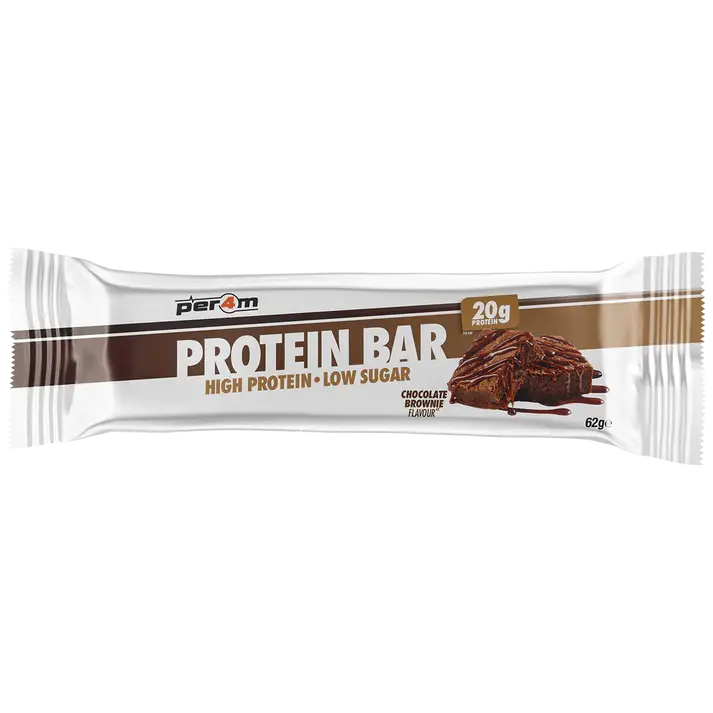
What is the Per4m Protein Bar?
It is a 62 g protein bar coated in milk chocolate, supplying 20 g of protein for 200 kcal. The flavours listed, from Dubai Chocolate to Baklava by way of Salted Caramel and Cookie Dough.
It is built in three layers: a protein blend at 37%, a caramel-flavoured layer at 10% and a milk chocolate coating at 15%. Sugar is replaced by maltitol, a polyol, and by oligofructose; vegetable glycerol acts as a humectant and gives the bar its softness.
One point about the composition needs raising straight away, because it changes how you read the label: the protein blend combines milk proteins, soya isolate crispies and hydrolysed bovine collagen. We come back to it below. The full range sits in our Per4m aisle, and the category as a whole in protein bars.
What does a 62 g bar contain?
| Nutrient | Per 62 g bar | Per 100 g* | % NRV |
|---|---|---|---|
| Energy | 836 kJ / 200 kcal | 1,348 kJ / 323 kcal | — |
| Protein | 20 g | 32.3 g | 40% |
| Carbohydrate | 14 g | 22.6 g | — |
| of which sugars | not disclosed | not disclosed | — |
| of which polyols | not disclosed | not disclosed | — |
| Fat | 8.5 g | 13.7 g | — |
| of which saturates | not disclosed | not disclosed | — |
| Fibre | 5.1 g | 8.2 g | — |
| Salt | 0.3 g | 0.48 g | — |
| Calcium | 120 mg | 194 mg | 15% |
| Potassium | 180 mg | 290 mg | 9% |
* Column calculated from the values declared for one bar. Three lines are missing from the data supplied, and they are not trivial ones: sugars, polyols and saturates. Yet maltitol appears twice in the ingredients list, as the main sweetener of both the bar and the coating. We will not publish a figure we do not have: read the label on the bar you receive, particularly if your digestion reacts to polyols.
What is solid, on the other hand, really is solid. Twenty grams of protein for 200 kcal means that 40% of the bar's energy comes from protein — double the 20% threshold that allows the “high protein” claim. It is one of the best ratios in the aisle, and it can be checked. The 5.1 g of fibre, that is 8.2 g per 100 g, also clear the “high fibre” threshold, set at 6 g per 100 g. And the 120 mg of calcium at 15% of the NRV allow the “source of calcium” claim, which is rare on a bar.
Now for the nuance that matters, and that the aisle never mentions. Hydrolysed bovine collagen is part of the protein blend. Collagen is an incomplete protein: its essential amino acid profile is very poor, in tryptophan especially. It counts in full towards the 20 g declared for labelling purposes, without bringing the same value as a milk protein. Since the manufacturer does not publish the split between the three sources, we cannot say what share of the total it represents. It is worth knowing before you compare this bar with another.
The applicable wording remains the only authorised one: protein contributes to a growth in and the maintenance of muscle mass. For calcium, at 15% of the NRV: calcium contributes to normal muscle function and is needed for the maintenance of normal bones.
How does this bar fit into the day?
Serving: 1 bar of 62 g. Liquid: 250 ml of water, as the bar is dense. Timing: after training, as a snack between two meals, or as a dessert. Frequency: one bar a day. Duration: none, it is a food.
Two hundred kilocalories is a proper snack and not a trivial nibble. For comparison, it is the energy equivalent of a large banana with a yoghurt — but with 20 g of protein instead of 5. That is exactly what makes the product worthwhile: the ratio, not the idea that it is “light”, which it is not.
The most relevant use is the one where nothing else is possible: a trip, a day with no break, a session followed by two hours of travel. That is where a bar beats a shake, because it needs no water, no shaker and no fridge. At home, a bowl of fromage blanc will do the same job for less.
On timing, let us keep it plain: there is no thirty-minute window to hit after training. The day's protein total matters more than the slot. Eat it when you are genuinely short of protein.
Store it dry, at room temperature and away from direct light. As the coating is milk chocolate, it melts in a car in summer — the only real drawback of the format in our part of the world.
Who is this bar for, and who is it not for?
It suits those who need a portable protein snack, and those looking for a treat that counts towards their totals rather than an ordinary chocolate bar. The flavours, squarely in dessert territory, are a genuine argument: boredom is the leading cause of people giving up in this aisle.
It contains MILK and SOYA, and may contain GLUTEN. The manufacturer declares it unsuitable for people allergic to NUTS and PEANUTS. It is aimed at adults; pregnant and breastfeeding women should seek advice before consuming it, as with any supplement.
It does not suit vegetarians: hydrolysed bovine collagen is of animal origin, which the name “protein bar” gives no hint of. It is a point we flag as a matter of course over the counter. It suits you less well if you tolerate polyols poorly: maltitol is the main sweetener, and its content is not declared. Excessive consumption of polyols may produce laxative effects; one bar is generally well tolerated, two or three much less so.
What you should not expect from it: this is not a weight-loss product. Two hundred kilocalories added to an already complete day remain 200 kcal added. A protein bar is only worthwhile if it replaces something — an afternoon snack, a pastry, a ruined meal. Stacked on top of everything else, it does nothing more than what its label says.
Per4m Protein Bar or Grenade Carb Killa?
These are the two bars most often compared over the counter, and we sell both.
The Grenade range is built on a bar that is lighter in weight, around 60 g, with a protein profile that is often entirely dairy and a crunchier texture. It is the better choice if you want to avoid collagen in the protein blend, or if you prefer a bar that crunches to one that is soft.
The Per4m wins on three measurable points: 40% of its energy supplied by protein, 5.1 g of fibre and 15% of the NRV in calcium, which few bars can show. It also offers flavours you will not find elsewhere. Its triple-layer texture — coating, caramel centre, crispies — really does come close to confectionery, which is an argument if the bar has to stand in for a dessert.
If your need is simply to add protein at the lowest cost, neither is the right choice: a shake from the protein aisle costs two to three times less for the same intake. You buy a bar for its convenience and its taste, not for its price-to-protein ratio. The other snack formats can be compared in our protein snacks and protein cookies aisles.
Frequently asked questions
Does all 20 g of protein come from milk?
No. The protein blend combines milk proteins, soya isolate and hydrolysed bovine collagen. Collagen is an incomplete protein, very poor in essential amino acids, but it counts in full towards the declared total. The manufacturer does not publish the split between the three sources.
How much sugar is in one bar?
The manufacturer does not declare that line in the labelling data available to us, any more than the polyol line, even though maltitol is the main sweetener. We will not publish an unverified figure: refer to the label on the bar you receive.
Is the bar suitable for vegetarians?
No. The hydrolysed bovine collagen in the protein blend is of animal origin. It is a piece of information that often comes as a surprise, since the name “protein bar” suggests a dairy or plant-based product only.
Can it cause digestive upset?
Maltitol is a polyol, and excessive consumption of polyols may produce laxative effects. One bar a day is generally well tolerated; two or three much less so, all the more since 5.1 g of fibre and oligofructose come with it. If you are sensitive, start with half a bar.
Is 200 kcal a lot for a snack?
It is a proper snack, the energy equivalent of a large banana with a yoghurt — but with 20 g of protein instead of 5. It is not a trivial nibble: it makes sense if it replaces something, less so if it is added to an already complete day.
Which flavour should you choose?
Chocolate Brownie and Cookie Dough are the safe bets, in a classic register. Dubai Chocolate and Baklava are the most marketed, enjoyable now and then but wearing after a few bars. Salted Caramel and Chocolate Peanut Butter are the sweetest on the palate. Note that flavour availability varies with deliveries.
Should you eat it right after training?
No. The thirty-minute window is an outdated notion: it is the protein total over twenty-four hours that counts. Eat the bar at the moment when you have no other decent option — that is where, and only where, it beats a real meal or a shake.
Where to buy the Per4m Protein Bar?
The available flavours can be ordered from this page, and we ship throughout France and Europe. The assortment moves with deliveries: it is an aisle worth checking regularly.
At the Vendargues shop, about ten minutes from Montpellier, this is the aisle where people buy singles before committing to a whole box, and that is the right instinct: a bar you do not like stays in the cupboard, whatever its nutritional values. The rest of the snacks can be compared in our sports nutrition section, and dedicated collagen sources in their own aisle.
What is a protein snack really for?
A protein snack solves a logistical problem, not a nutritional problem. It provides protein when you don't have a kitchen, a refrigerator, a shaker, or ten minutes to spare. It fits in a bag, stores at room temperature, and can be eaten on the go. That's its whole point, and it's a real point.
Let's be clear: it's not a superior food. A can of tuna, two hard-boiled eggs, a skyr, or 200g of plain cottage cheese provide as much protein, more micronutrients, fewer additives, and cost three to four times less. If you're at home, these solutions are better in every way except one: availability.
Some benchmarks. The reference adopted by ANSES for the general adult population is 0.83g of protein per kilogram of body weight per day. Usual benchmarks for a strength athlete are rather between 1.6 and 2.2g per kilogram. For a 75kg person who trains, this represents 120 to 165g per day, spread over three to five meals. A snack covers one of these meals when it would otherwise be missed. It does not replace the others.
Which format to choose depending on the time of day?
In the morning, when breakfast is skipped
A dense bar or a cookie will do, with carbohydrates to start the day. If you have five minutes at home, a preparation for protein pancakes or an omelet with liquid egg whites gives an incomparable result, for less money.
As an afternoon snack
This is when a protein snack is most relevant: it fills a four or five-hour gap and prevents late-day hunger pangs. A protein bar with 15 to 20g of protein for 200 kcal is the best value in its category. A protein cookie is suitable if you're genuinely hungry: it's larger, more filling, but also twice as caloric.
Before and after a workout
Before, allow 60 to 90 minutes margin: bars and cookies are rich in fiber and often polyols, and eaten a quarter of an hour before an intense workout, they'll make you pay during your sets. After, a snack is a good stopgap but not the best choice, as fats and fibers slow digestion when you want the opposite: a protein shake does better, faster, and for less. The timing isn't urgent; the two hours following the session are plenty.
On the go and in the evening
Airport, highway, day of meetings: this is the only context where the protein snack has no serious competitor. In the evening, nothing forbids it as long as it's counted in the daily intake; for an intake before bedtime, a casein is more suitable due to its slow digestion.
How to avoid the trap of high-calorie products?
This is the main flaw of this section, and it deserves to be named: the word "protein" on packaging does not make a product light. Some items exceed 400 kcal per unit, which is equivalent to a meal, while being perceived as dietary snacks. Three simple habits are enough to prevent this.
Calculate per serving, never per 100g. The nutritional table is legally expressed per 100g, but none of these products weigh 100g. A bar advertising "30g of protein" only contains 17g if it weighs 55g.
Look at the protein-to-calorie ratio. This is the only indicator that honestly ranks formats against each other. A bar with 18g of protein for 200 kcal gives 9g per 100 kcal; a protein donut with 15g for 350 kcal gives 4.3g. Both have their place, but they are not the same products, and the front of the package doesn't tell you that.
Count the polyols. European regulations require the mention "excessive consumption may produce laxative effects" beyond 10% polyols in a product. In this section, it is common. An isolated product rarely causes problems; three in the same day often do. Details can be found in our flavor and sweetener section.
What formats exist, and what are they used for?
This page is the entry point to the section; each format has its own page, which goes into detail.
- Protein bars: the most concentrated and portable format. 15 to 20g of protein for 190 to 250 kcal. The default choice.
- Protein cookies: larger, more filling, more caloric. For real hunger, or during a bulking phase. The page details label reading and a quantified homemade recipe.
- Peanut butter: not a grab-and-go snack, but the most economical snack base in the section, and the central ingredient for homemade versions.
- Protein pancakes: for at-home meals, breakfast or snack, at a much lower cost per serving than a packaged product.
- Liquid egg whites: the cheapest and leanest protein source for cooking, omelets, pancakes, cakes.
In addition to these formats, the section includes protein pastries — donuts, brownies — which embrace their position on the pleasure side, and oat-based bars that are more about energy snacks than protein intake.
Frequently Asked Questions
What is a protein?
A long chain of amino acids folded upon itself. Twenty different amino acids make up human proteins; the order in which they are linked determines the molecule's shape, and its shape determines its function. Nine of these twenty are called essential: the body cannot produce them and must obtain them from food. When you eat a protein, digestion breaks it down into amino acids, which the body then reassembles according to its own needs — that's why no dietary protein "becomes" muscle directly.
What is the role of protein in the body?
Much broader than muscle, even if that's what this section focuses on. Proteins are the body's structure — collagen in tendons and skin, keratin in hair, contractile proteins in muscle. They are also the enzymes that make chemical reactions possible, the transporters like hemoglobin that carry oxygen, part of the hormones, and the antibodies of the immune defense. Two European claims are authorized regarding them: proteins contribute to the growth and maintenance of muscle mass, and to the maintenance of normal bones. It is the maintenance of this vast ongoing construction site that explains why a daily intake is necessary.
What is the most protein-rich food?
Among common foods, the most dense are lean meat and fish, around 20 to 25g per 100g, hard cheeses, between 25 and 35g, canned tuna at about 25g, dried legumes between 20 and 25g before cooking, and eggs at 13g. But the "per 100g" ranking is misleading: a cheese with 30g of protein also provides 30g of fat, whereas chicken breast or egg white provide almost zero. The useful criterion is the protein-to-calorie ratio, and here the winners are egg whites, white fish, lean poultry, and 0% dairy products. Powders go up to 80g per 100g, but these are no longer foods.
How to replace protein powder?
With food, simply put, and it's perfectly feasible. 30g of whey provides about 24g of protein: the equivalent can be found in 100g of chicken breast, 120g of tuna, four egg whites, 250g of 0% cottage cheese, or one and a half skyrs. Powders have no nutritional superiority: they are simply faster, more portable, and often cheaper per gram of protein. The two situations where they maintain a clear advantage are immediately after training, where rapid digestion is a plus, and high intakes — beyond 150g per day, getting everything through food becomes a constraint.
Do protein snacks make you gain weight?
Not in themselves, but they can easily contribute when they are added to meals instead of replacing them. A bar weighs 190 to 250 kcal, a large cookie can exceed 400 kcal: two products a day represent 400 to 800 kcal added to your total. Taken instead of a snack you would have consumed anyway, they are neutral, or even favorable since proteins satisfy better for equal calories. Taken as a supplement because they are perceived as dietary, they push the balance upwards.
Which snack to choose when trying to lose weight?
The one that satisfies the most for the fewest calories, and fits into your day. In this game, fresh products win: 200g of 0% cottage cheese provides about 90 kcal and 15g of protein, a 150g skyr about 90 kcal and 15g, two hard-boiled eggs 140 kcal and 12g. A protein bar provides comparable protein for 200 to 250 kcal: it loses the comparison at home, and wins everywhere else. The real criterion for weight loss is not the nature of the product but the fact of counting it in the daily total.
What to snack on in the evening in front of the TV?
The problem with evening snacking is almost never hunger, it's automatism. Two strategies work better than substituting with a protein product. The first: portion out what you will eat in advance, on a plate, rather than putting a package on the table. The second: choose foods that are long to eat and voluminous for few calories — raw vegetables, plain popcorn, fruit, plain yogurt. A protein snack has the advantage of being pre-portioned, which avoids opening a whole bag "just for a little bit", but it's still 200 kcal per unit.
How many protein snacks per day?
One, as a general rule. Two are justified on a travel day where meals are impossible. Beyond that, you accumulate polyols, fermentable fibers and calories for a benefit that no longer increases. Daily protein should primarily come from meals, and the body uses spread out intakes better than massive ones.
Protein snack or protein shake?
The shake wins at home on all counts: three to four times cheaper for the same amount of protein, precisely dosable, better digested around exercise, and no polyols. The snack wins everywhere else, because a shake requires water, a container, and a place to wash it. The right way to ask the question isn't "which is better" but "where will I be at four o'clock."
How to make homemade protein snacks?
The basic recipe requires no cooking. Dry mix 60g of oat flour and 60g of flavored protein powder, add 60g of warmed peanut butter, then 40 to 70ml of milk one spoonful at a time until a compact dough is obtained. Press into a mold, refrigerate for two hours, cut into six. Keeps for four to five days in the refrigerator. The cost per serving is incomparable to that of a packaged product, and you control the sweetener. The protein cookies page offers a baked version with calculated values.
Why do I have a stomach ache after a protein snack?
Three causes, in order of frequency: polyols, primarily maltitol; added fibers such as inulin or fructo-oligosaccharides; residual lactose from milk proteins. Switching to an erythritol version or a plant-based version often solves the problem. For lactose, digestive enzymes can help. If the discomfort persists or worsens, speak to a doctor rather than endlessly changing brands.
Where to buy protein snacks in stores?
In a specialized store like ours, where bars and cookies can be bought individually: this is the only way to taste before buying a box of twelve. The criterion to check on the shelf is always the same: the actual weight of the unit, proteins per unit and not per 100g, and the eventual presence of the mention regarding polyols. We also ship everywhere in France and Europe for restocks.
Are they suitable for someone who doesn't exercise?
They have no particular disadvantage, but the benefit is lower. Without training, protein needs are covered by an ordinary diet in the vast majority of cases. The only valid argument then is satisfaction: a portioned and filling product instead of a packet of biscuits. This is valid, but it does not justify the price per kilo if simple alternatives are available.
What brands are in this section?
We select these products based on three criteria: the actual protein content relative to the unit's weight, the nature of the sweeteners, and the taste — a product that looks good on paper but is unpleasant ends up in the back of a cupboard and is useless.
For bars, Grenade and PhD Nutrition are at the top for coated versions, Warrior and Per4m cover other texture profiles, ESN offers formats without added sugar, and LSP Sports specializes in oat bars, which are more energetic than protein-focused. For pastries, Lenny & Larry's for large vegan cookies and IO Genix for donuts and brownies.
To place these products in a complete eating plan, see our mass gain and sports nutrition sections. And for the grocery side, zero sauces and zero jams complement homemade preparations.
Can I buy them individually near Montpellier?
A snack is chosen by taste, and taste cannot be read on any product sheet. At our store in Vendargues, about ten minutes from Montpellier, bars and cookies can be bought individually: you can try two references before leaving with a box of the one that suits you. This is the best way to avoid an opened box sitting in the cupboard for six months. We ship everywhere in France and Europe for restocks.


What is the IO Genix Protein Brownie?
IO Genix Protein Brownie is a ready-to-eat brownie, sold individually. A 60 g brownie provides 7.5 g of protein and 6.3 g of carbohydrate, of which only 0.9 g sugars, for 257 kcal. Several versions exist: dark chocolate chips or white chocolate chips.
What makes the recipe unusual is its base. The first ingredient is egg white, the second almond flour at 22%, and there is neither wheat flour nor added sugar. That is what explains a nutritional profile very unusual for a baked good: a lot of fat, very little carbohydrate.
Put another way, this is not a conventional protein brownie — those are generally built on a base of flour and glucose syrup. It is a baked good designed for a low-carbohydrate diet, and that is a rare position to take. The rest of the Spanish range is in our IO Genix aisle, and the other snacks of this type in our protein snacks aisle.
What is in a Protein Brownie?
| Values | Per 100 g | Per 60 g brownie |
|---|---|---|
| Energy | 429 kcal | 257 kcal |
| Fat | 32.4 g | 19.4 g |
| of which saturates | 2.9 g | approximately 1.7 g |
| Carbohydrate | 10.5 g | 6.3 g |
| of which sugars | 1.5 g | 0.9 g |
| Protein | 12.5 g | 7.5 g |
| Salt | 0.13 g | approximately 0.08 g |
0.9 g of sugars in a whole brownie: that is the figure that defines this product. A conventional bakery brownie of the same weight commonly contains twenty to thirty times more. The per 100 g content, at 1.5 g, puts the product below the European threshold for the low in sugars claim. The sweet taste comes from three sweeteners — isomalt, erythritol and steviol glycosides — and not from sugar.
The fat line, on the other hand, deserves to be faced squarely rather than passed over in silence: 19.4 g per brownie, or 32.4 g per 100 g. That is not a manufacturing flaw, it is the direct consequence of the recipe: almond flour makes up 22% of the product, and almonds are naturally high in fat. Saturates stay low, at 2.9 g per 100 g, which is rather good. But if you are counting your fat, this brownie weighs on the total.
An honest regulatory point, and it runs counter to what you would expect: with 12.5 g of protein for 429 kcal, the share of energy provided by protein works out at approximately 11.7%. The European threshold for the “source of protein” claim is 12%: this product therefore falls just below it, and we will not use the claim. 7.5 g per brownie remains a genuine contribution for a dessert, but this is not a protein snack in the strict sense.
Missing from the manufacturer's file: the fibre content is not disclosed. We will not invent it, even though it would be of interest given the proportion of almond flour. The label on the product you receive is the authority.
Ingredient list
EGG white, ALMOND flour (22%), sunflower oil, sweeteners (isomalt, erythritol, steviol glycosides), chocolate chips (7%) [cocoa mass, sweetener (erythritol), cocoa butter, emulsifier (sunflower lecithin), natural vanilla flavouring, sweetener (steviol glycosides)], MILK protein, cocoa powder, skimmed MILK powder, humectant (glycerol), raising agents (sodium bicarbonate, disodium diphosphate), flavourings, preservative (potassium sorbate).
Contains EGGS, MILK and NUTS (almonds). May contain traces of SOYA, PEANUTS, SULPHITES and SESAME.
How do you eat the Protein Brownie?
Serving: 1 brownie of 60 g. Preparation: none, the product is ready to eat. Timing: as a snack between meals, after training, or as a dessert. Frequency: according to your eating plan, allowing for the 257 kcal. Storage: in a cool, dry place.
It is the simplest product in this whole catalogue: there is nothing to measure out, nothing to mix, nothing to bake. That simplicity is its real selling point — a brownie in a gym bag or a desk drawer settles the four o'clock snack question better than a shaker you have to make up.
One warning from the manufacturer deserves to be taken seriously: excessive consumption may have a laxative effect, because of the polyols present. Isomalt and erythritol belong to that family of sweeteners, and how well they are tolerated varies a great deal from one person to the next. One brownie poses no problem at all for the vast majority of people; three in an afternoon is another story. If you are new to this kind of product, start with one and see how you cope with it.
On the calorie side, bear in mind that 257 kcal is not trivial for a snack. It is the equivalent of a light meal, and it comes almost entirely from the fat. On a day when you are counting, it has to be worked in, not added on.
It goes very well with a coffee or a tea, and slips into a low-carbohydrate diet without disrupting it — which is exactly the niche it was designed for. A spoonful of peanut butter on top makes it a more substantial dessert, at the cost of a little extra fat, and a sugar-free topping remains the lightest option.
Who is the Protein Brownie for, and who is it not for?
It suits first of all those following a low-carbohydrate diet and looking for a compatible dessert: with 6.3 g of carbohydrate per unit, it fits into almost any plan. It also suits anyone who needs a portable snack, with no preparation, and who can no longer face protein bars.
It is not suitable for people with a nut allergy: almond flour makes up 22% of the product. This is not a trace, it is the second ingredient in the recipe. Nor is it suitable for people allergic to eggs or milk proteins, or for vegans. Traces of soya, peanuts, sulphites and sesame are also possible.
Nor is it suitable if what you are chiefly after is protein. 7.5 g per unit for 257 kcal is a markedly less favourable ratio than that of a conventional protein bar. This product is first and foremost a low-sugar baked good, not a protein source.
Finally, it is not suitable for people sensitive to polyols, for the reason set out above. That is a matter of individual tolerance, to be tested with one unit, not with a box.
What not to expect from it: this is not a slimming product. 257 kcal is still 257 kcal, and the absence of sugars does not make it a neutral food. What it avoids is the glycaemic load of a conventional baked good — which is genuinely valuable if that is your constraint, and worth nothing if it is the calorie total you are watching.
Protein brownie or protein bar?
Both take up the same space in a bag, and you choose between them according to what you are counting.
A conventional protein bar generally provides 15 to 20 g of protein for a comparable weight, with higher carbohydrate and lower fat. It is the better choice if your aim is protein intake, particularly after training, or if you are watching your fat.
This brownie reverses the profile entirely: little protein, very little carbohydrate, a lot of fat. It is the better choice on a low-carbohydrate diet, at the end of the day when you want a dessert without pushing your carbohydrate up, and for the texture — a bar is still a bar, whereas a brownie is a genuinely moist cake.
If what you need is an indulgent snack with no particular carbohydrate constraint, protein cookies offer a middle ground. And if you are simply trying to hit your daily protein total, a protein powder remains, by a long way, the cheapest solution per gram.
Frequently asked questions
How much sugar is in a brownie?
0.9 g per 60 g brownie, or 1.5 g per 100 g. That is below the European threshold for the “low in sugars” claim. The sweet taste comes from isomalt, erythritol and steviol glycosides, three sugar-free sweeteners.
Why is there so much fat?
Because almond flour makes up 22% of the recipe and almonds are naturally high in fat, with sunflower oil added on top. It is the direct trade-off for a recipe without wheat flour and without sugar: 19.4 g of fat per brownie, of which only 1.7 g saturates.
Is it a source of protein?
Not in the regulatory sense. With 12.5 g of protein for 429 kcal, the share of energy from protein works out at approximately 11.7%, just below the 12% threshold required for the “source of protein” claim. 7.5 g per brownie remains a genuine contribution, but this product is first and foremost a dessert.
Can it have a laxative effect?
The manufacturer flags this in the event of excessive consumption, because of the polyols isomalt and erythritol. One brownie poses a problem for almost nobody; tolerance varies mainly when several are eaten one after another. Start with one unit.
Is it suitable for people with a nut allergy?
No, categorically. Almond flour makes up 22% of the product: it is a main ingredient and not a trace. The brownie is therefore ruled out in cases of nut allergy, with no possible exception.
What is the difference between the versions?
The chocolate chips: dark in one, white in the other. The brownie base remains the same. The exact composition of the chips does differ between versions, however: check the label on the unit you receive if you have an allergy or a specific requirement.
Is it suitable for a low-carbohydrate diet?
That is precisely the product's niche: 6.3 g of carbohydrate per brownie, of which 0.9 g sugars. It fits into most low-carbohydrate plans. Just bear in mind that the 257 kcal count like any other.
Where can you buy the IO Genix Protein Brownie?
The versions can be ordered from this page, and we ship throughout France and Europe. At the Vendargues shop, about ten minutes from Montpellier, this is the product we hand to customers on a low-carbohydrate diet who tell us they are allowed nothing sweet: 0.9 g of sugars is a concrete answer, and it is worth more than advice about willpower. The rest of the aisle can be browsed in our sports nutrition section.
Retrait au magasin sous 2 h
À Vendargues, près de Montpellier. Vous êtes prévenu dès que la commande est prête.
Commandé avant 14 h, expédié le jour même
Du lundi au samedi. Le délai d'acheminement appartient ensuite au transporteur.
Livraison offerte dès 50 €
En France métropolitaine, et dès 100 € en Europe. Modes et délais.
Une question avant de commander ?
Écrivez-nous ou passez au magasin : on connaît les produits qu'on vend.
What is a protein snack really for?
A protein snack solves a logistical problem, not a nutritional problem. It provides protein when you don't have a kitchen, a refrigerator, a shaker, or ten minutes to spare. It fits in a bag, stores at room temperature, and can be eaten on the go. That's its whole point, and it's a real point.
Let's be clear: it's not a superior food. A can of tuna, two hard-boiled eggs, a skyr, or 200g of plain cottage cheese provide as much protein, more micronutrients, fewer additives, and cost three to four times less. If you're at home, these solutions are better in every way except one: availability.
Some benchmarks. The reference adopted by ANSES for the general adult population is 0.83g of protein per kilogram of body weight per day. Usual benchmarks for a strength athlete are rather between 1.6 and 2.2g per kilogram. For a 75kg person who trains, this represents 120 to 165g per day, spread over three to five meals. A snack covers one of these meals when it would otherwise be missed. It does not replace the others.
Which format to choose depending on the time of day?
In the morning, when breakfast is skipped
A dense bar or a cookie will do, with carbohydrates to start the day. If you have five minutes at home, a preparation for protein pancakes or an omelet with liquid egg whites gives an incomparable result, for less money.
As an afternoon snack
This is when a protein snack is most relevant: it fills a four or five-hour gap and prevents late-day hunger pangs. A protein bar with 15 to 20g of protein for 200 kcal is the best value in its category. A protein cookie is suitable if you're genuinely hungry: it's larger, more filling, but also twice as caloric.
Before and after a workout
Before, allow 60 to 90 minutes margin: bars and cookies are rich in fiber and often polyols, and eaten a quarter of an hour before an intense workout, they'll make you pay during your sets. After, a snack is a good stopgap but not the best choice, as fats and fibers slow digestion when you want the opposite: a protein shake does better, faster, and for less. The timing isn't urgent; the two hours following the session are plenty.
On the go and in the evening
Airport, highway, day of meetings: this is the only context where the protein snack has no serious competitor. In the evening, nothing forbids it as long as it's counted in the daily intake; for an intake before bedtime, a casein is more suitable due to its slow digestion.
How to avoid the trap of high-calorie products?
This is the main flaw of this section, and it deserves to be named: the word "protein" on packaging does not make a product light. Some items exceed 400 kcal per unit, which is equivalent to a meal, while being perceived as dietary snacks. Three simple habits are enough to prevent this.
Calculate per serving, never per 100g. The nutritional table is legally expressed per 100g, but none of these products weigh 100g. A bar advertising "30g of protein" only contains 17g if it weighs 55g.
Look at the protein-to-calorie ratio. This is the only indicator that honestly ranks formats against each other. A bar with 18g of protein for 200 kcal gives 9g per 100 kcal; a protein donut with 15g for 350 kcal gives 4.3g. Both have their place, but they are not the same products, and the front of the package doesn't tell you that.
Count the polyols. European regulations require the mention "excessive consumption may produce laxative effects" beyond 10% polyols in a product. In this section, it is common. An isolated product rarely causes problems; three in the same day often do. Details can be found in our flavor and sweetener section.
What formats exist, and what are they used for?
This page is the entry point to the section; each format has its own page, which goes into detail.
- Protein bars: the most concentrated and portable format. 15 to 20g of protein for 190 to 250 kcal. The default choice.
- Protein cookies: larger, more filling, more caloric. For real hunger, or during a bulking phase. The page details label reading and a quantified homemade recipe.
- Peanut butter: not a grab-and-go snack, but the most economical snack base in the section, and the central ingredient for homemade versions.
- Protein pancakes: for at-home meals, breakfast or snack, at a much lower cost per serving than a packaged product.
- Liquid egg whites: the cheapest and leanest protein source for cooking, omelets, pancakes, cakes.
In addition to these formats, the section includes protein pastries — donuts, brownies — which embrace their position on the pleasure side, and oat-based bars that are more about energy snacks than protein intake.
Frequently Asked Questions
What is a protein?
A long chain of amino acids folded upon itself. Twenty different amino acids make up human proteins; the order in which they are linked determines the molecule's shape, and its shape determines its function. Nine of these twenty are called essential: the body cannot produce them and must obtain them from food. When you eat a protein, digestion breaks it down into amino acids, which the body then reassembles according to its own needs — that's why no dietary protein "becomes" muscle directly.
What is the role of protein in the body?
Much broader than muscle, even if that's what this section focuses on. Proteins are the body's structure — collagen in tendons and skin, keratin in hair, contractile proteins in muscle. They are also the enzymes that make chemical reactions possible, the transporters like hemoglobin that carry oxygen, part of the hormones, and the antibodies of the immune defense. Two European claims are authorized regarding them: proteins contribute to the growth and maintenance of muscle mass, and to the maintenance of normal bones. It is the maintenance of this vast ongoing construction site that explains why a daily intake is necessary.
What is the most protein-rich food?
Among common foods, the most dense are lean meat and fish, around 20 to 25g per 100g, hard cheeses, between 25 and 35g, canned tuna at about 25g, dried legumes between 20 and 25g before cooking, and eggs at 13g. But the "per 100g" ranking is misleading: a cheese with 30g of protein also provides 30g of fat, whereas chicken breast or egg white provide almost zero. The useful criterion is the protein-to-calorie ratio, and here the winners are egg whites, white fish, lean poultry, and 0% dairy products. Powders go up to 80g per 100g, but these are no longer foods.
How to replace protein powder?
With food, simply put, and it's perfectly feasible. 30g of whey provides about 24g of protein: the equivalent can be found in 100g of chicken breast, 120g of tuna, four egg whites, 250g of 0% cottage cheese, or one and a half skyrs. Powders have no nutritional superiority: they are simply faster, more portable, and often cheaper per gram of protein. The two situations where they maintain a clear advantage are immediately after training, where rapid digestion is a plus, and high intakes — beyond 150g per day, getting everything through food becomes a constraint.
Do protein snacks make you gain weight?
Not in themselves, but they can easily contribute when they are added to meals instead of replacing them. A bar weighs 190 to 250 kcal, a large cookie can exceed 400 kcal: two products a day represent 400 to 800 kcal added to your total. Taken instead of a snack you would have consumed anyway, they are neutral, or even favorable since proteins satisfy better for equal calories. Taken as a supplement because they are perceived as dietary, they push the balance upwards.
Which snack to choose when trying to lose weight?
The one that satisfies the most for the fewest calories, and fits into your day. In this game, fresh products win: 200g of 0% cottage cheese provides about 90 kcal and 15g of protein, a 150g skyr about 90 kcal and 15g, two hard-boiled eggs 140 kcal and 12g. A protein bar provides comparable protein for 200 to 250 kcal: it loses the comparison at home, and wins everywhere else. The real criterion for weight loss is not the nature of the product but the fact of counting it in the daily total.
What to snack on in the evening in front of the TV?
The problem with evening snacking is almost never hunger, it's automatism. Two strategies work better than substituting with a protein product. The first: portion out what you will eat in advance, on a plate, rather than putting a package on the table. The second: choose foods that are long to eat and voluminous for few calories — raw vegetables, plain popcorn, fruit, plain yogurt. A protein snack has the advantage of being pre-portioned, which avoids opening a whole bag "just for a little bit", but it's still 200 kcal per unit.
How many protein snacks per day?
One, as a general rule. Two are justified on a travel day where meals are impossible. Beyond that, you accumulate polyols, fermentable fibers and calories for a benefit that no longer increases. Daily protein should primarily come from meals, and the body uses spread out intakes better than massive ones.
Protein snack or protein shake?
The shake wins at home on all counts: three to four times cheaper for the same amount of protein, precisely dosable, better digested around exercise, and no polyols. The snack wins everywhere else, because a shake requires water, a container, and a place to wash it. The right way to ask the question isn't "which is better" but "where will I be at four o'clock."
How to make homemade protein snacks?
The basic recipe requires no cooking. Dry mix 60g of oat flour and 60g of flavored protein powder, add 60g of warmed peanut butter, then 40 to 70ml of milk one spoonful at a time until a compact dough is obtained. Press into a mold, refrigerate for two hours, cut into six. Keeps for four to five days in the refrigerator. The cost per serving is incomparable to that of a packaged product, and you control the sweetener. The protein cookies page offers a baked version with calculated values.
Why do I have a stomach ache after a protein snack?
Three causes, in order of frequency: polyols, primarily maltitol; added fibers such as inulin or fructo-oligosaccharides; residual lactose from milk proteins. Switching to an erythritol version or a plant-based version often solves the problem. For lactose, digestive enzymes can help. If the discomfort persists or worsens, speak to a doctor rather than endlessly changing brands.
Where to buy protein snacks in stores?
In a specialized store like ours, where bars and cookies can be bought individually: this is the only way to taste before buying a box of twelve. The criterion to check on the shelf is always the same: the actual weight of the unit, proteins per unit and not per 100g, and the eventual presence of the mention regarding polyols. We also ship everywhere in France and Europe for restocks.
Are they suitable for someone who doesn't exercise?
They have no particular disadvantage, but the benefit is lower. Without training, protein needs are covered by an ordinary diet in the vast majority of cases. The only valid argument then is satisfaction: a portioned and filling product instead of a packet of biscuits. This is valid, but it does not justify the price per kilo if simple alternatives are available.
What brands are in this section?
We select these products based on three criteria: the actual protein content relative to the unit's weight, the nature of the sweeteners, and the taste — a product that looks good on paper but is unpleasant ends up in the back of a cupboard and is useless.
For bars, Grenade and PhD Nutrition are at the top for coated versions, Warrior and Per4m cover other texture profiles, ESN offers formats without added sugar, and LSP Sports specializes in oat bars, which are more energetic than protein-focused. For pastries, Lenny & Larry's for large vegan cookies and IO Genix for donuts and brownies.
To place these products in a complete eating plan, see our mass gain and sports nutrition sections. And for the grocery side, zero sauces and zero jams complement homemade preparations.
Can I buy them individually near Montpellier?
A snack is chosen by taste, and taste cannot be read on any product sheet. At our store in Vendargues, about ten minutes from Montpellier, bars and cookies can be bought individually: you can try two references before leaving with a box of the one that suits you. This is the best way to avoid an opened box sitting in the cupboard for six months. We ship everywhere in France and Europe for restocks.
Questions fréquentes — Protein Snacks
Une protéine, c'est quoi ?
Une longue chaîne d'acides aminés repliée sur elle-même. Vingt acides aminés différents entrent dans la composition des protéines humaines ; l'ordre dans lequel ils s'enchaînent détermine la forme de la molécule, et sa forme détermine sa fonction. Neuf de ces vingt sont dits essentiels : l'organisme ne sait pas les fabriquer et doit les recevoir de l'alimentation. Quand vous mangez une protéine, la digestion la découpe en acides aminés, que le corps réassemble ensuite selon ses propres besoins — c'est pourquoi aucune protéine alimentaire ne « devient » du muscle directement.
Quel est le rôle des protéines dans l'organisme ?
Bien plus large que le muscle, même si c'est ce qui intéresse ce rayon. Les protéines sont la structure du corps — collagène des tendons et de la peau, kératine des cheveux, protéines contractiles du muscle. Elles sont aussi les enzymes qui rendent possibles les réactions chimiques, les transporteurs comme l'hémoglobine qui porte l'oxygène, une partie des hormones, et les anticorps de la défense immunitaire. Deux allégations européennes sont autorisées à leur sujet : les protéines contribuent au développement et au maintien de la masse musculaire, et au maintien d'une ossature normale. C'est le maintien de ce vaste chantier permanent qui explique qu'un apport quotidien soit nécessaire.
Quel est l'aliment le plus riche en protéines ?
Parmi les aliments courants, les plus denses sont la viande maigre et le poisson, autour de 20 à 25 g pour 100 g, les fromages à pâte dure, entre 25 et 35 g, le thon en conserve à environ 25 g, les légumineuses sèches entre 20 et 25 g avant cuisson, et les œufs à 13 g. Mais le classement « pour 100 g » est trompeur : un fromage à 30 g de protéines apporte aussi 30 g de lipides, là où le blanc de poulet ou le blanc d'œuf en apportent presque zéro. Le critère utile est le rapport protéines sur calories, et sur ce terrain les gagnants sont le blanc d'œuf, le poisson blanc, la volaille maigre et les produits laitiers à 0 %. Les poudres montent à 80 g pour 100 g, mais ce ne sont plus des aliments.
Comment remplacer les protéines en poudre ?
Par des aliments, tout simplement, et c'est parfaitement faisable. 30 g de whey apportent environ 24 g de protéines : l'équivalent se trouve dans 100 g de blanc de poulet, 120 g de thon, quatre blancs d'œufs, 250 g de fromage blanc à 0 % ou un skyr et demi. Les poudres n'ont aucune supériorité nutritionnelle : elles sont simplement plus rapides, plus transportables et souvent moins chères au gramme de protéine. Les deux situations où elles gardent un net avantage sont la prise juste après l'entraînement, où la digestion rapide est un plus, et les apports élevés — au-delà de 150 g par jour, tout faire passer par l'assiette devient une contrainte.
Les snacks protéinés font-ils grossir ?
Pas en eux-mêmes, mais ils y contribuent facilement quand ils s'ajoutent aux repas au lieu de les remplacer. Une barre pèse 190 à 250 kcal, un cookie de grand format peut dépasser 400 kcal : deux produits par jour représentent 400 à 800 kcal ajoutées à votre total. Pris à la place d'une collation que vous auriez consommée de toute façon, ils sont neutres, voire favorables puisque les protéines rassasient mieux à calories égales. Pris en supplément parce qu'ils passent pour diététiques, ils poussent le bilan vers le haut.
Quelle collation choisir quand on cherche à perdre du poids ?
Celle qui rassasie le plus pour le moins de calories, et qui tient dans votre journée. À ce jeu, les produits frais gagnent : 200 g de fromage blanc à 0 % apportent environ 90 kcal et 15 g de protéines, un skyr de 150 g environ 90 kcal et 15 g, deux œufs durs 140 kcal et 12 g. Une barre protéinée apporte des protéines comparables pour 200 à 250 kcal : elle perd la comparaison chez vous, et la gagne partout ailleurs. Le vrai critère en perte de poids n'est pas la nature du produit mais le fait de le compter dans le total de la journée.
Que grignoter le soir devant la télévision ?
Le problème du grignotage du soir n'est presque jamais la faim, c'est l'automatisme. Deux stratégies fonctionnent mieux que la substitution par un produit protéiné. La première : portionner à l'avance ce que vous mangerez, dans une assiette, plutôt que de poser un paquet sur la table. La seconde : choisir des aliments longs à manger et volumineux pour peu de calories — crudités, pop-corn nature, fruits, yaourt nature. Un snack protéiné a l'avantage d'être portionné par construction, ce qui évite le paquet entamé « juste un peu », mais il reste à 200 kcal l'unité.
Combien de snacks protéinés par jour ?
Un, en règle générale. Deux se justifient une journée de déplacement où les repas sont impossibles. Au-delà, vous accumulez polyols, fibres fermentescibles et calories pour un bénéfice qui n'augmente plus. Les protéines de la journée doivent d'abord venir des repas, et l'organisme utilise mieux des prises réparties que des prises massives.
Snack protéiné ou shaker de protéines ?
Le shaker gagne à domicile sur tous les plans : trois à quatre fois moins cher à quantité de protéines égale, dosable au gramme, mieux digéré autour de l'effort, et sans polyols. Le snack gagne partout ailleurs, parce qu'un shaker suppose de l'eau, un contenant et un endroit pour le laver. La bonne façon de poser la question n'est pas « lequel est le meilleur » mais « où serai-je à seize heures ».
Comment faire ses snacks protéinés maison ?
La recette de base ne demande aucune cuisson. Mélangez à sec 60 g de farine d'avoine et 60 g de protéine en poudre parfumée, ajoutez 60 g de beurre de cacahuète tiédi, puis 40 à 70 ml de lait une cuillère à la fois jusqu'à obtenir une pâte compacte. Tassez dans un moule, réfrigérez deux heures, coupez en six. Comptez quatre à cinq jours au réfrigérateur. Le coût par portion est sans commune mesure avec celui d'un produit emballé, et vous maîtrisez l'édulcorant. La page cookies protéinés propose une version cuite au four avec ses valeurs calculées.
Pourquoi ai-je mal au ventre après un snack protéiné ?
Trois causes, par ordre de fréquence : les polyols, le maltitol en tête ; les fibres ajoutées de type inuline ou fructo-oligosaccharides ; le lactose résiduel des protéines de lait. Passer à une version à l'érythritol ou à une version végétale règle souvent le problème. Sur le versant lactose, des enzymes digestives peuvent aider. Si la gêne persiste ou s'aggrave, parlez-en à un médecin plutôt que de changer de marque indéfiniment.
Où acheter des snacks protéinés en magasin ?
Dans une boutique spécialisée comme la nôtre, où les barres et les cookies se prennent à l'unité : c'est le seul moyen de tester un goût avant d'acheter une boîte de douze. Le critère à vérifier en rayon est toujours le même : le poids réel de l'unité, les protéines par unité et non pour 100 g, et la présence éventuelle de la mention relative aux polyols. Nous expédions par ailleurs partout en France et en Europe pour les réassorts.
Conviennent-ils à quelqu'un qui ne fait pas de sport ?
Ils ne présentent aucun inconvénient particulier, mais l'intérêt est plus faible. Sans entraînement, les besoins en protéines sont couverts par une alimentation ordinaire dans la grande majorité des cas. Le seul argument qui tienne alors est la satisfaction : un produit portionné et rassasiant à la place d'un paquet de biscuits. C'est valable, mais cela ne justifie pas le prix au kilo si des alternatives simples sont à portée.
