
4 products
Sort by:
4 products
4 products


What is Rabeko zero calorie sauce?
Rabeko sauces are condiment sauces reformulated to contain very few calories. Depending on the flavour, they provide 15 to 25 kcal per 100 g, with 0 to 0.5 g of sugars and 0 to 0.5 g of fat. The usual serving is 15 to 20 g, or one to two tablespoons.
The principle is simple: a base of water and modified maize starch replaces the oil and sugar of a conventional sauce, and the sweetness comes from sucralose. An ordinary barbecue sauce sits at around 150 kcal per 100 g, a mayonnaise at around 700. That is the gap, and it is a considerable one.
The flavours in the range: Ketchup, BBQ, Curry, Samouraï, Burger, Sweet Mayo, Truffle Mayo, Teriyaki, Honey Mustard, Snack Sauce, Sriracha, Garlic Zero, Sauce César and Sweet Chili. The rest of the brand can be browsed in our Rabeko department, and the other products in this category in our zero sauce department.
What does a Rabeko sauce contain?
| Per 100 g | Value | Per 20 g serving |
|---|---|---|
| Energy | 15 to 25 kcal depending on the flavour | 3 to 5 kcal |
| Fat | 0 to 0.5 g | 0 to 0.1 g |
| Carbohydrate | 2 to 6 g | 0.4 to 1.2 g |
| of which sugars | 0 to 0.5 g | 0 to 0.1 g |
| Protein | 0 to 1 g | 0 to 0.2 g |
| Salt | varies with the flavour | |
The figure that matters is not the one per 100 g, it is the one per serving. Nobody eats 100 g of sauce in one go. At 20 g — a generous tablespoon on a plate — you are between 3 and 5 kcal. In other words, the sauce drops out of the calculation. That is exactly what this kind of product is asked to do, and it explains why it does so well during a period of restriction.
As a guide, flavour by flavour: the Barbecue is declared at 15 kcal per 100 g, the Ketchup at 20 kcal. These are the manufacturer's labelling values. They vary slightly from one recipe to the next, and the exact table appears on the bottle you receive.
One point to know if you are following a strict diet: the Barbecue recipe includes roasted sugar syrup in its ingredients list, in quantities too small to show up in the "of which sugars" line. This is not a contradiction — the nutrition declaration and the ingredients list follow different rules — but it is better to know it than to discover it on the label.
In regulatory terms, two claims are governed and verifiable here: "no added sugars" and "low fat" rest on precise thresholds set by European regulation, which these recipes meet. No promise of an effect, on the other hand — on weight, satiety or digestion — is permitted for a sauce. This product does not support a diet: it makes a diet bearable, which is not the same thing.
Ingredients list
The composition varies with the flavour. Two representative examples:
Barbecue: water, tomato purée, modified maize starch, salt, roasted sugar syrup, onion, food acids (acetic acid, citric acid), paprika, vinegar, garlic, thickener (guar gum), smoke flavouring, chilli, preservative (potassium sorbate), parsley, sweetener (sucralose).
Ketchup: water, tomato purée, modified maize starch, salt, food acids (citric acid, acetic acid), onion, preservative (potassium sorbate), chilli, sage, nutmeg, cinnamon, sweetener (sucralose).
The allergens change from one flavour to another: you must check the label on the bottle you choose. The mayonnaise-style sauces contain EGG and MUSTARD; the Teriyaki contains SOYA and GLUTEN; some curry recipes contain LACTOSE. Most flavours are gluten free and lactose free, but not all of them.
How do you use Rabeko sauces?
Serving: 15 to 20 g depending on the dish. Preparation: shake before use; the sauce is used straight from the bottle, with no dilution. Temperature: hot or cold. Uses: alongside grilled meat, fish and vegetables; dressing salads, sandwiches and wraps; as a dipping sauce; as a marinade or the base of a cooked dish. Storage: in the fridge once opened, to be used within four weeks.
Shake the bottle properly, not for three seconds. These sauces are thickened with guar gum and starch, without a heavy emulsifier: the texture separates slightly when left to stand. A well-shaken bottle gives an even sauce; a barely shaken one gives a thin liquid first, then a thick residue at the bottom.
They hold up to cooking, and that is what they do best. A spoonful of Teriyaki or Barbecue added to a chicken breast at the end of cooking turns a cutting-phase meal into something edible. As a marinade, leave it to work for at least twenty minutes before cooking.
Refrigerating after opening is not optional. These sauces contain a great deal of water and very little sugar or fat — two natural preservatives that they have precisely been stripped of. Potassium sorbate does the rest, but four weeks refrigerated after opening is the sensible limit.
To round out a lighter kitchen, the same logic exists elsewhere: a cooking spray replaces the oil in the pan, and a zero jam does the same job on your morning toast.
Who are these sauces for, and who are they not for?
They are for anyone following a controlled diet who has had enough of plain chicken and rice. That is the number one reason people buy them, and it is a perfectly legitimate one: a diet you stick to for three months beats a perfect diet abandoned after ten days.
They are not suitable without checking if you have an allergy. This is the most important point on this page: the allergens vary with the flavour. Egg, mustard, soya, gluten and lactose may be present depending on the recipe. Do not rely on what is true of one flavour, read the label of the one you are buying.
They are not recommended for pregnant or breastfeeding women, in line with the statement carried by the manufacturer. And if you are following a strict medical diet — low salt, low residue — ask a healthcare professional for advice: the salt content varies with the flavour and is not negligible in some of them.
What you should not expect from them. They do not make you lose weight: they avoid adding calories, which is very different. They have no digestive or metabolic virtue. And the manufacturer notes a possible laxative effect if consumed to excess — meaning: if you empty a bottle in two days. At 20 g per meal, the question does not arise.
Zero sauce, or a conventional sauce in small amounts?
That is the real question, and it deserves better than a sales answer.
A teaspoon of conventional mayonnaise is around 35 kcal. That is not the end of the world. If you eat a balanced diet and have no numerical target, a small amount of a good sauce beats a product with fifteen ingredients including modified starch and sucralose. We say so freely across the counter, even if it is not what you would expect a retailer to say.
Zero sauce comes into its own when quantity is the problem. If you are one of those people who drown a plate in sauce, or if you are going through a period of restriction where every ten calories count, the gap becomes real: 5 kcal against 140 for the same amount of mayonnaise. That, and only that, is where this product changes something.
Another approach exists and costs less: seasoning with flavourings and sweeteners, spices, lemon, balsamic vinegar. It is less convenient than a bottle, but it is cooking without additives. To compare the ranges available, our Callowfit department offers another brand in the same niche, and our weight loss department brings together the products designed for this phase.
Frequently asked questions
How many calories are there in a serving?
Between 3 and 5 kcal for a 20 g serving, depending on the flavour, on the basis of 15 to 25 kcal per 100 g. That is the useful figure: nobody eats 100 g of sauce. A conventional sauce of the same volume provides between 30 and 140 kcal.
Which flavours are available?
In the range: Ketchup, BBQ, Curry, Samouraï, Burger, Sweet Mayo, Truffle Mayo, Teriyaki, Honey Mustard, Snack Sauce, Sriracha, Garlic Zero, Sauce César and Sweet Chili. The composition changes from one flavour to another, allergens included.
Do these sauces contain sugar?
The nutrition declaration gives 0 to 0.5 g of sugars per 100 g depending on the flavour, and the "no added sugars" claim is met. The Barbecue recipe does, however, include roasted sugar syrup in its ingredients list, in quantities too small to show up in the sugars line.
Which allergens should you watch out for?
That depends entirely on the flavour. The mayonnaise-style sauces contain egg and mustard, the Teriyaki soya and gluten, some curry recipes lactose. Most flavours are gluten free and lactose free, but you have to check bottle by bottle.
Can they be heated?
Yes, they can be used hot or cold. Added to meat at the end of cooking, or as a marinade twenty minutes beforehand, they hold up perfectly. This is in fact their most interesting use, more so than simply as a cold accompanying sauce.
How long do they keep once opened?
Four weeks in the fridge, with the bottle tightly closed. These recipes contain a great deal of water and very little sugar or fat, which are the natural preservatives of a conventional sauce. Refrigeration is therefore not a superfluous precaution.
Are they suitable for vegetarians?
Most of them are, but not those containing egg yolk — the mayonnaise-style recipes. As with the allergens, the answer depends on the flavour chosen and is there to be read on the bottle's label.
Where can you buy Rabeko sauces?
The bottles can be ordered from this page in the flavours available, and we ship throughout France and Europe. At the Vendargues shop, about ten minutes from Montpellier, this is the aisle customers spend the longest in front of — and our advice is always the same: take two different ones rather than the same one twice. Over a three-month cutting phase, boredom arrives faster than hunger. The rest of our selection can be browsed in the sports nutrition department.


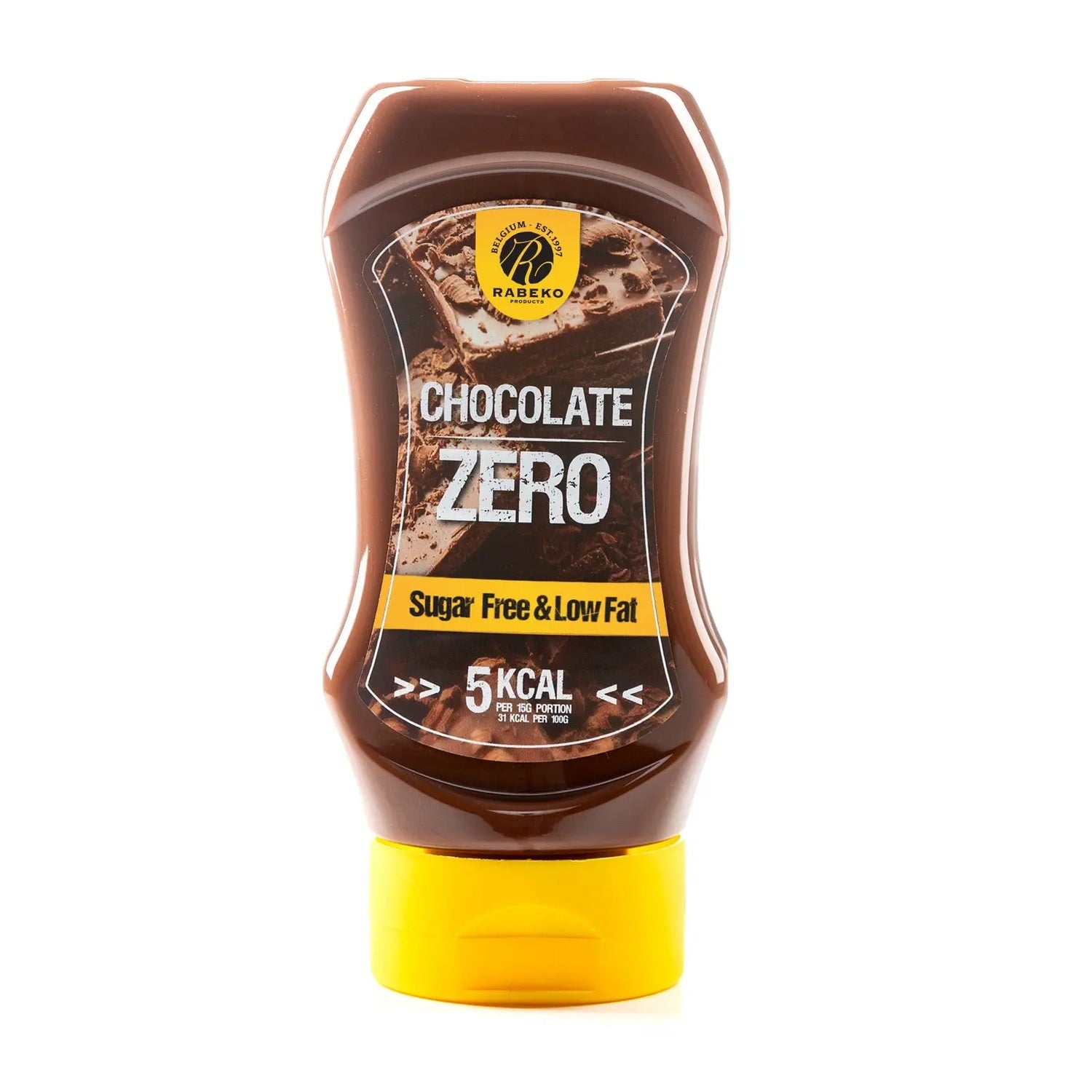
What is Rabeko's Sirop Zero?
Rabeko Sirop Zero is a sugar-free topping syrup at 8 kcal per 100 g. You pour it over pancakes, fromage blanc, oat flakes or into a coffee, exactly like a conventional syrup, but without the calories that usually come with it.
It belongs to the same family as our zero sauces, except that it is runnier and exclusively sweet. Its texture comes from two plant-based thickeners, cellulose gum and xanthan gum, and its sweetness from sucralose. It is that combination that makes a thick topping possible with no sugar and no fat. The rest of the Dutch range can be found in our Rabeko aisle.
The flavours we list: Chocolate and Salted Caramel. The manufacturer's documentation mentions two more, Vanilla and Strawberry, which are not in the catalogue as things stand. The list of variants available on this page is what counts.
What is in Sirop Zero?
| Values | Per 100 g | Per 20 g serving |
|---|---|---|
| Energy | 8 kcal | approximately 1.6 kcal |
| Fat | 0 g | 0 g |
| Carbohydrate | 1.7 g | approximately 0.34 g |
| of which sugars | 0 g | 0 g |
| Protein | 0 g | 0 g |
| Salt | varies by flavour | varies by flavour |
| Recommended serving | 10 to 20 g per use | |
The per-serving values are calculated from the per 100 g column published by the manufacturer.
8 kcal per 100 g is the figure that sums up the whole product. A generous 20 g serving delivers less than two calories, where the same amount of maple syrup delivers around sixty and 17 g of sugars. On a day when you are counting, the difference is far from trivial: it is what lets you keep a dessert without changing your total.
Salt is the only line that varies sharply from one flavour to another, and that stands to reason: Salted Caramel contains salt as a declared ingredient, which Chocolate does not. If you are watching your sodium intake, that is the point to look at.
One inconsistency deserves to be flagged rather than glossed over. The composition of Salted Caramel lists roasted sugar syrup among its ingredients, while the nutrition table declares 0 g of sugars per 100 g. The amount is in all likelihood very small and rounded down to zero, but we are not going to make that call on the manufacturer's behalf. If you need precise control over your carbohydrates, the label on the bottle you receive is what counts.
A final word on what the product cannot claim: no health claim is associated with this type of syrup. It does not help anyone lose weight in itself — it simply avoids adding calories where a conventional syrup would add them. The distinction matters, and it is already a good argument.
Ingredients list
Chocolate flavour: water, flavourings, thickeners (cellulose gum, xanthan gum), fat-reduced cocoa powder, sweetener (sucralose), preservatives (potassium sorbate, sodium benzoate).
Salted Caramel flavour: water, modified maize starch, salt, thickeners (xanthan gum, cellulose gum), natural flavouring, roasted sugar syrup, preservatives (potassium sorbate, sodium benzoate), acidity regulator (citric acid), sweetener (sucralose).
Gluten-free, lactose-free, with no major declared allergen — to be checked according to the flavour chosen.
How do you use Sirop Zero?
Amount: 10 to 20 g per use. Timing: at breakfast, as a snack or for dessert. Frequency: as you like, it is a condiment. Storage: in the fridge once opened, to be consumed within four weeks. Before each use: shake vigorously.
Shaking is not optional. The gums used here reorganise themselves at rest, and the syrup separates slightly in the bottle. Without shaking, the first spoonful is runny and the last one too thick. A few seconds are enough.
The best use, the one this product really exists for, is evening fromage blanc or skyr: 20 g of syrup turns a plain product into a dessert for less than two calories. It also works very well on protein pancakes or on a oat flour porridge, where it replaces honey without the calorie cost.
In baking, bear in mind that it does not behave like sugar: it provides neither structure, nor caramelisation, nor preservation. It is there to top or to flavour, not to replace the sugar in a batter. That is the limit of the category and it is better to know it before ruining a cake.
The fridge once opened is a genuine instruction, not a precaution of principle: the water content is high and the preservatives present do not do away with the need for cold. Four weeks is the period stated by the manufacturer.
Who is Sirop Zero for, and who is it not for?
It suits someone on a calorie deficit who does not want to give up sweet things, someone limiting their carbohydrates, and someone who eats a lot of plain dairy and ends up growing tired of it.
The formula is gluten-free and lactose-free, with no major declared allergen, which makes it accessible to most exclusion diets. The composition does vary by flavour, though: check the label on the bottle you receive if you have a serious allergy.
The manufacturer advises against it for pregnant and breastfeeding women. That statement is unusual for a topping syrup and we are reproducing it exactly as it is worded, without interpreting it: if you are pregnant, the question is one for your doctor.
It also flags a possible laxative effect if consumed to excess. At 10 or 20 g per use, that is not a problem at all; emptying half a bottle over a plate of pancakes is another matter.
What you should not expect from it: this is not a slimming product. It makes nobody lose anything. What it does is avoid adding 60 kcal and 17 g of sugars to a dessert, which is only worth something if the rest of the day is coherent. And if the aftertaste of sweeteners bothers you, no quantity will make it pleasant: that is a matter of palate, not of dosage.
Zero syrup or zero jam?
The two sit on the same shelf and are chosen according to the texture you are after.
Zero jam is thicker and contains pieces or fruit purée, which gives it body and a taste closer to the original product. It is the better choice for spreading, for lining the bottom of a yoghurt, or when you want a texture that holds. It generally delivers slightly more calories, a few dozen per 100 g, which is still very low.
The syrup is runny, it pours and spreads itself out. It is the better choice for topping, for flavouring a hot drink, or for stirring into fromage blanc, where jam would form clumps. It also goes lower in calories, at 8 kcal per 100 g.
If what you need is more on the savoury side — cooking without fat, dressing a salad — then calorie-free sauces are what to turn to. And if you are looking to flavour a powder rather than to top something, flavourings and sweeteners answer that need better. One classic and devastating pairing: this syrup over a spoonful of peanut butter, on fromage blanc.
Frequently asked questions
How many calories in a serving?
Around 1.6 kcal for a 20 g serving, the product being listed at 8 kcal per 100 g. By way of comparison, 20 g of maple syrup delivers around sixty calories and 17 g of sugars. That is the whole point of the product.
Does it need to be kept in the fridge?
Yes, once opened, and consumed within four weeks. The water content is high and the preservatives present are no substitute for cold. Before opening, a dry spot away from the light is enough.
Why does the bottle need shaking?
Because the gums that give the syrup its texture reorganise themselves at rest and cause a slight separation. Without shaking, the consistency is uneven from one use to the next. A few seconds of vigorous shaking are enough to restore the original texture.
Can it be used in baking?
For topping something already baked, yes. For replacing the sugar in a batter, no: it provides neither structure, nor caramelisation, nor any hold under heat. It is a finishing product, and that is what it does best.
Does it really contain zero sugar?
The nutrition table declares 0 g of sugars per 100 g. The composition of the Salted Caramel flavour does, however, list roasted sugar syrup among the ingredients, in a very small amount. If you need to count your carbohydrates precisely, the label on the bottle you receive is the only reference.
What is the difference between the flavours?
Chocolate contains fat-reduced cocoa powder and has a very short composition. Salted Caramel is more complex: modified maize starch, salt declared as an ingredient, natural flavouring and roasted sugar syrup. The latter is also saltier, which is the point to look at if you are watching your sodium.
Is there a laxative effect?
The manufacturer flags one if consumed to excess, which is a standard statement for products thickened with gums. At the recommended servings of 10 to 20 g, there is nothing to worry about. It is with very generous, repeated use that the question arises.
Where can you buy Rabeko's Sirop Zero?
The flavours can be ordered from this page, and we ship throughout France and Europe. At the Vendargues shop, about ten minutes from Montpellier, this is the product we put into the hands of people who give in every single evening: a fromage blanc with a topping solves the problem better than a lecture on willpower. The rest of the sugar-free treats aisle can be browsed in our sports nutrition section.


What is a Callowfit sauce?
It is a German zero sauce, in a 300 to 350 ml bottle, at 11 kcal per 100 ml on average across the range. The flavours listed here: Tomato Ketchup, Smoky BBQ, Mayo Style, Teriyaki Sauce, Salty Caramel and Chocolate Sauce.
The base is simple and identical from one product to the next: water, vinegar, modified maize starch, salt, a set of thickeners — xanthan gum, cellulose gum, guar gum — acidity regulators and sucralose as a sweetener. The thickeners replace the oil in mayonnaise and the sugar in ketchup, and that is where the texture comes from.
Some flavours are savoury, others sweet. That is what sets this range apart from most reduced-calorie sauces: the same brand covers the grilled steak and the evening fromage frais. The rest of the range is in our Callowfit section.
What is in a 15 ml serving?
| Nutrient | Per 100 ml | Per 15 ml serving | % of reference intake* |
|---|---|---|---|
| Energy | 44 kJ / 11 kcal | 1 to 6 kcal depending on the flavour | less than 1% |
| Fat | less than 0.5 g | 0 g | less than 1% |
| of which saturates | 0 g | 0 g | 0% |
| Carbohydrate | 1.9 g | 0.3 g | less than 1% |
| of which sugars | less than 0.5 g | less than 0.1 g | less than 1% |
| Protein | less than 0.5 g | traces | — |
| Salt | varies by flavour | varies by flavour | — |
* Reference intake for an average adult (8,400 kJ / 2,000 kcal), Regulation 1169/2011. The energy values are range averages published by the manufacturer; they vary from one flavour to another, from 1 to 6 kcal per serving. The salt content is not quantified in the data provided, and it is the figure most sorely missed on a savoury sauce.
The figure that decides the purchase is less than 0.5 g of sugars per 100 ml. The regulatory threshold for the “sugar-free” claim is set at 0.5 g per 100 ml on a liquid: this range meets it. The same goes for fat, below the 0.5 g threshold that permits the “fat-free” claim. These are not brand arguments, they are quantified thresholds, and they are cleared.
For perspective, the most telling comparison is mayonnaise. An ordinary mayonnaise sits at around 700 kcal per 100 ml, roughly 105 kcal for a tablespoon. The Mayo Style in this range puts that same spoonful at a few calories. For someone who uses sauce every day, that is not a subtlety.
The trade-off comes down to one word: additives are what do the work. Gums for texture, sucralose for sweetness, potassium sorbate as a preservative, lactic and citric acids for acidity — plus sodium benzoate on the ketchup version. This is not an artisan sauce, and nobody should present it to you as one. It is a technical product, and it owns what it is.
How do you use Callowfit sauces?
Serving: 1 to 2 tablespoons, that is 15 to 30 ml. When: at the table, at the end of cooking, or as a dip. How often: no practical limit given the calorie profile, while keeping an eye on salt. Storage: in the fridge once opened, to be used within the following weeks.
Four uses that work, as the manufacturer sets them out. On grilled meat: apply after cooking, or use the sauce as a marinade before grilling — the barbecue and smoky versions go particularly well with chicken and beef. In a salad: two tablespoons stirred through the vegetables replace a vinaigrette. As a dip: serve in a bowl for dipping raw vegetables or crackers. In a hot dish: add at the end of cooking to a wok or over pasta, warming gently without letting it boil.
Two practical habits: shake the bottle before use, as the gums settle unevenly at rest, and put it back in the fridge every time after opening. A sauce with this sugar content does not keep like a conventional ketchup.
The real piece of usage advice, the one that changes something: help yourself generously. That is the whole point of the product. Rationing a sauce at 11 kcal per 100 ml drop by drop means imposing a pointless constraint on yourself. The only parameter to watch remains the salt in the savoury versions, whose content is not published.
Who are these sauces for, and who are they not for?
They suit anyone on a calorie-controlled diet who is tired of eating bland food — which in practice means the majority of people who give up on changing their eating habits. They also suit meal prep, where the same chicken-and-rice base becomes bearable if the sauce changes. The manufacturer states a product that is gluten-free, lactose-free, aspartame-free, vegetarian and vegan.
On allergens, several flavours contain MUSTARD — that is the case for the barbecue and mayonnaise versions, whose spices include it. Traces of MILK, SOYA, GLUTEN and NUTS are possible depending on manufacturing conditions. The manufacturer asks that the product be kept out of the reach of children under 3.
They are not for you if you avoid additives. The list is long and unapologetic: gums, sweetener, preservatives, acidity regulators, flavourings. If your buying criterion is a short ingredients list, this product is not for you, and a home-made olive oil vinaigrette will suit you better — more calorific, simpler.
Nor are they for you if you monitor your sodium intake strictly. The manufacturer does not publish the salt content and states only that it varies by flavour: on savoury sauces, that is a missing piece of information, and we would rather say so than pass over it in silence.
What not to expect from them: any effect on weight. A sauce does not make you lose weight. What it does is take 100 kcal off a plate by replacing a mayonnaise, and make a diet meal good enough that you will cook it again tomorrow. The weight loss section has few products this useful and this unpretentious.
A zero sauce or a sugar-free flavouring?
Both exist to add taste without calories, but not at the same point in the meal.
A flavouring or sweetener is concentrated: a few drops are enough, it costs next to nothing per use, and it is measured out by the millilitre into fromage frais, porridge or a recipe. It is the best choice for flavouring a neutral base, particularly on the sweet side, and for cooking — a flavouring stands up to heat far better than a sauce.
Callowfit sauce brings something a flavouring cannot: texture and volume. The gums create a coating consistency that clings to a piece of meat or a salad, and it is that mouthfeel that is missed most on a diet, more than the taste itself. On savoury flavours — ketchup, barbecue, teriyaki, mayonnaise — a flavouring simply does not do the job.
So the two complement each other, like cooking spray for the pan and zero jam for toast. Four jobs, four products, none redundant.
Frequently asked questions
Is a serving really 1 kcal?
It depends on the flavour: the manufacturer states 1 to 6 kcal per 15 ml, with a range average of 11 kcal per 100 ml. The lightest versions are close to zero, the richest climb to a few calories. In every case, the gap with a conventional sauce runs to tens of calories per spoonful.
What does the sucralose taste like in these sauces?
Discreet in the savoury versions, where acidity and spices dominate by a distance. More noticeable in the sweet versions, Salty Caramel and Chocolate Sauce, where the sweetener carries most of the taste. If sweeteners bother you, start with a savoury flavour.
Can they be heated?
Yes, at the end of cooking and without letting them boil. The gums that give the texture cope badly with prolonged boiling: the sauce breaks down and turns runny. Add it to the wok or over the pasta off the heat, or just before serving.
How many servings in a bottle?
Around twenty, according to the manufacturer, for a stated format of between 300 and 350 ml. The range is wide because the format varies slightly from one product to another: the exact volume is shown on the bottle you receive.
Do they contain mustard?
Several flavours do, yes. The barbecue and mayonnaise versions contain spices that include it, and the manufacturer declares it as an allergen. If you are allergic to mustard, read the label flavour by flavour before buying.
How long do they keep once opened?
A few weeks in the fridge, tightly closed. The manufacturer gives no precise period. The practical rule of thumb: with no sugar to provide preservation, a zero sauce keeps less well than an ordinary ketchup once started.
Do all the flavours have the same composition?
The base is common, only the flavourings and certain ingredients change. The detailed label data available to us covers the ketchup, barbecue and mayonnaise versions; for the Teriyaki, Salty Caramel and Chocolate Sauce flavours, refer to the list printed on the bottle you receive.
Where to buy Callowfit sauces?
The flavours can be ordered from this page, and we ship throughout France and Europe. At this price, the smartest way to approach the range is to take two or three at once: one savoury for main courses, one sweet for desserts.
At the Vendargues shop, about ten minutes from Montpellier, this is the shelf people linger in front of the longest, and for good reason: nobody imagines before tasting it that a one-calorie sauce could have any body. The rest of the products that make a diet bearable can be browsed in our sports nutrition section.


What is Rabeko's Protein Spread?
The Rabeko Protein Spread is a chocolate spread enriched with protein, offered in Nutty Chocolate, made with Belgian chocolate and hazelnuts, and White Chocolate. It belongs to our protein snacks section, and the Dutch brand's full range can be found in the Rabeko section.
What sets it apart from an ordinary spread comes down to two formulation choices. Sugar is replaced by maltitol, a polyol, which takes first place on the ingredients list. And whey protein concentrate is added, which brings the protein content up to 20 g per 100 g. The Nutty Chocolate version contains 13% hazelnuts, skimmed milk powder, fat-reduced cocoa, cocoa butter and a blend of vegetable oils — sunflower, coconut and shea.
One detail that matters and that we will look at closely: the fat, on the other hand, has not been taken out. This is a spread reduced in sugars, not a spread reduced in calories, and that distinction changes everything in use.
What does a 30 g serving contain?
| Nutrient | Per 100 g | Per 30 g serving |
|---|---|---|
| Energy | 2,114 kJ / 509 kcal | 152 kcal |
| Fat | 38 g | 11 g |
| Carbohydrate | 35.9 g | 10 g |
| of which sugars | not disclosed | less than 2 g |
| Fibre | 2.6 g | 0.8 g |
| Protein | 20 g | 6 g |
| Salt | 0.24 g | 0.07 g |
Figures for the Nutty Chocolate version. Let us point out the missing boxes rather than fill them in: the manufacturer publishes neither the “of which saturates” line, nor the sugar content per 100 g, nor the “of which polyols” line. That last one is nevertheless the most telling here — the gap between 10 g of carbohydrate and less than 2 g of sugars per serving corresponds very largely to maltitol.
Now let us look at the figure nobody likes to lead with. 509 kcal per 100 g and 38 g of fat is the level of a conventional spread, and on fat sometimes even a little above it. The gain, then, is not a calorie one: it is entirely on the sugars, with less than 2 g per serving where an ordinary spread delivers 15 to 17 g for the same spoonful. If your aim is to cut sugar, this is real progress. If your aim is to cut calories, this product will not do it for you.
The 20 g of protein per 100 g represent roughly 16% of the product's energy. That is above the 12% threshold that permits the “source of protein” claim, but below the 20% that “high in protein” would require — so we will not be using that second wording. Six grams of protein in a 30 g serving is still a genuine contribution: it is about the same as an egg.
How should you use the Protein Spread?
Dose: 30 g, or two tablespoons. Liquid: none. When: at breakfast, as a snack, or at the end of a meal. Frequency: 1 to 2 servings a day at most. Duration: none, it is a food.
The step that changes the result: keep the jar between 12 and 20 °C, and serve it between 18 and 22 °C. This spread contains cocoa butter and shea, two fats that harden in the cold. Straight out of the fridge it is impossible to spread; at room temperature it is smooth. Stir it before use, as the texture is not uniform once it has been standing.
Beyond toast, it works into a yoghurt, a fromage blanc, a smoothie or a baking mix. The most coherent pairing remains one with a complex carbohydrate — wholemeal bread, protein pancakes, oats — which balances the profile of the meal.
Reseal tightly and use within four weeks of opening. And stick to one or two servings a day: this is not a rule for the sake of it, it is a matter of calories and polyols, which we come back to right now.
Who is this spread for, and who is it not for?
It suits anyone who wants to keep a chocolate treat while cutting sugars sharply, anyone looking for a little protein in an indulgent format, and anyone who prefers a spread that satisfies over a sugary product that leaves you empty.
It contains MILK, HAZELNUTS and SOYA. Traces of other NUTS, PEANUTS, EGGS and GLUTEN are possible. The manufacturer does not recommend it for pregnant or breastfeeding women and rules it out in case of allergy to milk proteins. If you are on medical treatment, seek advice.
It is not for you if you tolerate polyols poorly. The manufacturer carries the regulatory wording: excessive consumption of maltitol may have a laxative effect. Start with half a serving to gauge your tolerance. If you are affected by irritable bowel syndrome, caution is frankly called for.
What you should not expect of it, and this is the most useful point on this page: it is not a weight-loss product. At 509 kcal per 100 g, it sits at the level of a conventional spread. Its value lies in replacing the sugar, not the calories. A 30 g serving weighed out on a spoon is reasonable; three spoonfuls taken “because it is protein” is 450 kcal. Nor is it a protein source in the sense that a shake is: 6 g per serving rounds out a day, it does not build one — for that, you need to look at the protein powders.
Protein spread or zero-sugar jam?
This is the real breakfast trade-off, and the two products do not play the same role at all. Best to say so plainly before choosing.
Zero-sugar jam delivers around 55 kcal per 100 g, roughly ten kilocalories per spoonful. It is the unbeatable choice if calories are your priority: you spread it without it weighing on your day in any way. It also delivers plenty of fibre. What it does not do: satisfy, and supply protein or fat.
The Protein Spread is the better choice when satiety counts. Its 11 g of fat and 6 g of protein per serving turn a slice of toast into a snack that holds — where toast with jam alone leaves you wanting an hour later. It is also markedly closer to the taste of a real spread, which is precisely what you are after when a chocolate craving arrives.
The compromise we recommend most often: zero-sugar jam for everyday toast, protein spread for the evening sweet craving or the post-session snack. And if your priority is protein per pound spent on a slice of toast, a plain peanut butter remains more effective, with a simpler fat profile.
Frequently asked questions
Is it lower in calories than a conventional spread?
Barely, and that has to be said. 509 kcal per 100 g is the level of an ordinary spread, with even a little more fat. The real gain is on the sugars: less than 2 g per 30 g serving, against the usual 15 to 17 g. It is a product with no added sugar, not a reduced-calorie product.
Why 35.9 g of carbohydrate for less than 2 g of sugars?
Because most of the carbohydrate comes from maltitol, a polyol used as a bulk sweetener. It counts within the carbohydrate without being a sugar. Unfortunately the manufacturer does not publish an “of which polyols” line, which would make this table immediately readable.
How much hazelnut does it contain?
13% in the Nutty Chocolate version, which is an honest content for this type of product. Hazelnuts come fourth on the list, after the maltitol, the vegetable oils and the whey protein concentrate. The White Chocolate version has a different composition.
Does maltitol cause digestive trouble?
It can, in quantity. The manufacturer carries the legal wording about a possible laxative effect in case of excessive consumption, and recommends starting with small amounts to gauge your tolerance. That is advice worth following: reactions vary enormously from one person to another, and a 30 g serving goes down far better than 60.
Can it be heated or cooked with?
Yes, it works into a cake batter and melts very nicely on hot pancakes. Just be aware that the cocoa butter and the shea make it very runny in the heat: do not count on it to hold as a topping on a hot dish, it will run.
How long does an opened jar keep?
Four weeks, resealing tightly after each use. Keep it between 12 and 20 °C, never in the fridge: the cold hardens the fats and makes the spread impossible to spread without leaving it to come back to temperature for a long while.
Is it suitable for vegetarians or vegans?
For vegetarians, yes: no meat-derived ingredient goes into the composition. For vegans, no — the whey protein concentrate and the skimmed milk powder rule it out. Nor is it suitable in case of allergy to milk proteins, hazelnuts or soya.
Where to buy the Rabeko Protein Spread?
The versions can be ordered from this page, and we ship throughout France and Europe.
This is the kind of product you buy on an impulse and sometimes regret once the jar has been finished too quickly. At our Vendargues shop, about ten minutes from Montpellier, we would rather state the 509 kcal per 100 g before the purchase than after: used well, at two weighed spoonfuls, this spread has every place in a well-managed day. The rest of the indulgence aisle can be browsed in our sports nutrition.
How can a sauce have zero calories?
A zero-calorie sauce is primarily water. This starting point explains everything else. Where mayonnaise is an oil emulsion and barbecue sauce is a flavored sugar syrup, a zero-calorie sauce starts with a liquid, and body and flavor, normally provided by oil and sugar, are achieved through other means.
Three families of ingredients are responsible for this.
- Thickeners: xanthan gum, guar gum, locust bean gum. A few tenths of a percent are enough to transform water into a coating liquid. These are fibers, whose energy contribution is negligible at the doses used.
- Intense sweeteners: sucralose, steviol glycosides, acesulfame-K. Their sweetening power is hundreds of times that of sugar, so milligrams are used where grams of sucrose would have been needed.
- Flavorings, acidifiers, and preservatives: vinegar, lemon juice, spices, tomato concentrate, aromatic extracts, potassium sorbate.
The word "zero" is not entirely literal. The European regulation on nutrition claims reserves the "calorie-free" label for liquids providing no more than 4 kcal per 100 ml. Above this threshold, a label can still display 0 kcal per serving through simple rounding: at 20 kcal per 100 ml, a 15 ml tablespoon weighs 3 kcal, which is written as 0. The order of magnitude remains accurate — one to five kilocalories per spoon — but the honest reading is "negligible," not "zero."
How does it affect taste and texture?
Sugar and oil don't just sweeten and lubricate: they carry flavors, round out acidity, and leave a film in the mouth. By removing them, three things are lost.
Length of taste. Intense sweeteners deliver a rapid, somewhat sharper sweetness that fades faster than sucrose. Some leave a licorice note in the aftertaste, very pronounced with steviol glycosides, more subtle with sucralose.
Creaminess. Xanthan gum provides viscosity, not fat. The sauce coats well but remains more slippery, slightly elastic, without the coating of mayonnaise. This is the most noticeable difference on first use.
Roundness. Many recipes compensate for the loss of body with vinegar and spices, making them livelier than their classic equivalents. On a salad or cold chicken, this is an advantage; on an already acidic preparation, it quickly becomes too much. Take these sauces for what they are — very aromatic and very low-calorie seasonings — and not as a lightened copy of a classic sauce.
Zero-calorie sauce or classic sauce: what's the real difference?
Orders of magnitude per 100g, consistent with the ANSES Ciqual table.
- Mayonnaise: approximately 700 kcal
- Classic vinaigrette: 450 to 650 kcal depending on the proportion of oil
- Commercial barbecue sauce or sweet sauce: 130 to 200 kcal
- Ketchup: approximately 100 kcal
- Zero-calorie sauce: 5 to 25 kcal depending on the recipe
Per serving, a tablespoon of mayonnaise, or 15g, provides approximately 105 kcal; the same spoon of zero-calorie sauce provides two or three. On a mixed salad where one easily uses two spoons, the saving is around 200 kcal.
Two honest caveats. This saving only counts in an otherwise balanced calorie intake. And an olive oil vinaigrette provides unsaturated fatty acids and allows for the absorption of fat-soluble vitamins from vegetables, which a zero-calorie sauce does not: reasonable use often involves retaining a drizzle of oil and adding a zero-calorie sauce for flavor.
How to use them correctly?
As a cold seasoning, this is their natural territory: salads, raw vegetables, bowls, cold chicken or tuna, wraps. Savory versions — barbecue, curry, sweet and sour, burger, Caesar — directly replace vinaigrette or mayonnaise.
As a topping, on an already cooked dish removed from the heat: grilled meat, fish, roasted vegetables, rice. Pour just before serving.
In marinades, they flavor well but tenderize little: without oil, they penetrate the meat less. Allow one to two hours in the refrigerator, and add a little oil if you grill the meat afterwards.
For sweet dishes, caramel, chocolate, or red fruit versions, often sold as zero-calorie syrups, can be used on plain yogurt, porridge, protein pancakes, or in a shaker. They play the same role as zero-calorie jam but remain liquid, making them easier to dispense into a drink.
Why do they not hold up well to cooking?
A classic sauce withstands heat because its sugar caramelizes and its oil doesn't evaporate: it concentrates as it reduces. A zero-calorie sauce does the opposite. Composed mostly of water, it evaporates, leaving almost nothing in the pan. Gums, unlike starch, do not behave in the same way: when heated for a long time, they lose viscosity instead of gaining it, and the sauce separates. In addition, volatile flavors largely escape with the steam — acidity and bitterness hold up better than fruity notes.
The rule is simple: these sauces are used after cooking, not before. For cooking itself, a cooking spray does the job of fat with a fraction of the calories.
Are there any drawbacks to be aware of?
Polyols. Some recipes, especially for syrups and sweet sauces, use maltitol, sorbitol, or erythritol to provide body. Incompletely absorbed in the small intestine, they ferment in the colon: bloating, gas, laxative effect in high doses. European regulations require the mention "excessive consumption may have laxative effects" beyond 10% polyols. Erythritol is an exception, being absorbed and then eliminated through urine. Per spoon, the dose remains low; the problem arises when half a bottle is consumed.
Salt. In savory versions, removing fat often leads to compensating with salt. Check this line of the nutritional table as much as the energy content.
False sense of permission. A 3 kcal sauce does not make the plate it's poured on light. The feeling of "free" encourages using a lot, and especially neglecting the rest of the meal.
Frequently Asked Questions
What is the lowest calorie sauce?
The zero-calorie sauces in this section, between 5 and 25 kcal per 100g, which is two to three kilocalories per tablespoon. Among ordinary sauces, the ranking from lightest to heaviest is: balsamic vinegar and soy sauce, around 60 to 90 kcal per 100g but used in very small quantities; mustard, around 60 to 70; ketchup, around 100; cooked tomato sauce, 50 to 80; then anything containing oil or cream, between 300 and 700. The real criterion, however, is the quantity used: two spoons of mustard weigh less than one of mayonnaise.
What is the highest calorie sauce?
Mayonnaise, with approximately 700 kcal per 100g — it is almost 80% oil. Just behind are aioli, tartare sauce, cocktail sauce, and very oily vinaigrettes, between 450 and 650. Cream-based sauces — Béarnaise, Hollandaise, pepper sauce — are lower in displayed value, around 250 to 400, but much more is poured. It is almost always oil or cream that drives the number: sugar, even in abundance, provides half as many calories per gram as fat.
Do sauces make you gain weight?
They are primarily the item that we forget to count. A plate of raw vegetables at 80 kcal drowned under three spoons of vinaigrette suddenly weighs 380: the sauce contributes more than the dish. Over a year, a daily habit of two spoons of mayonnaise represents a considerable amount of calories, invisible because it doesn't look like food. This is precisely where zero-calorie sauces are useful: they don't make you lose weight, but they remove a line from the calorie budget that no one monitors.
What is the healthiest sauce?
"Lowest calorie" and "healthiest" are not the same question, and it's important. Nutritionally, an olive oil or rapeseed oil vinaigrette is excellent: unsaturated fatty acids, vitamin E, and it allows for the absorption of fat-soluble vitamins from vegetables — which a zero-calorie sauce does not. It simply costs a lot in calories. A zero-calorie sauce is the best choice for a tight calorie balance; a quality oil, in small quantities, remains the best nutritional choice. Many people do both: a drizzle of oil for quality, a zero-calorie sauce for taste and volume.
Is a zero-calorie sauce really 0 kcal?
Almost, but never entirely. Depending on the recipe, it ranges between 5 and 25 kcal per 100g, or one to four kilocalories per tablespoon. The "0" display comes from rounding applied per serving. The regulatory mention "calorie-free" is reserved for liquids with 4 kcal or less per 100 ml. The difference with mayonnaise remains a factor of a hundred, which is the essential point, but saying "negligible" is more accurate than "zero."
What is the lowest calorie mustard?
Classic Dijon mustard, around 60 to 70 kcal per 100g — which is about 5 kcal per teaspoon: it is already one of the lightest condiments in the cupboard. Old-fashioned mustards are similar. Honey, fruit, or "sweet" versions are significantly higher, with sugar being the first or second ingredient. The point to watch on mustard is not energy but salt, often above 2g per 100g. A zero-calorie mustard-honey type sauce provides the same aromatic profile without added sugar.
What is cheesy sauce?
A sauce with a melted cheese flavor, typically inspired by American cheddar: orange-yellow, coating, slightly salty, with that slightly tangy milky note associated with nachos and burgers. In its classic version, it relies on melted cheese, cream, and starch, and weighs between 200 and 300 kcal per 100g. In a zero-calorie version, the flavor comes from aromas and the texture from gums: the aromatic profile is present, but not the fatty creaminess or the melting during cooking. This is one of the flavors where the difference from the original is most noticeable — the sauce is still very good on a burger or roasted vegetables, but it does not gratinate.
Does ketchup make you gain weight?
Not in itself, and not in usual quantities. Classic ketchup is around 100 kcal per 100g, most of which comes from added sugar, about 20g per 100g. A tablespoon therefore represents 15 kcal and 3g of sugar: nothing that significantly impacts a day's intake. The problem comes from volume, when ketchup systematically accompanies already dense dishes and much more than a spoon is poured. A zero-calorie version divides this intake by five to ten: useful if you consume a lot, of little interest if you use a spoon once a week.
Do zero-calorie sauces make you lose weight?
No. No food makes you lose weight: what causes weight loss is a sustained calorie deficit. A zero-calorie sauce can contribute to this by eliminating 100 to 200 kcal from a meal, which is significant if the habit is daily. It burns nothing and compensates for no excess. For a weight loss goal, its real merit lies elsewhere: it makes simple dishes tolerable, dishes that are often abandoned out of weariness.
Can you cook with a zero-calorie sauce?
It's best to avoid it. In a pan, water evaporates, gums lose their viscosity, and volatile flavors escape with steam: only an acidic residue remains. They behave well cold, as a topping on a dish removed from the heat, or in a short marinade in the refrigerator. To glaze meat, add the sauce in the very last minutes, off direct heat.
How long does an opened bottle keep?
Refer to the bottle, the answer is there and varies according to the recipe. The general principle: without sugar or oil, two natural preservatives less, these sauces should be kept in the refrigerator after opening. Close tightly, avoid dipping a used utensil back in, and trust the appearance: a separation into two phases can be remedied by shaking, an abnormal smell, no.
Which zero-calorie sauce to choose for a salad?
Vinegary and herbaceous profiles work best: Caesar, honey-mustard, yogurt-dill, sweet and sour. Very sweet sauces like barbecue are not suitable for raw vegetables but very good for cold chicken or roasted vegetables. Pour at the last moment: gums retain water from vegetables and will make a salad left waiting soggy.
What's the difference between a zero-calorie sauce and a zero-calorie syrup?
Texture and use, not principle. Syrup is more fluid and designed to be diluted or poured: coffee, drinks, plain yogurt, porridge. Sauce is coating and stays on the surface of a food. To flavor a drink or preparation, concentrated flavorings and sweeteners are often more cost-effective.
Do they contain gluten or lactose?
It depends on the recipe: some use wheat starch as a thickener, others use milk powder in creamy versions. The ingredient list and the "allergens" line on the bottle are the only valid answers, and they change from one flavor to another within the same range.
What brands are in this section?
Two manufacturers structure the category in France. Rabeko covers the widest spectrum, from savory to sweet, with coating sauces and zero-calorie syrups in numerous flavors. Callowfit focuses on livelier and more vinegary profiles, oriented towards cold seasoning.
These sauces make perfect sense as part of a coherent whole. They accompany sweet preparations in the section — zero-calorie jams, peanut butter — and complement meals built around proteins or liquid egg whites. For snacks, see our protein snacks and protein bars.
Can I taste before buying near Montpellier?
A sauce is bought by taste, and taste cannot be read on any product sheet. At our Vendargues store, about ten minutes from Montpellier, bottles can be purchased individually: you test a flavor before ordering three. This is the best way to avoid an opened bottle ending up at the back of the refrigerator, as aromatic profiles vary greatly from one brand to another. We ship throughout France and Europe for refills.
Retrait au magasin sous 2 h
À Vendargues, près de Montpellier. Vous êtes prévenu dès que la commande est prête.
Commandé avant 14 h, expédié le jour même
Du lundi au samedi. Le délai d'acheminement appartient ensuite au transporteur.
Livraison offerte dès 50 €
En France métropolitaine, et dès 100 € en Europe. Modes et délais.
Une question avant de commander ?
Écrivez-nous ou passez au magasin : on connaît les produits qu'on vend.
How can a sauce have zero calories?
A zero-calorie sauce is primarily water. This starting point explains everything else. Where mayonnaise is an oil emulsion and barbecue sauce is a flavored sugar syrup, a zero-calorie sauce starts with a liquid, and body and flavor, normally provided by oil and sugar, are achieved through other means.
Three families of ingredients are responsible for this.
- Thickeners: xanthan gum, guar gum, locust bean gum. A few tenths of a percent are enough to transform water into a coating liquid. These are fibers, whose energy contribution is negligible at the doses used.
- Intense sweeteners: sucralose, steviol glycosides, acesulfame-K. Their sweetening power is hundreds of times that of sugar, so milligrams are used where grams of sucrose would have been needed.
- Flavorings, acidifiers, and preservatives: vinegar, lemon juice, spices, tomato concentrate, aromatic extracts, potassium sorbate.
The word "zero" is not entirely literal. The European regulation on nutrition claims reserves the "calorie-free" label for liquids providing no more than 4 kcal per 100 ml. Above this threshold, a label can still display 0 kcal per serving through simple rounding: at 20 kcal per 100 ml, a 15 ml tablespoon weighs 3 kcal, which is written as 0. The order of magnitude remains accurate — one to five kilocalories per spoon — but the honest reading is "negligible," not "zero."
How does it affect taste and texture?
Sugar and oil don't just sweeten and lubricate: they carry flavors, round out acidity, and leave a film in the mouth. By removing them, three things are lost.
Length of taste. Intense sweeteners deliver a rapid, somewhat sharper sweetness that fades faster than sucrose. Some leave a licorice note in the aftertaste, very pronounced with steviol glycosides, more subtle with sucralose.
Creaminess. Xanthan gum provides viscosity, not fat. The sauce coats well but remains more slippery, slightly elastic, without the coating of mayonnaise. This is the most noticeable difference on first use.
Roundness. Many recipes compensate for the loss of body with vinegar and spices, making them livelier than their classic equivalents. On a salad or cold chicken, this is an advantage; on an already acidic preparation, it quickly becomes too much. Take these sauces for what they are — very aromatic and very low-calorie seasonings — and not as a lightened copy of a classic sauce.
Zero-calorie sauce or classic sauce: what's the real difference?
Orders of magnitude per 100g, consistent with the ANSES Ciqual table.
- Mayonnaise: approximately 700 kcal
- Classic vinaigrette: 450 to 650 kcal depending on the proportion of oil
- Commercial barbecue sauce or sweet sauce: 130 to 200 kcal
- Ketchup: approximately 100 kcal
- Zero-calorie sauce: 5 to 25 kcal depending on the recipe
Per serving, a tablespoon of mayonnaise, or 15g, provides approximately 105 kcal; the same spoon of zero-calorie sauce provides two or three. On a mixed salad where one easily uses two spoons, the saving is around 200 kcal.
Two honest caveats. This saving only counts in an otherwise balanced calorie intake. And an olive oil vinaigrette provides unsaturated fatty acids and allows for the absorption of fat-soluble vitamins from vegetables, which a zero-calorie sauce does not: reasonable use often involves retaining a drizzle of oil and adding a zero-calorie sauce for flavor.
How to use them correctly?
As a cold seasoning, this is their natural territory: salads, raw vegetables, bowls, cold chicken or tuna, wraps. Savory versions — barbecue, curry, sweet and sour, burger, Caesar — directly replace vinaigrette or mayonnaise.
As a topping, on an already cooked dish removed from the heat: grilled meat, fish, roasted vegetables, rice. Pour just before serving.
In marinades, they flavor well but tenderize little: without oil, they penetrate the meat less. Allow one to two hours in the refrigerator, and add a little oil if you grill the meat afterwards.
For sweet dishes, caramel, chocolate, or red fruit versions, often sold as zero-calorie syrups, can be used on plain yogurt, porridge, protein pancakes, or in a shaker. They play the same role as zero-calorie jam but remain liquid, making them easier to dispense into a drink.
Why do they not hold up well to cooking?
A classic sauce withstands heat because its sugar caramelizes and its oil doesn't evaporate: it concentrates as it reduces. A zero-calorie sauce does the opposite. Composed mostly of water, it evaporates, leaving almost nothing in the pan. Gums, unlike starch, do not behave in the same way: when heated for a long time, they lose viscosity instead of gaining it, and the sauce separates. In addition, volatile flavors largely escape with the steam — acidity and bitterness hold up better than fruity notes.
The rule is simple: these sauces are used after cooking, not before. For cooking itself, a cooking spray does the job of fat with a fraction of the calories.
Are there any drawbacks to be aware of?
Polyols. Some recipes, especially for syrups and sweet sauces, use maltitol, sorbitol, or erythritol to provide body. Incompletely absorbed in the small intestine, they ferment in the colon: bloating, gas, laxative effect in high doses. European regulations require the mention "excessive consumption may have laxative effects" beyond 10% polyols. Erythritol is an exception, being absorbed and then eliminated through urine. Per spoon, the dose remains low; the problem arises when half a bottle is consumed.
Salt. In savory versions, removing fat often leads to compensating with salt. Check this line of the nutritional table as much as the energy content.
False sense of permission. A 3 kcal sauce does not make the plate it's poured on light. The feeling of "free" encourages using a lot, and especially neglecting the rest of the meal.
Frequently Asked Questions
What is the lowest calorie sauce?
The zero-calorie sauces in this section, between 5 and 25 kcal per 100g, which is two to three kilocalories per tablespoon. Among ordinary sauces, the ranking from lightest to heaviest is: balsamic vinegar and soy sauce, around 60 to 90 kcal per 100g but used in very small quantities; mustard, around 60 to 70; ketchup, around 100; cooked tomato sauce, 50 to 80; then anything containing oil or cream, between 300 and 700. The real criterion, however, is the quantity used: two spoons of mustard weigh less than one of mayonnaise.
What is the highest calorie sauce?
Mayonnaise, with approximately 700 kcal per 100g — it is almost 80% oil. Just behind are aioli, tartare sauce, cocktail sauce, and very oily vinaigrettes, between 450 and 650. Cream-based sauces — Béarnaise, Hollandaise, pepper sauce — are lower in displayed value, around 250 to 400, but much more is poured. It is almost always oil or cream that drives the number: sugar, even in abundance, provides half as many calories per gram as fat.
Do sauces make you gain weight?
They are primarily the item that we forget to count. A plate of raw vegetables at 80 kcal drowned under three spoons of vinaigrette suddenly weighs 380: the sauce contributes more than the dish. Over a year, a daily habit of two spoons of mayonnaise represents a considerable amount of calories, invisible because it doesn't look like food. This is precisely where zero-calorie sauces are useful: they don't make you lose weight, but they remove a line from the calorie budget that no one monitors.
What is the healthiest sauce?
"Lowest calorie" and "healthiest" are not the same question, and it's important. Nutritionally, an olive oil or rapeseed oil vinaigrette is excellent: unsaturated fatty acids, vitamin E, and it allows for the absorption of fat-soluble vitamins from vegetables — which a zero-calorie sauce does not. It simply costs a lot in calories. A zero-calorie sauce is the best choice for a tight calorie balance; a quality oil, in small quantities, remains the best nutritional choice. Many people do both: a drizzle of oil for quality, a zero-calorie sauce for taste and volume.
Is a zero-calorie sauce really 0 kcal?
Almost, but never entirely. Depending on the recipe, it ranges between 5 and 25 kcal per 100g, or one to four kilocalories per tablespoon. The "0" display comes from rounding applied per serving. The regulatory mention "calorie-free" is reserved for liquids with 4 kcal or less per 100 ml. The difference with mayonnaise remains a factor of a hundred, which is the essential point, but saying "negligible" is more accurate than "zero."
What is the lowest calorie mustard?
Classic Dijon mustard, around 60 to 70 kcal per 100g — which is about 5 kcal per teaspoon: it is already one of the lightest condiments in the cupboard. Old-fashioned mustards are similar. Honey, fruit, or "sweet" versions are significantly higher, with sugar being the first or second ingredient. The point to watch on mustard is not energy but salt, often above 2g per 100g. A zero-calorie mustard-honey type sauce provides the same aromatic profile without added sugar.
What is cheesy sauce?
A sauce with a melted cheese flavor, typically inspired by American cheddar: orange-yellow, coating, slightly salty, with that slightly tangy milky note associated with nachos and burgers. In its classic version, it relies on melted cheese, cream, and starch, and weighs between 200 and 300 kcal per 100g. In a zero-calorie version, the flavor comes from aromas and the texture from gums: the aromatic profile is present, but not the fatty creaminess or the melting during cooking. This is one of the flavors where the difference from the original is most noticeable — the sauce is still very good on a burger or roasted vegetables, but it does not gratinate.
Does ketchup make you gain weight?
Not in itself, and not in usual quantities. Classic ketchup is around 100 kcal per 100g, most of which comes from added sugar, about 20g per 100g. A tablespoon therefore represents 15 kcal and 3g of sugar: nothing that significantly impacts a day's intake. The problem comes from volume, when ketchup systematically accompanies already dense dishes and much more than a spoon is poured. A zero-calorie version divides this intake by five to ten: useful if you consume a lot, of little interest if you use a spoon once a week.
Do zero-calorie sauces make you lose weight?
No. No food makes you lose weight: what causes weight loss is a sustained calorie deficit. A zero-calorie sauce can contribute to this by eliminating 100 to 200 kcal from a meal, which is significant if the habit is daily. It burns nothing and compensates for no excess. For a weight loss goal, its real merit lies elsewhere: it makes simple dishes tolerable, dishes that are often abandoned out of weariness.
Can you cook with a zero-calorie sauce?
It's best to avoid it. In a pan, water evaporates, gums lose their viscosity, and volatile flavors escape with steam: only an acidic residue remains. They behave well cold, as a topping on a dish removed from the heat, or in a short marinade in the refrigerator. To glaze meat, add the sauce in the very last minutes, off direct heat.
How long does an opened bottle keep?
Refer to the bottle, the answer is there and varies according to the recipe. The general principle: without sugar or oil, two natural preservatives less, these sauces should be kept in the refrigerator after opening. Close tightly, avoid dipping a used utensil back in, and trust the appearance: a separation into two phases can be remedied by shaking, an abnormal smell, no.
Which zero-calorie sauce to choose for a salad?
Vinegary and herbaceous profiles work best: Caesar, honey-mustard, yogurt-dill, sweet and sour. Very sweet sauces like barbecue are not suitable for raw vegetables but very good for cold chicken or roasted vegetables. Pour at the last moment: gums retain water from vegetables and will make a salad left waiting soggy.
What's the difference between a zero-calorie sauce and a zero-calorie syrup?
Texture and use, not principle. Syrup is more fluid and designed to be diluted or poured: coffee, drinks, plain yogurt, porridge. Sauce is coating and stays on the surface of a food. To flavor a drink or preparation, concentrated flavorings and sweeteners are often more cost-effective.
Do they contain gluten or lactose?
It depends on the recipe: some use wheat starch as a thickener, others use milk powder in creamy versions. The ingredient list and the "allergens" line on the bottle are the only valid answers, and they change from one flavor to another within the same range.
What brands are in this section?
Two manufacturers structure the category in France. Rabeko covers the widest spectrum, from savory to sweet, with coating sauces and zero-calorie syrups in numerous flavors. Callowfit focuses on livelier and more vinegary profiles, oriented towards cold seasoning.
These sauces make perfect sense as part of a coherent whole. They accompany sweet preparations in the section — zero-calorie jams, peanut butter — and complement meals built around proteins or liquid egg whites. For snacks, see our protein snacks and protein bars.
Can I taste before buying near Montpellier?
A sauce is bought by taste, and taste cannot be read on any product sheet. At our Vendargues store, about ten minutes from Montpellier, bottles can be purchased individually: you test a flavor before ordering three. This is the best way to avoid an opened bottle ending up at the back of the refrigerator, as aromatic profiles vary greatly from one brand to another. We ship throughout France and Europe for refills.
Questions fréquentes — Zero-Calorie Sauces
Quelle est la sauce la moins calorique ?
Les sauces zéro de ce rayon, entre 5 et 25 kcal pour 100 g, soit deux à trois kilocalories par cuillère. Parmi les sauces ordinaires, le classement va du plus léger au plus lourd : vinaigre balsamique et sauce soja, autour de 60 à 90 kcal aux 100 g mais utilisés en très petite quantité ; moutarde, environ 60 à 70 ; ketchup, environ 100 ; sauce tomate cuisinée, 50 à 80 ; puis tout ce qui contient de l'huile ou de la crème, entre 300 et 700. Le vrai critère est cependant la quantité versée : deux cuillères de moutarde pèsent moins qu'une seule de mayonnaise.
Quelle est la sauce la plus calorique ?
La mayonnaise, avec environ 700 kcal pour 100 g — elle est constituée à près de 80 % d'huile. Juste derrière viennent l'aïoli, la sauce tartare, la sauce cocktail et les vinaigrettes très huileuses, entre 450 et 650. Les sauces à base de crème — béarnaise, hollandaise, sauce au poivre — se situent plus bas en valeur affichée, autour de 250 à 400, mais on en verse beaucoup plus. C'est presque toujours l'huile ou la crème qui fait le chiffre : le sucre, même abondant, apporte deux fois moins de calories par gramme que le gras.
Est-ce que les sauces font grossir ?
Elles sont surtout le poste que l'on oublie de compter. Une assiette de crudités à 80 kcal noyée sous trois cuillères de vinaigrette en pèse soudain 380 : la sauce apporte plus que le plat. Sur une année, une habitude quotidienne de deux cuillères de mayonnaise représente une quantité de calories considérable, invisible parce qu'elle ne ressemble pas à de la nourriture. C'est précisément là que les sauces zéro sont utiles : elles ne font pas maigrir, mais elles suppriment une ligne du budget calorique que personne ne surveille.
Quelle est la sauce la plus saine ?
« La moins calorique » et « la plus saine » ne sont pas la même question, et c'est important. Sur le plan nutritionnel, une vinaigrette à l'huile d'olive ou de colza est excellente : acides gras insaturés, vitamine E, et elle permet l'absorption des vitamines liposolubles des légumes — ce qu'une sauce zéro ne fait pas. Elle coûte simplement cher en calories. Une sauce zéro est le meilleur choix pour un bilan calorique serré ; une huile de qualité, en petite quantité, reste le meilleur choix nutritionnel. Beaucoup de gens font les deux : un filet d'huile pour la qualité, une sauce zéro pour le goût et le volume.
Une sauce zéro calorie est-elle vraiment à 0 kcal ?
Presque, jamais tout à fait. Selon la recette, on se situe entre 5 et 25 kcal pour 100 g, soit une à quatre kilocalories par cuillère à soupe. L'affichage « 0 » vient de l'arrondi appliqué à la portion. La mention réglementaire « sans calories » est, elle, réservée aux liquides à 4 kcal ou moins pour 100 ml. L'écart avec une mayonnaise reste d'un facteur cent, ce qui est l'essentiel, mais parler de « négligeable » est plus exact que de « nul ».
Quelle est la moutarde la moins calorique ?
La moutarde de Dijon classique, autour de 60 à 70 kcal pour 100 g — soit environ 5 kcal la cuillère à café : c'est déjà l'un des condiments les plus légers du placard. Les moutardes à l'ancienne sont proches. Les versions au miel, aux fruits ou « douces » montent nettement, le sucre étant le premier ou le deuxième ingrédient. Le point à surveiller sur la moutarde n'est pas l'énergie mais le sel, souvent au-dessus de 2 g aux 100 g. Une sauce zéro de type moutarde-miel apporte le même profil aromatique sans le sucre ajouté.
La sauce cheesy, c'est quoi ?
Une sauce au goût de fromage fondu, généralement inspirée du cheddar américain : jaune orangée, nappante, légèrement salée, avec cette note lactée un peu piquante qu'on associe aux nachos et aux burgers. Dans sa version classique, elle repose sur du fromage fondu, de la crème et de l'amidon, et pèse entre 200 et 300 kcal pour 100 g. Dans une version zéro, le goût vient d'arômes et la texture de gommes : on retrouve le profil aromatique, pas l'onctuosité grasse ni le fondu à la cuisson. C'est l'une des saveurs où l'écart avec l'original se sent le plus — la sauce reste très bonne sur un burger ou des légumes rôtis, mais elle ne gratine pas.
Est-ce que le ketchup fait grossir ?
Pas en soi, et pas dans les quantités habituelles. Un ketchup classique tourne autour de 100 kcal pour 100 g, dont l'essentiel vient du sucre ajouté, environ 20 g aux 100 g. Une cuillère à soupe représente donc 15 kcal et 3 g de sucre : rien qui pèse dans une journée. Le problème vient du volume, quand le ketchup accompagne systématiquement des plats déjà denses et qu'on en verse bien plus qu'une cuillère. Une version zéro divise cet apport par cinq à dix : utile si vous en consommez beaucoup, sans grand intérêt si vous en mettez une cuillère par semaine.
Les sauces zéro font-elles maigrir ?
Non. Aucun aliment ne fait maigrir : ce qui fait perdre du poids est un déficit calorique tenu dans la durée. Une sauce zéro peut y contribuer en supprimant 100 à 200 kcal sur un repas, ce qui compte si l'habitude est quotidienne. Elle ne brûle rien et ne compense aucun excès. Sur un objectif de perte de poids, son mérite réel est ailleurs : elle rend supportables des assiettes simples que l'on abandonne souvent par lassitude.
Peut-on cuisiner avec une sauce zéro calorie ?
Mieux vaut éviter. À la poêle, l'eau s'évapore, les gommes perdent leur viscosité et les arômes volatils partent avec la vapeur : il ne reste qu'un dépôt acide. Elles se comportent correctement à froid, en nappage sur un plat sorti du feu, ou en marinade courte au réfrigérateur. Pour laquer une viande, ajoutez la sauce dans les toutes dernières minutes, hors du feu vif.
Combien de temps se conserve un flacon ouvert ?
Reportez-vous au flacon, la réponse y figure et varie selon la recette. Le principe général : sans sucre ni huile, deux conservateurs naturels en moins, ces sauces se gardent au réfrigérateur après ouverture. Refermez bien, évitez de replonger un ustensile déjà utilisé, et fiez-vous à l'aspect : une séparation en deux phases se rattrape en secouant, une odeur anormale, non.
Quelle sauce zéro choisir pour une salade ?
Les profils vinaigrés et herbacés fonctionnent le mieux : césar, moutarde-miel, yaourt-aneth, aigre-douce. Les sauces très sucrées type barbecue conviennent mal aux crudités mais très bien au poulet froid ou aux légumes rôtis. Versez au dernier moment : les gommes retiennent l'eau des légumes et détrempent une salade laissée en attente.
Quelle différence entre une sauce zéro et un sirop zéro ?
La texture et l'usage, pas le principe. Le sirop est plus fluide et pensé pour être dilué ou versé : café, boisson, fromage blanc, porridge. La sauce est nappante et reste à la surface d'un aliment. Pour parfumer une boisson ou une préparation, les arômes et édulcorants concentrés reviennent souvent moins cher à l'usage.
Contiennent-elles du gluten ou du lactose ?
Cela dépend de la recette : certaines utilisent de l'amidon de blé comme épaississant, d'autres du lait en poudre dans les versions crémeuses. La liste d'ingrédients et la ligne « allergènes » du flacon sont les seules réponses valables, et elles changent d'une saveur à l'autre au sein d'une même gamme.
