
16 products
Sort by:
16 products
16 products


What is Applied Nutrition's ABE Pre Workout?
Applied Nutrition ABE — short for All Black Everything — is a powdered pre-workout sold in a 375 g tub, that is 30 servings of 12.5 g. The British brand has turned it into its best-selling line, and it is probably the most recognisable pre-workout on the shelf, thanks to its boldly pitched flavours.
The formula is built around four actives with stated amounts: 4 g of citrulline malate 2:1, 3.25 g of creatine monohydrate, 2 g of beta-alanine and 200 mg of anhydrous caffeine. To these are added 200 mg of taurine, VitaCholine™ choline, niacin and vitamin B12. All of it sugar-free, sweetened with sucralose.
The flavours on offer run from Fruit Punch to Cherry-Cola by way of Candy Ice Blast, Sour Gummy Bear and Slush Puppie. The product sits in our pre-workouts and Applied Nutrition sections.
What does a 12.5 g serving contain?
| Active | Per 12.5 g serving | % NRV |
|---|---|---|
| Citrulline malate (2:1) | 4 000 mg | NRV not established |
| Creatine monohydrate | 3 250 mg | NRV not established |
| Beta-alanine | 2 000 mg | NRV not established |
| Anhydrous caffeine | 200 mg | NRV not established |
| Taurine | 200 mg | NRV not established |
| Choline bitartrate (VitaCholine™) | dosage not disclosed | — |
| Niacin (nicotinamide) | dosage not disclosed | — |
| Vitamin B12 (cyanocobalamin) | dosage not disclosed | — |
| Servings per 375 g tub | 30 | — |
Three dosages are missing — choline, niacin, vitamin B12 — and we are not going to invent them. The manufacturer does not publish the energy value or the macronutrient breakdown per serving either. That is a shame, because the rest of the label is precise to the milligram.
The 200 mg of caffeine define where the product sits, and it is an intelligent choice. It corresponds exactly to the benchmark EFSA uses for a single serving that raises no safety concern in healthy adults — whereas many competitors climb to 350 or 400 mg. In practice, you get a genuine stimulant effect without hitting your daily ceiling first thing in the morning.
The 3.25 g of creatine monohydrate exceed the 3 g per day threshold above which European regulations authorise the claim: creatine increases physical performance in successive bursts of short-term, high intensity exercise. Read it carefully, though: that claim assumes a daily intake, and this product is only taken on training days. The 4 g of citrulline malate sit within the useful range without being remarkable. For citrulline, beta-alanine and taurine, no claim is authorised in Europe; for niacin, B12 and choline, approved wordings do exist, but since the dosages are not published we cannot verify that they reach the required thresholds.
How should you dose ABE Pre Workout?
Serving: 1 scoop of 12.5 g, one serving per day only. Liquid: 250 ml of cold water. Timing: 15 minutes before the session. Frequency: one serving per training day. Duration: in cycles of 6 to 8 weeks, followed by a break of 1 to 2 weeks.
New users start with a half serving of 6.25 g for the first seven days, as the manufacturer advises. At 200 mg of caffeine this is not essential for everyone, but it is the right way to find out your tolerance without ruining a session.
The manufacturer recommends taking it on an empty stomach or two hours after your last meal, and advises against taking it in the evening. Bear in mind that the stimulant effect stays noticeable for several hours: at 200 mg, a serving taken at 17:00 can still get in the way of falling asleep for anyone sensitive. For late sessions, the caffeine-free pre-workout section exists for exactly that.
Expect tingling within a quarter of an hour of taking it: that is the 2 g of beta-alanine, the sensation lasts around twenty minutes and has no consequences.
Who is ABE for, and who is it not for?
It is probably the pre-workout we most readily recommend for a first experience of the category. The dosages are serious without being extreme, the caffeine is at a sensible level, and the flavours are markedly more pleasant than the shelf average — a criterion that matters more than people admit when it comes to finishing a 375 g tub.
The restrictions are standard but real. High caffeine content: not recommended for children or for pregnant and breastfeeding women. Do not exceed one serving per day. Consult a healthcare professional if you have a known or suspected health condition, or if you are taking medication. The product contains no major allergen in its recipe, but it is manufactured in a facility that handles MILK, SOYA, EGGS, FISH, CELERY and CEREALS CONTAINING GLUTEN.
One thing to check before buying: if you already take creatine separately, the 3.25 g provided here are added on top on training days. That is not dangerous, it is simply money spent twice.
What you should not expect from it: strength or muscle. A pre-workout acts on alertness, focus and perceived effort. Creatine, for its part, works over weeks and only if taken every day — which this product does not allow for. And 200 mg of caffeine will not make up for a four-hour night.
ABE or a pre-workout with 400 mg of caffeine?
The question comes up often, and the answer has less to do with potency than with the way you train.
A heavily dosed pre-workout, at 350 or 400 mg of caffeine, earns its place in one specific case: two or three heavy sessions a week, for someone already well used to stimulants, who wants a pronounced effect and accepts not taking it the rest of the time. Those formulas also often list higher amounts of citrulline, sometimes 8 or 12 g. On that ground ABE is outdone, and there is no point pretending otherwise.
ABE wins on consistency. At 200 mg of caffeine, you can use it four or five times a week without sending your daily intake through the roof, which is impossible with a 400 mg formula. It also wins on the presence of creatine at a full dose, a rarity in this category, and on the flavours — a tub of pre-workout whose taste you tire of ends up at the back of a cupboard, whatever its dosages. If you want to avoid doubling up on creatine, a product from the creatine-free pre-workout section will suit you better.
Frequently asked questions
How many servings are in the 375 g tub?
Thirty servings of 12.5 g. At four sessions a week, one tub covers a little over seven weeks — that is, the 6 to 8 week cycle the manufacturer recommends before the break.
Is 200 mg of caffeine a lot?
It is the equivalent of two espressos, and it corresponds exactly to EFSA's benchmark for a single serving in healthy adults. It is an unapologetic but measured dosage: enough to be felt, low enough not to mortgage the rest of your day.
Should you take creatine alongside it?
If you want the benefit of creatine, yes: it requires a daily intake, rest days included, whereas ABE is only taken before sessions. The 3.25 g in here are a bonus on training days, not a complete supplementation.
Why are some dosages not stated?
VitaCholine™ choline, niacin and vitamin B12 appear in the ingredient list with no quantity published in the data available to us. We flag that rather than estimate it. The four main actives, on the other hand, are given to the milligram.
Which flavour should you choose?
Fruit Punch and Bubble Gum are the safest bets; Cherry-Cola and Candy Ice Blast the most unusual; Sour Gummy Bear and Baddy-Berry the sharpest. This is the section with the widest range of tastes, and it is worth switching from one tub to the next.
Can it be taken on an empty stomach in the morning?
Yes, the manufacturer even recommends it: on an empty stomach or two hours after your last meal. The effect comes on faster. If you are sensitive to stimulants, taking it on a stomach that is not completely empty remains more comfortable the first time.
Is the tingling normal?
Yes, it comes from the 2 g of beta-alanine. It appears within a quarter of an hour, affects the face and the forearms, lasts around twenty minutes and is harmless. At 2 g the intensity stays moderate compared with formulas that put in 3 or 6 g.
Where can you buy Applied Nutrition ABE Pre Workout?
The flavours can be ordered from this page, and we ship throughout France and Europe. It is the most requested pre-workout in our catalogue, and the only one where people regularly ask us to recommend the flavour rather than the formula.
In our shop in Vendargues, about ten minutes from Montpellier, the flavours are lined up on the shelf — that is still the best way to choose. The rest of the pre-training range can be compared from sports nutrition.


What is Redcon1 Total War Pre-Workout?
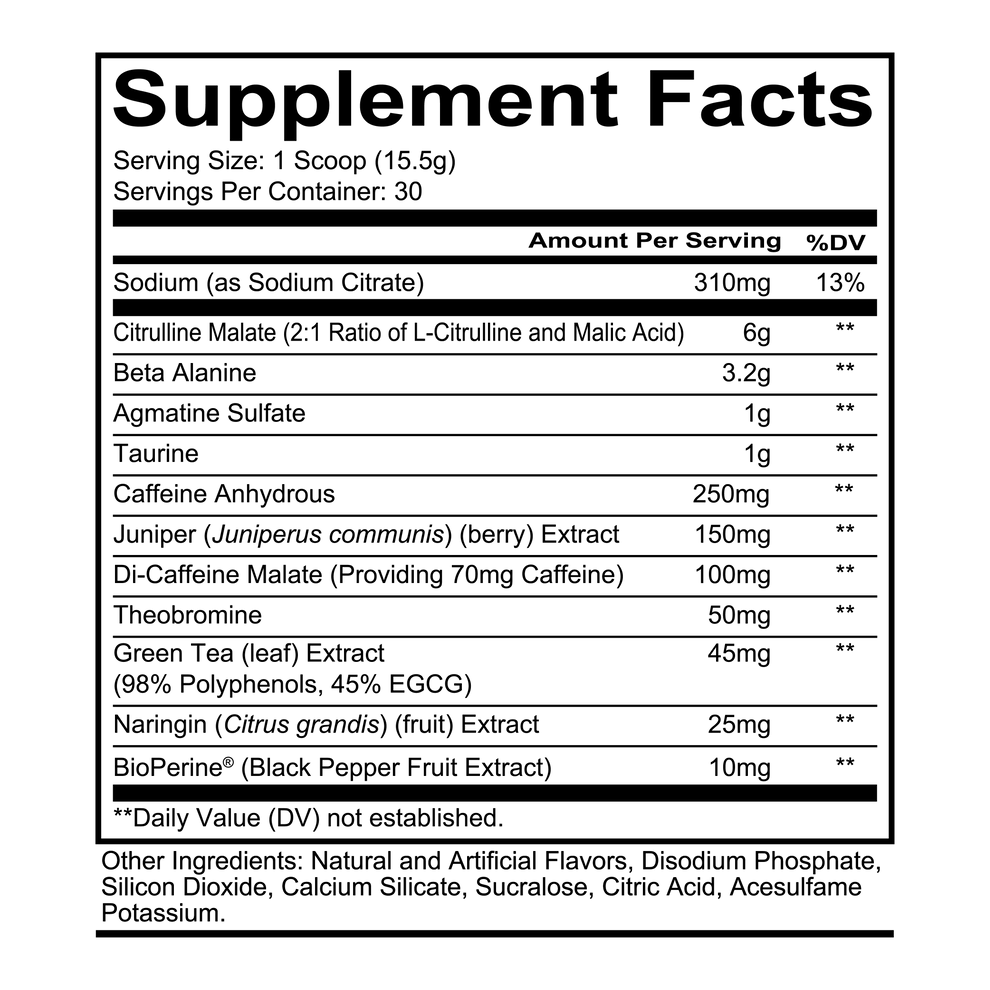
Redcon1 Total War is a powdered pre-workout, to be mixed with water and drunk before the session. The tub holds 441 g, that is 30 servings of 14.7 g, and we stock it in the following flavours: Strawberry Kiwi, Tiger's Blood, Pineapple Juice, Apple, Watermelon, Blue Lemonade, Blue Raspberry, Grape, Strawberry Mango, Sour Gummy Bear, Orange and Rainbow Candy.
This is a heavily caffeinated product, and that is what defines its place in the boosters section. It contains no creatine: if you take any, it still has to be handled separately, which effectively puts it among the creatine-free pre-workouts. Redcon1 is an American brand whose range we stock in the Redcon1 section.
What is in one serving of Total War?
One level 14.7 g serving provides 5 kcal and four actives quantified on the label:
- 320 mg of caffeine, from several sources including caffeine anhydrous and green tea extract;
- 6,000 mg of citrulline malate;
- 3,200 mg of beta-alanine;
- 1,000 mg of taurine.
The formula also contains theanine, agmatine sulfate and what is described as a nootropic complex. Let us be clear: these three elements are not quantified on the labelling available to us. A proprietary complex declared without a dose per ingredient allows no serious comparison with a competitor, and we will not fill that gap with an estimate.
A second useful point: "citrulline malate" refers to a salt, not to pure citrulline. Depending on the ratio used, often 2:1, the 6,000 mg declared correspond to a noticeably smaller amount of citrulline. The ratio is not stated on this product's label; here again, we would rather flag it than put forward a figure.
Finally, neither caffeine, nor beta-alanine, nor citrulline has an authorised health claim in Europe. So we describe what the serving contains, not what it is supposed to produce. The full detail is in the tabs on this page.
How should Total War be taken?
The standard serving is 1 level scoop of 14.7 g mixed into 150 to 200 ml of cold water, to be drunk 20 to 30 minutes before training. If you are not used to stimulants, start with half a scoop to gauge your tolerance before considering the full serving.
The frequency is one intake per training day, and on training days only. The manufacturer recommends not taking it after 15:00 and leaving at least 48 hours between two intakes to limit tolerance build-up, along with cycling of 8 weeks of use followed by 2 weeks off. The 30-serving tub therefore covers roughly two months at three sessions a week.
One figure worth keeping in mind: EFSA considers that single intakes of 200 mg of caffeine and a total of 400 mg a day raise no safety concern in healthy adults. A full serving of Total War delivers 320 in one go, well above the single-intake reference value. Half a serving, at 160 mg, sits below it. Then add up the coffee, tea and energy drinks over the day: it is the total that counts.
Who is Total War for, and who is it not for?
The product is aimed at trained adults who are already used to stimulants. This is a high dose, not a beginner's product.
It is not suitable for under-18s, for pregnant or breastfeeding women, or for people with heart conditions, high blood pressure, anxiety disorders or a known sensitivity to caffeine. If you are on any medication, ask your doctor or pharmacist before taking it. On allergens, the manufacturer states production in a facility that handles milk, soya, egg, peanuts, nuts, fish and crustaceans.
Two effects are worth knowing about before buying. Beta-alanine very often causes tingling in the face and forearms in the minutes after the intake: it is temporary and harmless, but disconcerting the first time. And caffeine at this dose can bring on jitteriness, palpitations or insomnia, especially if taken late. Finally, what not to expect from it: a pre-workout replaces neither sleep, nor the carbohydrates from the previous meal, nor a properly built training programme. Nor does it deliver progress in itself.
Total War or a caffeine-free booster?
The question genuinely arises, and not only for people sensitive to stimulants. Caffeine has a long half-life: a 320 mg dose taken at 18:00 is still largely present at bedtime, and lost sleep costs more, in training terms, than the lift gained.
A product from our caffeine-free booster section is the better choice if you train in the evening, if you already drink coffee during the day, if you tolerate stimulants poorly, or if you want to be able to take one at every session without cycling. These formulas generally keep the citrulline and the beta-alanine and drop the stimulant side.
Total War is the better choice if you train in the morning or early afternoon, if you are after a high dose of caffeine in a single intake, and if you accept the constraint of cycling. There is a third scenario: if your goal is strength rather than energy in the moment, creatine monohydrate is better established and costs far less per day. The two are not mutually exclusive, but the order of priority is not a matter of indifference.
Frequently asked questions
How long before training should Total War be taken?
Twenty to thirty minutes before the session, mixed into 150 to 200 ml of cold water. More than 45 minutes ahead and part of the stimulant effect drops away during the warm-up. Avoid a heavy meal in the two hours beforehand: at this dose, taking it on a very full stomach or on a completely empty one is less well tolerated.
How many coffees does 320 mg of caffeine amount to?
Something like three to four espressos, depending on the grind and the extraction. That is above the 200 mg per intake that EFSA uses as a reference in healthy adults. If you have already drunk coffee during the day, half a scoop is the sensible starting point.
Where does the tingling after the intake come from?
From the beta-alanine, dosed here at 3,200 mg. This pins-and-needles feeling in the face, neck and forearms appears within ten to twenty minutes, lasts about half an hour and is harmless. It fades as you get used to it. If the sensation bothers you, half a serving reduces it accordingly.
Which flavour should you choose?
The tart flavours — Blue Lemonade, Sour Gummy Bear, Rainbow Candy — go down better in a small volume of water, which is exactly the case here. The classic fruit flavours such as Apple, Orange or Watermelon are more neutral if you take it often. As the tub holds 30 servings, it is best not to commit to a very distinctive flavour without having tasted it.
Can Total War be taken every day?
The manufacturer recommends keeping it to training days, with at least 48 hours between two intakes and a cycle of 8 weeks followed by 2 weeks off. Taking it daily builds caffeine tolerance: at the same dose the effect diminishes, and that is what pushes people to raise the dose with no benefit.
Does Total War contain creatine?
No. The ingredients list does not include any. If you are supplementing with creatine, it therefore has to be taken separately, at 3 to 5 g a day, at any time of day since timing does not matter for it.
What exactly is in the nootropic complex?
It is declared without a per-ingredient dose in the labelling data available to us. That is common practice in this category, and a real limitation: there is no way to compare this block with a competitor's. We would rather tell you than turn it into a selling point.
Where can you buy Redcon1 Total War?
You can order it on this page, flavour by flavour, and we ship throughout France and Europe. In the Vendargues shop, about ten minutes from Montpellier, the first question we ask about this product concerns the time you train and the coffee already drunk during the day: at 320 mg per serving, that is what determines whether to go for a full scoop, half a scoop, or something else entirely. The whole category is gathered in our sports nutrition selection.
Caffeine reference: EFSA.


What is Raw Nutrition's CBUM Essential Pre Workout?
It is a powdered pre-workout booster to be mixed with liquid, dosed at one scoop of about 17 g. It carries the initials of Chris Bumstead, the athlete associated with the American brand Raw Nutrition, whose range we stock in the Raw Nutrition section.
Its distinguishing feature has less to do with its ingredient list — a conventional one — than with the way that list is published: every active is quantified individually. No "proprietary blend", no aggregate total to hide behind. You know exactly what the scoop contains, and that is still far from the norm on this shelf.
The formula combines four families. Pump actives, with 4 g of L-citrulline and 1 g of betaine. A muscle buffering active, 3.2 g of beta-alanine. Stimulation and focus actives, 200 mg of anhydrous caffeine and 1 g of L-tyrosine. And a hydration base, 1 g of taurine and 500 mg of Himalayan pink salt, rounded off with 2.4 µg of vitamin B12. This product contains no creatine, which places it in our pre workout without creatine section. The flavours stocked: Blue Raspberry, Peche Mango, Watermelon, Fruit Burst, Orange and Citrus Grapefruit.
What does a 17 g serving contain?
| Item | Per serving (1 scoop, approx. 17 g) | % NRV |
|---|---|---|
| Energy | 42 kJ / 10 kcal | — |
| Fat | 0 g | — |
| Carbohydrate | 2 g | — |
| Fibre | 0 g | — |
| Protein | 0 g | — |
| Salt | 0.2 g | — |
| L-citrulline | 4,000 mg | no NRV |
| Beta-alanine | 3,200 mg | no NRV |
| L-tyrosine | 1,000 mg | no NRV |
| Taurine | 1,000 mg | no NRV |
| Anhydrous betaine | 1,000 mg | no NRV |
| Himalayan pink salt | 500 mg | no NRV |
| Anhydrous caffeine | 200 mg | no NRV |
| Vitamin B12 (methylcobalamin) | 2.4 µg | 100 % |
Add it up: 10.9 g of declared actives in a 17 g serving. The rest is citric acid, malic acid, flavourings, sucralose and anti-caking agents. A ratio of two thirds actives is respectable — and it is a calculation you simply cannot carry out on a proprietary-blend product.
4 g of citrulline is a full dose. Plenty of boosters advertise it and put in one gram, which means nothing. On this count, the product is serious. The same goes for the 3.2 g of beta-alanine: that is the amount found in formulas that actually dose it, rather than the usual decorative pinch.
The 200 mg of caffeine deserves a sentence of its own, because it is a deliberate choice. The equivalent of two espressos, where some "extreme" formulas climb to 350 or 400 mg. That dose leaves you room for a coffee during the day without going past the EFSA benchmarks, which set 200 mg in a single dose and 400 mg per day as not raising safety concerns in healthy adults. It is a strong product, not a brutal one.
One essential regulatory clarification, and it applies to almost the whole list: citrulline, beta-alanine, tyrosine, taurine and betaine have no authorised health claim in Europe. So we describe doses, not promised effects. The only usable claim here is the one for vitamin B12, at 100 % of the NRV: vitamin B12 contributes to normal energy-yielding metabolism, to the reduction of tiredness and fatigue and to the normal functioning of the nervous system.
Finally, the net weight of the tub does not appear in the data supplied to us: we cannot work out the number of servings. Divide the weight printed on the packaging by 17 g.
How do you take Essential Pre Workout?
Dose: 1 scoop of about 17 g. Liquid: 200 to 400 ml of cool water. Timing: 20 to 30 minutes before the warm-up. Frequency: training days only, 2 scoops a day at most. Duration: a 2-week break every 8 to 10 weeks of use.
Always start with a single scoop, even if you are used to boosters. Two reasons: tolerance to 200 mg of caffeine varies a great deal from person to person, and the 3.2 g of beta-alanine cause a tingling that takes you by surprise the first time. Experienced users can go up to two scoops in 400 to 500 ml of water, but that means 400 mg of caffeine — the daily ceiling, with nothing else alongside it.
Shake vigorously, ideally in a shaker with a ball: the powder dissolves well in cold water but remains acidic and concentrated. Drink it straight away. For a morning session, the manufacturer advises taking it on an empty stomach with an extra glass of water; for an afternoon workout, leave at least three hours after your last main meal.
The most useful rule is the one about frequency: training days only. Taking a booster every day, rest days included, is the surest way to build up a tolerance and feel nothing at all after a month. The two-week break every eight to ten weeks serves the same purpose. And never take it after 16:00: caffeine has a half-life of several hours, and shortened sleep costs more than a good session brings in.
Who is this booster for, and who is it not for?
It is aimed at adults over 18 who train during the day and want a product that is well dosed but readable. It suits someone who wants verifiable figures rather than an aggressive formula name.
The manufacturer does not recommend it for pregnant or breastfeeding women or for people sensitive to caffeine, and asks that it not be consumed after 16:00. If you are on any medical treatment, consult a doctor before use.
Two normal effects to know about before you meet them. The skin tingling — face, neck, forearms — comes from the beta-alanine, appears 15 to 20 minutes after taking it and fades within half an hour. It is harmless. Caffeine, for its part, can cause jitteriness, tremors or palpitations if you are not used to it or if you stack it with a coffee.
On allergens: the product is made in a facility that handles MILK, SOYA, EGGS and GLUTEN. The manufacturer states that it is suitable for vegetarians but not suitable for vegans — check this point if your diet requires it.
What not to expect from it: it contains no creatine, so it does not replace your creatine monohydrate, which remains the best-documented supplement for strength. It does not make you lose weight. And it will not make up for a four-hour night: a booster masks fatigue, it does not remove it.
Essential Pre Workout or citrulline on its own?
This is the honest comparison to make, because many experienced athletes end up building their own pre-workout rather than buying a ready-made formula.
Citrulline on its own is the better choice in three cases. If you want to control each component: 6 or 8 g of citrulline instead of 4, without touching the rest. If you train in the evening and want no caffeine at all — you can then pair it with a product from our caffeine-free booster section. And if you tolerate beta-alanine poorly, since the tingling puts some people off. A pure powder generally costs less per gram of active.
The complete formula is the better choice everywhere else, for a plain and decisive reason: it is prepared in one go. Measuring out four different powders every session evening is something nobody keeps up for long. It also has the merit of offering coherent doses — 4 g of citrulline and 3.2 g of beta-alanine are quantities you would have chosen yourself — and a decent taste, which pure powders do not have. If you are starting out, take the formula; if you are experienced and watchful about the price per gram, build your own.
Frequently asked questions
How much caffeine, and can you take two servings?
200 mg per scoop, the equivalent of two espressos. The manufacturer caps it at two scoops a day, that is 400 mg — the daily total that EFSA considers as not raising safety concerns in healthy adults, but only if you drink nothing else containing caffeine. In practice, one scoop is enough for the vast majority of people.
Why the tingling after taking it?
It is the beta-alanine, at 3.2 g per serving: a known effect called paraesthesia, which affects the face, the neck and the forearms 15 to 20 minutes after taking it. It is harmless and it lessens with habit. If the sensation really bothers you, mix it into 400 ml rather than 200 and drink more slowly.
Does this booster contain creatine?
No, none at all. It is a formulation choice, and it is rather good news: creatine is taken every day, rest days included, whereas a booster is only taken on training days. The two are therefore easier to manage separately — take your creatine on its own, at whatever time suits you.
What is Himalayan pink salt doing in the formula?
It provides sodium, at a level of 0.2 g of salt per serving. Sodium is one of the electrolytes lost through sweat, and its presence in a pre-workout is consistent with an intense session. Let us be clear that no health claim is authorised for pink salt as such, and that its mineral composition is in no way exceptional compared with ordinary salt.
Can you take it on an empty stomach in the morning?
Yes, that is what the manufacturer recommends for morning sessions, with an extra glass of water. At 10 kcal, the drink breaks practically nothing. Just be aware that 200 mg of caffeine on an empty stomach hits harder — if you feel nauseous, take it after a few mouthfuls of food.
How many servings are there in a tub?
The net weight of the packaging does not appear in the data supplied by the manufacturer, so we cannot calculate it without risk of error. Divide the weight printed on the packaging by 17 g, the weight of one scoop.
Is it suitable for vegans?
No. The manufacturer explicitly states that the product is suitable for vegetarians but not for vegans. It is also made in a facility that handles milk, soya, eggs and gluten: in case of severe allergy to any of them, abstain.
Where to buy Raw Nutrition CBUM Essential Pre Workout?
The flavours can be ordered from this page, and we ship throughout France and Europe.
A booster is chosen first and foremost on its label, and that is an exercise we are happy to go through with you at the Vendargues shop, about ten minutes from Montpellier: take this tub, take the one next to it, and look for the "citrulline" line. When one shows 4,000 mg and the other a global blend with no detail, the comparison is over before it has begun. The rest of the amino acids can be found in the taurine section and in our sports nutrition range.


What is IO Genix Russian Roulette?
It is a ready-to-drink liquid pre-workout, packaged in 60 ml vials. The box holds 20 of them, i.e. 1.2 litres in total. The flavours listed: green apple and red berries.
One shot provides 200 mg of caffeine, 3 g of beta-alanine, 2 g of citrulline, 2 g of AAKG and 1 g of taurine, plus two B vitamins. The rest of the formula is water, citric acid, sucralose, two preservatives — sodium benzoate and potassium sorbate — and flavourings.
The appeal of the format comes down to one sentence: there is nothing to prepare. You shake it, unscrew it, drink it. No scoop, no shaker, no powder sticking to the bottom. For a session in a gym with no water point, or a competition in a car park, that is a genuine practical advantage over a powdered pre-workout. The rest of the Spanish range is in our IO Genix section.
What does a 60 ml shot contain?
| Active | Per 60 ml shot | % NRV |
|---|---|---|
| Beta-alanine | 3,000 mg | no NRV |
| L-citrulline base | 2,000 mg | no NRV |
| AAKG (L-arginine alpha-ketoglutarate) | 2,000 mg | no NRV |
| Taurine | 1,000 mg | no NRV |
| Anhydrous caffeine | 200 mg | no NRV |
| Vitamin B3 (niacin) | 16.2 mg | 101% |
| Vitamin B6 | 1.4 mg | 100% |
Pack format: 20 shots of 60 ml. The energy value is not declared in the data supplied; on a sugar-free water base it is marginal in any case.
Let us look at the doses one by one, because that is where the difference between a real pre-workout and a coloured drink is decided. Beta-alanine at 3,000 mg is correctly dosed: that is the market's benchmark range, whereas plenty of formulas announce it and then put in 800 mg. Caffeine at 200 mg is the equivalent of two or three espressos, and it is the amount EFSA considers as raising no concern in a single dose for a healthy adult.
Citrulline at 2,000 mg, on the other hand, is moderate. The best-dosed formulas in the category go up to 6 g. That is not a deal-breaker — everything has to fit into 60 ml, after all — but it is worth knowing before you buy: this is a shot built around caffeine and beta-alanine, not around the pump. Our citrulline and L-arginine sections let you top it up if that is your priority.
Now the regulatory framework, and it is strict. No health claim is authorised in Europe for beta-alanine, citrulline, arginine, taurine or caffeine. You will therefore read no promise here about endurance, pump or focus. The only usable wordings come from the two vitamins, both at 100% of the NRV: niacin contributes to normal energy-yielding metabolism and to the reduction of tiredness and fatigue; vitamin B6 contributes to the reduction of tiredness and fatigue and to normal energy-yielding metabolism. That is all, and it is already honest.
How do you take Russian Roulette?
Serving: 1 shot of 60 ml, never two. Liquid: none, the shot is drunk as it comes. Timing: 15 to 30 minutes before the warm-up. Frequency: 3 to 4 times a week at most. Duration: no set course, but the manufacturer advises against daily use.
Shake the vial before opening: the actives settle. Then drink it in one go. The manufacturer asks that you hydrate generously during the session, at least 500 ml of water: 60 ml of liquid does not count as hydration.
Three instructions deserve careful reading, because they concern safety rather than comfort. Never double the dose: two shots means 400 mg of caffeine, i.e. EFSA's daily reference figure in a single hit. Do not consume after 17:00, the half-life of caffeine being around five hours. And do not stack it with another source of caffeine on the same day — coffee, tea, another pre-workout — leaving at least six hours between them if you cannot avoid it.
The three-to-four-times-a-week limit is not window dressing: tolerance to caffeine sets in within two to three weeks of daily use, and you then have to raise the dose to get the same sensation back. Save this shot for your heaviest sessions.
A final word on what you are going to feel: the beta-alanine tingling, on the face, the back of the neck and the forearms, appears 10 to 15 minutes after taking it and fades during the warm-up. It is a known effect, harmless, and specific to this molecule. It is neither a sign of effectiveness nor a problem: it is simply what beta-alanine does.
Who is this shot for, and who is it not for?
It suits adults who tolerate caffeine well and who want a pre-workout with no preparation. The format slips into a gym bag and needs neither water nor a shaker: that is its argument, and it is a real one.
The manufacturer is categorical about the exclusions, and we pass them on as they stand. The product is prohibited for minors under 18, for pregnant women and for breastfeeding women. It is not recommended for people who are sensitive to caffeine or who have cardiovascular disorders. If you are on medical treatment, consult a doctor before use. Traces of MILK, EGGS, GLUTEN, SOYA, NUTS and FISH are possible.
It is not for you if you train in the evening: at 200 mg of caffeine and with an instruction to take nothing after 17:00, the question is settled. Nor is it for you if you already drink several coffees during the day — do the sum beforehand, not afterwards.
What you should not expect from it: nothing more than what 200 mg of caffeine and 3 g of beta-alanine do. A pre-workout does not make up for a short night, it masks it, and the sleep debt remains in full. Nor does it move your loads up by itself: it makes a session easier to get started, which is no small thing, but that is all that can honestly be said about it.
Ready-to-drink shot or powdered pre-workout?
That is the real choice, and it is decided not on effectiveness but on format and dosing.
A powdered pre-workout allows doses that 60 ml cannot hold: 6 g of citrulline, 3.2 g of beta-alanine, plus tyrosine, betaine or malate. It is the better choice if the pump and endurance matter to you as much as the kick, and it works out cheaper per serving. Its drawback: you need a scoop, a shaker and water.
The shot wins wherever logistics count. Nothing to prepare, an identical dose every time, and a vial that fits in a pocket. It also wins on consistency: nobody gets the dose wrong with a sealed vial, whereas powder scoops are filled by eye.
Two useful alternatives depending on your situation. If you train in the evening, look at a caffeine-free pre-workout: you will lose the kick, you will keep your night's sleep, and it is the best trade in the category. And if you want to push one active in particular, our beta-alanine and taurine sections let you dose each element yourself, which no shot will ever allow.
Frequently asked questions
200 mg of caffeine, how many coffees is that?
Two to three espressos. It is also the amount EFSA considers as raising no safety concern in a single dose for a healthy adult, with 400 mg as the reference figure for the whole day from all sources combined. One shot therefore places you exactly on the single-dose limit.
Why does it tingle?
That is the beta-alanine, at 3,000 mg per shot. The tingling appears 10 to 15 minutes after taking it, mainly on the face and forearms, and disappears during the warm-up. It is a known and harmless effect of this molecule, neither a sign of effectiveness nor a problem.
Can you take two?
No, and the manufacturer says so in black and white: one shot a day at most. Two vials represent 400 mg of caffeine in a single dose, i.e. EFSA's entire daily reference figure taken in one go. It is not a matter of taste, it is a matter of dose.
Up to what time can you drink it?
The manufacturer sets 17:00. That is consistent with the half-life of caffeine, around five hours in an average adult: a shot at 19:00 still leaves a hundred milligrams or so in circulation at midnight. If you train in the evening, this product is not the right one.
Why not take it every day?
Because tolerance to caffeine sets in within two to three weeks of daily use: the same dose no longer produces the same effect, and you then have to go up, which is not sustainable. The manufacturer recommends three to four times a week, reserved for the heaviest sessions.
Is 2 g of citrulline enough?
It is a moderate dose: the best-equipped formulas in the category go up to 6 g. The constraint is physical — five actives have to fit into 60 ml. If the pump is your priority, a powdered pre-workout or a separate citrulline will serve you better; this shot is built around caffeine and beta-alanine.
Can you choose your flavour?
The flavours, green apple and red berries, are listed separately on this page. Note that the manufacturer's documentation also mentions boxes that mix the flavours at random, which is where the product's name comes from: check the contents of the box you receive if that point matters to you.
Where can you buy IO Genix Russian Roulette?
The flavours can be ordered from this page, and we ship throughout France and Europe. The box of 20 shots represents five to six weeks at the recommended rate of three to four sessions a week.
At the Vendargues shop, about ten minutes from Montpellier, this is the product we recommend to those who cannot be bothered with a scoop, and advise against for those who train after work at the end of the day. The question of the training slot almost always decides the sale, well before that of the dosing. The rest of the category can be compared in our sports nutrition section.


What is The Curse by JNX Sports?
JNX Sports The Curse is a powdered pre-workout, to be mixed with water before your session. A 5 g serving delivers 155 mg of anhydrous caffeine, for under 5 kcal. The 250 g tub holds 50 servings, which makes it one of the longest-lasting formats in the category.
The Curse is a long-standing formula, on the market since the early 2010s, and it has kept the same positioning throughout: a very small scoop, 5 g, where most current pre-workouts sit somewhere between 10 and 15 g. Alongside the caffeine you will find CarnoSyn® beta-alanine, creatine monohydrate, L-citrulline, arginine alpha-ketoglutarate and an olive leaf extract.
The flavours in the range: Lemon, Lemon Rush, Peach, Peach Mango, Fruit Punch, Blue Raspberry and Green Apple. The composition is identical across all of them, only the flavouring and the colouring change. The other formulas in the category can be browsed in our boosters selection.
What does a serving of The Curse contain?
| Per 5 g serving | Amount | Detail |
|---|---|---|
| Energy | under 5 kcal | — |
| Anhydrous caffeine | 155 mg | only active with a stated figure |
| Beta-alanine (CarnoSyn®) | undisclosed | part of a blend |
| Creatine monohydrate | undisclosed | part of a blend |
| L-citrulline | undisclosed | part of a blend |
| L-arginine alpha-ketoglutarate | undisclosed | part of a blend |
| Olive leaf extract | undisclosed | part of a blend |
| Pack size | 250 g, i.e. 50 servings | |
155 mg of caffeine is the equivalent of two espressos. That is a measured dose for a pre-workout, and it counts in the product's favour: plenty of products in this category climb to 300 or 350 mg per serving, which becomes a genuine problem as soon as you train late in the day or already drink coffee. Here you stay below the 200 mg benchmark set for a single intake in a healthy adult.
The downside, and it needs saying plainly: apart from the caffeine, no dosage is published. Beta-alanine, creatine, citrulline and arginine are bundled into blends for which only the trade name is disclosed. There is no way, then, to know whether the beta-alanine comes close to the 3.2 g usually cited, or whether the creatine even reaches a gram. Given the size of the scoop — 5 g in total, of which 155 mg is caffeine — the arithmetic is quickly done: those four ingredients share less than 5 g between them, flavourings and sweeteners included. They are therefore present in amounts well below the reference dosages, and it would be dishonest to let you believe otherwise.
Put another way: this product is first and foremost a sensibly dosed stimulant, with a token supporting cast. That is not a flaw in itself, provided you buy it for what it is. If you want creatine at a useful dose, that means 3 to 5 g a day and it is taken separately, from our creatine monohydrate category. If citrulline is what interests you, reckon on 6 g per serving, which on its own is more than the entire scoop.
On the regulatory side, there is nothing to claim: no health claim is authorised in Europe for caffeine, beta-alanine, creatine at this dose, citrulline or arginine. We describe ingredients and the one published figure, never a promised effect.
Ingredients list
Beta-alanine (CarnoSyn®), creatine monohydrate, L-citrulline, citric acid, natural and artificial flavourings, L-arginine alpha-ketoglutarate, anhydrous caffeine, calcium silicate, silicon dioxide, sucralose, acesulfame potassium, olive leaf extract, colours depending on the flavour.
Gluten-free formula, manufactured in the United States. Produced in a facility that also handles peanuts, tree nuts, milk, egg, wheat, crustaceans, fish and soya: traces are possible.
How do you take The Curse?
Serving: 1 scoop of 5 g. Liquid: 150 to 250 ml of cold water. Timing: 20 to 30 minutes before training. Frequency: one serving a day, and no more than 5 consecutive days out of 7. Duration: the manufacturer sets no cycle length, but does impose this 5-days-in-7 pattern.
One scoop, and one only. You will read elsewhere that you can go up to two or three scoops: we do not advise it and we will not repeat it. Two scoops is 310 mg of caffeine; three is 465 mg, more than the 400 mg daily benchmark set for an adult, swallowed in one go. The manufacturer itself recommends assessing your tolerance with a single scoop: stick to that.
The 5-days-in-7 rule deserves to be respected. It is not folklore: tolerance to caffeine builds quickly, and two days off a week are enough to preserve the effect. It is also a simple way of not turning a training-day product into a daily habit.
No evening servings. 155 mg of caffeine at 19:00 is still active at bedtime. If you train late, our caffeine-free booster category suits your situation better, and you will keep your night's sleep.
Finally, expect possible tingling on the skin after taking it: that is the beta-alanine, the sensation is temporary and harmless. And do not combine it with any other source of caffeine on the same day — coffee, an energy can or a stimulant fat burner all add up.
Who is The Curse for, and who is it not for?
It suits a trained adult looking for a straightforward pre-workout, sensibly dosed in caffeine without excess, who has no wish to pay the price of a fifteen-ingredient formula. The ratio between the number of servings and the size of the tub is its strongest argument: 50 sessions in 250 g lasts a long time.
It is not suitable for under-18s, nor for pregnant or breastfeeding women. The manufacturer formally advises against it in cases of caffeine sensitivity or cardiovascular disorders. If you are on medical treatment — particularly for high blood pressure or a heart condition — a doctor's opinion is required before purchase, and the product must not be combined with any other stimulant.
Mind the allergen traces. The formula is gluten-free, but the facility handles peanuts, tree nuts, milk, egg, wheat, crustaceans, fish and soya. In cases of severe allergy this point is decisive, and it is rarely highlighted on product pages in this category.
What you should not expect from it. Do not count on this product for your creatine intake or for a pronounced vascular effect: the amounts involved are too small. A pre-workout does not make you progress, does not make up for a lack of sleep and does not replace a properly built programme. What it gives you is perceived energy at the moment you start — and on that front, at 155 mg, it does exactly what it says.
The Curse or a fully disclosed pre-workout?
That is the real choice in this category today, and it pits two philosophies against each other.
A fully disclosed pre-workout states every line: 6 g of citrulline, 3.2 g of beta-alanine, 200 mg of caffeine. You know what you are paying for and you can compare two products line by line. In return, the scoop is bigger — often 12 to 20 g — and the tub lasts far less time. Our creatine-free pre-workout category and our citrulline selection show you what stated dosages look like.
The Curse plays the other card: small serving, contained price, 50 sessions in a tub. For someone who simply wants a lift before the session without getting into label comparisons, it is a defensible choice and an honest one about its caffeine level.
The most rational solution is often to separate the two: a simple stimulant on one side, and your actives at a useful dose on the other. A beta-alanine is taken every day, rest days included, which a pre-workout does not allow; and an L-arginine or a seriously dosed citrulline will do more for the feeling of a pump than any undisclosed blend.
Frequently asked questions
How much caffeine per serving?
155 mg for a 5 g scoop, roughly two espressos. That is a moderate dose for this category and it stays below the 200 mg benchmark set for a single intake in an adult. One serving a day only, and no other source of caffeine alongside it.
Can you take two or three scoops?
We formally advise against it. Two scoops amount to 310 mg of caffeine and three to 465 mg, more than the 400 mg daily benchmark in a single intake. The manufacturer itself recommends sticking to one scoop to assess your tolerance. Stick to that.
Are the dosages of the other ingredients known?
No. Only the caffeine carries a figure; the beta-alanine, creatine, citrulline and arginine are bundled into blends that are not broken down. The whole scoop weighs only 5 g, flavourings and sweeteners included: these ingredients are therefore present well below the reference dosages.
How many servings in a tub?
Fifty 5 g servings in the 250 g tub. At four training sessions a week, that comes to around three months. It is one of the best ratios in the category on this specific point, most competitors offering 20 to 30 servings per tub.
Why not go beyond 5 days out of 7?
Because tolerance to caffeine builds quickly and the same dose ends up producing nothing at all. Two days off a week are enough to preserve the effect. It is the manufacturer that sets this rule, and it is consistent with what we know about this molecule.
Which flavours are available?
Lemon, Lemon Rush, Peach, Peach Mango, Fruit Punch, Blue Raspberry and Green Apple. The composition is identical across all of them; only the flavouring and the colouring change. The scoop is mixed into 150 to 250 ml of cold water depending on how concentrated you want it.
Does the product contain gluten?
No, the formula is declared gluten-free by the manufacturer. It is, however, produced in a facility that handles peanuts, tree nuts, milk, egg, wheat, crustaceans, fish and soya: traces are possible, which matters in cases of severe allergy.
Where can you buy The Curse by JNX Sports?
The 250 g tub can be ordered from this page in the available flavours, and we ship throughout France and Europe. At the Vendargues shop, about ten minutes from Montpellier, this is the pre-workout we recommend to anyone who finds recent formulas too heavily loaded with caffeine: 155 mg is reasonable, and the tub lasts a whole season. We simply remind you never to double the scoop. The rest of our selection can be browsed in the sports nutrition category.


What is 5150 Legendary by 5% Nutrition?
5% Nutrition Rich Piana 5150 Legendary is a powdered pre-workout, created by the brand founded by American bodybuilder Rich Piana. The tub holds 30 servings of 12.5 g. The name refers to the California police code 5150; the brand makes no secret of its intentions, and the formula lives up to them.
What sets this product apart from most others is its multi-source caffeine complex: caffeine anhydrous, dicaffeine malate, green tea extract, yerba mate extract, guarana extract standardised to 22 %, green coffee extract and gotu kola extract. The total exceeds 400 mg per serving. Alongside that, the formula delivers citrulline, beta-alanine, taurine, N-acetyl-L-tyrosine, choline, Cocoabuterol® (a patented cocoa extract), huperzine A and two B vitamins.
The flavours available: Green Apple, Blue Ice, Tropical, Wildberry, Raspberry Mojito and Citrus Mango. The product joins our boosters range, in the most heavily dosed category of all.
What is in a 12.5 g serving?
| Nutrient / active | Per 12.5 g serving | % NRV |
|---|---|---|
| Energy | 105 kJ / 25 kcal | 1 % |
| Fat | 0 g | 0 % |
| of which saturates | 0 g | 0 % |
| Carbohydrate | 6 g | 2 % |
| of which sugars | not disclosed | — |
| Fibre | 0 g | — |
| Protein | 0 g | 0 % |
| Salt | 0.2 g | 3.3 % |
| Caffeine complex (7 sources) | more than 400 mg | NRV not established |
| L-citrulline | 4,000 mg | NRV not established |
| Beta-alanine | 2,500 mg | NRV not established |
| L-taurine | 2,000 mg | NRV not established |
| N-acetyl-L-tyrosine | 750 mg | NRV not established |
| Choline bitartrate | 500 mg | NRV not established |
| Cocoabuterol® (cocoa extract) | 50 mg | NRV not established |
| Huperzine A | 300 µg | NRV not established |
| Vitamin B3 (niacin) | 20 mg | 125 % |
| Vitamin B12 | 1,000 µg | 40,000 % |
Unlike many competitors, almost everything here is quantified, and that is the first point in the product's favour. Only the split between the seven caffeine sources stays inside a proprietary blend: you know the total exceeds 400 mg, not how it breaks down. The "of which sugars" line is not declared either.
The 400 mg of caffeine deserve to be faced squarely. EFSA considers that 400 mg spread across the whole day raises no safety concern in healthy adults, and sets 200 mg as the reference for a single intake. One serving of 5150 therefore takes you to your daily ceiling in one go. This is a product for users already accustomed to stimulants, and the manufacturer says so itself.
On everything else, the dosing is serious: 4 g of citrulline and 2.5 g of beta-alanine sit within the ranges genuinely used, where many formulas make do with a pinch just to be able to print it on the label. The 1,000 µg of vitamin B12 represent 40,000 % of the NRV: enormous on paper, with no known risk for this water-soluble vitamin, but with no demonstrated benefit at that level either. The authorised wordings that apply are these: niacin and vitamin B12 contribute to the reduction of tiredness and fatigue and to normal energy-yielding metabolism. For citrulline, beta-alanine, taurine, tyrosine, choline, Cocoabuterol® and huperzine A, no claim is authorised in Europe.
How should 5150 Legendary be dosed?
Serving: 1 scoop of 12.5 g, never more than one a day. Liquid: 200 to 300 ml of cold water. Timing: 20 to 30 minutes before the session, ideally on an empty stomach or at least two hours after the last meal. Frequency: the manufacturer recommends keeping it to 2 or 3 sessions a week, no more. Duration: a 6 to 8 week period, followed by a compulsory 2 to 3 week break.
If you are not used to stimulants, start with half a scoop for the first three sessions. This is not a formality: at 400 mg of caffeine, misjudging your tolerance means shaking, a racing heart rate and a wasted session.
Three further instructions. Do not take it within 6 hours of going to bed. No other source of caffeine or stimulants on the same day — coffee, tea, energy drinks, thermogenic fat burners. And increase your water intake by at least 500 ml on the days you use it: the formula increases sweating.
Save it for the sessions that warrant it — legs, back, training that runs beyond 75 minutes. Used five times a week, it loses its edge within three weeks and you will have no headroom left to go up.
Who is this pre-workout for, and who is it not for?
It is aimed at trained adults who already have a high tolerance to stimulants, for heavy morning or midday sessions. As a first experience of the category, avoid it without hesitation: start at 150 or 200 mg of caffeine.
The restrictions are explicit. Strictly not recommended for under-18s, pregnant or breastfeeding women. Medical advice is mandatory in cases of cardiovascular disorders, high blood pressure, diabetes or anxiety disorders. The possible effects listed by the manufacturer are the tingling associated with beta-alanine, an increased heart rate, sweating and restlessness; stop using it if the discomfort persists. The product is made in a facility that also handles MILK, EGGS, SOYA, NUTS and FISH, and may contain traces of them. Shelf life 24 months in the original packaging.
What you should not expect from it: strength or muscle. A pre-workout acts on alertness, focus and perceived effort. It makes up neither for insufficient sleep nor for food intake that is too low — and at this level of caffeine, using it to mask chronic fatigue is precisely the wrong idea.
5150 Legendary or a caffeine-free booster?
The choice does not come down to the quality of the formulas but to your tolerance and to the time of day you train.
A caffeine-free booster is the better choice in three clear cases. You train after 18:00: 400 mg of caffeine at that hour costs you a night's sleep, and sleep weighs more heavily on progress than any pre-workout. You train four to six times a week: 5150 is designed for 2 to 3 weekly sessions, so you will need a solution for the other days anyway. Or you have anxiety, high blood pressure, palpitations — in which case the question does not even arise.
5150 keeps the advantage on the sessions where you want everything: it combines serious doses of citrulline at 4 g and beta-alanine at 2.5 g with a stimulant load few products reach. Non-stimulant formulas often supply just as much citrulline, sometimes more, but nothing on the nervous side. Plenty of users end up with both tubs in the cupboard, alternating according to the session. If you would rather build your own, taurine and B vitamins are also available separately.
Frequently asked questions
How many servings are in a tub?
Thirty servings of 12.5 g. At the recommended use of 2 or 3 sessions a week, one tub covers roughly ten to fifteen weeks — breaks included, since the manufacturer requires 2 to 3 weeks off every 6 to 8 weeks.
Why seven different caffeine sources?
The sources do not all behave in the same way: caffeine anhydrous is absorbed quickly, dicaffeine malate and the plant extracts more slowly. The idea is to spread the effect across the length of the session rather than produce a single peak. The exact split between the seven is not published by the brand.
Is 400 mg of caffeine dangerous?
In a healthy adult who is used to it, EFSA puts at 400 mg the daily intake that raises no safety concern — but spread across the day, not in a single intake. Here it all arrives at once, which explains the manufacturer's warning and the recommendation to start with half a serving. Anyone affected by the contraindications listed above should abstain.
Should it be taken on an empty stomach?
The manufacturer recommends it, or at least two hours after the last meal. In practice, on an empty stomach the effect arrives faster and harder — which is not always what you want the first time. If you are sensitive, take it on a stomach that is not empty for your first session.
What are Cocoabuterol® and huperzine A?
Cocoabuterol® is a patented extract of cocoa (Theobroma cacao), present at 50 mg. Huperzine A is an alkaloid extracted from Huperzia serrata, dosed at 300 µg. No health claim is authorised in Europe for either of them: we mention them because they appear on the label with a precise dose, which is already better than the average for the category.
Can it be combined with a fat burner?
No. The manufacturer explicitly asks that it not be combined with other sources of caffeine or stimulants, and a thermogenic fat burner typically supplies a further 200 to 400 mg. Stacking them would take you well beyond any safety reference.
Is the 40,000 % NRV of vitamin B12 a problem?
Vitamin B12 is water-soluble and no upper safe limit has been established for it: the excess is excreted. The figure impresses more than it worries. You simply should not read a proportional benefit into it — 1,000 µg do not deliver 400 times more than a normal dose.
Where can you buy 5150 Legendary by 5% Nutrition?
The flavours can be ordered from this page, and we ship throughout France and Europe. This is a product we do not put in just anyone's hands: the question of stimulant tolerance comes before the question of flavour.
In our shop in Vendargues, about ten minutes from Montpellier, we often advise starting with half a serving and keeping this tub for two heavy sessions a week — that is the use it was built for. The brand's full range can be found in the 5% Nutrition collection.


What is FULL AF by 5% Nutrition?
5% Nutrition Rich Piana FULL AF is a pre-workout with no stimulants whatsoever. No caffeine, no stimulant extracts: the formula is built solely around muscle pump and cellular hydration. It is a category in its own right, often misunderstood, and this product is one of its most heavily dosed representatives.
Five active ingredients make up the formula: 8 g of L-citrulline, 2 g of L-taurine, 2 g of GlycerSize™ (65% glycerol), 2 g of anhydrous betaine and 750 mg of Nitrosigine® (inositol-stabilised arginine silicate). Everything is quantified, there is no proprietary blend — rare enough in this section to be worth pointing out.
The flavours on offer: Wildberry, Push Pop and Blue Raspberry. The product appears in our caffeine-free booster section, and also stands comparison with the formulas in the creatine-free pre-workout section.
What does one serving of FULL AF contain?
| Active ingredient | Per serving (1 scoop) | % NRV |
|---|---|---|
| Energy | 60 kcal | 3% |
| L-citrulline | 8,000 mg | NRV not established |
| L-taurine | 2,000 mg | NRV not established |
| GlycerSize™ (65% glycerol) | 2,000 mg | NRV not established |
| Anhydrous betaine | 2,000 mg | NRV not established |
| Nitrosigine® (inositol arginine silicate) | 750 mg | NRV not established |
| Caffeine | 0 mg | — |
The manufacturer publishes neither the macronutrient breakdown, nor the salt content, nor the number of servings per tub: we are flagging that rather than estimating it. The 60 kcal come mostly from the glucose polymers used as a carrier.
The figure that makes this whole page is the 8 g of citrulline per serving. For context: ordinary pre-workouts provide 1 to 2 g, serious formulas 4 to 6 g. Very few products reach 8 g, quite simply because citrulline is expensive and takes up room in the scoop. At that dose, the price of the tub explains itself.
One regulatory point is interesting, and rare in this category: betaine has an authorised claim in Europe — it contributes to normal homocysteine metabolism, from an intake of 1.5 g a day. The 2 g in this formula exceeds that threshold. The regulations require it to be stated that a daily intake in excess of 4 g may significantly increase blood cholesterol levels: at 2 g per serving and one serving a day, you stay below that, but the information has to appear. For citrulline, taurine, glycerol and arginine, no claim is authorised.
How should you dose FULL AF?
Serving: 1 full scoop, without exceeding one a day. Liquid: 250 to 350 ml of cold water. Timing: 30 minutes before training, preferably on an empty stomach. Frequency: one serving a day. Duration: the manufacturer gives no cycle or mandatory break — logically enough, since there is no stimulant to build tolerance to.
One particular feature of this product: it can also be taken on rest days, in the morning on an empty stomach. The manufacturer recommends this to maintain the sensation of muscle fullness, and it is a use that would make no sense with a stimulant pre-workout.
Drink plenty. This is not a throwaway piece of advice: glycerol works by holding water, and without a sufficient fluid intake the formula cannot do anything. Allow at least an extra half a litre on the day you use it.
The manufacturer also states that it is possible to pair it with a stimulant pre-workout, by taking FULL AF thirty minutes beforehand. It is a common combination among advanced users: the pump on one side, the energy on the other. If you do it, add up the caffeine from the second product, not from this one — it has none.
Who is FULL AF for, and who is it not for?
It is aimed at three clearly identified profiles. Those who train in the evening and do not want to sacrifice their sleep. Those who are sensitive to stimulants — palpitations, anxiety, tremors — and have given up on conventional pre-workouts. And those who work in long sets, in the 8 to 12 rep range, and are after the sensation of a pump.
The restrictions are shorter than on a stimulant product, but they exist. For adults over 18 only. Not recommended for pregnant or breastfeeding women. Consult a healthcare professional before use if you are on any medical treatment. Do not exceed one scoop a day. The product contains COCONUT derivatives, which rules it out if you are allergic to tree nuts. It also contains FD&C Yellow No. 5, tartrazine, for which European regulations require the statement: may have an adverse effect on activity and attention in children. Finally, do not use the product if the safety seal is damaged.
What not to expect from it: energy. That is the most frequent misunderstanding about this product. Without caffeine, you will feel no kick, no heightened alertness, nothing edgy. You may feel your muscles fuller, and that is all the formula is aiming for. Nor should you expect strength or muscle from it: a pump is a sensation, not a result.
FULL AF or a stimulant pre-workout?
The two do not replace each other, and the best advice we can give is to work out which of the two problems you are trying to solve.
A stimulant pre-workout is the right choice when the problem is finding the will to go. A session at 6:00 in the morning, a heavy end to the week, motivation at a low ebb: caffeine is what solves that, and nothing else. The formulas in the pre-workouts section typically provide 200 to 400 mg of caffeine, often with more modest citrulline doses. They also win on price: citrulline costs more than caffeine, and a tub with 8 g per serving has to be paid for.
FULL AF wins as soon as stimulation is not the point, or is itself the problem. On citrulline alone, it is ahead of just about everything we sell, including the most expensive formulas. It also wins on flexibility: it is the only type of product you can take at 20:00 without a second thought, or on rest days. The isolated ingredients that make it up — taurine, L-arginine — are also available separately if you would rather put together your own blend, but at 8 g of citrulline per serving, the sums rarely work in your favour.
Frequently asked questions
How many servings does a tub contain?
The manufacturer does not publish the net weight or the number of servings in the data supplied, and we will not estimate it. The information is on the packaging: read it when it arrives. The serving is one full scoop, once a day at most.
Is there really zero caffeine?
Yes. The formula contains neither caffeine nor any other stimulant, and the manufacturer states so explicitly. That is precisely the point of the product: it can be taken late in the day with no consequences for sleep.
What is the glycerol in the formula for?
GlycerSize™ is a 65% glycerol powder, dosed at 2 g. Glycerol holds water in the tissues, which explains the instruction to increase hydration that comes with the product. No health claim is authorised in Europe for glycerol: we describe its role in the formula without attributing any regulated effect to it.
Can it be combined with a stimulant pre-workout?
Yes, and the manufacturer even recommends it: take FULL AF thirty minutes before the stimulant. Since it provides no caffeine, there is no risk of stacking on that front. Just check the caffeine dose of the second product, which remains subject to the usual guidelines.
Can it be taken on days without training?
The manufacturer says so: one serving in the morning on an empty stomach on rest days. It is a possible use, specific to non-stimulant formulas. That said, if your budget is tight, keep the product for training sessions: that is where it makes the most sense.
Do you need to drink more than usual?
Yes, at least 500 ml more on the day you use it. Glycerol works by holding water: if you are already short on fluids, the formula cannot work and you mostly risk headaches. A bottle next to the bench is not optional here.
Does it contain allergens?
Yes, it contains coconut derivatives, which rules it out if you are allergic to tree nuts. It is, on the other hand, declared gluten-free and free from artificial colours with the exception of FD&C Yellow No. 5.
Where can you buy FULL AF by 5% Nutrition?
The flavours can be ordered from this page, and we ship throughout France and Europe. It is a product we often recommend to customers who tell us they have stopped taking pre-workouts because of sleep or palpitations: most of them do not know this category exists.
Our Vendargues shop, about ten minutes from Montpellier, is also the place to compare citrulline labels side by side — that is generally the moment when the gap in dosing becomes obvious. The full range can be found in the 5% Nutrition collection.


What is Raw Nutrition Pre Extreme?
Raw Nutrition Pre Extreme is a pre-workout powder whose serving weighs 12 g and delivers 400 mg of caffeine. Raw Nutrition is an American brand whose formulas are developed with bodybuilder Chris Bumstead; this one is squarely positioned on the stimulation side rather than the pump side.
Six active ingredients make up the formula, all quantified to the milligram: 3.5 g of CarnoSyn® beta-alanine, 2.5 g of citrulline malate, 1.5 g of L-tyrosine, 1.5 g of agmatine sulphate, 1 g of anhydrous betaine and 500 mg of NitroRocket®, a patented rocket extract (Eruca sativa). No proprietary blend.
The flavours on offer: Fruit Burst, Tropical Paradise and Kiwi Blueberry. The formulation is declared GMO-free, aspartame-free and free from artificial colourings. The product joins our pre-workouts and Raw Nutrition sections.
What does a 12 g serving contain?
| Nutrient / active | Per 12 g serving | % NRV |
|---|---|---|
| Energy | 42 kJ / 10 kcal | < 1 % |
| Fat | 0 g | 0 % |
| of which saturates | 0 g | 0 % |
| Carbohydrate | 0.5 g | < 1 % |
| of which sugars | not disclosed | — |
| Dietary fibre | 0 g | — |
| Protein | 1.5 g | 3 % |
| Salt | 0.2 g | 3.3 % |
| Anhydrous caffeine | 400 mg | NRV not established |
| CarnoSyn® beta-alanine | 3,500 mg | NRV not established |
| L-citrulline malate | 2,500 mg | NRV not established |
| Agmatine sulphate | 1,500 mg | NRV not established |
| L-tyrosine | 1,500 mg | NRV not established |
| Anhydrous betaine | 1,000 mg | NRV not established |
| NitroRocket® (rocket extract) | 500 mg | NRV not established |
Everything is quantified, with the exception of the “of which sugars” line. The manufacturer does not publish the net weight of the tub: we cannot state the number of servings, so divide the weight on the packaging by 12 g.
The 400 mg of caffeine in a 12 g scoop represents a rare density: as much as formulas two to three times bulkier. EFSA takes 400 mg as the total daily intake that does not raise safety concerns for a healthy adult, and 200 mg for a single dose. So in one single scoop you are at your ceiling for the day — morning coffee not included.
Two honest remarks about the rest of the formula. The 2.5 g of citrulline malate is a modest dose: this product is not built around the pump, and if that is what you are after, look elsewhere. And the 1 g of betaine stays below the threshold of 1.5 g per day above which European regulation permits the claim on homocysteine metabolism — so we cannot invoke it here. On the other hand, the 3.5 g of CarnoSyn® beta-alanine, a patented raw material, is a serious dose. For citrulline, agmatine, tyrosine and rocket extract, no claim exists in Europe.
How should you dose Pre Extreme?
Serving: 1 scoop of 12 g, without exceeding one per day. Liquid: 250 to 300 ml of cold water. Timing: 30 to 45 minutes before training. Frequency: occasional use, depending on how intense the sessions are. Duration: breaks of 1 to 2 weeks every 8 weeks.
Start with half a scoop if you are not used to heavily dosed formulas. At 400 mg of caffeine in 12 g of powder, misjudging it is costly: shakes, racing heart, session ruined.
The timing instruction is stricter here than on most products: nothing after 14:00 according to the manufacturer, and no consumption within the 6 hours before bedtime. At 400 mg, that is not an excessive precaution. Avoid any other source of caffeine on the same day.
The manufacturer suggests a light carbohydrate-rich snack 60 to 90 minutes before taking it, and increased hydration during the session. Expect tingling from the 3.5 g of beta-alanine: face and extremities, 15 to 30 minutes, harmless.
Who is this pre-workout for, and who is it not for?
It is aimed at experienced adults who are well used to stimulants, for weight training, CrossFit or combat sports sessions scheduled in the morning or early afternoon. It is a high-intensity product, to be kept for the sessions that warrant it.
The restrictions are explicit. High caffeine content: not recommended for children or for pregnant and breastfeeding women. Not advised for people sensitive to stimulants, or with cardiovascular disorders, high blood pressure or anxiety disorders. Consult a healthcare professional before use if you are on any medication. Do not exceed one scoop per day. The product may contain traces of MILK, SOYA and GLUTEN. Keeps for 24 months in the closed original packaging.
What you should not expect from it. First, a marked pump: with 2.5 g of citrulline malate, that is not what the formula is aiming at, and it would be dishonest to let you think otherwise. Then strength or muscle: a pre-workout acts on alertness and on perceived effort. And finally, catching up on sleep — at 400 mg of caffeine, using this product to make up for short nights is the surest way to string together more bad ones.
Pre Extreme or a pump-focused pre-workout?
Both carry the same shelf label but do not do the same job, and the choice comes down to what you are really looking to feel.
A pump-focused pre-workout — the formulas with 6, 8 or 12 g of citrulline — is the better choice in three cases. You train in long sets and you are after that swollen-muscle sensation. You are sensitive to caffeine and you want the vascular effect without the nervous side. Or you train in the evening, in which case a product from our caffeine-free pre-workout section is the only sensible option. On citrulline dosing, Pre Extreme is clearly outmatched, and we will not claim otherwise.
Pre Extreme wins on pure stimulation and on compactness: 400 mg of caffeine and 3.5 g of beta-alanine in 12 g of powder is a density few formulas reach — many need 30 g to do as much. It also wins on transparency, with six quantified actives and a patented raw material for the beta-alanine. Keep it for two or three sessions a week, and take something else the rest of the time.
Frequently asked questions
400 mg of caffeine, is that too much?
It is the daily ceiling set by EFSA for a healthy adult — reached here in a single serving. For someone accustomed to it and with no contraindication, it is usable occasionally. For everyone else, start with half a scoop, and do not combine it with any other source of caffeine that day.
How many servings in a tub?
The net weight does not appear in the data supplied by the manufacturer, so we cannot calculate it. Divide the weight shown on the packaging by 12 g to obtain the number of servings.
Why so little citrulline?
Because the formula is not built around the pump. Raw Nutrition designed this product around stimulation and endurance under effort, and allocates its active-ingredient budget accordingly: 400 mg of caffeine and 3.5 g of beta-alanine rather than 8 g of citrulline. It is a coherent choice, provided you know what you are buying.
What is NitroRocket®?
A patented rocket extract (Eruca sativa), present at 500 mg. Rocket is naturally rich in nitrates. No health claim is authorised in Europe for this extract: we mention it because it appears on the label with a precise dose.
Can you take it late in the day?
No. The manufacturer asks you to avoid taking it after 14:00 and within the 6 hours before bedtime. That instruction is to be followed to the letter: 400 mg of caffeine at 18:00 means a sleepless night for a lot of people.
Is the tingling normal?
Yes, it comes from the 3.5 g of CarnoSyn® beta-alanine. It appears within a quarter of an hour, affects the face and the extremities, lasts 15 to 30 minutes and has no known consequences. It fades with regular use.
Does the betaine bring anything at this dose?
The gram present here stays below the threshold of 1.5 g per day required for the European claim on homocysteine metabolism. So we cannot attribute anything to it under the regulations. It is a point we would rather flag than pass over in silence.
Where can you buy Raw Nutrition Pre Extreme?
The flavours can be ordered from this page, and we ship throughout France and Europe. It is a product we sell while always asking two questions: how used to stimulants you are, and what time you train.
Our Vendargues shop, about ten minutes from Montpellier, keeps the range in stock, and it is the place where we will explain to you why 12 g of powder can contain as much caffeine as 30 g of another formula. The rest of the range can be compared from sports nutrition.
What is the purpose of a workout booster?
A booster is a mixture to be taken 20 to 30 minutes before training to act on three distinct levers: alertness and perception of effort, blood flow to the muscle, and resistance to acidity during long sets. It does not create additional strength and does not replace sleep or calories: it helps you to leverage the form you already have, on a day when it's not quite there.
The terminology varies depending on the aisles and habits. Muscle booster, pre-workout, pre-training, or even booster for bodybuilding all refer to the same thing: a powder, capsule, or shot taken before a session. Searches like bodybuilding booster or boost bodybuilding lead to the same section. What really distinguishes two products is not their commercial name, but the composition of their nutritional table.
This is not an everyday product. Used every session, it loses its effectiveness in a few weeks, for reasons explained below. Its proper use: heavy training, sessions at the end of a workday, and intensity blocks.
What are the main types of boosters?
Four categories cover the bulk of the market, and they are not aimed at the same people.
Stimulant formulas
They are built around caffeine, often 250 to 400 mg per dose, sometimes combined with theanine, tyrosine, or sustained-release caffeine sources. This is the family of "strong" products, the one that provides the desired kick. It is also the one that requires the most caution regarding the initial dose and the time of intake.
Pump formulas, without stimulants
No caffeine, no nervous system stimulants. The work is done by vasodilators — citrulline, arginine and AAKG, nitrates, glycerol — which increase blood flow and the sensation of a pump. Our caffeine-free booster section includes these formulas: they are the logical choice for evening sessions and for people sensitive to stimulants.
Mixed formulas
The most common configuration: a moderate to high dose of caffeine, plus 6 to 8g of citrulline, plus beta-alanine, sometimes electrolytes and taurine. They are suitable for most users, provided the dosages are clearly indicated.
Shots and cans
Ready-to-drink format, fixed dose, no shaker to prepare. Practical on the go or for an outdoor session, but the reduced volume requires compromises: you rarely find the 6 to 8g of citrulline of a powder. To be seen as a complementary product, closer to our energy drinks than a complete pre-workout.
How to choose your booster according to your goal and schedule?
Two questions are enough to decisively narrow down the choice.
First question: what time do you train? Caffeine's half-life is around five hours. A 300mg dose taken at 7 PM still leaves the equivalent of 150mg in the body at midnight, and sleep quality is affected even if you fall asleep without difficulty. If your session starts after 6 PM, a stimulant-free formula is the rational choice; if it takes place in the morning or early afternoon, the question doesn't arise.
Second question: what exactly are you looking for? For strength on short, heavy sets, caffeine does the work, and most of the rest is incidental that day. For volume, 12 to 20 rep sets and a pump, citrulline and beta-alanine are what matter. For endurance on long sessions, electrolytes and intra-training carbohydrates weigh more than any stimulant: see cyclic dextrin.
A final filter concerns what you are already taking. If you are on daily creatine monohydrate — which is the case for most regular exercisers — a booster that contains a variable dose of it unnecessarily complicates the calculation. Our creatine-free pre-workout section deals with this situation in detail, as well as line-by-line label reading and how to take it.
Why should you be wary of proprietary blends?
A proprietary blend groups several ingredients under a commercial name and a single total weight, without detailing the breakdown. The formula is legal, but it makes any comparison impossible.
The reason for this practice is economic. In a pre-workout, expensive ingredients are those whose useful dose is measured in grams: citrulline, beta-alanine, tyrosine. Inexpensive ingredients are those dosed in milligrams, including caffeine. A blend advertised at 6,000 mg can therefore contain 5,500 mg of a cheap ingredient and a few hundred milligrams of everything else, while displaying an impressive list.
The practical reflex: look for the grams next to each name, not the number of ingredients. A well-dosed five-line formula is better than a list of fifteen active ingredients without figures.
Why does the effect diminish over weeks?
What you feel during the first few intakes does not last. Caffeine acts by blocking adenosine receptors, the molecule that signals fatigue. With repeated use, the body increases the number of these receptors: a higher dose is then needed to obtain the same sensation. This adaptation sets in within two to three weeks of daily use.
Three ways to manage this phenomenon, in order of effectiveness. The simplest is to limit the booster to two or three sessions per week, reserving it for workouts that warrant it. The second is to alternate: a stimulating formula for heavy sessions, a stimulant-free pump formula the rest of the time. The third, if tolerance has already set in, is a complete break of seven to ten days without any caffeine — coffee included. The first few days are unpleasant, but sensitivity then returns.
Increasing the dose is the only strategy that doesn't work long-term: it delays the problem by a month and brings you closer to thresholds where side effects become the norm.
What are the risks and limitations?
The side effects of a booster almost always come from caffeine: nervousness, tremors, increased heart rate, digestive problems, insomnia if taken late. They are dose-dependent, and the first dose should always be half a dose, regardless of your training level.
The tingling in the face and forearms comes from beta-alanine. These are harmless, disappear within about twenty minutes, and the section dedicated to it explains how to avoid them.
Certain situations require medical advice before any stimulant supplementation: hypertension, heart rhythm disorders, ongoing treatment, pregnancy, and breastfeeding. ANSES (the French Agency for Food, Environmental and Occupational Health & Safety) has also published several opinions on caffeine-containing beverages and their consumption associated with physical exercise; European recommendations on caffeine intake fall under EFSA (the European Food Safety Authority). Finally, do not combine a pre-workout with a stimulant fat burner without checking the total caffeine of both products: see our fat burners and caffeine-free versions if the total exceeds what you tolerate.
Frequently Asked Questions
What is a pre-workout?
A pre-workout — or booster — is a mixture taken before training, in powder to dilute, in capsules, or in a ready-to-drink shot. Its usual base: caffeine for alertness, citrulline for blood flow, beta-alanine to buffer acidity during long sets, sometimes tyrosine, taurine, or electrolytes. It is neither an anabolic, nor a doping product, nor a food: it is a punctual aid to the execution of a session, whose interest entirely depends on the doses listed in the nutritional table.
How does a pre-workout work?
Through three independent mechanisms, which are useful to distinguish. Caffeine occupies adenosine receptors, the molecule that signals fatigue to the brain: fatigue is not eliminated, it is less perceived, and effort seems easier at equal load. Citrulline is converted into arginine then serves as a substrate for nitric oxide production, which dilates blood vessels and increases blood flow to the muscle: this is the pump. Beta-alanine gradually increases muscle carnosine levels, which buffers the acidity produced during efforts of 60 to 240 seconds — an effect which, unlike the other two, requires several weeks of daily intake to set in.
Why take a pre-workout?
For three defensible reasons: a heavy session after a day's work, an intensity block where every set counts, or a morning workout where alertness isn't quite there yet. Outside of these cases, it's not a necessary product: it adds neither strength nor muscle, and a good night's sleep plus a proper meal do more for your session than any formula. Used every day, it loses its effect anyway within two to three weeks.
When should I take a booster, and how long before my workout?
Allow 20 to 30 minutes for a powder diluted in 300 to 400 ml of water: caffeine reaches its peak blood level between 30 and 60 minutes after ingestion. For a concentrated shot, 15 minutes are sufficient. Too early, the window is missed; if you wait until the start of the workout, the effect will only kick in halfway through the session. On an empty stomach, it takes effect faster and stronger, which is not always comfortable: on an empty stomach, a high dose of caffeine can more easily cause nausea. A light snack 45 minutes beforehand usually solves the problem.
What effects do you feel with a pre-workout?
Three distinct sensations, produced by three different ingredients. Caffeine provides alertness and reduces the perception of effort: this is the clearest effect, noticeable in 30 to 45 minutes. Citrulline provides the pump, that more swollen and harder muscle during long sets, without affecting the nervous system. Beta-alanine causes tingling in the face and forearms, unrelated to the product's effectiveness. What a booster does not do: create strength you don't have, or compensate for a short night or insufficient food intake.
Why does pre-workout cause tingling?
These tingling sensations in the face, scalp, and forearms have a name: beta-alanine paresthesia. They appear 10 to 20 minutes after taking it, last about twenty minutes, and disappear on their own. They are harmless and do not indicate the product's effectiveness or any kind of "kick-in": they merely signal that a dose greater than approximately 800 mg was taken at once. To avoid them, there are two solutions: split the beta-alanine into several doses throughout the day, or choose a beta-alanine-free formula. However, be aware that the effect of this ingredient depends on daily intake, not pre-workout intake: the tingling before a session is the most visible and least useful symptom.
Is pre-workout dangerous?
For a healthy adult and at the indicated doses, the problem is more often discomfort than danger: nervousness, tremors, racing heart, digestive problems, insomnia if taken late. These effects are dose-dependent, hence the rule of half-dose for the first try. The real risk areas are elsewhere: the accumulation of several stimulants on the same day, imported formulas outside the European circuit whose label is incomplete, and pre-existing medical conditions. Hypertension, heart rhythm disorders, ongoing treatment, pregnancy, and breastfeeding require medical advice before any intake.
What is the best booster for bodybuilding?
There is no single answer, and a page that would give one would be suspicious. The best product for you depends on your caffeine tolerance, the time of your session, and the type of work performed. One objective criterion remains valid for everyone: a formula that displays each dose is better than one that hides them. Useful benchmarks on a complete label: 6 to 8g of citrulline, 2 to 3.2g of beta-alanine, and a dose of caffeine that you know you can tolerate.
What is the strongest pre-workout?
"Strong" almost always refers to the caffeine dose, and that's a poor buying criterion. Going from 200 to 400 mg doesn't double strength or performance: it mainly doubles nervousness, tremors, and the duration your sleep will be disturbed. A truly strong formula is a complete formula — with correctly dosed citrulline and beta-alanine — not just a highly caffeinated one. If you want to try a product from the strong segment, you absolutely must start with half a dose, during a morning session, and do not add coffee or fat burner that day.
Is a caffeine-free pre-workout useful?
Yes, for two specific groups. Firstly, those who train after 6 PM: with a half-life of about five hours, 300 mg of caffeine taken at 7 PM will degrade sleep even if falling asleep goes well. Secondly, those who already consume caffeine elsewhere — coffee, tea, thermogenic fat burner. A pump formula built on citrulline, arginine, and nitrates acts on blood flow without stimulating the nervous system. Our caffeine-free booster section is dedicated to this.
Is there a natural pre-workout?
"Natural" has no regulatory definition here. A strong coffee provides 70 to 100 mg of caffeine for a few cents: it is the most reliable natural pre-workout available. Guarana, mate, and green tea extract work through the same molecule, simply in lower and less precisely quantified doses. Conversely, citrulline and beta-alanine are isolated compounds that common food does not provide in useful quantities: no natural source provides 6g of citrulline per day. Read the displayed doses rather than the claimed origin.
How to make a homemade pre-workout?
It's totally feasible, and often cheaper than a ready-made formula: you just need to buy the isolated ingredients and dose them yourself. A simple and consistent base: 6 to 8g of citrulline malate, 2 to 3g of beta-alanine, possibly 1 to 2g of taurine, all in 400ml of water, with the stimulant part provided by a strong coffee. Our flavorings and sweeteners correct the taste, which is frankly acidic without them. Three points of vigilance: weigh with a precision scale and not a spoon, keep track of your total daily caffeine intake, and don't pile up ingredients "just in case" — three well-dosed lines are better than eight approximate ones.
What to eat before exercise?
A complete meal should be consumed 2 to 3 hours before exercise: slow-digesting carbohydrates, a protein source, little fat, and little fiber, which slow down gastric emptying. If the delay is shorter, reduce the volume and switch to simple carbohydrates — a banana, puffed rice, applesauce — 45 to 60 minutes before. For very early morning sessions, many train on an empty stomach with only EAAs or BCAAs. The rest of the day, however, weighs more heavily than this snack: it's the total protein and carbohydrate intake that matters.
Can a booster skew an anti-doping test?
Some imported formulas contain stimulants on the list of prohibited substances in competition. If you are licensed, check each ingredient with your federation before purchasing, and prioritize fully detailed labels.
Where to buy a pre-workout?
Online on this page, with shipping throughout France and Europe, or in our store in Vendargues, about ten minutes from Montpellier, where jars can be compared label by label and where pickup is available within two hours. The crucial criterion, regardless of the point of sale: a product distributed within the European circuit, with a complete and legible composition in French. Formulas imported outside this circuit pose two real problems — unauthorized stimulants in Europe, and a label impossible to verify.
What pre-workout brands do we offer?
Our selection covers different intensities rather than a single approach. IO.Genix for detailed line-by-line formulas, including shot and stimulant-free versions, Applied Nutrition and RAW Nutrition for classic and readable dosages, Redcon1, 5% Nutrition, and Dorian Yates in the strong formula segment, GAT Sport and Bucked Up in the mid-range.
Those who prefer to build their own blend will find the isolated ingredients in their respective sections, up to the Creapure® range for the creatine component.
Personalized advice near Montpellier
Our Vendargues store, located about ten minutes from Montpellier, allows you to compare two labels side-by-side and discuss the starting dose based on your actual tolerance. For a booster, the difference between two products comes down to three lines in the nutritional table, rarely to the marketing claims on the front. We also ship everywhere in France and Europe.
To learn more: glycerol, hydration and performance and muscle pump, what it is and how to achieve it.


What is Applied Nutrition's ABE Energy Performance?
ABE Energy Performance is a ready-to-drink sparkling drink, sold in a 330 ml can. One can brings 200 mg of caffeine, 2 g of citrulline malate, 2 g of beta-alanine, 200 mg of anhydrous betaine, 200 mg of taurine and 200 mg of L-tyrosine, for zero calories and zero sugar. ABE stands for "All Black Everything", the name of the pre-workout range from Applied Nutrition, a British brand based in Liverpool.
The idea behind the product fits in one sentence: take the actives you usually find in a powder you have to scoop, and put them in a can. You open it, you drink it, there is no shaker to wash and no scoop to level off. It is a format as much as a formula.
The flavours in the catalogue: Grape Soda, White, Blue Lagoon, Apple Burst, Cloudy Lemonade, Orange Burst, Cherry Slushie, Fruit Candy and Slush Puppie. Each is available singly or in packs of twelve. The rest of the brand can be browsed in our Applied Nutrition aisle, and the other ready-to-drink formats in our energy drinks aisle.
What does a can of ABE Energy contain?
| Per 330 ml can | Amount | % NRV |
|---|---|---|
| Energy | 0 kJ / 0 kcal | — |
| Fat | 0 g | — |
| of which saturates | 0 g | — |
| Carbohydrate | 0 g | — |
| of which sugars | 0 g | — |
| Protein | 0 g | — |
| Salt | 0 g | — |
| Niacin (vitamin B3) | 32 mg | 200 % |
| Vitamin B12 | 10 µg | 400 % |
| Citrulline malate | 2,000 mg | ** |
| Beta-alanine | 2,000 mg | ** |
| Anhydrous betaine | 200 mg | ** |
| Caffeine | 200 mg | ** |
| Taurine | 200 mg | ** |
| L-tyrosine | 200 mg | ** |
** Nutrient reference values not established for these components. The values above are those declared by the manufacturer on the label.
200 mg of caffeine is the equivalent of two short espressos in a 330 ml can. That is not trivial, and it is precisely the threshold beyond which the European authorities consider that a single intake deserves attention in adults. If you are sensitive, if you already drink coffee during the day, or if you train in the evening, take it into account before opening a second one.
On the other actives, the dosages have to be read honestly. 2 g of citrulline malate and 2 g of beta-alanine are real amounts, but they stay below the dosages found in a powdered pre-workout, where the figures are more like 6 to 8 g of citrulline and 3.2 g of beta-alanine. The can is a convenience format, not a complete booster compressed into 330 ml. If you are after high dosages, look instead at our pre-workout boosters aisle.
Two authorised claims can, on the other hand, be quoted as they stand, because they rest on the declared amounts: niacin and vitamin B12 contribute to normal energy-yielding metabolism and to the reduction of tiredness. Those are the official wordings from the European regulation. By contrast, no claim exists for caffeine, beta-alanine, citrulline, betaine or tyrosine: what we are describing there are ingredients and quantities, not promised effects.
Ingredients list
Carbonated water, beta-alanine, citrulline, anhydrous betaine, acidity regulator (citric acid), natural flavouring, caffeine, taurine, L-tyrosine, sweetener (sucralose), preservative (potassium sorbate), niacin, vitamin B12 (cyanocobalamin).
The manufacturer declares the absence of common allergens. High caffeine content: not recommended for children or for pregnant or breastfeeding women (200 mg per 330 ml).
How do you take ABE Energy Performance?
Dose: 1 can of 330 ml. Liquid: none, the drink is ready to drink. Timing: 15 to 30 minutes before training. Frequency: one can a day, without stacking another source of caffeine. Duration: the manufacturer does not set out a course, it is a training-day drink.
Drink it very cold. This is not a comfort tip: taken from the cupboard at room temperature, the beta-alanine and the acidity make the taste distinctly less pleasant, and many people who find these drinks undrinkable have simply drunk them lukewarm. The fridge changes everything.
Expect tingling on the skin, and do not worry about it. The 2 g of beta-alanine cause, in most people, passing pins and needles on the face, neck or forearms, appearing some twenty minutes after drinking and going away on their own. It is a well-known reaction to this molecule, and it is harmless. Nobody ever warns you, and yet it is the first question we get asked at the counter.
One can a day, and not two. At 200 mg of caffeine per unit, two cans put you at 400 mg, which matches the maximum daily reference for a healthy adult — before counting the morning coffee. And no late-day intake: caffeine stays active for several hours, and an 8 pm session paid for with a broken night is a poor trade.
Who is ABE Energy for, and who is it not for?
It suits a trained adult who wants energy before a session without preparing a drink, and who tolerates caffeine well. The can format has a real practical advantage: it slips into a bag, it can be drunk in the car or in the changing room, and the zero sugar makes it compatible with a controlled diet.
It is not for children, nor for pregnant or breastfeeding women — that is the mandatory statement tied to the caffeine content, and it is not decorative. It is strongly discouraged for people sensitive to caffeine, as well as in cases of high blood pressure, heart rhythm disorders, anxiety or ongoing medical treatment: in all of those cases, a doctor's opinion comes before the purchase.
Do not stack it with any other source of caffeine. A coffee, a powdered pre-workout, a fat burner in capsules, a tea: it all adds up. That is the situation where we see the most unpleasant surprises, with palpitations and a sleepless night at the end of it. If you train in the evening, there is a simple solution: our caffeine-free pre-workout aisle offers exactly the same vascular actives without the stimulant.
What not to expect from it. It does not make you progress, it does not replace structured training or adequate food, and it does not make up for a short night. It contains zero calories, therefore zero fuel: on a long session it will supply no energy in the metabolic sense of the word. It is a pleasant stimulant before training, nothing more.
ABE can or powdered pre-workout?
Both answer the same intention, but not the same need, and the choice becomes clear once you lay out the figures.
The powder wins on dosages, no argument. A classic pre-workout brings 6 to 8 g of citrulline and 3.2 g of beta-alanine, against 2 g of each here. You can also adjust the dose: half a scoop on the days you are tired, a full scoop before a big session. Our creatine-free pre-workout aisle and our citrulline selection cover those formulas.
The can wins on everything else: taste, simplicity, consistency. No lumps, no shaker rolling around in the bag, no approximate scoop. And a pleasant drink actually gets drunk, where a tub of mediocre-tasting powder ends up at the back of the cupboard. For someone training three times a week who simply wants a lift before the session, it is the most honest format.
A third route is worth mentioning: if what you are mainly after is beta-alanine, it is taken every day and not only on training days, which a can does not reasonably allow. Our beta-alanine aisle offers dedicated powders for daily use. And for what gets drunk during the session rather than before it, look instead at EAA.
Frequently asked questions
How much caffeine is in a can?
200 mg per 330 ml, roughly two short espressos. That is a high content, which requires a mandatory statement on the label. One can a day at most, without stacking a coffee, a powdered booster or a fat burner in capsules, since it all adds up.
Which flavours are available?
Grape Soda, White, Blue Lagoon, Apple Burst, Cloudy Lemonade, Orange Burst, Cherry Slushie, Fruit Candy and Slush Puppie. The formula is identical from one flavour to another, only the flavouring changes. Each is available singly or in packs of twelve.
Why do I get tingling after drinking it?
That is the beta-alanine, present at 2 g per can. In most people it causes passing pins and needles on the face, neck or forearms, some twenty minutes after drinking. The sensation lasts a few tens of minutes and goes away on its own. It is harmless.
Zero calories, is that really possible?
That is what the manufacturer's label declares, and that is what we report. The drink contains neither sugar, nor fat, nor protein: the sweetness comes from sucralose. What matters most is that it supplies no fuel, which makes it unsuited to a long session where you need carbohydrates.
Can you drink it on non-training days?
Nothing forbids it, but it is not the intended use and it is an expensive way to consume caffeine. The formula is designed to be drunk 15 to 30 minutes before training. On rest days, an ordinary coffee does the same job for a great deal less.
Is it suitable for a vegan diet?
The ingredients list contains no component of animal origin and the manufacturer declares no common allergen. We do not, however, have a certified vegan statement on the label: if that point is decisive for you, check the wording on the can you receive.
Does it need to be drunk cold?
Yes, and that is the most useful tip on this page. Lukewarm, the acidity and the beta-alanine dominate the taste and the drink becomes unpleasant. Straight from the fridge, it goes down easily. That is the main reason some people find it excellent and others undrinkable.
Where to buy ABE Energy Performance
The can can be ordered singly or by the pack of twelve from this page, in the available flavours, and we ship throughout France and Europe. In the Vendargues shop, about ten minutes from Montpellier, we always advise trying a single can before buying a pack: at 200 mg of caffeine, tolerance varies enormously from person to person, and a flavour you do not like bought twelve at a time is a bad memory. The rest of our selection can be browsed in the sports nutrition aisle.


What is Skill Nutrition's Pre Workout?
Skill Nutrition Pre Workout is a powdered pre-workout sold in a 400 g tub, i.e. 25 servings of 16 g. The brand presents it as a “no crash” formula: the idea is to pair caffeine with L-theanine and a slow-release caffeine so as to smooth the effect out rather than produce a spike followed by a slump.
The composition covers the three usual areas of a complete pre-workout. The pump, with 6 g of citrulline malate. Performance, with 3 g of creatine monohydrate and 2.4 g of beta-alanine. The nervous side, with 300 mg of caffeine split between anhydrous caffeine and slow-release Xtenergy®, plus 100 mg of TheaGreen™ L-theanine, 500 mg of tyrosine, 500 mg of VitaCholine® and a Korean ginseng extract. On top of that come AstraGin® and three heavily dosed B group vitamins.
The flavours on offer: Blue Raspberry and Tropical. The product joins our boosters range.
What does a 16 g serving contain?
| Nutrient / active | Per 16 g serving | % NRV |
|---|---|---|
| Energy | 188 kJ / 45 kcal | 2% |
| Fat | 0 g | 0% |
| of which saturates | 0 g | 0% |
| Carbohydrate | 2 g | < 1% |
| of which sugars | not disclosed | — |
| Fibre | 0 g | — |
| Protein | 0 g | 0% |
| Salt | 0.3 g | 5% |
| Citrulline malate (2:1) | 6,000 mg | NRV not established |
| Creatine monohydrate | 3,000 mg | NRV not established |
| Beta-alanine | 2,400 mg | NRV not established |
| L-tyrosine | 500 mg | NRV not established |
| Taurine | 500 mg | NRV not established |
| VitaCholine® (choline bitartrate) | 500 mg | NRV not established |
| Total caffeine (anhydrous + Xtenergy®) | 300 mg | NRV not established |
| L-theanine (TheaGreen™) | 100 mg | NRV not established |
| Korean ginseng extract 4:1 | 40 mg | NRV not established |
| AstraGin® | 35 mg | NRV not established |
| Niacin (vitamin B3, nicotinic acid) | 100 mg | 625% |
| Vitamin B6 | 10 mg | 714% |
| Vitamin B12 | 100 µg | 4,000% |
Everything is quantified, with no proprietary blend, apart from the split between anhydrous caffeine and slow-release caffeine. The only line missing is “of which sugars”.
Two positives first. The 3 g of creatine monohydrate correspond exactly to the threshold above which European regulation authorises the claim: creatine increases physical performance in successive bursts of short-term, high intensity exercise. That is rare in a pre-workout, where creatine is most often present in a token dose. And the 6 g of citrulline malate sit within the genuinely useful range.
Then a point to watch, and an important one. The 100 mg of niacin, declared as nicotinic acid, represent 625% of the NRV. At that dose, nicotinic acid very frequently causes a flush: redness of the face and neck, a feeling of warmth and tingling, appearing within 15 to 30 minutes and lasting half an hour. It is harmless and well documented, but disconcerting if nobody has warned you — and it comes on top of the beta-alanine tingling. Be aware, too, that this level of intake goes well beyond what is needed to cover a nutritional requirement. The applicable authorised claims are: niacin, vitamin B6 and vitamin B12 contribute to normal energy-yielding metabolism and to the reduction of tiredness and fatigue, choline contributes to normal lipid metabolism. No claim exists for citrulline, beta-alanine, taurine, tyrosine, theanine, ginseng or AstraGin®.
How do you dose Skill Nutrition Pre Workout?
Dose: 16 g, with no more than one serving in any 24-hour period. Liquid: 300 ml of cold water. Timing: 30 minutes before your session. Frequency: one serving per training day. Duration: continuous use is possible, with a 7-day break every 8 weeks.
If this type of product is new to you, start with a half serving of 8 g for the first week. The manufacturer recommends it, and at 300 mg of caffeine plus 100 mg of nicotinic acid, this is no token precaution.
Nothing after 16:00. The manufacturer states that the stimulant effects may last 4 to 6 hours, which is consistent with a slow-release caffeine. Do not take any other caffeinated product on the same day. And drink at least 500 ml of extra water during your session.
Expect two distinct sensations within a quarter of an hour of taking it: the skin tingling from the beta-alanine, and possibly the redness caused by the nicotinic acid. Both are temporary. Keep the tub closed, in a dry place, away from light.
Who is this pre-workout for, and who is it not for?
It is aimed at adults already used to stimulants, for weight training, CrossFit or combat sports sessions scheduled in the morning or the early afternoon. The presence of 3 g of creatine also makes it an interesting product if you are not yet taking creatine elsewhere: it is two products in one.
The restrictions are explicit. The product is not recommended for the under-18s, or for pregnant and breastfeeding women. Medical advice is required for anyone sensitive to caffeine, or with cardiovascular disorders, high blood pressure or sleep disorders. Do not exceed 16 g a day. The product may contain traces of GLUTEN, MILK, EGG and SOYA.
One further point specific to this formula: if you already take creatine, factor in the 3 g provided here so as not to stack it needlessly. And if you already take a B vitamin complex, the 100 mg of niacin, 10 mg of B6 and 100 µg of B12 come on top — vitamin B6 deserves particular attention, high and prolonged intakes being far from trivial.
What you should not expect from it: strength or muscle in themselves. A pre-workout acts on alertness, focus and perceived effort. Creatine, for its part, works over time and only if it is taken every day — whereas this product is only taken on training days. If creatine is your goal, buy it separately.
Skill Nutrition Pre Workout or creatine bought separately?
This is the most useful trade-off on this particular product, because the 3 g of creatine are a genuine selling point — and they deserve a close look.
Buying creatine monohydrate separately is the better choice in one very common case: you want to take it every day. And that is how creatine works — muscle saturation is built over weeks of daily intake, rest days included. A pre-workout taken three times a week does not allow that. A plain creatine powder also costs a few cents per serving, and you choose your own dose. On that front, no pre-workout can compete.
The Skill Nutrition keeps the advantage if you are after a single, complete product with straightforward doses across three areas at once — 6 g of citrulline, 2.4 g of beta-alanine and 300 mg of caffeine in the same scoop. It also wins on the caffeine-theanine pairing, which few formulas offer and which genuinely softens the nervous profile. If caffeine alone is what interests you, a product from the creatine-free pre-workout range will avoid the duplication.
Frequently asked questions
How many servings are there in the 400 g tub?
Exactly twenty-five servings of 16 g. At three sessions a week, one tub covers a little over eight weeks — which is the point at which the manufacturer recommends a seven-day break.
Why does the face go red after taking it?
That is the nicotinic acid flush, nicotinic acid being the form of niacin used here at 100 mg. Redness, warmth and tingling appear within 15 to 30 minutes and disappear within half an hour. It is harmless and of no consequence, but startling the first time. A half serving markedly reduces the effect.
What does the theanine paired with caffeine bring?
L-theanine is an amino acid found in tea, present here at 100 mg as TheaGreen™. It is traditionally paired with caffeine in so-called “no crash” formulas. No health claim is authorised in Europe for theanine: we are describing a formulation choice, without attributing any regulated effect to it.
Is 3 g of creatine enough?
For the authorised claim, yes: the European threshold is set at 3 g a day. But the claim assumes a daily intake, and this product is only taken on training days. If you want the benefit of creatine, top up on the other days with creatine powder.
Can it be taken in the evening?
No. The manufacturer asks you to avoid taking it after 16:00 and states that the stimulant effects last 4 to 6 hours, with the slow-release caffeine stretching the window further still. For a late session, go for a stimulant-free formula.
Can you start with a half serving?
Yes, and it is in fact the manufacturer's recommendation for the first week: 8 g instead of 16 g. That way you gauge your tolerance to the caffeine and to the niacin flush before moving to the full serving.
How many espressos does 300 mg of caffeine represent?
About three, going by the benchmark the manufacturer itself gives. That is below the daily reference points EFSA sets for a healthy adult, but above the 200 mg it sets for a single intake. Any other source of caffeine during the day comes on top of it.
Where can you buy Skill Nutrition Pre Workout 400 g?
The flavours can be ordered from this page, and we ship throughout France and Europe. This is a complete pre-workout, and you will find creatine in it — a point we always flag, because it changes what you need to buy alongside.
Drop into Vendargues, about ten minutes from Montpellier, if you would like the niacin flush explained to you before you experience it: that is the sort of thing better known before the first serving. The rest of the pre-workout range can be compared from sports nutrition.

Qu'est-ce que le Kre-Alkalyn Hardcore ?
Un pre-workout en gélules. C'est la particularité du produit : là où la quasi-totalité du rayon se présente en poudre à diluer, celui-ci tient dans un flacon et se prend avec un verre d'eau.
Il réunit deux choses qu'on achète habituellement séparément : 2 000 mg de Kre-Alkalyn®, la créatine monohydrate tamponnée brevetée de la marque, et un complexe stimulant à 264 mg de caféine par dose de 3 gélules. Le flacon donne 40 doses.
Le complexe stimulant, ligne par ligne
La caféine vient de deux sources : 180 mg de caféine anhydre et 120 mg d'extrait de café vert titré à 70 %, qui en apportent 84 de plus. Total affiché sur l'étiquette : 264 mg.
S'y ajoutent 100 mg de théobromine et 25 mg de théophylline — deux molécules de la même famille que la caféine, les méthylxanthines, mais à l'action plus lente et plus longue. Et 25 mg de Razberi-K®, un extrait de cétones de framboise.
264 mg, c'est l'équivalent de trois expressos serrés pris d'un coup. C'est un dosage haut, et c'est voulu : le nom du produit ne cherche pas à le cacher.
La dose s'ajuste, et c'est son vrai atout
Le mode d'emploi prévoit 1 à 3 gélules. Avec une poudre, fractionner une dosette se fait à l'estime ; ici, le découpage est net :
- 1 gélule — environ 88 mg de caféine, l'équivalent d'un café. De quoi réveiller une séance de fin de journée sans y passer la nuit.
- 2 gélules — environ 176 mg. Le dosage de croisière.
- 3 gélules — 264 mg et 2 000 mg de Kre-Alkalyn. La dose complète, pour les séances qui le méritent.
C'est la vraie différence avec une poudre : on choisit son intensité séance par séance, sans changer de produit.
À qui ça s'adresse
À ceux qui voient le shaker de pre-workout comme une corvée. En salle, en déplacement, en compétition, un flacon de gélules se glisse dans un sac et ne demande ni eau mesurée, ni dosette, ni rinçage.
Et à ceux qui tiennent bien la caféine. Si ce n'est pas votre cas, commencez à une gélule — le produit se prête justement à cette approche, ce qui n'est pas le cas d'une poudre déjà dosée. Comptez aussi les autres sources de caféine de votre journée : café, thé, boisson énergisante, brûleur de graisse.
La créatine dans ce produit
Les 2 000 mg de Kre-Alkalyn® sont un vrai apport, pas une trace. Reste à les situer : le seuil retenu dans l'Union européenne pour l'allégation sur la créatine est de 3 g par jour, et une dose en apporte 2. Ceux qui suivent une créatine en continu la gardent donc à côté, sur les jours sans séance notamment.
Le brevet américain n° 6 399 661 qui couvre le procédé de tamponnage est inscrit directement dans le tableau nutritionnel du produit, comme sur les autres références Kre-Alkalyn de la marque.
La marque derrière le produit
EFX Sports produit dans sa propre usine — un cas rare dans un rayon où la quasi-totalité des marques font fabriquer. Son fondateur, le Dr Jeff Golini, est l'inventeur du Kre-Alkalyn, procédé breveté aux États-Unis sous le n° 6 399 661.
Quand le prendre ?
30 à 60 minutes avant la séance, avec un grand verre d'eau. Le complexe de méthylxanthines agissant sur plusieurs heures, les séances tardives se gèrent mieux à une ou deux gélules qu'à trois.
Questions fréquentes
Combien de caféine par dose ?
264 mg pour une dose de 3 gélules, soit environ 88 mg par gélule. Ce total réunit 180 mg de caféine anhydre et les 84 mg apportés par l'extrait de café vert titré à 70 %.
Combien de gélules faut-il prendre ?
De 1 à 3, selon la tolérance et la séance. Commencez par une pour vous situer : c'est précisément ce que permet un pre-workout en gélules et pas une poudre déjà dosée.
Quelle différence avec un pre-workout en poudre ?
Pas de shaker, pas de dosette, pas de rinçage, et une dose qui se fractionne au comprimé près. En contrepartie, il n'y a ni goût ni volume de boisson, ce que certains recherchent avant la séance.
Y a-t-il assez de créatine pour remplacer ma créatine habituelle ?
Une dose apporte 2 000 mg de Kre-Alkalyn®, là où le seuil retenu dans l'Union européenne pour l'allégation sur la créatine est de 3 g par jour. C'est un apport réel mais partiel : ceux qui suivent une créatine en continu la gardent à côté.
Que sont la théobromine et la théophylline ?
Deux molécules de la même famille que la caféine, les méthylxanthines. Leur action est plus lente et plus longue que celle de la caféine, ce qui explique la durée d'effet de la formule — et pourquoi mieux vaut éviter une prise tardive.
Qu'est-ce que le Razberi-K® ?
Un extrait de cétones de framboise, dosé à 25 mg par dose. Nous le décrivons tel qu'il figure sur l'étiquette, sans lui prêter d'effet.
Combien de doses par flacon ?
40 doses de 3 gélules, soit 120 gélules. À une gélule par séance, le flacon dure évidemment beaucoup plus longtemps.
Les gélules conviennent-elles aux végétariens ?
Non, l'enveloppe est en gélatine.
Peut-on le prendre avec un café ?
C'est possible mais il faut faire le compte : une dose complète apporte déjà 264 mg de caféine. Si vous ajoutez du café, de l'énergisant ou un brûleur, descendez à une ou deux gélules.
Où acheter le Kre-Alkalyn Hardcore ?
Vous pouvez le commander sur cette page, et nous expédions partout en France et en Europe. Toute la gamme est réunie sur notre page EFX Sports, et notre rayon Pre-Workout permet de comparer les étiquettes.
Ces références sont également présentées en rayon dans notre boutique de Vendargues, à une dizaine de minutes de Montpellier.
Les compléments alimentaires s'intègrent dans une alimentation variée et équilibrée et un mode de vie sain. Ces informations ne remplacent pas un avis médical.


Qu'est-ce que le Mega Pump Elite ?
Le Mega Pump Elite est la formule la plus complète de la ligne avant-séance de Conteh Sports, et elle est sans stimulant. Aucune caféine : tout passe par le travail vasculaire et par les ingrédients de la concentration.
Une dosette de 19,5 g apporte 5 000 mg de L-citrulline, 3 000 mg de glycérol GlycerSize™, 3 000 mg de L-tyrosine, 1 500 mg d'acétyl-L-carnitine, 1 000 mg de RedNite® — un extrait de betterave sous licence —, 1 000 mg de L-ornithine, 600 mg de VitaCholine®, 500 mg d'extrait de pépin de raisin et 500 mg de sel rose de l'Himalaya.
Chaque ligne est chiffrée : aucun mélange propriétaire. Le pot de 390 g couvre 20 dosettes.
Trois mécanismes dans une seule dosette
C'est ce qui distingue cette formule d'un produit pump classique : elle travaille sur trois registres à la fois.
L'afflux sanguin, d'abord, avec 5 000 mg de L-citrulline et le RedNite®, un extrait de betterave sous licence qui apporte des nitrates par une voie différente.
L'hydratation intramusculaire, ensuite, avec 3 000 mg de glycérol GlycerSize™. Le glycérol retient l'eau : c'est le mécanisme de l'hyperhydratation, et c'est ce qui donne du volume au muscle à l'effort. Notre article sur le glycérol, hyperhydratation et performance détaille le sujet.
La concentration, enfin, avec 3 000 mg de L-tyrosine et 600 mg de VitaCholine®, une choline sous licence. C'est la partie qu'on ne trouve pas sur un pump simple, et c'est elle qui remplace, en partie, ce qu'on attend habituellement d'une formule caféinée.
Sans caféine, mais pas sans effet
C'est le point qui demande d'être dit clairement : un avant-séance sans stimulant ne « fait rien sentir » de la même manière qu'une formule à 300 mg de caféine. La sensation est différente, pas absente — congestion, volume, et une vigilance qui ne vient pas d'un coup de fouet.
En échange, il se prend à n'importe quelle heure, y compris pour une séance à 21 h, sans toucher au sommeil et sans entrer dans votre total de caféine de la journée. Pour beaucoup de pratiquants qui s'entraînent après le travail, c'est le seul moyen d'avoir un avant-séance qui fonctionne.
Notre rayon booster sans caféine regroupe les autres formules de ce type.
Comment le prendre ?
Une dosette rase de 19,5 g dans 200 à 300 ml d'eau, à secouer trente secondes et à boire immédiatement, selon l'indication du fabricant. Le glycérol demande un volume d'eau franc pour travailler : accompagnez la prise d'un apport hydrique suffisant.
Placez-le 20 à 30 minutes avant la séance. Il se combine à une créatine quotidienne sans difficulté.
Questions fréquentes
Contient-il de la caféine ?
Aucune. C'est une formule sans stimulant, qui convient aux séances du soir et n'entre pas dans votre total de caféine de la journée.
Quelle différence avec The Pump ?
Le Mega Pump Elite est la version la plus complète : dosette de 19,5 g contre 13,8 g, 5 000 mg de citrulline contre 4 000, et surtout deux ajouts que The Pump n'a pas — le glycérol GlycerSize™ pour l'hydratation intramusculaire, et la L-tyrosine avec la VitaCholine® pour la concentration.
Combien de dosettes par pot ?
Vingt dosettes de 19,5 g dans le pot de 390 g.
Qu'est-ce que le GlycerSize™ ?
Une forme de glycérol sous licence, dosée ici à 3 000 mg. Le glycérol retient l'eau dans l'organisme, ce qui augmente l'hydratation intramusculaire. Il demande d'être accompagné d'un volume d'eau suffisant pour fonctionner.
Qu'est-ce que le RedNite® ?
Un extrait de betterave sous licence, dosé à 1 000 mg, qui apporte des nitrates. Comme pour tout ingrédient nommé sur l'étiquette, l'intérêt est de savoir exactement quelle matière première a été utilisée.
Peut-on l'ajouter à un avant-séance caféiné ?
Oui. Ne contenant aucun stimulant, il n'additionne rien : certains gardent leur formule caféinée habituelle et ajoutent celle-ci pour la partie vasculaire et le glycérol.
Faut-il boire plus d'eau avec ?
Oui, c'est la condition de fonctionnement du glycérol : il retient l'eau que vous lui donnez. Les 200 à 300 ml de préparation sont un minimum, à compléter sur la séance.
Où acheter le Mega Pump Elite ?
Vous pouvez le commander sur cette page, et nous expédions partout en France et en Europe. Cette référence est tenue en stock à l'entrepôt et n'est pas présentée en rayon à Vendargues : si vous souhaitez la voir en boutique, dites-le-nous à l'avance et nous la faisons venir.
La gamme complète de la marque est sur notre page Conteh Sports.
Ces informations ne remplacent pas un avis médical.


Qu'est-ce que The Pump ?
The Pump est l'avant-séance sans stimulant de Conteh Sports. Aucune caféine, aucun stimulant du système nerveux : tout le travail est fait par des vasodilatateurs et des précurseurs d'oxyde nitrique.
Une dosette de 13,8 g apporte 4 000 mg de L-citrulline, 3 000 mg de taurine, 2 000 mg de bétaïne anhydre et 1 000 mg d'extrait de betterave, complétés par de l'extrait de melon amer, du sel rose de l'Himalaya, de l'extrait de pépin de raisin titré à 95 % en proanthocyanidines et 5 mg de BioPerine®.
Chaque ligne est chiffrée sur l'étiquette : il n'y a pas de mélange propriétaire sur cette formule. Le pot de 414 g couvre 30 dosettes.
À qui s'adresse une formule sans stimulant ?
À trois situations très concrètes, et elles concernent plus de monde qu'on ne le pense.
Les séances du soir. La demi-vie de la caféine tourne autour de cinq heures : 300 mg pris à 19 h en laissent encore l'équivalent de 150 mg à minuit, et le sommeil s'en ressent même quand on s'endort sans difficulté. Une formule sans stimulant règle la question.
La sensibilité aux stimulants. Nervosité, cœur qui s'emballe, inconfort digestif : certains ne supportent pas les doses élevées de caféine, et se privent de tout avant-séance pour cette raison.
Le cumul. Si vous buvez déjà du café dans la journée, The Pump n'ajoute rien à votre total. C'est aussi ce qui permet de le combiner librement, y compris avec un produit caféiné pris par ailleurs.
Notre rayon booster sans caféine regroupe les autres formules de ce type, et notre rayon boosters explique comment se construit un avant-séance.
Que font les ingrédients principaux ?
La L-citrulline est le substrat de la production d'oxyde nitrique : c'est l'ingrédient de référence des formules pump, et 4 000 mg par dosette est un dosage franc.
L'extrait de betterave apporte des nitrates, qui empruntent une voie différente pour arriver au même endroit. Associer les deux est une logique de formulation courante et cohérente.
La bétaïne et la taurine sont deux composés qu'on retrouve couramment dans les avant-séance, ici à 2 000 et 3 000 mg. Le BioPerine®, extrait de poivre noir sous licence, ferme la formule à 5 mg.
Le sel rose de l'Himalaya, à 350 mg, apporte du sodium — un choix logique sur une formule destinée à être bue avant un effort.
Comment le prendre ?
Une dosette de 13,8 g dans 200 à 300 ml d'eau, secouée franchement, 20 à 30 minutes avant la séance. Contrairement à une formule caféinée, il n'y a pas de dose à tester prudemment : l'absence de stimulant retire la question de la tolérance nerveuse.
Il se combine sans difficulté à une créatine quotidienne ou à un shaker de protéine.
Questions fréquentes
Contient-il de la caféine ?
Aucune, et c'est sa raison d'être. La formule ne contient aucun stimulant du système nerveux : elle convient aux séances du soir et n'entre pas dans votre total de caféine de la journée.
Combien de dosettes par pot ?
Trente dosettes de 13,8 g dans le pot de 414 g.
Quelle différence avec le Mega Pump Elite ?
Les deux sont sans stimulant, mais le Mega Pump Elite est la formule la plus complète de la ligne : dosette plus lourde, davantage de citrulline, du glycérol et de quoi travailler la concentration. The Pump est la version resserrée, centrée sur l'afflux sanguin.
Quand le prendre avant la séance ?
20 à 30 minutes avant, dans 200 à 300 ml d'eau. Sans caféine à attendre, le minutage est moins critique qu'avec une formule stimulante.
Peut-on l'ajouter à un avant-séance caféiné ?
Oui, sans rien additionner côté stimulants. C'est l'un des usages de ce type de formule : garder sa dose de caféine habituelle et renforcer la partie vasculaire.
Pourquoi du sel dans un avant-séance ?
Le sel rose de l'Himalaya apporte du sodium, à hauteur de 350 mg par dosette. C'est un choix de formulation courant sur une boisson prise avant l'effort.
Y a-t-il des allergènes ?
La formule elle-même n'en contient pas, mais elle est fabriquée dans un atelier qui traite plusieurs allergènes. Le détail figure dans l'onglet Ingrédients.
Où acheter The Pump ?
Vous pouvez le commander sur cette page, et nous expédions partout en France et en Europe. Cette référence est tenue en stock à l'entrepôt et n'est pas présentée en rayon à Vendargues : si vous souhaitez la voir en boutique, dites-le-nous à l'avance et nous la faisons venir.
La gamme complète de la marque est sur notre page Conteh Sports.
Ces informations ne remplacent pas un avis médical.


Qu'est-ce que l'EVP AQ ?
L'EVP AQ est le glycérol liquide d'Evogen, la marque de Hany Rambod. Ce n'est pas un avant-séance complet : c'est un concentré liquide à ajouter à votre préparation habituelle, ou à boire seul.
Une dose de 30 ml, soit deux cuillères à soupe, apporte 20 g de glycérol végétal GlycoSpan™, 2,5 g de bétaïne, 250 mg de vitamine C et 50 mg du mélange végétal S7™. La bouteille de 473 ml couvre 16 doses complètes, ou 32 demi-doses.
La vitamine C contribue au maintien du fonctionnement normal du système immunitaire pendant et après un exercice physique intense. L'effet bénéfique est obtenu par la consommation journalière de 200 mg de vitamine C en complément de l'apport journalier recommandé : une dose de 250 mg couvre cette condition.
À quoi sert le glycérol dans une séance ?
Le glycérol est une molécule qui retient l'eau. Consommé avec un volume de liquide suffisant, il augmente la quantité d'eau retenue dans l'organisme — c'est le principe de l'hyperhydratation, utilisé de longue date dans les sports d'endurance en conditions chaudes.
En salle, c'est la raison pour laquelle on le retrouve dans les formules dites « pump » : un muscle mieux hydraté est un muscle plus volumineux à l'effort. C'est aussi pourquoi l'EVP AQ se combine naturellement avec une formule à base de citrulline, qui agit sur un mécanisme différent, celui de l'afflux sanguin.
Nous avons consacré un article complet au sujet : le glycérol, hyperhydratation et performance, qui détaille le mécanisme et le protocole de prise.
Comment le prendre ?
Le format liquide le rend facile à doser : deux cuillères à soupe pour une dose complète, une seule pour une demi-dose. Commencez par la demi-dose, le temps de voir comment vous le tolérez.
Le volume d'eau est déterminant. Le glycérol ne travaille que s'il est accompagné : accompagnez la prise d'une quantité d'eau franche, et répartissez-la plutôt que de tout boire d'un coup. Une prise mal hydratée est au mieux inefficace, au pire inconfortable sur le plan digestif.
Il s'ajoute à votre booster habituel sans difficulté. Ne contenant aucun stimulant ajouté, il n'alourdit pas votre total de caféine et convient aux séances du soir : voyez aussi notre rayon booster sans caféine.
Questions fréquentes
L'EVP AQ remplace-t-il un pre-workout ?
Non, et ce n'est pas son rôle. Il n'apporte aucun stimulant et ne travaille pas sur la vigilance : c'est un concentré de glycérol à ajouter à une formule existante, ou à prendre seul si vous cherchez uniquement l'effet d'hydratation.
Contient-il de la caféine ?
Aucune caféine ajoutée. Le mélange S7™, dosé à 50 mg au total pour sept ingrédients végétaux, comprend de l'extrait de café vert et de thé vert en quantités minimes. C'est donc un produit qui convient aux séances tardives et qui n'entre pas dans votre total de stimulants de la journée.
Combien de doses par bouteille ?
Seize doses complètes de 30 ml, ou trente-deux demi-doses de 15 ml. C'est le format qui permet d'ajuster finement la quantité, contrairement à une poudre pré-dosée.
Qu'est-ce que la bétaïne ?
Un dérivé d'acide aminé présent naturellement dans la betterave, dosé ici à 2,5 g par dose complète. On la retrouve couramment dans les formules d'avant-séance.
Qu'est-ce que le mélange S7™ ?
Un mélange végétal sous licence, dosé à 50 mg, qui réunit sept extraits : café vert, thé vert, curcuma, cerise acidulée, myrtille, brocoli et chou kale. Comme pour tout ingrédient nommé sur l'étiquette, l'intérêt est de savoir exactement ce qui a été utilisé.
Faut-il boire plus d'eau avec ?
Oui, c'est la condition même de son fonctionnement. Le glycérol retient l'eau que vous lui donnez : sans apport hydrique franc autour de la prise, il n'y a rien à retenir.
Puis-je l'utiliser si je suis licencié en fédération ?
Le statut du glycérol a évolué au fil des années dans les règlements antidopage. Si vous êtes soumis aux contrôles, vérifiez chaque ingrédient auprès de votre fédération et référez-vous à la liste en vigueur de l'AFLD avant d'en consommer.
Où acheter l'EVP AQ ?
Vous pouvez le commander sur cette page, et nous expédions partout en France et en Europe. Cette référence est tenue en stock à l'entrepôt et n'est pas présentée en rayon à Vendargues : si vous souhaitez la voir en boutique, dites-le-nous à l'avance et nous la faisons venir.
La gamme complète de la marque est sur notre page Evogen.
Ces informations ne remplacent pas un avis médical.


What is Dorian Yates' Blood & Guts?
Blood & Guts is the powdered pre-workout from Dorian Yates Nutrition, the brand of the British bodybuilder and six-time Mr. Olympia winner. The name is taken from his 1990s training method. It is a product to be mixed with water and taken before your session, and it sits right at the top end of the scale when it comes to stimulation.
The formula combines three families of ingredients. Nitric oxide precursors first: citrulline DL-malate and an A-AKG complex pairing L-arginine with calcium alpha-ketoglutarate. Stimulants next: anhydrous caffeine, guarana extract standardised to 22% caffeine, green tea extract standardised to 95% polyphenols and 5% caffeine. And what is billed as a focus component: L-tyrosine, vitamin B3 as nicotinamide, black pepper extract standardised to 95% piperine. Beta-alanine is in there too.
The flavours on offer: Cola, Strawberry, Pear-Kiwi, Mojito, Mango, Bubble Gum, Blueberry and Watermelon. The product joins our selection of boosters, and the brand's full range can be found in the Dorian Yates collection.
What is in a serving of Blood & Guts?
A full serving is two scoops, or 19 g. One scoop therefore weighs 9.5 g. Here is what the manufacturer declares.
| Active | Per 19 g serving (2 scoops) | % NRV |
|---|---|---|
| L-citrulline DL-malate (2:1) | 6,004 mg | NRV not established |
| of which L-citrulline | 4,340 mg | NRV not established |
| A-AKG complex | 4,009 mg | NRV not established |
| of which L-arginine | 2,679 mg | NRV not established |
| Total caffeine (anhydrous + guarana + green tea) | approximately 350 mg | NRV not established |
| Vitamin B3 (nicotinamide) | 47.6 mg | 297% |
| Beta-alanine | dosage not disclosed | — |
| L-tyrosine | dosage not disclosed | — |
| Guarana extract (22% caffeine) | dosage not disclosed | — |
| Green tea extract (95% polyphenols) | dosage not disclosed | — |
| Black pepper extract (95% piperine) | dosage not disclosed | — |
Four dosages are missing from the list — beta-alanine, tyrosine, guarana, green tea — and we are not going to invent them. That is a pity in the case of beta-alanine in particular, whose usefulness depends directly on the amount. Nor does the manufacturer publish energy values or macronutrients for the serving.
The figures that are available, on the other hand, are serious ones. 6 g of citrulline malate, of which 4.34 g is pure citrulline: that is the top of the range you tend to come across, where many pre-workouts settle for 1 to 2 g just so they can put it on the front of the tub. 2.68 g of arginine is added on top. And above all 350 mg of caffeine for two scoops, which is considerable: EFSA puts the single dose of no safety concern for healthy adults at 200 mg, and total daily intake at 400 mg. A full serving therefore takes you well above the single-dose benchmark. This is not a product to start out on.
For vitamin B3, the authorised wordings apply: niacin contributes to normal energy-yielding metabolism and contributes to the reduction of tiredness and fatigue. For citrulline, arginine, beta-alanine and tyrosine, no health claim is authorised in Europe, and we will not be making any.
How should you dose Blood & Guts?
Five reference points, all of them quantified by the manufacturer. Serving: start with 1 scoop of 9.5 g to gauge your tolerance, then move up to 2 scoops (19 g) if all goes well. Liquid: 250 ml of cold water. Timing: 20 to 30 minutes before your session. Frequency: one serving a day, never two. Duration: 4 to 5 days a week, with a 1 to 2 week break every 8 weeks.
One instruction on timing that is not negotiable: nothing after 16:00. With 350 mg of caffeine, a session at 19:00 will cost you your night's sleep, and you will pay for it twice over at training the next day. Also avoid any other source of caffeine in the 6 hours before and after.
Drink more than usual during your session. And if you feel tingling on your face or forearms in the twenty minutes after taking it, that is the beta-alanine: the sensation is temporary, harmless, and fades as you get used to it. If it bothers you, the creatine-free pre-workout aisle and formulas with separately dosed beta-alanine let you adjust.
Who is this pre-workout for, and who is it not for?
It is aimed at trained adults, used to stimulants, who train early in the day and are looking for genuinely full citrulline dosages. As a first pre-workout it is a bad idea: start with a product at 150 or 200 mg of caffeine and you will keep some headroom for later.
The product is not for minors and contraindicated in pregnant or breastfeeding women. It is not recommended for people who are sensitive to stimulants or who have cardiovascular disorders. Seek advice from a healthcare professional before use if you are on any medication whatsoever. Stop immediately if you experience any adverse effect.
Two regulatory points worth knowing. The formula contains the colours Ponceau 4R and indigo carmine; for Ponceau 4R, European regulations require the statement “may have an adverse effect on activity and attention in children”, which comes on top of the ban on sale to minors. And the product is made in a facility that handles MILK, GLUTEN, EGGS, SOYA, NUTS and PEANUTS: traces are possible.
What you should not expect from it: no gain in strength or mass in itself. A pre-workout acts on alertness and on perceived effort. What you do with that energy under the bar remains your own work, and a product with 350 mg of caffeine makes up neither for poor sleep nor for inadequate intake.
Blood & Guts or a caffeine-free booster?
That is the trade-off that matters, and it turns not on effectiveness but on the time of your sessions and on your relationship with stimulants.
A caffeine-free booster is the better choice in three specific cases. You train in the evening: at 19:00, 350 mg of caffeine wrecks your sleep, and sleep weighs more heavily on your progress than any pre-workout. You already drink several coffees during the day and you do not want to stack more on top. Or you are only after the pump, in which case citrulline and arginine are enough — which is exactly what the non-stimulant formulas offer, often with equivalent citrulline dosages.
Blood & Guts keeps the advantage when what you are after is the stimulation itself: a heavy morning session, legs at the end of the week, training after a short night. On its 6 g of citrulline malate it stands comparison with just about everything we sell. That said, beta-alanine and tyrosine are not quantified, which rules out any serious comparison on those two actives — a point on which several competitors in the aisle do better. The isolated amino acids, for their part, are found in L-arginine and beta-alanine.
Frequently asked questions
How much caffeine is there in one scoop?
Around 175 mg for a 9.5 g scoop, since the manufacturer states approximately 350 mg for the full two-scoop serving. That is already the equivalent of two strong espressos. Start there, and only add the second scoop once you have checked your tolerance.
Why is the beta-alanine not quantified on the label?
The manufacturer declares it as present “at the clinical dose” without giving a figure. We can therefore neither verify it nor compare it, and we would rather say so. If that point matters to you, choose a product that publishes its gram amounts, or dose beta-alanine separately.
Is the tingling normal?
Yes. That pins-and-needles feeling on the face, the back of the neck or the forearms is the paraesthesia linked to beta-alanine. It comes on within twenty minutes, lasts about half an hour, and has no known consequences. It fades with regular use. If it makes you uncomfortable, cut back to one scoop.
Can you take it in the evening?
No. The manufacturer asks that you avoid taking it after 16:00, and at this caffeine level that is an instruction to follow to the letter. For late-in-the-day sessions, go for a stimulant-free formula.
How many servings per tub?
The manufacturer does not publish the net weight of the container in the data supplied to us, so we cannot work out the exact number of servings. What we do know: a full serving weighs 19 g, a scoop 9.5 g, and the recommended use is 4 to 5 sessions a week.
Should you take breaks?
Yes, the manufacturer recommends a 1 to 2 week interruption every 8 weeks. Caffeine tolerance builds quickly, and the break serves as much to bring the effect back as to give the nervous system a rest.
Which flavour should you choose?
Cola and Bubble Gum are the safest bets, Mojito and Pear-Kiwi the most refreshing with very cold water. Pre-workouts heavily dosed in amino acids all have an underlying bitterness; diluting a little more generously than the recommended 250 ml takes the edge off it noticeably.
Where can you buy Dorian Yates' Blood & Guts?
The flavours can be ordered from this page, and we ship throughout France and Europe. In our shop in Vendargues, about ten minutes from Montpellier, this is a product we never recommend without first asking two questions: what time do you train, and how many coffees have you had today. The answers are almost always enough to settle it.
The rest of the pre-workout aisle can be compared in sports nutrition.


What is Bucked Up Pre-Workout?
Bucked Up Pre-Workout is a powdered pre-workout from DAS Labs, an American brand. The dose is one 15 g scoop, and the formula is presented as free of any proprietary blend — a claim we qualify further down, because not every dosage is published.
Three actives give the formula its structure: 6 g of L-citrulline, 2 g of beta-alanine and 200 mg of caffeine anhydrous. To these are added AlphaSize® (alpha-GPC), ActiGin® (an extract of Panax notoginseng and Rosa roxburghii), AstraGin®, taurine, vitamin B12 and one unusual ingredient: 50 mg of deer antler velvet, of animal origin.
The product declares zero calories, zero carbohydrate and zero sugar, and it is stated to be gluten-free, aspartame-free and compatible with a ketogenic diet. The flavours on offer: Strawberry Kiwi, Rocket Pop, Killa OJ, Blue Raz and Blood Raz. It joins our boosters and Bucked Up ranges.
What does a 15 g dose contain?
| Nutrient / active | Per 15 g dose | % NRV |
|---|---|---|
| Energy | 0 kcal | 0% |
| Carbohydrate | 0 g | 0% |
| of which sugars | 0 g | 0% |
| L-citrulline | 6,000 mg | NRV not established |
| Beta-alanine | 2,000 mg | NRV not established |
| Caffeine anhydrous | 200 mg | NRV not established |
| Deer antler velvet | 50 mg | NRV not established |
| AlphaSize® (alpha-GPC) | dosage not disclosed | — |
| ActiGin® | dosage not disclosed | — |
| AstraGin® | dosage not disclosed | — |
| Taurine | dosage not disclosed | — |
| Vitamin B12 | dosage not disclosed | — |
Here is the qualification we promised: all four of the main actives are quantified, but five secondary ingredients are not in the data available to us — alpha-GPC, ActiGin®, AstraGin®, taurine and vitamin B12. The net weight of the tub is not published either, which makes it impossible to work out the number of doses. We point this out rather than paper over it.
On what is quantified, the balance is good. The 6 g of citrulline is a full dose, well above the average for the category — and this is pure citrulline, not citrulline malate, so the 6 g really are 6 g of citrulline. The 200 mg of caffeine matches the EFSA reference for a single serving in a healthy adult: enough to feel stimulated without hitting your daily ceiling during the warm-up. And zero calories for 15 g of powder, which explains the claimed compatibility with a ketogenic diet.
A word on the deer antler velvet, dosed at 50 mg: this is an ingredient of animal origin, which rules the product out of a vegetarian or vegan diet. No health claim is authorised in Europe for this ingredient, nor for the citrulline, the beta-alanine, the alpha-GPC or the patented extracts in the formula. Athletes subject to anti-doping testing should check with their federation before using a product containing this ingredient.
How should Bucked Up Pre-Workout be dosed?
Dose: 1 scoop of 15 g, one per day at most. Liquid: 200 to 250 ml of cold water. Timing: 15 to 30 minutes before the session. Frequency: 5 to 6 days a week, with 1 to 2 stimulant-free days. Duration: the manufacturer recommends alternating with stimulant-free periods rather than setting a fixed course length.
Start with half a scoop to gauge your tolerance, then build up gradually. At 200 mg of caffeine this is not strictly essential for a regular user, but it is the right method if this is your first pre-workout.
Two instructions from the manufacturer. Do not take it within the 6 hours before bedtime, and take no other source of caffeine the same day. Hydrate well during training. Expect mild tingling from the 2 g of beta-alanine: at that dose it stays moderate compared with formulas that use 3 or 6 g.
The recommendation to keep 1 to 2 days a week stimulant-free is worth following. It is what preserves your sensitivity to caffeine, and what stops you needing a double dose two months down the line.
Who is this pre-workout for, and who is it not for?
It suits someone who trains often and wants a product they can use almost every day: at 200 mg of caffeine, using it five or six times a week remains manageable, which is impossible with a 400 mg formula. The 6 g of citrulline also make it a good choice for those who want the pump as much as the energy. And the zero-calorie profile suits ketogenic diets or periods of strict deficit.
The restrictions are clear-cut. Contraindicated in pregnant or breastfeeding women. Not recommended for people sensitive to caffeine or with cardiovascular disorders. Consult a healthcare professional before use if you are taking medication or have a health condition. Stop use if any adverse effect occurs. The product may contain traces of DAIRY, SOYA and EGGS depending on production conditions.
Two further points. Deer antler velvet is of animal origin: the product is therefore suitable for neither vegetarians nor vegans. And if you are subject to anti-doping testing, check with your federation before taking it.
What you should not expect from it: strength, muscle or a transformation. A pre-workout acts on alertness and on perceived effort, not on the result. And expect nothing perceptible from the undisclosed ingredients: without figures, nobody can say whether they are present at a useful level.
Bucked Up or a stimulant-free formula?
The choice comes down to the time of your sessions and to how much caffeine you get elsewhere.
A caffeine-free formula is the better choice in two clear-cut cases. You train after 18:00: even 200 mg can interfere with falling asleep, and sleep weighs more heavily on progress than any booster. Or you already drink three coffees during the day and do not want to stack. These formulas often offer as much citrulline, or more — up to 8 or 10 g — with no nervous-system trade-off at all.
Bucked Up keeps the advantage on balance. Six grams of pure citrulline and 200 mg of caffeine in 15 g of powder is the most usable day-to-day compromise: stimulating enough to be felt, moderate enough to be taken five times a week. It also wins on the nutritional profile, with zero calories and zero sugar, which is not the case for every formula in the category. The isolated amino acids it contains are available separately in beta-alanine and taurine, if you would rather build your own blend.
Frequently asked questions
How many doses are in a tub?
The net weight does not appear in the data supplied by the manufacturer, so we cannot work it out. Divide the weight shown on the packaging by 15 g to get the number of servings.
Is the citrulline pure or in malate form?
Pure. The label states 6,000 mg of L-citrulline, not citrulline malate. The distinction matters: with a 2:1 malate, you need around 9 g to obtain 6 g of effective citrulline. Here, the 6 g stated really are 6 g of citrulline.
What is deer antler velvet?
An ingredient of animal origin, present at 50 mg in the formula, traditionally used in Asia. No health claim is authorised in Europe regarding it. Its presence rules the product out of vegetarian and vegan diets, and warrants a check with your federation if you are subject to anti-doping testing.
Is 200 mg of caffeine enough?
For most people, yes: it is the equivalent of two espressos, and the reference adopted by EFSA for a single serving in a healthy adult. If you already take 400 mg elsewhere and no longer feel anything, the problem is not the product's dosage, it is your tolerance — hence the recommendation of stimulant-free days.
Can it be taken every day?
The manufacturer recommends 5 to 6 days a week, with 1 to 2 recovery days free of stimulants. That is a reasonable rhythm, and it is one of the few products in this category that allows it without blowing past the caffeine reference values.
Is it suitable for a ketogenic diet?
The manufacturer states so explicitly: zero calories, zero carbohydrate, zero sugar, gluten-free and aspartame-free. That is consistent with the composition, which contains neither maltodextrin nor any carbohydrate bulking agent.
Why are some dosages not published?
Alpha-GPC, ActiGin®, AstraGin®, taurine and vitamin B12 appear in the ingredients list with no quantity given in the data available to us. The brand claims a formula with no proprietary blend; on these five ingredients we cannot verify it, and we would rather say so.
Where to buy Bucked Up Pre-Workout?
The flavours can be ordered from this page, and we ship throughout France and Europe. It is a well-balanced pre-workout, one we happily recommend to people who train often rather than intensely twice a week.
Our Vendargues shop, about ten minutes from Montpellier, keeps the range in stock. If you are torn between several formulas, bring the list of what you already take: adding up the caffeine is what makes the right product obvious.
Retrait au magasin sous 2 h
À Vendargues, près de Montpellier. Vous êtes prévenu dès que la commande est prête.
Commandé avant 14 h, expédié le jour même
Du lundi au samedi. Le délai d'acheminement appartient ensuite au transporteur.
Livraison offerte dès 50 €
En France métropolitaine, et dès 100 € en Europe. Modes et délais.
Une question avant de commander ?
Écrivez-nous ou passez au magasin : on connaît les produits qu'on vend.
What is the purpose of a workout booster?
A booster is a mixture to be taken 20 to 30 minutes before training to act on three distinct levers: alertness and perception of effort, blood flow to the muscle, and resistance to acidity during long sets. It does not create additional strength and does not replace sleep or calories: it helps you to leverage the form you already have, on a day when it's not quite there.
The terminology varies depending on the aisles and habits. Muscle booster, pre-workout, pre-training, or even booster for bodybuilding all refer to the same thing: a powder, capsule, or shot taken before a session. Searches like bodybuilding booster or boost bodybuilding lead to the same section. What really distinguishes two products is not their commercial name, but the composition of their nutritional table.
This is not an everyday product. Used every session, it loses its effectiveness in a few weeks, for reasons explained below. Its proper use: heavy training, sessions at the end of a workday, and intensity blocks.
What are the main types of boosters?
Four categories cover the bulk of the market, and they are not aimed at the same people.
Stimulant formulas
They are built around caffeine, often 250 to 400 mg per dose, sometimes combined with theanine, tyrosine, or sustained-release caffeine sources. This is the family of "strong" products, the one that provides the desired kick. It is also the one that requires the most caution regarding the initial dose and the time of intake.
Pump formulas, without stimulants
No caffeine, no nervous system stimulants. The work is done by vasodilators — citrulline, arginine and AAKG, nitrates, glycerol — which increase blood flow and the sensation of a pump. Our caffeine-free booster section includes these formulas: they are the logical choice for evening sessions and for people sensitive to stimulants.
Mixed formulas
The most common configuration: a moderate to high dose of caffeine, plus 6 to 8g of citrulline, plus beta-alanine, sometimes electrolytes and taurine. They are suitable for most users, provided the dosages are clearly indicated.
Shots and cans
Ready-to-drink format, fixed dose, no shaker to prepare. Practical on the go or for an outdoor session, but the reduced volume requires compromises: you rarely find the 6 to 8g of citrulline of a powder. To be seen as a complementary product, closer to our energy drinks than a complete pre-workout.
How to choose your booster according to your goal and schedule?
Two questions are enough to decisively narrow down the choice.
First question: what time do you train? Caffeine's half-life is around five hours. A 300mg dose taken at 7 PM still leaves the equivalent of 150mg in the body at midnight, and sleep quality is affected even if you fall asleep without difficulty. If your session starts after 6 PM, a stimulant-free formula is the rational choice; if it takes place in the morning or early afternoon, the question doesn't arise.
Second question: what exactly are you looking for? For strength on short, heavy sets, caffeine does the work, and most of the rest is incidental that day. For volume, 12 to 20 rep sets and a pump, citrulline and beta-alanine are what matter. For endurance on long sessions, electrolytes and intra-training carbohydrates weigh more than any stimulant: see cyclic dextrin.
A final filter concerns what you are already taking. If you are on daily creatine monohydrate — which is the case for most regular exercisers — a booster that contains a variable dose of it unnecessarily complicates the calculation. Our creatine-free pre-workout section deals with this situation in detail, as well as line-by-line label reading and how to take it.
Why should you be wary of proprietary blends?
A proprietary blend groups several ingredients under a commercial name and a single total weight, without detailing the breakdown. The formula is legal, but it makes any comparison impossible.
The reason for this practice is economic. In a pre-workout, expensive ingredients are those whose useful dose is measured in grams: citrulline, beta-alanine, tyrosine. Inexpensive ingredients are those dosed in milligrams, including caffeine. A blend advertised at 6,000 mg can therefore contain 5,500 mg of a cheap ingredient and a few hundred milligrams of everything else, while displaying an impressive list.
The practical reflex: look for the grams next to each name, not the number of ingredients. A well-dosed five-line formula is better than a list of fifteen active ingredients without figures.
Why does the effect diminish over weeks?
What you feel during the first few intakes does not last. Caffeine acts by blocking adenosine receptors, the molecule that signals fatigue. With repeated use, the body increases the number of these receptors: a higher dose is then needed to obtain the same sensation. This adaptation sets in within two to three weeks of daily use.
Three ways to manage this phenomenon, in order of effectiveness. The simplest is to limit the booster to two or three sessions per week, reserving it for workouts that warrant it. The second is to alternate: a stimulating formula for heavy sessions, a stimulant-free pump formula the rest of the time. The third, if tolerance has already set in, is a complete break of seven to ten days without any caffeine — coffee included. The first few days are unpleasant, but sensitivity then returns.
Increasing the dose is the only strategy that doesn't work long-term: it delays the problem by a month and brings you closer to thresholds where side effects become the norm.
What are the risks and limitations?
The side effects of a booster almost always come from caffeine: nervousness, tremors, increased heart rate, digestive problems, insomnia if taken late. They are dose-dependent, and the first dose should always be half a dose, regardless of your training level.
The tingling in the face and forearms comes from beta-alanine. These are harmless, disappear within about twenty minutes, and the section dedicated to it explains how to avoid them.
Certain situations require medical advice before any stimulant supplementation: hypertension, heart rhythm disorders, ongoing treatment, pregnancy, and breastfeeding. ANSES (the French Agency for Food, Environmental and Occupational Health & Safety) has also published several opinions on caffeine-containing beverages and their consumption associated with physical exercise; European recommendations on caffeine intake fall under EFSA (the European Food Safety Authority). Finally, do not combine a pre-workout with a stimulant fat burner without checking the total caffeine of both products: see our fat burners and caffeine-free versions if the total exceeds what you tolerate.
Frequently Asked Questions
What is a pre-workout?
A pre-workout — or booster — is a mixture taken before training, in powder to dilute, in capsules, or in a ready-to-drink shot. Its usual base: caffeine for alertness, citrulline for blood flow, beta-alanine to buffer acidity during long sets, sometimes tyrosine, taurine, or electrolytes. It is neither an anabolic, nor a doping product, nor a food: it is a punctual aid to the execution of a session, whose interest entirely depends on the doses listed in the nutritional table.
How does a pre-workout work?
Through three independent mechanisms, which are useful to distinguish. Caffeine occupies adenosine receptors, the molecule that signals fatigue to the brain: fatigue is not eliminated, it is less perceived, and effort seems easier at equal load. Citrulline is converted into arginine then serves as a substrate for nitric oxide production, which dilates blood vessels and increases blood flow to the muscle: this is the pump. Beta-alanine gradually increases muscle carnosine levels, which buffers the acidity produced during efforts of 60 to 240 seconds — an effect which, unlike the other two, requires several weeks of daily intake to set in.
Why take a pre-workout?
For three defensible reasons: a heavy session after a day's work, an intensity block where every set counts, or a morning workout where alertness isn't quite there yet. Outside of these cases, it's not a necessary product: it adds neither strength nor muscle, and a good night's sleep plus a proper meal do more for your session than any formula. Used every day, it loses its effect anyway within two to three weeks.
When should I take a booster, and how long before my workout?
Allow 20 to 30 minutes for a powder diluted in 300 to 400 ml of water: caffeine reaches its peak blood level between 30 and 60 minutes after ingestion. For a concentrated shot, 15 minutes are sufficient. Too early, the window is missed; if you wait until the start of the workout, the effect will only kick in halfway through the session. On an empty stomach, it takes effect faster and stronger, which is not always comfortable: on an empty stomach, a high dose of caffeine can more easily cause nausea. A light snack 45 minutes beforehand usually solves the problem.
What effects do you feel with a pre-workout?
Three distinct sensations, produced by three different ingredients. Caffeine provides alertness and reduces the perception of effort: this is the clearest effect, noticeable in 30 to 45 minutes. Citrulline provides the pump, that more swollen and harder muscle during long sets, without affecting the nervous system. Beta-alanine causes tingling in the face and forearms, unrelated to the product's effectiveness. What a booster does not do: create strength you don't have, or compensate for a short night or insufficient food intake.
Why does pre-workout cause tingling?
These tingling sensations in the face, scalp, and forearms have a name: beta-alanine paresthesia. They appear 10 to 20 minutes after taking it, last about twenty minutes, and disappear on their own. They are harmless and do not indicate the product's effectiveness or any kind of "kick-in": they merely signal that a dose greater than approximately 800 mg was taken at once. To avoid them, there are two solutions: split the beta-alanine into several doses throughout the day, or choose a beta-alanine-free formula. However, be aware that the effect of this ingredient depends on daily intake, not pre-workout intake: the tingling before a session is the most visible and least useful symptom.
Is pre-workout dangerous?
For a healthy adult and at the indicated doses, the problem is more often discomfort than danger: nervousness, tremors, racing heart, digestive problems, insomnia if taken late. These effects are dose-dependent, hence the rule of half-dose for the first try. The real risk areas are elsewhere: the accumulation of several stimulants on the same day, imported formulas outside the European circuit whose label is incomplete, and pre-existing medical conditions. Hypertension, heart rhythm disorders, ongoing treatment, pregnancy, and breastfeeding require medical advice before any intake.
What is the best booster for bodybuilding?
There is no single answer, and a page that would give one would be suspicious. The best product for you depends on your caffeine tolerance, the time of your session, and the type of work performed. One objective criterion remains valid for everyone: a formula that displays each dose is better than one that hides them. Useful benchmarks on a complete label: 6 to 8g of citrulline, 2 to 3.2g of beta-alanine, and a dose of caffeine that you know you can tolerate.
What is the strongest pre-workout?
"Strong" almost always refers to the caffeine dose, and that's a poor buying criterion. Going from 200 to 400 mg doesn't double strength or performance: it mainly doubles nervousness, tremors, and the duration your sleep will be disturbed. A truly strong formula is a complete formula — with correctly dosed citrulline and beta-alanine — not just a highly caffeinated one. If you want to try a product from the strong segment, you absolutely must start with half a dose, during a morning session, and do not add coffee or fat burner that day.
Is a caffeine-free pre-workout useful?
Yes, for two specific groups. Firstly, those who train after 6 PM: with a half-life of about five hours, 300 mg of caffeine taken at 7 PM will degrade sleep even if falling asleep goes well. Secondly, those who already consume caffeine elsewhere — coffee, tea, thermogenic fat burner. A pump formula built on citrulline, arginine, and nitrates acts on blood flow without stimulating the nervous system. Our caffeine-free booster section is dedicated to this.
Is there a natural pre-workout?
"Natural" has no regulatory definition here. A strong coffee provides 70 to 100 mg of caffeine for a few cents: it is the most reliable natural pre-workout available. Guarana, mate, and green tea extract work through the same molecule, simply in lower and less precisely quantified doses. Conversely, citrulline and beta-alanine are isolated compounds that common food does not provide in useful quantities: no natural source provides 6g of citrulline per day. Read the displayed doses rather than the claimed origin.
How to make a homemade pre-workout?
It's totally feasible, and often cheaper than a ready-made formula: you just need to buy the isolated ingredients and dose them yourself. A simple and consistent base: 6 to 8g of citrulline malate, 2 to 3g of beta-alanine, possibly 1 to 2g of taurine, all in 400ml of water, with the stimulant part provided by a strong coffee. Our flavorings and sweeteners correct the taste, which is frankly acidic without them. Three points of vigilance: weigh with a precision scale and not a spoon, keep track of your total daily caffeine intake, and don't pile up ingredients "just in case" — three well-dosed lines are better than eight approximate ones.
What to eat before exercise?
A complete meal should be consumed 2 to 3 hours before exercise: slow-digesting carbohydrates, a protein source, little fat, and little fiber, which slow down gastric emptying. If the delay is shorter, reduce the volume and switch to simple carbohydrates — a banana, puffed rice, applesauce — 45 to 60 minutes before. For very early morning sessions, many train on an empty stomach with only EAAs or BCAAs. The rest of the day, however, weighs more heavily than this snack: it's the total protein and carbohydrate intake that matters.
Can a booster skew an anti-doping test?
Some imported formulas contain stimulants on the list of prohibited substances in competition. If you are licensed, check each ingredient with your federation before purchasing, and prioritize fully detailed labels.
Where to buy a pre-workout?
Online on this page, with shipping throughout France and Europe, or in our store in Vendargues, about ten minutes from Montpellier, where jars can be compared label by label and where pickup is available within two hours. The crucial criterion, regardless of the point of sale: a product distributed within the European circuit, with a complete and legible composition in French. Formulas imported outside this circuit pose two real problems — unauthorized stimulants in Europe, and a label impossible to verify.
What pre-workout brands do we offer?
Our selection covers different intensities rather than a single approach. IO.Genix for detailed line-by-line formulas, including shot and stimulant-free versions, Applied Nutrition and RAW Nutrition for classic and readable dosages, Redcon1, 5% Nutrition, and Dorian Yates in the strong formula segment, GAT Sport and Bucked Up in the mid-range.
Those who prefer to build their own blend will find the isolated ingredients in their respective sections, up to the Creapure® range for the creatine component.
Personalized advice near Montpellier
Our Vendargues store, located about ten minutes from Montpellier, allows you to compare two labels side-by-side and discuss the starting dose based on your actual tolerance. For a booster, the difference between two products comes down to three lines in the nutritional table, rarely to the marketing claims on the front. We also ship everywhere in France and Europe.
To learn more: glycerol, hydration and performance and muscle pump, what it is and how to achieve it.
Questions fréquentes — Pre-Workout Boosters
Un pre-workout, c'est quoi ?
Un pre-workout — ou booster — est un mélange pris avant l'entraînement, en poudre à diluer, en gélules ou en shot prêt à boire. Sa base habituelle : de la caféine pour la vigilance, de la citrulline pour l'afflux sanguin, de la bêta-alanine pour tamponner l'acidité sur les séries longues, parfois de la tyrosine, de la taurine ou des électrolytes. Ce n'est ni un anabolisant, ni un produit dopant, ni un aliment : c'est une aide ponctuelle à l'exécution d'une séance, dont l'intérêt dépend entièrement des doses inscrites au tableau nutritionnel.
Comment fonctionne un pré-workout ?
Par trois mécanismes indépendants, qu'il est utile de distinguer. La caféine occupe les récepteurs de l'adénosine, la molécule qui signale la fatigue au cerveau : la fatigue n'est pas supprimée, elle est moins perçue, et l'effort paraît plus facile à charge égale. La citrulline est convertie en arginine puis sert de substrat à la production d'oxyde nitrique, qui dilate les vaisseaux et augmente l'afflux sanguin vers le muscle : c'est la congestion. La bêta-alanine élève progressivement le taux musculaire de carnosine, qui tamponne l'acidité produite sur les efforts de 60 à 240 secondes — effet qui, contrairement aux deux autres, demande plusieurs semaines de prise quotidienne pour s'installer.
Pourquoi prendre un pre-workout ?
Pour trois raisons très concrètes : une séance lourde après une journée de travail, un bloc d'intensité où chaque série compte, ou un entraînement matinal où la vigilance n'est pas encore là. C'est sur ces séances-là qu'il se ressent le plus, et c'est aussi en le gardant pour elles qu'il conserve son effet d'une semaine sur l'autre. Le sommeil et les apports alimentaires restent la base sur laquelle il s'ajoute.
Quand prendre un booster, et combien de temps avant la séance ?
Comptez 20 à 30 minutes pour une poudre diluée dans 300 à 400 ml d'eau : la caféine atteint son pic sanguin entre 30 et 60 minutes après l'ingestion. Sur un shot concentré, 15 minutes suffisent. Trop tôt, la fenêtre est manquée ; au moment de commencer, l'effet arrive au milieu de la séance. À jeun, il arrive plus vite et plus fort, ce qui n'est pas toujours confortable : sur estomac vide, une dose élevée de caféine provoque plus facilement des nausées. Une collation légère 45 minutes avant règle en général la question.
Quels effets ressent-on avec un pre-workout ?
Trois sensations distinctes, produites par trois ingrédients différents. La caféine donne de la vigilance et réduit la perception de l'effort : c'est l'effet le plus net, perceptible en 30 à 45 minutes. La citrulline apporte la congestion, ce muscle plus gonflé et plus dur sur les séries longues, sans toucher au système nerveux. La bêta-alanine provoque des picotements du visage et des avant-bras, indépendants de l'efficacité du produit. L'ensemble agit sur l'exécution de la séance, en appui du sommeil et des apports de la journée.
Pourquoi le pré-workout picote-t-il ?
Ces picotements du visage, du cuir chevelu et des avant-bras portent un nom : la paresthésie à la bêta-alanine. Ils apparaissent 10 à 20 minutes après la prise, durent une vingtaine de minutes et disparaissent seuls. Ils sont bénins et signalent simplement qu'une dose supérieure à 800 mg environ a été prise en une fois. Pour les éviter, deux solutions : fractionner la bêta-alanine en plusieurs prises dans la journée, ou choisir une formule sans bêta-alanine. À savoir : l'effet de cet ingrédient se construit par la prise quotidienne, indépendamment de la prise pré-séance.
Le pre-workout est-il dangereux ?
Chez un adulte en bonne santé et aux doses indiquées, ce que l'on rencontre relève de l'inconfort : nervosité, tremblements, cœur qui s'emballe, troubles digestifs, insomnie en cas de prise tardive. Ces effets dépendent de la dose, d'où la règle de la demi-dose au premier essai. Deux points demandent de l'attention : le cumul de plusieurs stimulants sur une même journée, et une étiquette qui ne détaille pas sa composition. Hypertension, trouble du rythme cardiaque, traitement en cours, grossesse et allaitement imposent un avis médical avant toute prise.
Quel est le meilleur booster pour la musculation ?
Le bon produit dépend de votre tolérance à la caféine, de l'heure de votre séance et du type de travail effectué. Un critère objectif reste valable pour tout le monde : une formule qui affiche chaque dose se compare et se dose. Les repères utiles sur une étiquette complète : 6 à 8 g de citrulline, 2 à 3,2 g de bêta-alanine, et une dose de caféine que vous savez tolérer.
Quel est le pré-workout le plus puissant ?
« Puissant » désigne presque toujours la dose de caféine. Passer de 200 à 400 mg augmente surtout la nervosité, les tremblements et la durée pendant laquelle le sommeil est perturbé. Une formule vraiment forte est une formule complète — citrulline et bêta-alanine correctement dosées — autant que très caféinée. Si vous voulez essayer un produit du segment fort, commencez à la demi-dose, sur une séance de matinée, et sans y ajouter de café ni de brûleur ce jour-là.
Un pre-workout sans caféine a-t-il un intérêt ?
Oui, pour deux publics précis. Ceux qui s'entraînent après 18 heures d'abord : avec une demi-vie d'environ cinq heures, 300 mg de caféine pris à 19 h dégradent le sommeil même lorsque l'endormissement se passe bien. Ceux qui consomment déjà de la caféine ailleurs ensuite — café, thé, brûleur thermogénique. Une formule pump construite sur la citrulline, l'arginine et les nitrates agit sur l'afflux sanguin sans stimuler le système nerveux. Notre rayon booster sans caféine y est consacré.
Existe-t-il un pre-workout naturel ?
« Naturel » n'a pas de définition réglementaire ici. Le guarana, le maté et l'extrait de thé vert apportent la caféine par la même molécule, dans des teneurs plus variables qu'une dose pesée. La citrulline et la bêta-alanine, elles, sont des composés isolés que l'alimentation courante n'apporte pas en quantité utile : aucune source naturelle ne fournit 6 g de citrulline par jour, et c'est précisément ce qu'une poudre permet. Lisez les doses affichées plutôt que l'origine revendiquée.
Comment faire un pré-workout maison ?
C'est tout à fait faisable : il suffit d'acheter les ingrédients isolés et de les doser soi-même. Une base simple et cohérente : 6 à 8 g de citrulline malate, 2 à 3 g de bêta-alanine, éventuellement 1 à 2 g de taurine, le tout dans 400 ml d'eau. Nos arômes et édulcorants corrigent le goût, franchement acide sans eux. Trois points de vigilance : pesez avec une balance de précision et non à la cuillère, tenez le compte de la caféine totale de votre journée, et restez sur quelques lignes bien dosées plutôt que sur une longue liste approximative.
Que manger avant le sport ?
Un repas complet se place 2 à 3 heures avant l'effort : glucides à digestion lente, une source de protéines, peu de matières grasses et peu de fibres, qui ralentissent la vidange gastrique. Si le délai est plus court, réduisez le volume et passez à des glucides simples — une banane, du riz soufflé, une compote — 45 à 60 minutes avant. Pour les séances très matinales, beaucoup s'entraînent à jeun avec seulement des EAA ou des BCAA. Le reste de la journée pèse de toute façon plus lourd que cette collation : ce sont les apports totaux en protéines et en glucides qui comptent.
Un booster peut-il fausser un contrôle antidopage ?
Certaines formules importées contiennent des stimulants figurant sur la liste des substances interdites en compétition. Si vous êtes licencié, vérifiez chaque ingrédient auprès de votre fédération avant d'acheter, et privilégiez les étiquettes entièrement détaillées.
Où acheter un pre-workout ?
En ligne sur cette page, avec expédition partout en France et en Europe, ou dans notre boutique de Vendargues, à une dizaine de minutes de Montpellier, où les pots se comparent étiquette contre étiquette et où le retrait se fait sous deux heures. Le critère qui compte, quel que soit le point de vente : un produit distribué dans le circuit européen, avec une composition complète et lisible en français. C'est ce qui garantit des ingrédients autorisés en Europe et une étiquette vérifiable, et c'est le cadre de toute notre sélection.
