
18 products
Sort by:
18 products
18 products


What is IO Genix Isolate Professional?
IO Genix Isolate Professional is a powdered whey isolate, available in 1 kg and 2 kg, from intense chocolate to pistachio. It is produced by IO Genix, a Spanish brand.
Its raw material is a whey protein isolate obtained by cross-flow microfiltration, the process the acronym CFM refers to, sold under the ingredient brand PROMIKO®. This is a mechanical membrane filtration carried out cold, not an ion exchange. In the Chocolat intense flavour, this isolate accounts for 86.91% of the recipe according to the manufacturer's ingredient list.
One point deserves to be settled straight away, because the confusion appeared on this page and is found elsewhere in the sector: 86.91% is the share of the isolate ingredient in the formula, not the protein content of the powder. The latter is declared at 83.1%. Both figures are correct; they simply do not measure the same thing.
The formula is completed with milk proteins, fat-reduced cocoa powder in the chocolate flavours, yoghurt powder, flavourings, two sweeteners (sucralose and acesulfame K), vitamin B6, soya lecithin as an emulsifier and a complex of five enzymes sold under the name DigeZyme®: amylase, protease, lactase, lipase, cellulase.
What does a 30 g serving of Isolate Professional contain?
The reference serving is 30 g. In the Chocolat intense flavour, it provides 25 g of protein for 114 kcal, 1.9 g of carbohydrate of which 0.6 g sugars, 0.6 g of fat of which 0.3 g saturates and 0.03 g of salt. To this are added 0.5 mg of vitamin B6, or 36% of the nutrient reference value, and 30 mg of DigeZyme® complex. The details appear in the nutritional values tab, which takes precedence over everything this page says.
The declared protein content is 83.1%, the level expected of a flavoured isolate: the cocoa, the yoghurt powder and the flavourings take up space in the powder and bring the percentage down. It is the 0.6 g of fat and the 0.6 g of sugars per serving that stand out, and that is precisely what you are buying when you pay for an isolate rather than a concentrate.
The 1 kg tub covers 33 servings and the 2 kg one 66 servings. These are divisions we make here: the manufacturer does not publish a number of servings.
What we cannot give you, for want of having it: the value in kilojoules, the regulatory "per 100 g" column, the fibre content, the residual lactose content and a detailed amino acid profile. None of these data are passed on to us, and we will not reconstruct them from literature averages: an estimate presented as a measurement remains an invention.
Two regulatory wordings can be used here, and they are the only ones. Proteins contribute to a growth in and the maintenance of muscle mass. And, as the vitamin B6 content exceeds 15% of the NRV per serving, vitamin B6 contributes to normal protein and glycogen metabolism. The enzyme complex, for its part, can be described but nothing can be promised of it: no digestive claim is authorised in Europe for this type of ingredient, and you will read none here.
How do you prepare IO Genix Isolate Professional?
The manufacturer indicates 30 g of powder, that is one scoop, in 250 to 300 ml of cold water or plant-based drink, shaken for about fifteen seconds. Only one volume figure is given, and that is the one.
Allow one to three servings per day, depending on the gap between what your meals already cover and your protein target. No course duration is indicated by the manufacturer, and there is no reason to set one: a protein powder is a food, not an active ingredient to be cycled.
The timing is a matter of convenience: after the session, at breakfast or as a snack. There is no thirty-minute window to respect — it is the twenty-four-hour protein total that determines the result, not the timing of the shaker.
An isolate dissolves quickly and gives a more fluid drink than a concentrate. It can be cooked with, but withstands long cooking less well, where it tends to dry out: add it at the end of preparation. A wide-mouth shaker, in our accessories, limits lumps; for a more substantial snack, pair it with a carbohydrate source such as cream of rice.
Who is this isolate suitable for, and who is it not suitable for?
It is aimed at three profiles. Those who digest a whey concentrate poorly and are looking for a more filtered powder. Those counting carbohydrates and fat at the end of a cutting phase, where 1.9 g and 0.6 g per serving change the day's calculation. And those taking two to three servings daily, for whom the 2 kg format brings down the price per gram of protein.
The product contains MILK and SOYA. It may contain traces of EGGS, GLUTEN and NUTS owing to shared manufacturing methods. A diagnosed allergy to cow's milk proteins contraindicates it: filtration removes lactose, never the proteins. The manufacturer advises against it for pregnant and breastfeeding women. In the event of medical treatment or kidney or liver disorder, the question is one for your doctor or your pharmacist, not for a product page.
What should not be expected of it. It is not a lactose-free product: the residual content is not quantified by the manufacturer, and the presence of lactase in the enzyme complex does not change the composition of the powder. Nor is it a weight loss product: it provides a lot of protein for few calories, which helps to maintain a deficit, but it is the deficit that produces the result. Finally, it does not build muscle on its own, without training or sufficient calorie intake.
Isolate Professional or IO Genix Whey 80 Professional?
This is the trade-off that matters on this page, and it is settled in favour of the concentrate more often than one might think.
The Whey 80 Professional, from the same brand, contains 82% protein and provides 24.6 g per 30 g serving, against 25 g and 83.1% here. The gap comes down to four tenths of a gram of protein per serving. The concentrate, on the other hand, provides 7.2 g of BCAAs at an 8:1:1 ratio, obtained by directly adding L-leucine, which the isolate does not do. On the price per gram of protein, it wins almost every time.
The isolate retains three real advantages, and at least one of them must apply to you to justify the price difference. First, the fat: 0.6 g per serving against 1.0 g. Then a more thorough filtration, hence less residual lactose — the point that matters if shakers sit heavily with you. Finally the 2 kg format, which the Whey 80 does not offer. Note in passing that on carbohydrates the ranking is reversed: 1.9 g here against 1.3 g for the concentrate, because of the cocoa and the yoghurt powder.
If none of these three points speaks to you, take the concentrate. That is what our protein section already says, and we are not changing our minds because the isolate sells for more.
Frequently asked questions
Why 83.1% protein and not 86.91%?
Because the two figures do not measure the same thing. 86.91% is the proportion of the PROMIKO® isolate ingredient in the recipe for the Chocolat intense flavour, as it appears in the ingredient list. 83.1% is the protein content of the finished powder, that is 25 g for a 30 g serving. It is this second figure that is used to compare two proteins with one another.
Should you take the 1 kg or the 2 kg?
The 1 kg covers 33 servings of 30 g, the 2 kg covers 66. At one serving a day, the first lasts a month; at two servings daily, the second lasts barely longer. The 2 kg format lowers the price per gram of protein, provided you keep the same flavour to the end — which not everyone can put up with.
What is the DigeZyme® complex in the formula for?
It brings together five enzymes: amylase, protease, lactase, lipase and cellulase, at 30 mg per serving. We limit ourselves to this description. No digestive claim is authorised in Europe for an enzyme complex in a food, and we will therefore attribute no effect to it, whatever other product pages may say.
How much lactose is left in a serving?
We do not know: the manufacturer does not quantify the residual lactose content, and we will not put forward an invented value. What can be said is that the serving provides 1.9 g of carbohydrate in total, of which 0.6 g sugars. In case of severe intolerance, ask for the batch's technical data sheet before buying.
Which flavours are available?
Chocolat intense, Milkshake Vanille, Strawberry Cream, Original Black Cookies, Cookies & Cream, Bombon Rocher, Chocolate Amazonico, ChokoKrac, Peanut Butter & Cookies and Salted Caramel. The register is that of the milk dessert. Each exists in 1 kg and in 2 kg.
Are the nutritional values identical across all flavours?
No. The figures published here correspond to the Chocolat intense flavour, whose recipe contains fat-reduced cocoa. Flavours without cocoa show slightly different values, particularly on carbohydrates. The label on the tub you receive takes precedence over the one on this page.
Do you have an isolate without sweeteners?
Yes. This one contains sucralose and acesulfame K. If you are looking for an ingredient list without sweeteners or emulsifiers, look at the whey from Protéalpes, produced in France: three ingredients per flavour, a lower protein level for that very reason, and a smaller format. It is not the same product nor the same price per kilo.
Where to buy IO Genix Isolate Professional?
The flavours can be ordered from this page, in 1 kg as well as 2 kg, and we ship throughout France and Europe. The choice of format is rarely made well on a screen: in our shop in Vendargues, about ten minutes from Montpellier, we set the 1 kg and the 2 kg side by side and we work out the price per gram of protein in front of you, isolate against concentrate.
The rest of the section can be browsed from our sports nutrition.


What is IO Genix Thermo R8?
IO Genix Thermo R8 is a fat burner in capsule form — that is the commercial name of the category, not a promise of results. One capsule brings together eight actives: 250 mg of taurine, 200 mg of L-carnitine tartrate, 125 mg of anhydrous caffeine, 125 mg of artichoke extract, 100 mg of guarana extract, 100 mg of green tea extract, 75 mg of L-tyrosine and 25 mg of cayenne. The bottle holds 120 of them.
That is where the product name comes from: eight ingredients, one single capsule. The format is what explains its real appeal. Buying a carnitine, a taurine, a green tea and a guarana separately means stacking four tubs and swallowing four to six capsules a day. Here everything fits into a single intake, and you know to the milligram what you are taking, because nothing is hidden behind a "proprietary blend".
Caffeine is the ingredient that really gives the formula its shape, and the figure to remember is not the one on the label line by line. There is 125 mg of anhydrous caffeine plus 22 mg supplied by the guarana extract, so 147 mg per capsule. That is the equivalent of a double espresso. Read that figure before anything else: it is the one that decides whether this product suits you or not. The rest of the Spanish range can be browsed in our IO Genix aisle, and the other products in the category in our fat burner capsules.
What does one Thermo R8 capsule contain?
| Composition | Per capsule | Detail |
|---|---|---|
| Taurine | 250 mg | sulphur-containing amino acid |
| L-carnitine tartrate | 200 mg | tartrate form |
| Anhydrous caffeine | 125 mg | synthetic caffeine |
| Artichoke extract | 125 mg | including 3 mg of cynarin |
| Guarana extract | 100 mg | including 22 mg of caffeine |
| Green tea extract | 100 mg | 50% polyphenols, 30% catechins |
| L-tyrosine | 75 mg | amino acid |
| Cayenne powder | 25 mg | Capsicum frutescens |
| Total caffeine | 147 mg | 125 mg + 22 mg from the guarana |
| Pack size | 120 capsules, i.e. 120 days at one capsule a day | |
Let us look at the doses honestly, because that is where the difference lies between a serious product and a window-dressing one. The 147 mg of caffeine is a genuine dose: it is what a strong cup of coffee contains, and it is enough to be felt. The 200 mg of carnitine, on the other hand, is modest: the published protocols on carnitine sit closer to 2 g a day, and here you are ten times below that. The same goes for taurine, whose 250 mg stays a long way from the 1 to 3 g used in the performance literature.
That is not a criticism of the product, it is a reading of what it is: a formula built around caffeine, with plants and amino acids in support. If your aim is a straightforward dose of carnitine or of taurine on its own, take them separately — you will find them in our taurine aisle.
A word on the regulatory framework, because it is stricter than the fat burner aisle would have you believe. No health claim is authorised in Europe for caffeine, green tea, guarana, carnitine or cayenne with a view to weight loss or energy expenditure. The dossiers submitted were rejected. So we describe the composition and the usage, without announcing any effect on body fat. No fat burner has ever made anyone lose a gram if their diet did not change.
The artichoke extract is standardised to 3 mg of cynarin, and the green tea extract to 50% polyphenols of which 30% catechins — two declared standardisations, which remains rare in this aisle, where "green tea extract" is often written without saying what it contains.
Ingredients list
Taurine, L-carnitine tartrate, anhydrous caffeine, dry artichoke extract (Cynara scolymus L.), dry guarana extract (Paullinia cupana Kunth.), dry green tea extract (Camellia sinensis L. Kuntze), L-tyrosine, cayenne powder (Capsicum frutescens L.). Other components: anti-caking agent (magnesium stearate), rice flour. Capsule shell: GELATINE, colouring.
Made in a facility that handles GLUTEN, MILK, EGG, SOYA, NUTS and FISH.
How do you take Thermo R8?
Dose: 1 capsule. Liquid: a large glass of water. Timing: in the morning on waking on non-training days, or 30 minutes before the session on training days. Frequency: one intake a day only, never after 16:00. Duration: the manufacturer recommends a course of one to two months, followed by a two-week break.
The "never after 16:00" instruction is not decorative. Caffeine has a half-life of several hours: a capsule taken at 18:00 before an evening session will still leave a notable amount of caffeine in your blood at bedtime. And shortened sleep does more damage to a cutting phase than any fat burner can make up for. If you consistently train in the evening, this is not the right product.
The two-week break has a precise reason: caffeine tolerance sets in fast, within two to three weeks for most people. Beyond that point, the same capsule does very little. The break resets the counter. It is an instruction few manufacturers write down, and this one is worth following.
One capsule a day, not two. The threshold of 400 mg of caffeine a day set by the European Food Safety Authority for a healthy adult is quickly reached once you add the morning coffee, the afternoon tea and a pre-workout. Do the arithmetic before doubling the dose. If you already take a caffeinated pre-workout, space the two intakes out or choose a stimulant-free version.
The product fits without overlap alongside a protein and a multivitamin complex, neither of which supplies any caffeine.
Who is Thermo R8 for, and who is it not for?
It suits an adult who tolerates caffeine well, who trains in the morning or in the early afternoon, and who is already in a calorie deficit. That last condition is not a turn of phrase: it is the deficit that makes you lose fat, and no capsule will change that if the plate does not follow.
It is not suitable if you are sensitive to stimulants, if you have high blood pressure or cardiovascular disorders, if you are on medication without having discussed it with your doctor, or if you sleep badly. It is not recommended for children, adolescents, pregnant women or breastfeeding women — 147 mg of caffeine per intake is already half the daily reference figure set for pregnancy.
The capsule shell is made of gelatine: the product is therefore suitable neither for vegetarians nor for vegans. People with allergies should read the facility statement above carefully.
What you should not expect from it. It does not make you lose weight. It does not target one area of the body. It does not make up for a diet that exceeds your needs. What you will actually feel is the effect of the caffeine: more alertness, a session that starts more easily, sometimes a slightly smaller appetite in the late morning. That is already useful, and it is all that can honestly be said about it. Any question about a treatment, a medical condition or significant weight loss is a matter for your doctor or your pharmacist.
Thermo R8 or a caffeine-free fat burner?
That is the real question to ask in this aisle, and it is settled in a minute.
If you cope with caffeine and you train before 16:00, Thermo R8 is coherent: 147 mg per capsule, eight actives, one single intake. You have nothing to stack alongside it.
If you are sensitive to stimulants, if you train in the evening, or if you already drink three coffees a day, take the other route. Our caffeine-free fat burner aisle brings together formulas built on carnitine, chromium or plant extracts, with no stimulant. They do not deliver the kick of Thermo R8 — that is precisely the point — and they can be taken at any hour, including the evening, without touching your sleep.
The choice is therefore settled not on the supposed effectiveness of one or the other, but on your tolerance and on the timing of your sessions. For a powder to be mixed rather than a capsule, our fat burner powder aisle offers a third option, often more heavily dosed in carnitine. And if your overall aim is structured weight loss, the whole weight loss aisle is worth a look before you choose.
Frequently asked questions
How much caffeine is in one Thermo R8 capsule?
147 mg in total: 125 mg of anhydrous caffeine plus 22 mg supplied by the guarana extract. That is the equivalent of a double espresso. This figure is the most important one on the label, and it has to be added to your coffee and your pre-workout to work out your total for the day.
How long does one bottle last?
The bottle holds 120 capsules and the dose is one capsule a day, which comes to 120 days. Since the manufacturer recommends courses of one to two months separated by two-week breaks, one bottle covers two to four full courses in practice.
Can it be taken before an evening session?
No, and that is the product's main limitation. The manufacturer sets the cut-off at 16:00. With 147 mg of caffeine and a half-life of several hours, an intake late in the day degrades your sleep. If you train in the evening, turn to a stimulant-free formula.
Should you take breaks between courses?
Yes. The manufacturer sets out a course of one to two months, then two weeks off. The reason is simple: caffeine tolerance sets in within two to three weeks, and without a break the same capsule ends up doing nothing. Starting again after the break restores your sensitivity.
Are the capsules suitable for vegetarians?
No. The shell is gelatine, of animal origin. There is no plant-based version of this reference. The eight actives themselves pose no problem, but the capsule that holds them does.
Is the carnitine dose high enough?
200 mg per capsule is a supporting dose, not a main one. The published protocols on L-carnitine use more like 2 g a day. If carnitine is your objective, take it as a standalone product and consider Thermo R8 for what it is: a formula built around caffeine.
Does this product make you lose weight?
No, and no product in this aisle does. No weight-loss claim is authorised in Europe for caffeine, green tea, guarana or carnitine. Losing body fat comes from a calorie deficit and physical activity. This type of formula supports an approach already in place, it does not replace it.
Where can you buy IO Genix Thermo R8?
The 120-capsule bottle can be ordered from this page, and we ship throughout France and Europe. At the Vendargues shop, about ten minutes from Montpellier, this is a product on which we always ask the same question before selling it: what time do you train, and how many coffees do you drink a day. The two answers are almost always enough to point someone either to this one or to a stimulant-free formula. The whole category can be browsed in our fat burners aisle.


What is IO Genix Carni3000?
IO Genix Carni3000 is an L-carnitine supplement in capsule form. A three-capsule dose provides 2,000 mg of L-carnitine tartrate, of which 1,360 mg is pure L-carnitine and 640 mg tartaric acid. The bottle holds 90 capsules, which is exactly 30 doses and one month's course.
L-carnitine is not an amino acid in the strict sense but an amino acid derivative, which the body makes in the liver and kidneys from lysine and methionine. Food supplies it too, almost exclusively through animal products: red meat is by far the richest source, hence its name, taken from the Latin carnis.
Its biological role is well established: it carries long-chain fatty acids across the mitochondrial membrane, where they are broken down to produce energy. Without carnitine, that transport does not happen. It is this mechanism, a real one, that gave the product its reputation — and we shall see below why you should be wary of drawing hasty conclusions from it. The rest of the Spanish range can be found in our IO Genix aisle.
What does a dose of Carni3000 contain?
| Composition | Per capsule | Per 3 capsules (the dose) |
|---|---|---|
| L-carnitine tartrate (Carnipure) | 667 mg | 2,000 mg |
| of which pure L-carnitine | around 453 mg | 1,360 mg |
| of which tartaric acid | around 213 mg | 640 mg |
| Format | 90 capsules, that is 30 doses and one month's course | |
The figure to remember is not 2,000 mg, it is 1,360 mg, and the difference deserves an explanation that many product pages gloss over. L-carnitine tartrate is a salt: the carnitine molecule is bound to tartaric acid to stabilise the powder. Out of 2,000 mg of salt, around 68% is genuinely usable carnitine. When a label states “2,000 mg of L-carnitine tartrate”, it is accurate, but it is not saying the same thing as “2,000 mg of L-carnitine”. Here the manufacturer publishes both values, which does it credit and allows an honest comparison with other products.
The Carnipure mention refers to the origin of the raw material, that of a specialist Swiss manufacturer. It is traceability information that the manufacturer prints on the label; we report it as such, without turning it into an efficacy argument.
On the regulatory side, the position is clear: no health claim is authorised in Europe for L-carnitine. Not on weight loss, not on fat metabolism, not on endurance, not on recovery. Its role as a mitochondrial transporter is an established fact of physiology; what oral supplementation changes in a healthy adult who already eats meat is another matter entirely, and one with no validated answer. The previous version of this page promised increased fat oxidation and support during a cutting phase, and announced limited stock to rush the purchase: those passages have been removed.
Ingredients list
L-carnitine tartrate (Carnipure), anti-caking agent (magnesium stearate), capsule shell (GELATINE). No stimulants and no added sugars. The exact composition of the shell appears on the label of the bottle you receive.
May contain traces of GLUTEN, EGG, FISH, SOYA and MILK.
How do you take Carni3000?
Dose: 3 capsules. Liquid: a large glass of water. When: 30 minutes before training; on rest days, in the morning on an empty stomach. Frequency: one dose a day. Duration: a 6 to 8 week course, followed by a week off according to the manufacturer.
Three capsules at once is not trivial for anyone who struggles to swallow supplements. Take them one after the other with a large glass of water rather than together: that is the only practical difficulty with this product, and it is solved in ten seconds.
The capsule format is a genuine advantage here over the liquid format, which is very common for this molecule. Liquid carnitine ampoules travel badly, open up inside bags and often contain flavourings and sweeteners you can do without. A bottle of capsules slips into a gym bag with no risk, and the dose does not vary from one intake to the next.
The manufacturer recommends courses of 6 to 8 weeks with a week off. One bottle covers a month: count on two bottles for a full course, then. On days without training, the dose is taken in the morning on an empty stomach.
This product contains neither caffeine nor any stimulant. It can therefore be taken late in the day with no consequence for sleep, which is not the case for most of the products in our fat burners aisle. It combines without difficulty with a protein or an omega 3.
Who is Carni3000 for, and who is it not for?
It is of interest above all to two profiles. The first: people whose diet supplies little or no red meat — vegetarians, vegans, or simply heavy eaters of poultry and fish — in whom dietary carnitine intake is structurally low. The second: those who want a product with no caffeine, because they are already sensitive to stimulants or because they train in the evening.
One important reservation for the first profile, however: the capsule shell is gelatine, of animal origin. A strict vegetarian will therefore not be able to use it, which is a regrettable paradox for a product that would make particular sense in their case. We are flagging it rather than leaving the discovery for when the bottle is opened.
The manufacturer advises against it for pregnant and breastfeeding women, asks that it be kept out of the reach of children and that you consult a healthcare professional if you are on medical treatment. Do not exceed the recommended daily dose. The product may contain traces of gluten, egg, fish, soya and milk.
What not to expect from it, and this is the point on which we are most direct: this is not a fat burner. In a healthy person who eats meat, muscle carnitine stores are already close to their maximum, and muscle takes up circulating carnitine very poorly. No capsule creates a calorie deficit. If your goal is weight loss, diet and physical activity do all the work, and our weight loss aisle will not change that rule.
Carnitine or a burner with caffeine, which should you choose?
The two cross paths in the same cutting-phase basket, and they do not do the same thing at all.
A conventional capsule burner relies mainly on caffeine, sometimes combined with green tea or cayenne pepper. Its effect is noticeable: heightened alertness, a sense of energy, appetite often somewhat blunted. It is that sensation which explains its success, and it is real — but it comes from a stimulant, with the drawbacks that go with it: tolerance building up, disrupted sleep if taken late, palpitations in sensitive people.
Carnitine, on the other hand, is not felt at all. No noticeable effect, no kick, no effect on appetite. It is the better choice if you want to avoid stimulants, if you train late, or if you already drink a lot of coffee during the day. It is also the most honest thing to recommend to someone who already has three sources of caffeine in their routine.
If your priority is a stimulant-free product that you can nonetheless feel, look instead at our plant-based caffeine-free burners. And if you are already stacking several supplements, ask yourself about the total: three products doing half the same job cost more than a single well-chosen one.
Frequently asked questions
Why 2,000 mg of tartrate but 1,360 mg of carnitine?
Because L-carnitine tartrate is a salt: the carnitine is bound to tartaric acid, which stabilises the powder. Around 68% of the salt is usable carnitine, that is 1,360 mg for 2,000 mg of tartrate. Both values are accurate, but only the second lets you compare two products with each other.
Should it be taken before or after training?
The manufacturer states 30 minutes before the session, and in the morning on an empty stomach on rest days. This is a daily product: consistency matters more than the precise timing, since it produces no noticeable effect in the hour that follows.
Are these capsules suitable for vegetarians?
No. The shell is gelatine, of animal origin. That is all the more unfortunate given that vegetarians are precisely the profile in whom dietary carnitine intake is lowest, red meat being the main source.
How long does a bottle last?
Exactly 30 days: 90 capsules, three per dose, one dose a day. Since the manufacturer recommends courses of 6 to 8 weeks, count on two bottles to see a full course through.
Does it make you lose weight?
No, and no claim of that kind is authorised in Europe for L-carnitine. The product does not create a calorie deficit and does not alter appetite. It may accompany an effort, it never replaces one.
Is there any caffeine in it?
None. The formula contains only carnitine tartrate, an anti-caking agent and the capsule shell. That is what makes it possible to take it late in the day with no consequence for sleep, unlike most products in this aisle.
Can it be combined with a conventional burner?
Nothing stands in the way as far as composition goes, since the ingredients do not overlap. The real question is whether it is useful: adding together two products that do not act in the same place is expensive for a benefit that is hard to measure. Start with one and judge for yourself.
Where to buy IO Genix Carni3000?
The 90-capsule bottle can be ordered from this page, and we ship throughout France and Europe. At the Vendargues shop, around ten minutes from Montpellier, this is the product we point people towards when they want something without caffeine — and we tell them straight away that they will not feel a thing, because it is the truth and because it saves a disappointment a fortnight later. The rest of the aisle can be browsed in our sports nutrition section.


What is IO Genix Carniluxe Liquid?
IO Genix Carniluxe Liquid is a liquid L-carnitine, ready to drink, supplied in a one-litre bottle. One serving is 30 ml and provides 2,000 mg of L-carnitine. The bottle covers 33 servings, which is more than a month at one serving a day.
The raw material is Carnipure®, an L-carnitine produced under licence by the Swiss group Lonza. The rest of the composition comes down to six lines: water, citric acid as an acidity regulator, flavouring, beetroot red colouring, preservatives (potassium sorbate and sodium benzoate) and sucralose as a sweetener. No added sugars, no stimulants.
The flavours available: Green Apple, Raspberry, Lemon and Red Berries. The product sits in our fat burners section, alongside the powder and capsule formulas.
What does a 30 ml serving contain?
| Component | Per 30 ml serving | % NRV |
|---|---|---|
| L-carnitine (Carnipure®) | 2,000 mg | NRV not established |
| Added sugars | 0 g | — |
| Caffeine and stimulants | 0 mg | — |
| Servings per one-litre bottle | 33 | — |
The manufacturer does not publish a full nutrition table: no energy value, no macronutrients, no salt content. We are flagging this rather than reconstructing it. Given the composition — water, an acid, a flavouring and a high-intensity sweetener — the calorie contribution is necessarily very low, but we will not put forward a figure the manufacturer does not give.
The 2,000 mg per serving matches common practice in this category; serious products sit between 1,000 and 3,000 mg. The Carnipure® designation has concrete value: it identifies the origin of the raw material and its manufacturer, where many products simply write "L-carnitine" without saying where it comes from.
One regulatory point to state clearly, because it is decisive: no health claim is authorised in Europe for L-carnitine. Not on weight loss, not on fat utilisation, not on performance. The applications filed with the European authorities were not successful. "Fat burner" is the commercial name of the shop category, not a promise of effect, and we stick strictly to that. What we can tell you is factual: here is the molecule, here is its dosage, here is its origin.
How do you take Carniluxe Liquid?
Serving: 30 ml, without exceeding this daily dose. Liquid: to be drunk as it is, or diluted in a glass of water or a drink. Timing: 30 minutes before training, or in the morning on an empty stomach. Frequency: one serving a day. Duration: the manufacturer gives no course length or break — we are flagging this rather than inventing one.
That is the product's main selling point: there is nothing to mix. You pour, you drink. Compared with a powder to weigh out or capsules to count, the liquid format removes the friction — and with a supplement to be taken every day, friction is what makes people give up.
Shake the bottle well before each use and close it carefully after use. Store it in a dry place away from light. The liquid is also easy to add to a pre-workout shaker or an isotonic drink, if you would rather not drink it neat.
An honest clarification: the manufacturer suggests that a liquid format would be absorbed more quickly than a capsule. We have no published data allowing us to verify that, and we will not repeat it as our own. What the liquid format certainly does bring is convenience.
Who is this product for, and who is it not for?
It is aimed at adults in a calorie deficit or in a preparation phase who want to add L-carnitine to their routine without adding another shaker or more capsules. The complete absence of stimulants also makes it an option for those who cannot tolerate the caffeine in thermogenic burners, or who train in the evening.
The precautions are brief. Do not exceed the recommended daily dose of 30 ml. Not recommended for pregnant or breastfeeding women. Keep out of reach of children. The product may contain traces of GLUTEN, MILK and EGG. It also contains two preservatives, potassium sorbate and sodium benzoate, which is inherent to the liquid format: an aqueous solution kept open for a month needs them.
What you should not expect from it, and this is the central point: this product does not make you lose weight. No claim authorises it, no regulatory data supports it. Losing body fat comes down to the calorie deficit and physical activity, full stop. If you are looking for a supplement to make up for a diet that is not on track, this one will do no more than any other — and we would rather tell you before the purchase than after the third bottle.
Carniluxe Liquid or a thermogenic burner?
The two sit in the same section and do not work in remotely the same way. The choice comes down to your tolerance for stimulants.
A thermogenic burner from the burners in capsules section generally relies on caffeine, often 200 to 400 mg a day, sometimes combined with other stimulants. What you feel is heightened alertness and a sense of energy that helps you stick to a diet. It is the right choice if that is the effect you are after, and if you tolerate it. Note that none of these products has an authorised weight-loss claim either.
Carniluxe Liquid wins in three situations. You are sensitive to caffeine, you have high blood pressure or an anxious disposition: here there is no stimulant at all, so no nervous trade-off. You train in the evening and you value your sleep. Or you are already taking a caffeinated pre-workout and you do not want to stack — by far the most common case over the counter. For a broader stimulant-free approach, see the caffeine-free fat burner section, and for the general context, weight loss.
Frequently asked questions
How many servings are in the one-litre bottle?
Thirty-three 30 ml servings, which is more than a month at one serving a day. It is one of the most generous formats in the section, and it saves reordering every fortnight.
Does it need diluting?
No, it is drunk as it is — that is the whole point of the format. You can, however, dilute it in a glass of water, add it to a pre-workout shaker or to an isotonic drink if the concentrated taste bothers you. Shake the bottle before each serving.
Is the liquid better absorbed than the capsule?
The manufacturer suggests so, but we have no published data allowing us to confirm it, and we will therefore not assert it. What the liquid format definitely brings is convenience: nothing to weigh, nothing to swallow, nothing to mix.
Does it contain caffeine?
No, none at all, and no other stimulant. The formula has no added sugars and no stimulants, which means it can be taken at any time of day, including before an evening session.
What is Carnipure®?
It is an L-carnitine produced by the Swiss group Lonza and sold under that brand name. It does not change the molecule: it is L-carnitine. What the designation adds is identification of the supplier and its specifications, where many labels give no origin at all.
When should it be taken?
Thirty minutes before training, or in the morning on an empty stomach, according to the guidance given by the manufacturer. There is no magic moment: take it at the time when you will not forget to take it, since consistency matters more than the schedule.
Why does it contain preservatives?
Because it is an aqueous solution stored at room temperature and open for several weeks. Potassium sorbate and sodium benzoate are the standard preservatives for this type of preparation. A powder does not need them; a liquid does.
Where to buy IO Genix Carniluxe Liquid?
The flavours can be ordered from this page, and we ship throughout France and Europe. The one-litre bottle is a format that travels well: it is the kind of product you order once for the month.
In Vendargues, about ten minutes from Montpellier, it is a product we mainly recommend to customers who tell us they stopped taking burners because of palpitations. The rest of the range can be found in the IO Genix collection.


What is Liot liquid egg white?
Liot liquid egg white is a one-litre bottle of pasteurised, ready-to-use liquid egg white. A single ingredient: 100 % pasteurised hen egg white. No additives, no preservatives, no added protein, no flavourings.
Pasteurisation is what sets this product apart from an egg white separated at home. The liquid is brought to a controlled temperature, high enough to destroy pathogenic micro-organisms but too low to coagulate the albumin. It is this treatment that allows the unopened bottle to be kept at room temperature, below 25 °C, without refrigeration — a detail that changes how a cupboard is organised, since you no longer have to weigh fridge space against the quantity you buy.
The one-litre bottle is the equivalent of 32 egg whites, on the basis of 30 ml for an average white. That is the second advantage of the format: no more shells, no more separating the yolk, no more yolks piling up in the fridge, and dosing to the millilitre where an egg white varies from one size grade to the next.
What does Liot liquid egg white contain?
Per 100 g, the product provides 49 kcal (207 kJ), 10.8 g of protein, 1 g of carbohydrate of which 0.7 g sugars, 0.2 g of fat of which 0 g saturates, 0 g of fibre and 0.42 g of salt. The full table is set out in the nutritional values tab.
The figure that matters is the ratio between the first two. The 10.8 g of protein account for close to 90 % of the 49 kcal provided: the product therefore comfortably exceeds the 20 % of energy threshold that European regulations require for the nutrition claim "high protein". There are three authorised health claims for protein, and they are the only ones we will write: protein contributes to a growth in muscle mass, to the maintenance of muscle mass and to the maintenance of normal bones.
Two honest clarifications are called for. The first: this egg white is not entirely free from fat. It contains 0.2 g per 100 g, and 1 g of carbohydrate. You often read "zero fat" and "100 % pure protein" on this kind of product page; that is untrue in the light of the label, even if the amounts are small. The second: the manufacturer does not publish a quantified amino acid profile for this reference, nor a density allowing millilitres to be converted exactly into grams. So we give the values per 100 g as they appear on the label, and the practical volume equivalents separately, without mixing the two.
How do you use Liot liquid egg white?
Shake the bottle before each use, then pour out the volume you want. The benchmarks are simple: 30 ml for one egg white, 90 ml for three, 150 to 200 ml for an omelette for two to three people.
The rule that overrides all the others: never consume this product raw. Pasteurisation reduces the microbiological risk, it does not remove it, and the manufacturer requires cooking before consumption. That rules out the cold shaker, whatever gym habits may say. The real uses are therefore cooked: omelettes and scrambled eggs, pancakes, muffins and cakes, meringues, or folding it into a preparation that will go in the oven or the pan.
Once the bottle is open, storage changes completely: in the fridge between 0 and 4 °C, and to be used within 48 hours. This is the point buyers get wrong most often, because ambient storage before opening suggests a flexibility that disappears the moment the cap is first unscrewed. An opened litre needs planning over two days: two omelettes and a batch of pancakes, for example. The product is for adults only, and its use is not recommended for pregnant or breastfeeding women.
Who is this product for, and who is it not for?
It is aimed at people who cook regularly and want to raise their protein intake without going through a powder: savoury breakfasts, batch cooking for the week, lighter baking. It also helps anyone who digests dairy protein poorly, since it contains none — much like plant proteins, but with a complete amino acid profile.
The product contains EGGS and may contain traces of GLUTEN, MILK and SOYA. An egg allergy rules it out absolutely, with no room for nuance: it is an egg white, not a derivative. It is for adults only, not recommended for pregnant or breastfeeding women, and it must never be consumed raw. On any question of allergy or particular diet, speak to your doctor or your pharmacist.
What you should not expect from it. It is not a shaker protein: the requirement to cook it makes it a cooking ingredient, not a post-session drink — for that, look instead at our protein powders. It is not a slimming product: 49 kcal per 100 g help build a low-calorie meal, but it is the meal doing the work, not the bottle. And it is not economical per gram of protein: at 10.8 g per 100 g, you have to pour a lot of it to reach the amounts a scoop of powder delivers in one go. We would rather say so before you buy.
Liquid egg white or egg protein powder?
Both come from the same food, and they do not answer the same need.
Egg protein powder is the better choice in three cases. When you want a shaker: it can be drunk, which the liquid does not allow. When you travel or work away from home, since it requires neither cold storage nor cooking. And when you are aiming for a high protein intake, because it comes in at around 80 g of protein per 100 g of powder where the liquid provides 10.8 g per 100 g of product. On these three points, the bottle clearly loses.
Liquid egg white wins wherever cooking comes into play. It binds a preparation, it gives an omelette or protein pancakes the texture of a real egg — a reconstituted powder cannot manage that. It also wins on composition, with a single ingredient and no sweeteners, and on price per litre against the cost of a tub of powder. In practice, plenty of people keep both: the powder for shakers, the bottle for the pan.
Frequently asked questions
Where can you find liquid egg white?
This is the question most often asked about this product, and availability in supermarkets remains patchy from one chain and one region to the next. The Liot brand is distributed in France; we stock it on this page, in stock, with same-day dispatch on any order placed before 14:00 and collection within two hours at our shop in Vendargues, near Montpellier.
How many egg whites are there in a one-litre bottle?
The equivalent of 32 whites, on the basis of 30 ml for an average egg white. A litre therefore represents roughly 108 g of protein in total, to be spread over the 48 hours following opening — that is where the real constraint lies, not in the volume.
Can you drink it raw in a shaker?
No. The manufacturer requires cooking before consumption, and that instruction overrides the widespread use of raw egg white in bodybuilding. Pasteurisation reduces the microbiological risk without eliminating it, and raw white is in any case poorly digested. If you want a protein to drink, take a powder designed for it.
Does it really keep outside the fridge?
Yes, but only while the bottle is unopened, at a temperature below 25 °C. After opening, the product must go into the fridge between 0 and 4 °C and be used within 48 hours. That is the distinction that matters, and the one most often forgotten.
Does liquid egg white contain cholesterol?
The cholesterol in an egg is found in the yolk, not in the white. The bottle provides only 0.2 g of fat per 100 g. On any question of lipid profile or a prescribed diet, the person to talk to is your doctor, not a product page.
Does it whisk to stiff peaks as well as a fresh white?
No, and that is the most common disappointment with this product — better said before you buy. Pasteurisation has already begun to denature the proteins that stabilise the foam: the white does whip up, but more slowly, with less volume, and it collapses faster than a fresh white. What genuinely helps: take it out twenty to thirty minutes beforehand, use a perfectly grease-free bowl and whisk (stainless steel or glass, never plastic), add a few drops of lemon or a pinch of cream of tartar, and allow twice the whisking time. For a chocolate mousse, a soufflé or classic meringues, it works very well. For macarons or an Italian meringue, where the stability of the foam is critical, use fresh egg whites.
What recipes can you make with liquid egg white?
Omelettes, scrambled eggs, pancakes, meringues, cakes and financiers make up the bulk of it. Rather than lining up recipes here that would teach you nothing about the product, we have gathered them into a complete guide to the ways of using it in cooking, with the proportions and cooking times.
Where to buy Liot liquid egg white?
The one-litre bottle can be ordered from this page, and we ship throughout France and Europe. It is a product people often buy several bottles at a time, which only makes sense if you allow for the 48 hours of storage after opening: better several sealed litres in reserve than one open litre you do not finish. In our shop in Vendargues, about ten minutes from Montpellier, that is the first piece of advice we give on this aisle, and collection there takes place within two hours.
The rest of the protein sources can be compared from our sports nutrition range.

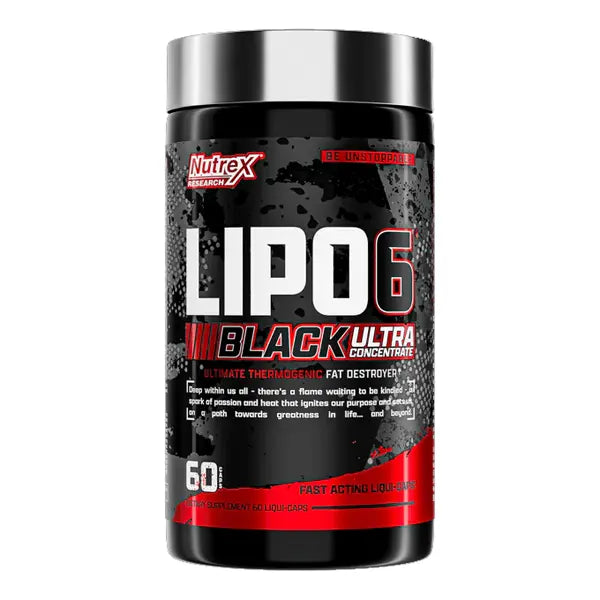

What is Nutrex Lipo-6 Black Ultra Concentrate?
Lipo-6 Black Ultra Concentrate is a food supplement supplied as liquid capsules, which Nutrex Research calls Liqui-Caps: the plant-based shell holds a glycerine solution rather than a compacted powder. There are 60 in the bottle. This is the most concentrated version in the Lipo-6 range, and the words "ultra concentrate" are not there for decoration.
The formula rests on five actives: anhydrous caffeine, anhydrous theobromine, AdipoSyn™ (Citrus aurantium extract standardised to 50 % p-synephrine), GBBGO® (gamma-butyrobetaine hydrochloride) and a Rauwolfia vomitoria root extract standardised to 90 % rauwolscine. The rest comes down to the capsule itself: glycerine, purified water, chlorophyllin, and a plant-based shell with no animal gelatine.
One detail matters here, and the brand does not draw attention to it: caffeine is the only active with a figure on the label, at 200 mg per capsule. The other four are declared without individual dosages. This is a proprietary blend, and you will not know how much synephrine or rauwolscine you are swallowing. We are not going to invent those numbers on the manufacturer's behalf. If that opacity bothers you — and it is a defensible position — a good share of the capsule fat burners aisle carries fully itemised formulas.
What does one Lipo-6 Black Ultra Concentrate capsule contain?
| Per Liqui-Cap capsule | Amount | % NRV |
|---|---|---|
| Energy | 0 kJ / 0 kcal | 0 % |
| Fat | 0 g | 0 % |
| of which saturates | 0 g | 0 % |
| Carbohydrate | 0 g | 0 % |
| of which sugars | 0 g | 0 % |
| Fibre | 0 g | — |
| Protein | 0 g | 0 % |
| Salt | < 0.01 g | < 1 % |
| Anhydrous caffeine | 200 mg | NRV not established |
| Anhydrous theobromine | dosage not disclosed | — |
| AdipoSyn™ Citrus aurantium (50 % p-synephrine) | dosage not disclosed | — |
| GBBGO® (gamma-butyrobetaine HCl) | dosage not disclosed | — |
| Rauwolfia vomitoria (90 % rauwolscine) | dosage not disclosed | — |
The only usable figure is therefore the caffeine: 200 mg per capsule, 400 mg if you take both of the day's servings. For context, EFSA considers that a caffeine intake of 400 mg spread across the day raises no safety concern for healthy adults, and that a single 200 mg serving raises none either. At the full dose, this product places you exactly on that ceiling — before you count your morning coffee. That is the point to take away ahead of everything else.
No health claim is authorised in Europe for synephrine, rauwolscine, theobromine or gamma-butyrobetaine. "Fat burner" is the commercial name of the category, not a promise of results, and we will leave it at that.
How should you take Lipo-6 Black Ultra Concentrate?
The manufacturer's protocol is precise, so follow it to the letter. One capsule in the morning, one capsule in the afternoon, between meals and on an empty stomach, leaving at least 6 hours between the two servings. Two capsules per day maximum. Never within the 6 hours before bedtime: at 200 mg a serving, your sleep picks up the bill.
If you are sensitive to stimulants, or if this is your first fat burner at this dosage level, start with a single capsule in the morning for the first week and only add the second one afterwards. This is not token caution: at 400 mg, palpitations and headaches give no warning.
The first serving goes 30 minutes before breakfast, the second in the middle of the afternoon, or 30 to 45 minutes before training if you train early in the day. As for the length of a course, the manufacturer states 4 to 8 weeks of use, followed by a break of at least 4 weeks. A 60-capsule bottle covers one month at the full dose.
During the course, do not stack other caffeine sources — coffee, tea, energy drinks, and certainly not a stimulant pre-workout from the pre-workouts aisle. Drink plenty of water. And bear in mind that the calorie deficit does all the work: this product replaces neither what is on your plate nor your training sessions.
Who is this fat burner for, and who is it not for?
It is aimed at adults already accustomed to stimulants, in a properly structured cutting phase, looking for a kick from unapologetic dosages. As a first purchase in the category it is too much: start lower down the range.
The list of contraindications is long and serious. Not for anyone under 18, nor for pregnant or breastfeeding women. Avoid it in cases of caffeine sensitivity, heart conditions, high blood pressure, diabetes, thyroid disorders or psychiatric disorders. Do not combine it with monoamine oxidase inhibitors, antidepressants, or medicines containing phenylephrine, ephedrine or pseudoephedrine. The manufacturer asks that you stop taking the product 2 weeks before any surgical procedure. Stop immediately in the event of rapid heartbeat, dizziness, severe headaches or shortness of breath, and speak to a doctor.
The product may contain traces of GLUTEN, MILK, EGGS, SOYA, FISH, CRUSTACEANS and NUTS. The capsules are plant-based, with no animal gelatine.
What you should not expect from it: any weight loss in its own right. A thermogenic fat burner acts on alertness and the feeling of having energy, which helps you stick to a diet — the diet itself still has to be done. If you want support without the nervous-system trade-off, look instead at caffeine-free fat burners, compared in the next section.
Lipo-6 Black Ultra Concentrate or a caffeine-free fat burner?
This is the real decision, and it turns not on potency but on your tolerance to stimulants and on the time of day you train.
A caffeine-free fat burner is the better choice in three clear-cut situations: you train in the evening and you value your sleep; you already drink three coffees a day and you do not want to stack more on top; you have high blood pressure, palpitations or simply an anxious disposition. In those cases the dosage question does not even arise, and a product built on L-carnitine, chromium or non-stimulant plant extracts will be the smarter call.
Lipo-6 Black Ultra Concentrate keeps the advantage on one point: the convenience and the transparency of its caffeine dosage. Two capsules swallowed, nothing to mix, 200 mg per serving that you can work out exactly. The powders in the powder fat burners aisle often provide more actives with stated amounts, but they require a shaker. The category as a whole can be compared in fat burners, and the wider context — protein, satiety, activity — in weight loss.
Frequently asked questions
How long does a 60-capsule bottle last?
Exactly one month, at two capsules a day. Two months if you stay on one capsule daily, which is the pace advised for the first week and often enough for people who are sensitive to stimulants.
How much caffeine is there really per day?
400 mg at the full dose, that is 200 mg per capsule. That is the equivalent of roughly four strong espressos split across two servings. Any other caffeine source during the day adds to that total: this is precisely why the manufacturer asks you to cut them out for the duration of the course.
Why are the dosages of the other actives not stated?
Because Nutrex groups them into a proprietary blend, a common practice in the United States. Caffeine is the only one with a figure. We flag that gap rather than fill it in: no figure for synephrine, rauwolscine, theobromine or GBBGO® appears on the packaging.
Can it be taken before training instead of a pre-workout?
The second serving can indeed be placed 30 to 45 minutes before the session. What you must not do is stack the two products: a standard pre-workout often adds 200 to 350 mg of caffeine, and you would go well beyond the 400 mg per day benchmark.
Does the liquid capsule make any difference?
In terms of comfort, yes: a Liqui-Cap goes down easily and leaves no aftertaste. In terms of effects, the manufacturer publishes no comparative data against a powder capsule, and we are not going to invent any. Treat it as a question of format, not of performance.
Should you take breaks?
Yes. The manufacturer states 4 to 8 weeks of use followed by a break of at least 4 weeks. Sensitivity to caffeine dulls with continuous use, and the break serves as much to restore the effect as to give your system a rest.
Is it compatible with medical treatment?
Not without medical advice. The interactions listed by the manufacturer involve monoamine oxidase inhibitors, antidepressants and decongestants in particular. If you are on any form of treatment, the answer belongs to your doctor or your pharmacist, not to a product page.
Where can you buy Lipo-6 Black Ultra Concentrate?
The 60-capsule bottle can be ordered on this page, and we ship throughout France and Europe. This is a product we would rather talk through before selling: in our shop in Vendargues, about ten minutes from Montpellier, the first question we ask is always how much coffee you have already drunk that day and what time you train. Two answers are usually enough to tell whether this is the right product or whether you should be looking elsewhere.
The rest of the range can be found in the Nutrex collection.


What is IO Genix Iso Clear?
IO Genix Iso Clear, also sold as IsoZero Clear, is a whey protein isolate formulated to give a clear, fruity drink rather than a creamy shake. That is the principle behind clear whey: the protein stays dissolved in an acidic medium, and the result drinks like a lemonade.
The raw material is Lacprodan® Clearshake, a whey isolate from the Danish supplier Arla, which accounts for 96.82 % of the formula in the Strawberry flavour. The rest fits into five lines: flavouring, citric acid as an acidity regulator, sucralose and acesulfame K as sweeteners, azorubine as a colour, and pyridoxine hydrochloride for the vitamin B6.
The flavours available: Blueberry, Iced Peach, Piña Colada, Strawberry Mojito, Watermelon and Raspberry. The register is that of a summer drink, not a milky dessert. The product also sits in our whey isolate and IO Genix ranges.
What does a 30 g serving contain?
| Nutrient | Per 100 g* | Per 30 g serving | % NRV per serving |
|---|---|---|---|
| Energy | 1,465 kJ / 350 kcal | 440 kJ / 105 kcal | 5 % |
| Fat | 0.1 g | 0.03 g | < 1 % |
| of which saturates | 0 g | 0 g | 0 % |
| Carbohydrate | 1.2 g | 0.36 g | < 1 % |
| of which sugars | 0.2 g | 0.06 g | < 1 % |
| Protein | 86.6 g | 25.98 g | 52 % |
| Salt | 0.1 g | 0.03 g | < 1 % |
| Vitamin B6 | 1.67 mg | 0.5 mg | see note |
* Column calculated from the values declared for 30 g, as the manufacturer does not publish a per-100 g column. The figures correspond to the Strawberry flavour and may vary slightly from one flavour to another. One inconsistency worth flagging: the manufacturer declares 0.5 mg of vitamin B6 per serving and states 118 % of the NRV. Yet the European nutrient reference value for vitamin B6 is 1.4 mg: 0.5 mg represents roughly 36 % of it. We reproduce the amount exactly as declared and flag the discrepancy rather than settling it on the brand's behalf. Dietary fibre is not declared.
The figure that matters is 26 g of protein for 105 kcal. Referred back to the powder, that gives 86.6 % protein, which is the top of the range for a clear whey — many stop at around 80 %. Put another way, a 30 g serving delivers as much protein as a 33 g serving of standard whey, without the fat or the lactose.
A word on a claim doing the rounds that needs correcting: this product is not "zero sugar, zero fat". It contains 0.06 g of sugars and 0.03 g of fat per serving. These are negligible amounts over the course of a day, and the product comfortably meets the regulatory thresholds allowing the "high protein" and "low fat" statements — but zero means zero, and that is not the case here. The claims authorised for protein are precise: it contributes to a growth in muscle mass, to the maintenance of muscle mass and to the maintenance of normal bones. Vitamin B6 contributes to normal energy-yielding metabolism. There is no recovery claim for protein, contrary to what you read everywhere.
How do you prepare Iso Clear?
Serving: 30 g. Liquid: 250 ml of cold water. When: after training, or as a snack between meals. How often: 1 to 2 servings a day depending on your protein requirements. How long: no limit — it is a protein, and it can be used for as long as your diet needs it.
Method matters more here than with other products. Pour the water in first, then the powder, shake, then let the foam settle for about thirty seconds before drinking: whey proteins are surface-active and stabilise the bubbles. The more you shake, the longer the foam holds.
Two things you must never do with a clear whey. Never mix it with milk: the acidity destabilises the casein, and the mixture curdles and turns grainy. And never cook with it: a clear whey coagulates with heat and has no business in a pancake. For cooking, keep a whey concentrate. Served very cold, with crushed ice, it is noticeably better.
Who is Iso Clear for, and who is it not for?
The strongest use case is this one: you can no longer face milky shakes. Digestive heaviness, the taste of vanilla every single day, or simply a summer session after which nothing creamy will go down. A protein you do not drink is of no use to anyone, and that is exactly where this format earns its place. During a cutting phase, 105 kcal a serving is also hard to beat.
It is not suitable in several cases. The product contains MILK and may contain traces of NUTS, EGGS, FISH and SOYA. In the event of a diagnosed cow's milk protein allergy it is contraindicated: filtration removes the lactose, not the proteins. It is not recommended for children or pregnant women. The colour azorubine also carries the following mandatory statement: may have an adverse effect on activity and attention in children.
What you should not expect from it: anything more than any other protein. A clear isolate is neither better nor less well absorbed than a standard isolate, and the 26 g of protein do exactly the same job. The difference is one of comfort, not of performance. And it is not a slimming product: it helps you hold a deficit, and it is the deficit that does the work.
Iso Clear or a standard whey isolate?
Both start from the same raw material. What separates them is the formulation and the use you will make of it.
A standard whey isolate wins in three situations. You take two or three servings a day: the price per kilo of protein becomes decisive, and the standard isolate is almost always better placed. You cook with your powder: a clear whey coagulates, a standard whey does not. You want a creamy drink that keeps you going between two meals: a clear whey, by design, does not satisfy in the same way. On those three points, Iso Clear loses.
Iso Clear wins when the drink itself is the problem. Difficulty digesting milky shakes, weariness of the milky taste, the urge for a cold, tangy drink at the end of a session. It also wins on protein density: 86.6 % puts this product above the average for its category. The calculation that settles it is the same on both sides: price of the tub, divided by its weight in kilos, divided by the protein content per 100 g. Do it before you buy. All the families can be compared in the protein range.
Frequently asked questions
How many servings are there in a tub?
The net weight of the tub does not appear in the data supplied by the manufacturer, so we cannot calculate the exact number of servings. What we do know for certain: the reference serving weighs 30 g and provides 26 g of protein. Divide the weight shown on the packaging by 30 to get the count.
Can it be mixed with milk?
No. The acidity of the formula makes the casein in milk flocculate: the mixture curdles and turns grainy. Use cold water, 250 ml per 30 g serving. That is a constraint of every product in this category, not a fault of this one.
Does it contain lactose?
Very little. The filtration process removes most of the lactose and the fat, which explains the 0.36 g of carbohydrate per serving. Many people who struggle with a whey concentrate tolerate it without difficulty. Take care not to confuse this with milk protein allergy, which rules the product out.
Why does the stated vitamin B6 percentage not add up?
The manufacturer declares 0.5 mg per serving and states 118 % of the NRV, which is inconsistent with the European reference value of 1.4 mg. We flag the discrepancy rather than correcting it ourselves. In any case, vitamin B6 is not the reason to buy this product.
How do you avoid the foam?
Pour the water in before the powder, shake moderately, then let it stand for thirty seconds. Taking the metal whisk out of the shaker helps a great deal. Made in advance and left in the fridge for an hour, the drink is more pleasant and completely clear.
Can it be used in baking?
No. A clear whey coagulates when cooked and gives a rubbery texture. For pancakes, cookies or protein cakes, you need a whey concentrate or a casein from the casein range.
Does the composition change from one flavour to another?
Yes, slightly. The published values correspond to the Strawberry flavour, where the isolate accounts for 96.82 % of the formula and the protein concentration reaches 86.6 %. The manufacturer indicates a content of around 86 % depending on the flavour. The colour used also varies from one flavour to the next.
Where can you buy IO Genix Iso Clear?
The flavours can be ordered from this page, and we ship anywhere in France and Europe. With a tangy drink, flavour remains the one criterion no product page can replace: it is the kind of product you choose better by talking to someone who has drunk it.
Our shop in Vendargues, about ten minutes from Montpellier, keeps the full range in stock. If you are looking instead for an amino acid drink to sip during training, take a look at the EAA range.


What is JNX Sports The Ripper?
The Ripper is a powder to be mixed with water from the fat burners category, sold in a tub and dosed at 5 g per serving. It comes as a fruity drink to be made up in the morning, rather than a capsule to swallow. That is a genuine practical difference: you drink 180 to 250 ml of flavoured water, which often replaces the wake-up coffee.
Its formula is built around two blends named by the manufacturer. The first, Extreme Muscle Fuel Blend, weighs 2,500 mg and brings together beta-alanine, guarana extract, raspberry ketones and anhydrous caffeine. The second, Ripper Shred Matrix, weighs 1,450 mg and gathers taurine, acetyl L-carnitine, green coffee extract, green tea extract, cinnamon bark extract and olive leaf extract standardised to 40% oleuropein. To these are added vitamin C, vitamin B5, vitamin B12 and chromium picolinate.
The flavours listed: Blue Raspberry, Lime, Pineapple, Red Grape, Watermelon, Fruit Punch, Raspberry Lemonade and Peach Mango. The product belongs to our fat burner powder and weight loss sections.
What does a 5 g serving contain?
| Item | Per 5 g serving |
|---|---|
| Energy | 42 kJ / 10 kcal |
| Fat | 0 g |
| Carbohydrate | 1 g |
| Fibre | 0 g |
| Protein | 0 g |
| Salt | 0.05 g |
| Extreme Muscle Fuel Blend | 2,500 mg |
| of which anhydrous caffeine | 200 mg |
| Ripper Shred Matrix | 1,450 mg |
| Vitamins C, B5, B12 and chromium | amounts not disclosed |
This table has to be read for what it is. Only one active ingredient in this formula is quantified individually: caffeine, at 200 mg per serving. Everything else is published as a proprietary blend — you know the total weight of the two blends and the list of what they contain, but not the breakdown. It is therefore impossible to know how much beta-alanine, carnitine or green tea extract you are actually taking. That is the manufacturer's right, it is also the product's limitation, and we would rather write it down than work around it.
The same goes for the vitamins and the chromium: their amounts do not appear in the labelling data available to us. Yet a nutrition or health claim can only be used if the product provides at least 15% of the nutrient reference value per serving. Without figures, that threshold cannot be checked, and we will therefore make no claim for the vitamin C, the B5, the B12 or the chromium in this formula.
That leaves the figure that really counts. 200 mg of caffeine is the equivalent of two to three espressos in a single glass. That is a straightforward dose, at the level of a full pre-workout, and it is what you will feel. For reference, EFSA considers that a single intake of 200 mg and a total of 400 mg per day raise no safety concern in healthy adults. You are exactly at the single-intake limit — hence the importance of what follows.
Finally, 10 kcal per serving and 1 g of carbohydrate: the drink is nutritionally neutral. It does not break a fast in the caloric sense of the term and slots into a calorie-restricted diet without a second thought.
How should The Ripper be taken?
Dose: 5 g, i.e. one scoop. Liquid: 180 to 250 ml of well-chilled water. Timing: 15 to 30 minutes before breakfast, or 30 to 45 minutes before the session. Frequency: 1 serving per day, 2 at most for regular users, the second 5 to 6 hours after the first and never after 16:00. Duration: cycles of 60 days at most, followed by 2 to 4 weeks off. The tub covers 30 days at one serving per day.
Start with a single serving for two days, long enough to gauge your tolerance. This is not a token precaution: with 200 mg of caffeine in one go, a body unused to it may react with trembling, a racing heart or nausea. If that happens to you, half a scoop will do perfectly well, and you will lose nothing.
Use well-chilled water: it dissolves better and the taste is markedly more pleasant. Start at 180 ml and go up to 250 ml if the flavour seems too concentrated to you. Drink immediately after making it up.
The 16:00 rule is not negotiable. Caffeine has a half-life of several hours: a serving taken at 17:00 is still working at midnight, and degraded sleep largely cancels out whatever you hoped to gain during the day. Finally, drink enough water throughout the day, and do not combine this product with a caffeinated pre-workout booster: you would double the dose without noticing.
Who is The Ripper for, and who is it not for?
It is aimed at healthy adults over 18, used to stimulants, and running a calorie deficit. Outside that framework, it serves no purpose.
The manufacturer does not advise it for pregnant and breastfeeding women, nor in cases of high blood pressure, heart problems, diabetes, psychological disorders, or liver or kidney disorders. It also states that it should not be combined with alcohol or with other stimulants. These statements are not a matter of style: at 200 mg of caffeine per serving, they exist for a reason.
Two expected effects, worth knowing about before they take you by surprise. Beta-alanine causes passing skin tingling — paraesthesia — on the face, the neck or the forearms. It is unpleasant the first time, harmless, and it fades. Caffeine, for its part, can cause nervousness, restlessness and insomnia, especially if you add coffee on top during the same day.
As for allergens, none is an ingredient, but the product is made in a facility that handles PEANUTS, TREE NUTS, MILK, EGG, WHEAT, CRUSTACEANS, FISH and SOYA. In the event of a severe allergy to any of them, refrain.
What you should not expect from it, and this is the most important paragraph on this page: this product does not make you lose weight. "Fat burner" is a commercial category name, not a promise of an effect, and no weight-loss claim is authorised for the ingredients in this formula. What caffeine does is make you more alert and more inclined to train. The rest — the calorie deficit — is your work, and without it this tub will be of no use at all.
The Ripper or a caffeine-free burner?
That is the real decision in this category, and it does not depend on the formula but on your day. The question to ask yourself is simple: how much caffeine do you already consume, and at what time do you train?
A product from our caffeine-free fat burner section is the better choice in three very common cases. If you already drink three or four coffees during the day — add them up, you will be surprised by the total. If you train in the evening, because no adjustment of timing will make 200 mg of caffeine compatible with a 20:00 session. And if you are simply sensitive: palpitations, clammy hands, anxiety. In those situations the stimulant-free option is objectively better, and we would rather tell you so than sell you this one.
The Ripper keeps two clear advantages. The drink format first: 5 g in a large glass of cold water is more pleasant than a handful of capsules and it contributes to morning hydration. Then the straightforward caffeine dose: if you are looking for a kick before a fasted session, 200 mg does the job without needing a pre-workout on top. If you would still rather have the capsule format, the whole capsule burners section answers the same intention.
Frequently asked questions
How much caffeine is in one serving, and can two be taken?
200 mg per 5 g serving. Two servings come to 400 mg, the daily total that EFSA considers to raise no safety concern in healthy adults — but on condition that you drink nothing else caffeinated alongside. The manufacturer caps it at two servings per day, the second 5 to 6 hours after the first and never after 16:00.
Why are the ingredient doses not stated?
Because the manufacturer publishes them as proprietary blends: 2,500 mg for the first, 1,450 mg for the second, without detailing the share of each ingredient. Only the caffeine is quantified separately. You therefore cannot compare item by item with a product that does set out its own amounts.
Where does the tingling after taking it come from?
From the beta-alanine. It is a known effect, called paraesthesia: a pins-and-needles sensation on the face, the neck or the arms, appearing 15 to 20 minutes after taking it and lasting half an hour. It is harmless and it lessens with habit. Taking the serving with a little food often eases the sensation.
Can it be taken on an empty stomach in the morning?
Yes, that is the way of using it chosen by the manufacturer: 15 to 30 minutes before breakfast. At 10 kcal, the drink weighs nothing. Just be aware that 200 mg of caffeine on an empty stomach hits harder and sometimes sits less well — if you feel nauseous, take it after a few mouthfuls.
Can it be combined with a pre-workout?
No, not on the same day and above all not a few hours apart. Most pre-workouts contain 150 to 300 mg of caffeine; by combining them, you would go well beyond the 400 mg daily figure. Choose one or the other. The same care applies to a tea, a soft drink or a coffee taken straight afterwards.
How long does a tub last, and should a break be taken?
The manufacturer states 30 days of daily use per tub, at one serving per day. It recommends cycles of 60 days at most followed by 2 to 4 weeks off. That break has a real point: tolerance to caffeine sets in quickly, and it is stopping that resets it, not raising the dose.
Does this product cause weight loss on its own?
No. No weight-loss claim is authorised for these ingredients, and we will make none. What causes fat loss is a calorie deficit held over time. A stimulant can help you train when motivation is lacking — that is a helping hand, not a mechanism.
Where can I buy JNX Sports The Ripper?
The flavours can be ordered from this page, and we ship throughout France and Europe.
This is exactly the kind of product where a two-minute conversation prevents a bad purchase. At our Vendargues shop, about ten minutes from Montpellier, the first question asked is never "which flavour?" but "how many coffees a day, and at what time do you train?". Depending on the answer, we point you either to this tub or to a stimulant-free version. The full section can be browsed in our sports nutrition.
What really makes you lose weight?
Only one thing: a caloric deficit, which means an energy expenditure that consistently exceeds your intake. Everything else—meal distribution, food choices, training, supplements—only facilitates or complicates maintaining this deficit. No product sold on this page will create it for you.
We state this plainly because regulations and honesty align here: no weight loss claims are allowed for dietary supplements in this category, and we will not make any. Any product that promises weight loss on its own is lying to you, regardless of the wording used.
What this page can do is more useful: explain what each category actually provides, and help you avoid buying what won't be useful.
What are these products really for?
Each category has a defined role, and none of them are intended to cause weight loss.
Proteins are the strongest support on the list, for two reasons independent of fat loss: they are the most satiating macronutrient for a given amount of energy, and a high protein intake combined with resistance training helps preserve muscle mass when intake decreases. A whey isolate or clear whey provides a lot of protein for few calories; liquid egg white serves the same purpose in cooking.
Fat burners have a commercial name that poorly describes their content. They are essentially formulas built around caffeine, sometimes combined with plant extracts, chromium, or L-carnitine. The effect you will feel comes from caffeine: alertness, a feeling of energy during training. No weight loss claims are allowed for these products. The same formulas exist in capsules, powder, or caffeine-free versions when stimulation is an issue.
Sugar-free flavor products—zero sauces, zero jams, flavorings and sweeteners—have no metabolic properties. Their only interest is pleasure: they make repetitive meals palatable, which is not insignificant, as food boredom is one of the primary reasons for giving up.
Protein bars and protein snacks are convenient: a portable snack with known composition. They are processed foods, not weight loss products, and they remain less satiating than a real meal.
Electrolytes concern hydration during training, when it's hot or sessions are long. They have nothing to do with body composition.
Multivitamins address a real but indirect problem: when food intake is restricted, its variety often decreases along with its quantity. A multivitamin supplement is a simple insurance against this impoverishment. It is not a weight loss tool, and it does not replace a varied diet.
How to preserve muscle mass?
This is the issue that should take precedence over the number on the scale. In a deficit, the body mobilizes its reserves, and muscle tissue is part of that. However, muscle is difficult to rebuild, and its loss reduces resting energy expenditure, making subsequent efforts more difficult. Three factors are truly important, and none of them are supplements.
Resistance training is the signal that tells the body that muscle mass must be preserved. Without this stimulus, muscle loss in a deficit is significantly greater.
A significantly higher protein intake than during maintenance, distributed throughout the day rather than concentrated in a single meal. This is where protein powder finds its most defensible justification: achieving a high protein total while reducing calories is simpler with a concentrated source. The protein section details the numerical benchmarks, including those from ANSES.
A gradual rather than abrupt deficit. The more severe the restriction, the greater the proportion of non-fat mass in the loss. A drop in training loads is the most reliable signal that the deficit is too pronounced.
Creatine monohydrate can be continued without inconvenience: it supports performance in brief, intense efforts, thus maintaining training load. It retains water in muscle cells, which can temporarily mask weight changes on the scale.
Why does weight loss eventually stop?
A slowdown followed by a stop is expected, not abnormal. Several mechanisms combine.
Expenditure mechanically decreases with weight: a lighter body consumes less, both at rest and in motion. Spontaneous activity also decreases, often unnoticed. Appetite, however, increases. And the accuracy of dietary tracking loosens over the weeks: estimated portions always drift in the same direction.
Before concluding that it's a plateau, check the observation period: variations in water, digestive content, and hormonal cycle can easily mask real changes over a few days. A plateau is judged on an average, not on a single weighing.
If confirmed, two paths exist: further reduce intake, or increase expenditure. The first has a limit beyond which diet becomes difficult to sustain and micronutrient intake insufficient; the second is often more sustainable. A period of returning to balance, without restriction, also has its place. Calibrating all of this requires a professional who knows your situation, not a category page.
Why does the weight often return afterward?
Weight regain after restriction is common and can be explained without mystery. The adaptations described above—reduced expenditure, increased appetite—do not disappear the day restriction stops: if the return to usual eating is abrupt, intake will largely exceed expenditure.
The most crucial factor lies elsewhere: a restriction based on rules you don't intend to keep will not produce lasting results. Habits that do not survive the weight loss period will not protect the outcome. The exit strategy is therefore as important as the period itself, with a gradual increase in intake and the maintenance of resistance training.
This is also why we do not offer diet plans or numerical goals on this page. Real support requires knowing your history, any ongoing treatments, your biological profile, and your relationship with food. This falls under the purview of your primary care physician or a registered dietitian-nutritionist, and them alone. We sell food products; we do not replace a consultation, and we will not claim otherwise.
Frequently Asked Questions
What is a caloric deficit?
A state in which your body expends more energy than it takes in over a prolonged period: it then draws on its reserves to make up the difference. A deficit is not a diet or a method; it is the common mechanism for all approaches that work. An approach that yields results creates a deficit, whether it states it or not.
How do you achieve a caloric deficit?
The principle is to increase expenditure, reduce intake, or both. In practice, it starts by measuring before modifying: most people misestimate their actual intake, almost always underestimating it. The extent of the deficit that suits you depends on your weight, body composition, activity level, health status, and treatments. We will not provide a number here: this is precisely what a doctor or registered dietitian-nutritionist calibrates during a consultation.
How many pounds can you lose per week?
The benchmarks generally adopted by health professionals suggest a reasonable loss of about 0.5 to 1% of body weight per week, or about 0.4 to 0.8 kg for an 80 kg person. This is not an arbitrary limit: beyond this, the proportion of muscle mass in the loss increases, micronutrient intake becomes difficult to cover, and restriction becomes difficult to sustain—which sets the stage for regaining weight. Two nuances: the first few weeks often show more loss, because water and digestive content shift; and the lighter you are to begin with, the slower the reasonable pace. The number adapted to your situation is determined in consultation, not on a web page.
Can you lose 10 kilograms in a month?
Not in a healthy or sustainable way, and we prefer to state this clearly rather than sell you something based on that promise. Ten kilograms in thirty days implies a deficit of a magnitude that exceeds what an adult can maintain without losing muscle, performance, and a significant portion of their vitamin and mineral intake. What the scale shows in such cases is largely water, digestive content, and lean tissue—not just fat—and experience shows that weight regain is almost systematic. The only situations where such rapid loss is supervised are under strict medical monitoring for specific medical reasons. If you have a deadline in mind, talk to a doctor or a registered dietitian-nutritionist: a realistic goal maintained for six months will take you further than a month of severe restriction.
Can you lose weight by stopping eating?
No, not in a useful way, and it's one of the worst possible strategies. Extreme restriction causes weight to drop on the scale, but a significant portion of this loss is water and muscle tissue; resting energy expenditure decreases, appetite increases sharply, and subsequent weight regain often exceeds the starting point. Added to this are real consequences: fatigue, loss of strength, deficiencies, concentration and sleep problems. If the idea of skipping meals or severely restricting your diet seems like the only solution, or if your relationship with food is a burden, talk to your doctor: it's a conversation infinitely more valuable than any product in this category.
What hinders weight loss?
In the vast majority of cases, four very mundane things, and none of them are a "blocked metabolism." First, tracking drift: estimated portions always drift downwards, and oil, sauces, and drinks disappear from the count. Second, the mechanical decrease in expenditure: a lighter body consumes less, and the deficit from two months ago has become a maintenance level. Third, the reduction in spontaneous activity, which goes unnoticed. And fourth, the observation period: three days of stable weight on the scale is not a plateau; you need to think in averages over two to three weeks. If the blockage is confirmed despite rigorous tracking, or if it is accompanied by unusual fatigue or other symptoms, you need to see a doctor: certain medical conditions and treatments influence weight.
Does a fat burner cause weight loss?
No, and no weight loss claims are allowed for these products. Without a caloric deficit, nothing happens. What you will feel comes from the caffeine they contain: alertness and a feeling of energy during training. This is real and useful for maintaining session intensity, but it has no direct effect on body fat. Any communication claiming otherwise deserves your distrust.
Which protein to choose during a deficit phase?
The one that provides the most protein for the fewest calories, and that you digest well. An isolate or clear whey fulfills this role well, with very few carbohydrates and lipids. A concentrated whey also works if it suits you and is cheaper per kilo of protein. The decisive criterion remains the total daily protein intake, not the category of the tub.
Can you target belly fat loss?
No. Fat mass loss is global: the body mobilizes its reserves according to a distribution that depends on individual factors, particularly genetic and hormonal ones, which no localized exercise affects. Abdominal exercises strengthen the abdominal muscles; they do not remove the fat that covers them. No supplement or device alters this order.
In what order do you lose weight?
According to a pattern specific to each person, which you do not choose. Some areas thin out early, others late, and the last to yield are often the ones that concern you the most. This is a classic source of discouragement and does not reflect any error on your part.
How long does it take to see results?
We will not give a timeframe, because there isn't one that's valid for everyone, and a number announced here would be at best useless, at worst discouraging. What is true, however: the first few days of a dietary change primarily shift water and digestive content, which makes the scale misleading at the start. Judge by averages and over weeks, and talk to a healthcare professional if you want a benchmark adapted to your situation.
Why am I losing weight when I'm eating normally?
This question does not call for an answer from a sports nutrition store, and we will not provide one. Unintended weight loss, when your diet has not changed, deserves to be explored by a doctor: the possible causes are numerous, some benign, others not, and none can be diagnosed online. What we can usefully say: do not fill the gap with gainers before understanding what is happening. Make an appointment, and do so quickly if the loss is significant or accompanied by other symptoms.
When should you worry about weight loss?
The benchmark most often used by health professionals is an involuntary loss of approximately 5% of body weight in six months, or any rapid loss that cannot be explained. Consult without delay if it is accompanied by unusual fatigue, fever, night sweats, marked loss of appetite, persistent digestive problems, or unusual thirst. Intentional and progressive weight loss, achieved through an adapted diet and physical activity, does not fall into this category—but it also warrants medical advice if accompanied by persistent fatigue, a drop in performance, or a relationship with food that becomes intrusive.
What can you find in our selection?
We select formulas whose composition is fully transparent: displayed dosages rather than hidden behind a proprietary blend, indicated caffeine content, short ingredient lists. Remember to add up the caffeine from all your products—a fat burner, a booster, and your daily coffee accumulate faster than you might think; EFSA has published guidelines on this topic.
These products are intended for adults only. They are not recommended for pregnant or breastfeeding women and individuals sensitive to caffeine, and medical advice is a prerequisite in case of illness, ongoing treatment, or sleep disorders. When the restriction period ends, the mass gain section is based on exactly the same principle, reversed.
Where can I discuss this near Montpellier?
This is the category where commercial promises are strongest and disappointments are most frequent. Our store in Vendargues, about ten minutes from Montpellier, is where we will tell you directly what, in this section, will not be useful to you—and where we will refer you to a doctor or a registered dietitian-nutritionist when that is what you need. We ship everywhere in France and Europe.
Sources: ANSES for nutritional references and advice on supplements for athletes, EFSA for authorized claims and caffeine guidelines. This information does not replace medical advice. To be integrated into a varied diet and a healthy lifestyle.
To go further: eating a balanced diet and adjusting quantities.


What is ESN Clear Whey Isolate?
ESN Clear Whey Isolate is a clear whey: a whey protein isolate formulated to stay dissolved in an acidic medium and give a translucent, fruity drink rather than a creamy shake. The list is short: whey isolate, citric acid, flavourings, sweeteners (sucralose, acesulfame K), colours depending on the flavour.
It is produced by ESN, a German brand, and stands out from most clear wheys on the market by how much it is diluted: the manufacturer recommends 500 ml of water for a single serving, where the average across the category sits between 300 and 400 ml. The result is closer to a thirst-quenching drink than to a shake.
The flavours listed, two of them built on an iced tea profile — which remains rare in the category.
What does a serving of ESN Clear Whey Isolate contain?
The reference serving is 30 g. It provides 25 g of protein for around 100 kcal, less than 0.5 g of carbohydrate of which as much again in sugars, less than 0.1 g of fat and less than 0.1 g of lactose per 100 ml of the prepared drink once diluted.
Twenty-five grams of protein in thirty grams of powder puts the product very high on density, where many clear wheys top out at 18 or 20 g per serving. The manufacturer states a purity of 90 to 95% on the raw material, as well as 48.9% essential amino acids and 22.7% BCAAs in the protein fraction — figures we pass on while attributing them to it, in the absence of a detailed amino acid profile.
Three pieces of data are missing and we are not inventing them: the manufacturer publishes neither a "per 100 g" column, nor a value in kilojoules, nor a salt content — it states only that the salt varies according to the flavour. The net weight of the tub and the number of servings it contains have not been communicated to us; we would rather write that than put forward a figure. The detail that is available appears in the nutritional values tab.
Protein here accounts for virtually all of the energy provided. The only usable health wording remains the one in Regulation 432/2012: proteins contribute to a growth in and the maintenance of muscle mass.
How do you prepare ESN Clear Whey Isolate?
The manufacturer states 30 g of powder in 500 ml of very cold water, shaken for 10 to 15 seconds. One to three servings a day, with no course duration: it is a protein food, not a treatment. You can go down to 400 ml for a more concentrated drink, but below that the taste turns acidic and the foam lingers longer.
Two instructions apply specifically to this type of product. Do not mix it with milk: the acidity makes the casein flocculate and the drink turns grainy. And do not heat it — a clear whey coagulates when cooked, so it is unusable in baking.
Timing is not decisive: during the session in small sips, straight afterwards, or elsewhere in the day. What matters is the total protein over 24 hours. A shaker with a wide neck and no metal whisk keeps the foam down; the accessories section has some.
Who is this clear whey for, and who is it not for?
It is aimed at three profiles. Those who can no longer face a milky shake, whether from heaviness or from weariness. Those who train in summer and for whom nothing creamy goes down at the end of a session. And those who digest lactose poorly: less than 0.1 g per 100 ml of drink is one of the best tolerated forms of whey.
The product contains MILK and may contain traces of SOYA, EGG and NUTS owing to manufacture in a shared facility. An allergy to cow's milk protein rules it out: filtration removes the lactose, never the proteins. The manufacturer invites pregnant or breastfeeding women to seek professional advice and refers you to your doctor in the event of kidney trouble.
It does not suit you if you cook with your powder, if you are looking for a drink that keeps you going between meals, or if you take two or three servings a day: at that rate, the price per kilo of protein becomes the deciding criterion and a conventional isolate wins out. Nor is it a drink for during exercise: it provides neither carbohydrate nor electrolytes in useful amounts. For that, see our electrolytes or our EAAs.
ESN Clear Whey Isolate or Rule One Clear Isolate?
We sell both, and they are not separated by quality but by three figures.
The serving: 30 g at ESN for 25 g of protein, against 25 g at Rule One for 20 g of protein. If you are aiming for a high intake in a single serving, ESN comes out ahead. The volume: 500 ml against 350 to 400 ml. The ESN version takes longer to drink and is more thirst-quenching; the Rule One one is closer to a conventional shaker format. The formula: Rule One adds 300 mg of an electrolyte complex per serving, ESN adds none.
Rule One is therefore the better choice if you want a reasonable drink volume and a touch of sodium after a sweaty session. ESN wins if you are after the maximum protein per serving and a drink that lasts the whole session. And if the main criterion is budget, then neither: a whey concentrate is enough for most people, and an isolate is only justified by lactose intolerance, a tight cutting phase or a genuine digestive problem.
Frequently asked questions
What exactly is a clear whey?
A whey isolate formulated to stay clear in an acidic medium. Where a conventional whey gives an opaque, milky drink, a clear whey gives a transparent, tangy drink, close to a juice. The raw material is the same; it is the formula that changes.
Why 500 ml of water and not 250?
Because the formula is acidic and very concentrated in protein. Below 400 ml, the acidity dominates, the foam persists and the drink becomes hard to finish. The 500 ml recommended by ESN make it a drink to sip during exercise rather than a shake to down in one.
Which flavours are available?
Fresh Cherry, Iced Tea Peach, Iced Tea Peach-Mango, Green Apple, Blackberry and Cactus Fruit. The salt varies according to the flavour, as the manufacturer does not publish a single value.
How many servings does the tub contain?
We do not know for certain: the net weight of the pack does not appear in the data passed on by the manufacturer, and we do not publish a number of servings calculated on an assumption. Ask us before ordering and we will check on the tub.
Can it be mixed with milk?
No, and it is not a question of taste. The acidity of the formula destabilises the casein in milk: the mixture curdles and turns grainy. Use very cold water. Crushed ice improves the result further, especially on the iced tea flavours.
Is it suitable in cases of lactose intolerance?
In most cases, yes: less than 0.1 g of lactose per 100 ml of prepared drink is very low. Take care not to confuse lactose intolerance with an allergy to cow's milk protein: in the second case, the product is contraindicated, whatever the degree of filtration.
What is the difference from ESN Designer Whey?
Designer Whey is a blend of concentrate and isolate, to be drunk in 200 ml, with a milkshake texture and milky flavours. Clear Whey Isolate is an isolate on its own, to be drunk in 500 ml, translucent and fruity. The first can be cooked with, the second cannot. They are not aimed at the same moment of the day.
Where can you buy ESN Clear Whey Isolate?
The flavours can be ordered here, and we ship throughout France and Europe. On a tangy drink, the flavour is the one criterion a product sheet cannot settle: in our shop in Vendargues, about ten minutes from Montpellier, we will tell you which ones come up most often in the regulars' baskets — and which ones rarely leave a second time.
The rest of the range can be compared in our proteins collection.


What is IO Genix's Caffeine 200 mg?
It is anhydrous caffeine in capsules, dosed at 200 mg per unit, in a bottle of 100. A single active ingredient, no flavouring, no sweetener, no blend: it is the simplest product in the whole stimulant aisle.
Two hundred milligrams is the equivalent of two to three espressos. The difference with coffee comes down to three things: the dose is identical from one capsule to the next, it travels in a pocket, and it requires neither finding a machine nor drinking anything. For a session at 6:00 in the morning or a competition in a car park, those are three real advantages.
The rest of the composition takes three lines: magnesium carbonate as a bulking agent, magnesium stearate as an anti-caking agent, and a gelatine capsule coloured with calcium carbonate and sodium starch octenyl succinate. As the shell is made of gelatine, the product is not suitable for vegetarians. The rest of the Spanish range can be found in our IO Genix aisle.
What does one capsule contain?
| Element | Per capsule | Equivalent | % NRV |
|---|---|---|---|
| Anhydrous caffeine | 200 mg | roughly 2 to 3 espressos | * |
| Energy | less than 1 kcal | — | — |
* No NRV is established for caffeine. Other components: bulking agent (magnesium carbonate), capsule (gelatine, colours: calcium carbonate and sodium starch octenyl succinate), anti-caking agent (magnesium stearate). Pack size: 100 capsules. Traces of GLUTEN, MILK, EGG, SOYA, SULPHITES, FISH, MOLLUSCS and CRUSTACEANS are possible depending on manufacturing conditions.
The framework needs setting out straight away, because it is what determines how the product is used. EFSA considers that a single intake of 200 mg of caffeine raises no safety concern in healthy adults, and takes 400 mg as the benchmark for the whole day, from all sources combined. One capsule therefore puts you exactly on the single-intake limit — and if you drink coffee alongside it, the total climbs fast.
A concrete calculation, because it often changes the advice: one capsule in the morning, two coffees during the day and a 200 mg pre-workout already adds up to 550 to 600 mg. You are above the daily benchmark without having given it a single thought.
On the effects, let us be precise: caffeine has no authorised health claim in Europe. Not on alertness, not on endurance, not on weight loss. We can therefore promise you nothing, and we will not. What we can describe: a molecule, a dose, an equivalent in cups of coffee, and a protocol for use. The rest you already know from experience — you have all drunk a coffee.
How should Caffeine 200 mg be taken?
Dose: 1 capsule, i.e. 200 mg. Liquid: a large glass of water. Timing: 30 to 45 minutes before physical or mental effort, in the morning or in the early afternoon. Frequency: one intake a day, never after 15:00. Duration: cycling advised, 5 days on for 2 days off, or 3 weeks for 1 week off.
If you have never taken caffeine in this form, start with half a capsule. The manufacturer recommends it, and it is good advice: the capsule opens, the powder can be divided, and one session will tell you whether 100 mg is enough for you. Two hundred milligrams at once, on an empty stomach, does not go the same way for everybody.
The 15:00 rule is the one that matters most, and it is stricter here than on many products: the manufacturer asks that no caffeine be taken in the 6 hours before bedtime. The half-life of the molecule is around five hours in an average adult, more in some people. A capsule at 18:00 still means a hundred milligrams or so in circulation at midnight.
Cycling is not a whim either. Tolerance to caffeine sets in within a few weeks, and the doses then have to go up to recover the same sensation — which is neither desirable nor sustainable. Five days on for two days off is enough to maintain sensitivity.
Two practical remarks. The manufacturer advises increasing water intake to 2 or 3 litres a day during use, caffeine having a mild diuretic effect. And it advises against taking it at the same time as other stimulants — tea, coffee, guarana — which amounts to repeating the daily total calculation.
Who is this product for, and who is it not for?
It is for adults only, and suits those who tolerate caffeine well and want a precise, portable dose with no taste and no preparation. It is also the most economical format in the category: 100 capsules, i.e. more than three months at one intake a day, for the price of a few energy drinks.
The manufacturer is categorical about the contraindications, and we repeat them as they stand. This product is not advised for children or for pregnant and breastfeeding women, and is ruled out in the case of a heart condition, high blood pressure, an anxiety disorder, insomnia or hypersensitivity to caffeine. If any of those apply to you, this product is not for you, and that is not negotiable.
It is not suitable for vegetarians or vegans: the shell is made of gelatine. Nor is it suitable if you train in the evening, for the sleep reasons set out above.
The possible side effects are well known and the manufacturer lists them: nervousness, irritability, palpitations, headaches, digestive upset. They appear mainly in people who are not used to it or at cumulative doses. That is precisely why the trial half-capsule makes sense.
What not to expect from it: nothing more than a well-measured coffee. Caffeine does not make up for a short night, it masks it — and the sleep debt itself remains entirely. Nor does it make you lose weight, whatever the label on half of the fat burners aisle may say. What it does do is make a session easier to get started, which is already something.
Caffeine on its own or a complete pre-workout?
That is the real choice, and the answer depends on what you are trying to achieve.
A complete pre-workout provides, on top of the caffeine, pump and endurance ingredients: citrulline at 4 or 6 g, beta-alanine at 3.2 g, often tyrosine or betaine. It is the better choice if you want the complete formula without having to put anything together yourself, and if the sensation of a pump is part of what you are looking for. Its drawback: you pay for the whole thing, including the ingredients you have no interest in, and you do not choose the caffeine dose.
Caffeine on its own does exactly the opposite. You know what you are taking to the milligram, you adjust in half-capsules, and you can combine it with whatever you want — citrulline on its own, beta-alanine on its own, or nothing at all. At 100 capsules a bottle, it is also by far the cheapest option per session. It is the rational choice if you already know what works for you.
And if you train in the evening, neither suits: a caffeine-free pre-workout is what to turn to, even if it means losing that kick. On this point, a night's sleep is worth more than a good session.
Frequently asked questions
How many coffees does 200 mg correspond to?
Two to three espressos, according to the manufacturer. It is an average equivalent: the content of a coffee varies a great deal with the grind, the machine and the volume. The useful benchmark is EFSA's — 200 mg in a single intake, 400 mg over the day from all sources combined.
Can the capsule be opened to take half a dose?
Yes, and it is even what the manufacturer advises for a first trial. The capsule opens, the powder can be divided. The taste of pure caffeine is extremely bitter: better to close the half back inside the capsule and swallow it than to put it on your tongue.
How late in the day can it be taken?
The manufacturer asks that none be consumed in the 6 hours before bedtime, and in practice that you stay before 15:00. That is consistent with the half-life of the molecule, around five hours in an average adult — and a good deal more in some people. An evening intake costs a night.
Why take breaks?
Because tolerance sets in quickly: after two to three weeks of daily use, the same dose no longer produces the same effect. The manufacturer advises 5 days on for 2 days off, or 3 weeks for 1 week. That is what allows you to keep one capsule effective without raising the doses.
Are the capsules suitable for vegetarians?
No. The shell is made of gelatine, of animal origin. The manufacturer also reports possible traces of gluten, milk, egg, soya, sulphites, fish, molluscs and crustaceans depending on manufacturing conditions.
Can it be combined with a pre-workout?
Technically yes, but you have to do the arithmetic. Most pre-workouts contain 150 to 350 mg of caffeine per serving: added to the 200 mg of a capsule, you exceed EFSA's daily benchmark in a single intake. The manufacturer does in fact explicitly advise against combining it with other stimulants.
How long does a bottle last?
More than three months at one capsule a day, the bottle holding 100. With the advised cycling — five days out of seven — reckon on four to five months. It is one of the most favourable dose-to-price ratios in the whole shop.
Where can you buy IO Genix Caffeine 200 mg?
The bottle of 100 capsules can be ordered from this page, and we ship anywhere in France and Europe. It is a product that covers a whole quarter of a year with a single bottle: few items in the catalogue can say as much.
At the counter in Vendargues, about ten minutes from Montpellier, it is the product we suggest to those who come in looking for a complete pre-workout without realising that what they like in it is essentially the caffeine. The test is simple: try a capsule on its own for two weeks, and you will know. The rest of the stimulants and pre-training formulas can be compared in our sports nutrition selection.


What is IO Genix's Chromium Picolinate?
IO Genix Chromium Picolinate is a single-ingredient supplement. One capsule provides 200 µg of elemental chromium, in picolinate form. The bottle contains 100 capsules, i.e. more than three months of daily use.
Chromium is a trace element, that is to say a mineral the body needs only in minute quantities — a few tens of micrograms a day. Food provides it, chiefly through meat, wholegrain cereals, tree nuts and green vegetables, but the levels vary a great deal from one food to another and from one soil to another.
The picolinate form refers to chromium bound to picolinic acid. It is the most widespread form in food supplements, chosen for its stability. The rest of the Spanish range appears in our IO Genix section. The catalogue's other trace elements can be found in our zinc and iron sections.
What does a capsule of Chromium Picolinate contain?
| Composition | Per capsule | % NRV |
|---|---|---|
| Elemental chromium (as picolinate) | 200 µg | 500% |
| Bulking agent | Microcrystalline cellulose | |
| Anti-caking agents | Magnesium stearate, silicon dioxide | |
| Shell | Gelatine capsule | |
| Pack size | 100 capsules, i.e. more than three months at one a day | |
The nutrient reference value for chromium is set at 40 µg per day at European level. One capsule provides 200 µg: five times the daily reference, and that is a figure to face squarely rather than turn into a selling point. A high dose is not automatically a better product, particularly for a trace element whose requirements are counted in tens of micrograms.
Two claims are authorised in Europe for this trace element, and they are worded exactly like this: chromium contributes to normal macronutrient metabolism, and chromium contributes to the maintenance of normal blood glucose levels. The threshold for being allowed to state them is comfortably met here. Note the word “normal”, which is not decorative: it refers to the workings of a healthy body, not to the correction of a disorder.
A nuance few product pages give, and one that nonetheless decides the purchase: chromium deficiency is rare on an ordinary Western diet. A supplement makes sense if your diet is heavily processed, very low in wholegrain cereals, or if a healthcare professional has advised it. It makes a good deal less sense if you already take a complete multivitamin, which almost always contains chromium — check your label before stacking.
The manufacturer also asks you to consult a doctor before use and states that the product is not suitable for pregnant and breastfeeding women, children or people on medical treatment. Requiring medical advice is unusual for a simple trace element: it is explained by the dose level, and it deserves to be followed.
Ingredients list
Bulking agent (microcrystalline cellulose), GELATINE (capsule shell), anti-caking agents (magnesium stearate, silicon dioxide), chromium picolinate. The exact composition of the shell appears on the label of the bottle you receive.
May contain traces of GLUTEN, MILK, EGGS, FISH and SOYA.
How do you take Chromium Picolinate?
Dose: 1 capsule. Liquid: a glass of water. Timing: with a meal, never on an empty stomach. Frequency: one dose a day, never exceeded. Duration: a review after three months, with a one-month break possible before resuming.
Taking it with a meal serves two distinct purposes. The first is comfort: on an empty stomach, a concentrated trace element can cause stomach discomfort. The second is consistency: since chromium is involved in macronutrient metabolism, taking it at the moment those macronutrients arrive is logical.
The manufacturer recommends avoiding taking it at the same time as coffee or tea and leaving an hour between the two. Tannins and caffeine can interfere with the absorption of several minerals. If your breakfast is a strong coffee, move the capsule to lunch: it is simpler than clock-watching.
One capsule a day, at a set time, never exceeded. The 100-capsule bottle covers more than three months, which corresponds exactly to the period after which the manufacturer suggests taking stock. A one-month break is then possible before resuming.
This product combines without redundancy with an omega 3 or a magnesium. It does, on the other hand, duplicate most multivitamins and the berberine formulas that already include chromium in their composition: read the labels before stacking.
Who is chromium picolinate for, and who is it not for?
It is aimed at a healthy adult whose diet is low in chromium sources, or someone a healthcare professional has advised to take a targeted supply. It is a product with a very short formula, which remains a good criterion: one ingredient, one dose, one capsule.
The manufacturer is explicit about the exclusions and its list is stricter than average: the product is for adults only, and it is not suitable for pregnant or breastfeeding women, for children, or for people on medical treatment. It asks you to seek a doctor's advice before use and to stop immediately and consult a doctor if any adverse effect occurs.
One situation calls for particular care: if you are being monitored for disturbed blood glucose or are on antidiabetic treatment, this product is not something to improvise with. The fact that a claim mentions the maintenance of normal blood glucose levels does not mean a supplement has a place alongside a course of treatment — quite the opposite, and the question belongs to your doctor.
The capsule contains gelatine: it is suitable for neither vegetarians nor vegans. The product may also contain traces of gluten, milk, eggs, fish and soya.
What not to expect from it: it is not an appetite suppressant, it is not a fat burner, and it is not a weight-loss product, whatever you may read. No weight-control claim is authorised for chromium in Europe. If that is your goal, our weight loss section and, above all, your everyday diet will do the work.
Chromium on its own or a multivitamin, which should you choose?
This is the only real question to ask yourself before buying this product, and the answer depends on what you already take.
A complete multivitamin almost always contains chromium, often at a level close to the reference value, alongside twenty other micronutrients. If you are simply looking to cover your overall intake, that is more rational, cheaper overall, and it saves you adding one more capsule to your morning routine.
Chromium on its own, at 200 µg, answers a different logic: a targeted and deliberately high supply of a single element. That only makes sense if you know precisely why you are taking it — professional advice, a diet identified as low in chromium — and not simply because the words blood glucose appear somewhere on the label.
Watch out for stacking, which is the most frequent mistake in this category: multivitamins, capsule fat burners and metabolic complexes each contain chromium. Three products taken together can add up intakes without anyone noticing. If you already take a caffeine-free fat burner or a complex, read its composition again before adding this one.
Frequently asked questions
Is 200 µg a lot?
It is five times the European nutrient reference value, which is set at 40 µg per day. It is a deliberately high dose. The manufacturer does in fact ask for medical advice before use and forbids exceeding the daily dose, which is consistent with that level of intake.
Should you take it with a meal or on an empty stomach?
With a meal. On an empty stomach, a concentrated trace element can cause stomach discomfort, and the manufacturer explicitly recommends avoiding that situation. Taking it during a meal is also more consistent with chromium's role in macronutrient metabolism.
Why avoid coffee when you take it?
Because caffeine and the tannins in tea can interfere with the absorption of several minerals. The manufacturer recommends leaving an hour between the two. In practice, the simplest thing is to move the capsule to lunch rather than slotting it between two morning coffees.
Does chromium make you lose weight?
No, and no weight-control claim is authorised for chromium in Europe. The only two permitted wordings concern normal macronutrient metabolism and the maintenance of normal blood glucose levels, in a healthy person. This is not a slimming product.
How long does a bottle last?
More than three months: 100 capsules, one a day. That is also the period after which the manufacturer suggests taking stock, before a possible one-month break. A bottle therefore corresponds exactly to one review period.
Are these capsules suitable for vegetarians?
No. The shell is gelatine, of animal origin. It is a common limitation across this range, and it is all the more regrettable given that vegetarian diets are sometimes listed among those that provide less chromium.
Can you take it alongside a multivitamin?
You can, but it is rarely useful, and it requires doing the sums. Most complete multivitamins already contain chromium. Adding two sources together without looking at the labels is the surest way to exceed, without knowing it, an intake the manufacturer specifically asks you not to exceed.
Where can you buy IO Genix's Chromium Picolinate?
The 100-capsule bottle can be ordered from this page, and we ship throughout France and Europe. At the Vendargues shop, about ten minutes from Montpellier, we always ask to see what the customer is already taking before selling this one: nine times out of ten a multivitamin is already in use and the question of stacking comes before the question of buying. The rest of the category can be browsed in our sports nutrition section.


What is Animal Cuts by Universal Nutrition?
Animal Cuts is a food supplement supplied as 42 individual sachets, each sachet containing several capsules to be taken together. It is the long-standing format of Universal Nutrition's Animal range: one sachet a day, nothing to measure out, nothing to weigh.
The phrase "thermogenic fat burner" that appears in its name is a commercial category label, not a promise of any effect. We come back to this further down, because it is the most important point on this page. The product belongs to our fat burners range, and more specifically to capsule fat burners. Universal Nutrition is an American brand whose range we stock in our Universal Nutrition section.
What does a sachet of Animal Cuts contain?
The formula is organised into eight complexes, for a stated total of more than 8,500 mg of active ingredients per sachet. Four of them are quantified on the label:
- Thermogenic complex: 200 mg of anhydrous caffeine, guarana, yerba mate, kola nut;
- Stimulant complex: 750 mg — tyrosine, choline bitartrate, gotu kola;
- Diuretic complex: 800 mg — nettle root, dandelion root;
- Nootropic complex: 500 mg, and the so-called thyroid complex: 350 mg — L-tyrosine, olive leaf extract.
The other three — a metabolic complex based on green, oolong, white and black tea extracts; a cortisol-inhibiting complex containing SerinAid and ashwagandha; a bioavailability complex with Bioperine — are not quantified ingredient by ingredient. That is a genuine limitation: without doses, no serious comparison with another product is possible, and we will not fill the gap with an estimate.
Two points about the composition to be aware of before buying. The excipients include bovine gelatine: the product is suitable neither for vegetarians, nor for vegans, nor for anyone who avoids beef. And the labelling data we hold lists colourings under their American names (FD&C Red #40, Blue #1, Yellow #5 and #6) as well as titanium dioxide: these are North American labelling conventions, and the composition of a version intended for the European market may differ. Read the list printed on the tub you receive, it is the one that counts.
The exact number of capsules per sachet does not appear in the data available to us; we would rather flag that than put forward a figure.
How do you take Animal Cuts?
The manufacturer's protocol is precise. 1 sachet a day, on waking, with a light meal and 250 ml of water. Advanced users may move up to 2 sachets a day, the second 4 to 6 hours after the first. In every case, nothing after 15:00, since the caffeine content disrupts sleep when taken late.
The course is organised into cycles of 3 weeks on followed by 1 week off. The 42-sachet format therefore covers two complete cycles at one sachet a day. Always start with a single daily sachet, even if you are aiming for the advanced protocol: it is the only way to assess your tolerance.
The caffeine arithmetic is worth setting out. One sachet provides 200 mg, exactly the single-dose intake that EFSA considers safe for a healthy adult. At two sachets you are at 400 mg for that day alone, which is the daily reference total, without counting coffee, tea or any pre-workout. The diuretic complex also means drinking more than usual during the course.
Who is Animal Cuts for, and who is it not for?
The product is intended for healthy adults who are used to stimulants. The list of situations that rule it out is long and deserves to be read in full.
It is not suitable for the under-18s, for pregnant or breastfeeding women, nor in cases of heart disorders, high blood pressure, thyroid disorders, diabetes, liver or kidney disease, nor while on antidepressant treatment. The name of the "thyroid complex" should mislead no one: it is a commercial designation, and a thyroid that is not working properly is precisely a contraindication. If in doubt, or if you are on any current treatment, medical advice is essential before starting.
On allergens and composition, the manufacturer flags possible traces of soya and the presence of bovine gelatine. The effects reported are those of a stimulant product: increased sweating, palpitations, anxiety, disturbed sleep when taken late. Stop using it if you experience an adverse effect and speak to a healthcare professional.
That leaves what you should not expect from it, and this is the most important point: no slimming, fat-loss or weight-control claim is authorised in Europe for this type of formula. So you will read no promise here of cutting, definition or kilos lost. What changes body composition is a calorie deficit sustained over time, protein intake, training and sleep; a supplement replaces none of the four, here as throughout our weight loss range. What this product does provide can be described without ambiguity: a quantified dose of caffeine, plant extracts, a format that avoids juggling several tubs, and a cycling protocol written by the manufacturer.
Animal Cuts or a caffeine-free fat burner?
The difference comes down first to caffeine, and the choice depends on how your day actually runs, not on the formula. A product from our caffeine-free fat burner range is the better choice if you already drink coffee, if you take a stimulant pre-workout, if you train late in the day, or if you tolerate stimulants poorly. It is also the only workable option for anyone who has to keep an eye on their blood pressure.
Animal Cuts is the better choice if you are starting from zero where stimulants are concerned, if you prefer a single sachet in the morning to a pile of tubs to manage, and if the cycled protocol suits you. Its all-in-one format is its real advantage: it avoids the stacking of supplements that nobody really keeps track of taking.
There is a third route, and it is often the right one: take no stimulant at all and put the budget into your daily protein intake, the item that changes the most during a calorie deficit.
Frequently asked questions
How many sachets of Animal Cuts a day?
One sachet a day on waking, with a light meal and 250 ml of water. The advanced protocol allows a second sachet 4 to 6 hours later, but at two sachets you reach 400 mg of caffeine over the day from this product alone. Start with one, whatever your experience.
How long does a box of 42 sachets last?
Forty-two days at one sachet a day, that is two complete three-week cycles separated by a week off. At two sachets a day, the box lasts three weeks, in other words a single cycle. The cost-per-day calculation doubles depending on which protocol you follow.
Does Animal Cuts make you lose weight?
No, and nobody can claim it does: no weight-loss claim is authorised for this type of product in Europe. A change in body composition comes from a calorie deficit, protein intake, training and sleep. A supplement is no substitute for any of the four.
Is the product suitable for vegetarians?
No. The capsules contain bovine gelatine, which rules out vegetarian and vegan diets as well as anyone who does not eat beef. The manufacturer also flags possible traces of soya. If that is a deal-breaker for you, look instead at a powder form or a vegetable capsule.
Should you take it on non-training days?
Yes, the manufacturer's protocol is daily throughout the three weeks of the cycle, training or not, since it is taken on waking rather than before the session. That is a difference from a pre-workout, which is kept for training days. Do not combine the two on the same day without having added up your total caffeine.
Why do you need to drink more during the course?
Because the formula contains an 800 mg diuretic complex based on nettle and dandelion root, and caffeine pushes in the same direction. The manufacturer stresses increased hydration throughout the cycle. If you train in hot weather, give some thought to your electrolytes as well.
Can it be combined with a pre-workout?
That is not advised on the same day without doing the arithmetic. One sachet already provides 200 mg of caffeine, and most boosters contain as much, if not more. EFSA takes 400 mg a day as the reference total for a healthy adult, coffee and tea included. Beyond that, adverse effects increase with nothing gained in return.
Where can you buy Animal Cuts 42 packs?
You can order it on this page, and we ship throughout France and Europe. At the Vendargues shop, about ten minutes from Montpellier, this product prompts the most useful conversation in the range: what actually happens over a day — how many coffees, what time the session is, what the protein intake is — counts for far more than the choice between two fat burner brands. The whole range is brought together in our sports nutrition section.
Caffeine reference: EFSA.


What is Rule One Clear Isolate 689 g?
Rule One Clear Isolate is a clear whey in a 689 g tub, that is to say a whey protein isolate formulated to stay dissolved in an acidic medium and give a translucent, fruity drink rather than a creamy shake. It is made by Rule One, an American brand.
The base is a whey isolate, never a concentrate: only that degree of filtration allows the clarity. The rest of the list is short — natural and artificial flavourings, malic acid and citric acid for the tartness, salt, sucralose and acesulfame potassium as sweeteners, silicon dioxide as an anti-foaming agent, potassium chloride, and blue spirulina as a colouring in the relevant flavours.
The flavours on offer: Blue Raspberry, Cherry Limeade, Peach Mango and Strawberry Lemonade. The register is that of a lemonade, not of a milky dessert. The manufacturer states that its batches undergo third-party laboratory testing for banned substances; we report that information and attribute it to them, not having seen the reports.
What does a serving of Clear Isolate contain?
The reference serving is 25 g. It provides 20 g of protein for 90 kcal (377 kJ), 1 g of carbohydrate, 0 g of fat, 0.3 g of salt and 120 mg of sodium. The 689 g tub covers 27 servings.
Two figures deserve to be looked at together. First the protein density: 20 g of protein in 25 g of powder, that is 80 g per 100 g. Then the size of the serving. Clear wheys are generally dosed at around 20 to 25 g against 30 to 35 g for a conventional whey, because beyond that the drink turns syrupy. This one therefore sits at the top of its category for the amount of protein actually delivered per serving, which is not that common.
| Nutrient | Per 100 g* | Per 25 g serving | % RI** per serving |
|---|---|---|---|
| Energy | 1,508 kJ / 360 kcal | 377 kJ / 90 kcal | 4.5% |
| Fat | 0 g | 0 g | 0% |
| of which saturates | not disclosed | not disclosed | — |
| Carbohydrate | 4 g | 1 g | < 1% |
| of which sugars | not disclosed | not disclosed | — |
| Fibre | 0 g | 0 g | — |
| Protein | 80 g | 20 g | 40% |
| Salt | 1.2 g | 0.3 g | 5% |
| Sodium | 480 mg | 120 mg | — |
| Essential amino acids | > 36 g | > 9 g | — |
| Electrolyte complex | 1,200 mg | 300 mg | — |
* Column calculated from the values declared for 25 g, the manufacturer not publishing a per 100 g column. ** Reference intake of an average adult (8,400 kJ / 2,000 kcal, 50 g of protein, 6 g of salt). Two pieces of data are missing and we are not inventing them: the “of which saturates” line and the “of which sugars” line do not appear in the data supplied by the manufacturer. Nor is the mineral-by-mineral breakdown of the electrolyte complex published: only the sodium is quantified. The values correspond to the Blue Raspberry flavour and may vary slightly from one flavour to another.
The product comfortably exceeds the regulatory threshold allowing the “high protein” nutrition claim — protein accounts for close to 90% of the serving's energy. As for health claims, the authorised wordings are these: protein contributes to a growth in muscle mass, to the maintenance of muscle mass and to the maintenance of normal bones. No recovery claim exists for protein, and we shall not write one.
How do you prepare Rule One Clear Isolate?
The manufacturer specifies a 25 g serving in 350 to 400 ml of ice-cold water, to be shaken vigorously and then left to stand for 30 seconds while the foam subsides. One or two servings a day are enough for most uses; no course length is given, and there is no reason for one with a protein.
The timing: 30 minutes before the session, or immediately after, or at any point in the day to top up an intake. The timing matters less than the total protein over 24 hours — that is the point on which most labels mislead you.
Two instructions apply specifically to this type of product. Do not mix it with milk: the acidity makes the casein flocculate and the drink turns grainy. And do not heat it, do not use it in baking: a clear whey coagulates when cooked. For cooking, keep a whey concentrate.
Who is Clear Isolate for, and who is it not for?
It is aimed first of all at those who can no longer stomach the milky shake format — heaviness on digestion, the taste of vanilla every day, or simply a summer session after which nothing creamy will go down. A protein you do not drink is of no use: that is the soundest use case.
The product contains MILK. It is made in a facility that also handles SOYA, EGG and FISH, and may contain traces of them. In the case of a diagnosed allergy to cow's milk proteins, it is contraindicated: filtration removes the lactose, not the proteins. The manufacturer advises against it for children under 12 and invites pregnant or breastfeeding women, as well as people on medication, to seek advice before use. Any kidney or liver condition is a matter for your doctor.
What not to expect from it: the 300 mg of electrolytes per serving do not make it a sports drink. With 1 g of carbohydrate, the formula meets none of the European conditions that would allow a claim on hydration or on endurance. If that is what you are after, look instead at our electrolytes. Nor does it make you lose weight: it supplies a lot of protein for few calories, which helps you hold a deficit, but it is the deficit that does the work.
Clear Isolate or a conventional whey isolate?
Both rest on the same raw material. The difference lies in the formulation and, above all, in what you will do with it.
A conventional whey isolate is the better choice in three clear cases: you have a high protein requirement to cover and you take two or three servings a day, in which case the price per kilo of protein becomes decisive; you cook with your powder; or you prefer a creamy drink that keeps you going between two meals. On those three points, Clear Isolate loses.
Clear Isolate wins when the drink itself is the problem: milky shakes that are hard to digest, weariness of the milky taste, the urge for a cold, tart drink at the end of a session. It also wins on density, with 20 g of protein in a 25 g serving where many clear wheys stop at 18 g. The calculation that settles it remains the same: price of the tub, divided by its weight in kilos, divided by the protein content per 100 g. Do it on both sides before buying. The protein aisle lets you compare every family.
Frequently asked questions
How many servings does a 689 g tub contain?
Twenty-seven 25 g servings. At one serving a day, that covers almost a month; at two servings on training days only, count on longer. The manufacturer states a shelf life of 24 months in the unopened original packaging, kept away from moisture.
Do the nutritional values change with the flavour?
Slightly. The published figures correspond to the Blue Raspberry flavour, and the manufacturer notes that the others may vary a little. The flavours available are Blue Raspberry, Cherry Limeade, Peach Mango and Strawberry Lemonade. The blue colouring is spirulina, present only in the relevant flavours.
When should Clear Isolate be taken during the day?
Thirty minutes before the session, just after, or at any time to make up a shortfall in intake. The thirty-minute window people talked about fifteen years ago no longer holds: what determines the result is the day's total protein. In practice, take it at the moment you will actually drink it.
Can it be mixed with milk?
No, and that is a manufacturer's instruction, not a preference. The acidity of the formula destabilises the casein in milk: the mixture curdles and turns grainy. Use very cold water, 350 to 400 ml per serving. Crushed ice improves the result further.
Do the 300 mg of electrolytes replace a sports drink?
No. Set against the volume of the preparation, the 120 mg of sodium per serving remain well below the levels that characterise a carbohydrate-electrolyte solution within the meaning of European regulation, and the formula supplies only one gram of carbohydrate. Those minerals improve the drink's profile; they do not turn it into an endurance drink.
Does it contain lactose?
Traces only: this is an isolate, filtered to the point of removing most of the lactose and the fat. Many people troubled by a whey concentrate tolerate it without difficulty. Take care not to confuse this with an allergy to cow's milk proteins, which rules the product out — filtration does not remove the proteins.
How do you avoid the foam?
Pour the water in first, the powder second, shake, then leave it to stand for 30 seconds as the manufacturer indicates. Whey proteins are surface-active and stabilise bubbles: the harder you shake, the longer the foam holds. Taking the metal whisk out of the shaker and diluting generously settles the matter. Made in advance and left to chill, the drink is better.
Where to buy Rule One Clear Isolate 689 g?
This page lets you order the flavours, and we ship throughout France and Europe. With a tart drink, the flavour is the one criterion no product page can replace: in our Vendargues shop, around ten minutes from Montpellier, we talk them through with people who have actually drunk them, and we work out the price per kilo of protein against a conventional isolate in front of you.
If what you are after is instead an amino acid drink to sip during exercise, see our EAA; the whole aisle can be found in our sports nutrition section.


What is IO Genix Liquid Squeezer?
IO Genix Liquid Squeezer is a plant complex in vegetable capsules. A serving of three capsules provides 300 mg of Cactinea, 200 mg of artichoke extract, 150 mg of horsetail, 150 mg of dandelion, 100 mg of bilberry, 50 mg of bromelain and 1.4 mg of vitamin B6, which is 100% of the nutrient reference value. The bottle contains 60 capsules for a net weight of 52 g, which works out at 20 servings.
Cactinea is an extract of prickly pear fruit (Opuntia ficus-indica), a cactus grown around the Mediterranean and in the Americas. It is the central ingredient in the formula, the one that sets it apart from more conventional plant complexes, and it is dosed to the milligram — which is not all that common in this section.
The five other extracts are plants traditionally associated with the urinary and digestive systems: artichoke, field horsetail, dandelion and bilberry, plus bromelain, an enzyme extracted from pineapple. The rest of the Spanish range is in our IO Genix section.
What does a serving of Liquid Squeezer contain?
| Composition | Per 3 capsules (daily serving) | % NRV |
|---|---|---|
| Cactinea (prickly pear extract) | 300 mg | Not established |
| Artichoke extract (Cynara scolymus) | 200 mg | Not established |
| Horsetail extract (Equisetum arvense) | 150 mg | Not established |
| Dandelion extract (Taraxacum officinale) | 150 mg | Not established |
| Bilberry extract (Vaccinium myrtillus) | 100 mg | Not established |
| Bromelain (pineapple enzyme) | 50 mg | Not established |
| Vitamin B6 (pyridoxine hydrochloride) | 1.4 mg | 100% |
| Packaging | 60 capsules, net weight 52 g, which works out at 20 servings | |
The strong point of this formula is its transparency: seven ingredients, seven doses, no “proprietary blend” hiding the quantities. You can compare this product with another line by line, which most plant complexes do not allow.
Only one ingredient in this formula holds claims authorised in Europe, and that is vitamin B6. At 1.4 mg, which is exactly 100% of the reference value, the thresholds are comfortably met: vitamin B6 contributes to normal energy-yielding metabolism, to the normal functioning of the nervous system, to the reduction of tiredness and fatigue and to the regulation of hormonal activity. Those are the exact wordings, and they are the only ones we will write.
For the six plant extracts, no health claim is authorised. Not for prickly pear, not for artichoke, not for horsetail, not for dandelion, not for bilberry, not for bromelain. The dossiers submitted at European level for botanicals have remained on hold, which rules out any statement of effect. The word “drainer” here is a commercial category label, not a promise: we describe what the formula contains, at what dose, and nothing more.
One point of consistency worth flagging rather than glossing over: the bottle covers 20 servings, a little under three weeks, whereas the manufacturer recommends a course of three to four weeks. So you need to plan for a second bottle to see a full course through — better to know that before ordering.
Ingredients list
Cactinea (dry extract of prickly pear fruit, Opuntia ficus-indica), dry artichoke extract (Cynara scolymus), dry horsetail extract (Equisetum arvense), dry dandelion extract (Taraxacum officinale), dry bilberry extract (Vaccinium myrtillus), bromelain (pineapple enzyme), vitamin B6 (pyridoxine hydrochloride), vegetable capsule (hydroxypropyl methylcellulose), anti-caking agent (magnesium stearate).
May contain traces of GLUTEN, MILK and EGG. The capsule is plant-based: the product is suitable for vegetarian and vegan diets.
How do you take Liquid Squeezer?
Serving: 3 capsules. Liquid: at least 250 ml of water. Timing: in the morning on waking, before breakfast. Frequency: one serving per day. Duration: a course of 3 to 4 weeks, repeatable after a week's break.
Hydration is not an incidental piece of advice with this product, it is the condition of using it. The manufacturer explicitly asks you to keep up an intake of at least two litres of water a day during the course. Taking a complex of this type while drinking little is counterproductive and uncomfortable. If you are not prepared to drink more, this product is of no use to you.
Taking it in the morning on waking, before breakfast, is what the manufacturer settles on. It has an obvious practical advantage: it puts most of the effect into the day rather than the night, which avoids waking up in the small hours.
Three capsules at once with a large glass of water: take them one at a time if you find capsules hard to swallow. The manufacturer also recommends going easy on salt during the course and keeping up regular physical activity — two levers that genuinely do something, and a good deal more than a capsule does.
A course of three to four weeks, a week's break, then start again if needed. This is not a product to take continuously all year round, and the manufacturer does not envisage it that way either.
The product combines without overlap with a magnesium or an electrolyte powder if you sweat a lot. Do check your other supplements though: vitamin B6 is in almost every multivitamin, and this serving already provides 100% of the daily reference.
Who is Liquid Squeezer for, and who is it not for?
It is aimed at a healthy adult who wants to support a specific period — a phase of dietary restriction, a return to activity, a spell of hot weather — with a plant complex, over three to four weeks. It is a product for an occasional course, not for permanent use.
The contraindications here are specific and you need to read them before buying. The manufacturer advises against the product for pregnant or breastfeeding women, and for people with kidney disorders, kidney stones or prostate problems without prior medical advice. It also asks you to consult a healthcare professional if you are taking diuretics or medication for high blood pressure.
That last point is the most important on this page. Several of the plants in the formula are traditionally associated with urinary elimination; combined with a treatment that works in the same direction, they may amplify its effects, particularly on mineral balance. If you take a diuretic or an antihypertensive, the question is one for your doctor or pharmacist before you open the bottle.
The presence of bromelain adds two points to watch: interactions are described with anticoagulant treatments, and people allergic to pineapple or latex may react to it. The product may also contain traces of gluten, milk and egg. The capsules are plant-based, which makes it compatible with vegetarian and vegan diets.
What you should not expect from it: this product does not make you lose weight. It is not a fat burner, it creates no calorie deficit, and a change on the scales linked to fluid is not a loss of body fat. It replaces neither diet nor physical activity — those are the only two levers that count, as our weight loss section points out. And it treats nothing: heavy legs that settle in, oedema or unexplained weight gain are matters for a doctor.
Plant complex or fat burner, what is the difference?
The two sit side by side in the same section and are often confused, wrongly.
A fat burner in capsules relies mainly on stimulants, caffeine first among them. Its effect is noticeable — alertness, energy — and it concerns energy expenditure and tolerance to training. It disrupts sleep if taken too late and does not suit every level of sensitivity.
This complex contains no stimulant at all. That is a structural difference: you do not feel it, it does not disrupt sleep and it can be taken by someone who cannot tolerate caffeine. It is also a short-course product, whereas a fat burner is used across a whole phase. If you are looking for stimulant-free support, our caffeine-free fat burners section offers other approaches.
What the two families have in common is worth saying plainly: neither one makes you lose weight in itself. No weight-loss claim is authorised for their ingredients. What produces the result is the calorie deficit and physical activity; the rest is support.
Frequently asked questions
How many servings are there in a bottle?
20 servings: 60 capsules at three a day, for a net weight of 52 g. Since the manufacturer recommends a course of three to four weeks, one bottle does not quite cover a full course. Plan on two if you want to see it through.
Do you need to drink more during the course?
Yes, and it is a firm instruction from the manufacturer: at least two litres of water a day, on top of the 250 ml that goes with the serving. That is the condition for using this type of complex comfortably. Without it, most of the point of the product disappears.
Does this product make you lose weight?
No, and no weight-loss claim is authorised in Europe for its ingredients. A change linked to body fluids is not a loss of body fat. Only a calorie deficit and physical activity produce that result.
Can you take it alongside blood pressure medication?
Not without medical advice. The manufacturer explicitly asks you to consult a healthcare professional if you are taking diuretics or medication for high blood pressure. Several of the plants in the formula work in a neighbouring register, and combining them is not a trivial matter.
Are these capsules suitable for vegans?
Yes. The capsule is plant-based, made from hydroxypropyl methylcellulose, and all the actives are of plant or synthetic origin. It is one of the few products in this range that is, as most use gelatine.
What is Cactinea?
It is an extract of prickly pear fruit (Opuntia ficus-indica), dosed here at 300 mg per serving. It is the main and most distinctive ingredient in the formula. No health claim is authorised for this plant in Europe: we state its presence and its dose, without attributing any effect to it.
Is there any caffeine in it?
None. The formula contains no caffeine, no guarana, no green tea and no stimulant of any kind. It can therefore be taken by someone sensitive to stimulants, and in the morning as intended with no consequences for sleep.
Where can you buy IO Genix Liquid Squeezer?
The 60-capsule bottle can be ordered from this page, and we ship throughout France and Europe. At the Vendargues shop, about ten minutes from Montpellier, this is a product we always ask the same question about before selling it: how much do you drink a day? When the answer is somewhere around a litre, we suggest starting there — it costs nothing and changes a great deal more. The rest of the section can be browsed in our sports nutrition range.


What is IO Genix Synephrine?
It is a single-ingredient supplement, in capsules, containing 330 mg of bitter orange dry extract (Citrus aurantium L.) standardised to 6%, that is 19.8 mg of p-synephrine per capsule. The bottle of 100 capsules, 58 g net, covers more than three months at one capsule a day.
P-synephrine is a molecule found naturally in the bitter orange fruit. To give a sense of scale: the manufacturer states that one litre of bitter orange juice contains between 15 and 27 mg of it, where a capsule delivers 19.8 mg in standardised form. That is the most useful comparison for understanding what you are buying.
The rest of the composition fits in three lines: a gelatine capsule shell, microcrystalline cellulose as a bulking agent and magnesium stearate as an anti-caking agent. As the capsule shell is made of gelatine, the product is suitable for neither vegetarians nor vegans. It joins our fat burners in capsules and IO Genix sections.
What is in one capsule?
| Component | Per capsule | Per bottle | % NRV |
|---|---|---|---|
| Bitter orange dry extract (Citrus aurantium L.) | 330 mg | 33 g | no NRV |
| of which p-synephrine (standardised to 6%) | 19.8 mg | 1.98 g | no NRV |
Other ingredients: capsule shell (gelatine), bulking agent (microcrystalline cellulose), anti-caking agent (magnesium stearate). Pack size: 100 capsules, 58 g net. No energy value is declared and, at this scale, it is negligible.
A point of vocabulary first, because it accounts for half the comparison mistakes made in this category: 330 mg is the weight of the extract, 19.8 mg the weight of the active molecule. A label that advertises “500 mg of bitter orange” without giving a standardisation figure tells you nothing at all. It is the second number you should look for, every time.
That figure of 19.8 mg is anything but arbitrary, and it is the most important point on this page. ANSES has published an opinion on food supplements intended for athletes containing synephrine and recommends not exceeding 20 mg of synephrine per day, avoiding combination with caffeine and not consuming it during intense physical exercise. This product sits just under that limit, which is to its credit — but it also means there is no margin at all: one capsule only, never two, and nothing else alongside it.
On effects, the framework is unambiguous: no health claim is authorised in Europe for synephrine or for bitter orange. Not on weight, not on fat, not on energy, not on appetite. So you will read no promise here, not even one phrased indirectly. The “fat burner” label used in our sections is a commercial category name, not a description of an effect.
How do you take Synephrine?
Dose: 1 capsule a day, never more. Liquid: a large glass of water. When: in the morning on waking. How often: one intake a day. Duration: the manufacturer sets no precise duration but recommends a periodic break.
One discrepancy has to be flagged, and we will not pass over it in silence. The manufacturer suggests taking it “before training”; the ANSES opinion, on the contrary, recommends avoiding the consumption of synephrine during intense physical exercise. Between the two, we follow ANSES: take the capsule in the morning, well away from your session. That is the advice we give over the counter, and it deliberately differs from the leaflet.
Second instruction, and this one is absolute: never combine this product with another source of caffeine or stimulant without medical advice. That includes coffee, tea, energy drinks and above all pre-workouts, which commonly contain 200 to 350 mg of caffeine. The manufacturer says so, and so does ANSES: on this point there is no debate.
The manufacturer also advises against taking it late in the day, so as not to disturb sleep. With 100 capsules in the bottle, it covers more than three months — so plan the breaks it recommends rather than running through it without interruption.
Who is this product for, and who is it not for?
It is aimed at healthy adults engaged in a structured weight loss approach who want a single active ingredient with its standardisation stated. On that last point, the label is exemplary: one extract, one standardisation figure, one active molecule content.
The list of contraindications is one of the longest in the catalogue, and it needs to be read in full. The product is not recommended for pregnant or breastfeeding women, children and adolescents, people on medical treatment, or people suffering from cardiovascular disorders, hypertension, glaucoma, diabetes, prostate adenoma, depression or thyroid disorders. If any one of these applies to you, this product is not for you, and that is not negotiable.
It is suitable for neither vegetarians nor vegans, as the shell is made of gelatine. Traces of GLUTEN (wheat and oats), NUTS, PEANUT, EGG, MILK, FISH and SOYA are possible. Nor is it for you if you drink coffee during the day or already take a caffeinated pre-workout booster: stacking stimulants is precisely what the health authorities ask you to avoid.
What not to expect from it, and we will be blunt: this product does not make you lose weight. No claim exists, which means no European authority has validated any effect. Nor is it a pre-workout, or an appetite suppressant. If your calorie deficit is not in place, this bottle will change absolutely nothing.
Synephrine or a stimulant-free fat burner?
That is the real choice in this category, and it does not come down to effectiveness — neither family has an authorised claim — but to the balance between constraints and sensations.
A caffeine-free fat burner cannot be felt and imposes no constraints: no timing to respect, no stacking to watch, no cardiovascular contraindication. It is the better choice for the vast majority of people, and by far the safest. You will feel nothing at all, which is precisely the point.
Synephrine belongs to the other family, the actives with a stimulant effect, like the thermogenics in the fat burners section. It is only of interest in one specific case: you want a single active, dosed below the threshold recommended by ANSES, with no caffeine added to the formula — which leaves you in full control of your other intakes. That is a genuine advantage over a complete thermogenic in which caffeine is imposed on you.
The advice we actually give over the counter: if you drink coffee, walk on by. And if you are going to add a single supplement during a deficit, take a protein rather than a fat burner — protein contributes to the maintenance of muscle mass is an authorised claim, and that is what a diet really hinges on.
Frequently asked questions
Is 19.8 mg of p-synephrine a lot?
It is just under the threshold of 20 mg a day recommended by ANSES for synephrine in supplements intended for athletes. In other words: the dose is set at the maximum of what is advised, and there is no margin. One capsule a day, never two, and nothing else alongside it.
Can it be combined with a coffee or a pre-workout?
No. The manufacturer advises against it and ANSES recommends avoiding the combination of synephrine with caffeine. A pre-workout commonly delivers 200 to 350 mg of caffeine: stacking is exactly what should be avoided. On this specific point, there is no room for compromise.
Should it be taken before training?
The manufacturer suggests it, but ANSES recommends avoiding the consumption of synephrine during intense physical exercise. We follow ANSES: take the capsule in the morning, well away from your session. It is a deliberate departure from the leaflet, and we would rather explain it than keep quiet about it.
What is the difference between 330 mg and 19.8 mg?
The first figure is the weight of the plant extract, the second the weight of the p-synephrine it contains, at a standardisation of 6%. It is the second one you should compare from one product to another. A label that gives an extract weight without a standardisation figure allows no comparison at all.
How long does a bottle last?
More than three months, at one capsule a day for 100 capsules. The manufacturer recommends periodic breaks rather than uninterrupted use: plan them from the outset rather than running straight through to the last tablet.
Are the capsules suitable for vegetarians?
No, the shell is made of gelatine of animal origin. The contents, on the other hand, are indeed a plant extract of bitter orange. The manufacturer also reports possible traces of gluten, nuts, peanut, egg, milk, fish and soya.
Why are there so many contraindications?
Because synephrine is an active with a stimulant effect, structurally close to molecules that act on the cardiovascular system. The manufacturer rules out in particular cardiovascular disorders, hypertension, glaucoma, diabetes, prostate adenoma, depression and thyroid disorders. That list is not decorative: read it before buying.
Where to buy IO Genix Synephrine?
The bottle of 100 capsules can be ordered from this page, and we ship throughout France and Europe. Three months per bottle: this is a purchase that belongs to the long run, not to a moment of impulse.
At the Vendargues shop, about ten minutes from Montpellier, this is the product in front of which we ask three questions before selling: do you drink coffee, are you on any medication, and what time do you train? A single wrong answer is enough to put it back on the shelf, and that happens often. The rest of the range can be compared in our sports nutrition section.
Source: ANSES.


What is Rule One Burn?
Rule One Burn is a mix-with-water powder from the fat burners family, built around 200 mg of caffeine per serving and a series of plant extracts. The word “burner” here describes a commercial category, not a proven effect: we will come back to that further down, because it is the point most product pages in this aisle quietly skip over.
What sets the formula apart is the way the caffeine is delivered. Rather than a single anhydrous caffeine, Rule One combines five sources: anhydrous caffeine, guarana, tea, coffee and a microencapsulated fraction. The release rates are not identical, which spreads out the rise and softens the come-down. It is a formulation choice you can feel in use if you cope badly with an abrupt spike. The rest of the range is in our Rule One aisle.
The flavours listed: Watermelon, Snow Cone and Peach Mango. One point to watch when reading the label: the manufacturer's documentation also describes a capsule version, with different dosages and one extra ingredient, forskholii extract. That capsule version is not the one sold on this page — here it is the powder, and it is its figures that we set out.
What does a serving of Rule One Burn contain?
| Active | Per serving (powder version) | What it is |
|---|---|---|
| Total caffeine, five sources | 200 mg | Anhydrous, guarana, tea, coffee, microencapsulated |
| L-carnitine L-tartrate | 1,500 mg | Stabilised form of carnitine, the molecule behind fatty acid transport |
| Green tea and coffee extracts | 370 mg | Sources of polyphenols and natural caffeine |
| L-theanine | 100 mg | Amino acid from tea, paired with caffeine to smooth out its effect |
| Capsimax® | 25 mg | Microencapsulated chilli extract, capsaicinoids |
| Grains of paradise | 20 mg | Seed extract of Aframomum melegueta |
| Tyrosine, BioPerine®, ginger extract | amounts not disclosed | Precursor amino acid, black pepper extract, ginger root |
The energy values are negligible, as the formula is sugar-free. The number of servings per tub is not published by the manufacturer in the information available to us.
200 mg of caffeine is exactly the threshold set by EFSA as a single dose that raises no safety concern for a healthy adult, with the recommended total daily intake staying below 400 mg. In practice, one serving is the equivalent of two short espressos. It is neither timid nor excessive: it is calibrated to work without forcing you to split the dose. What it does leave is very little room for the rest of the day. If you drink three coffees at the office, you are already at the limit before you even open the tub.
Caffeine is the only ingredient in this formula with authorised health claims in Europe, and it is worth knowing which ones: it helps to increase alertness and helps to improve concentration, at 75 mg. It also contributes to an increase in endurance performance and to a reduction in the rated perceived exertion, at 3 mg per kilogram of body weight before exercise. No claim covers weight loss or fat burning.
The 100 mg of theanine is the other good idea in the formula. This amino acid from tea, paired with caffeine, takes the edge off the jitters without reducing its effect on alertness. It is a classic pairing and one of the best documented in this aisle.
The 1,500 mg of L-carnitine tartrate is a genuine dose for this molecule. One thing has to be clear, however: carnitine has no authorised claim in Europe, and the work on oral supplementation in people who are not deficient is very mixed. The powder burners aisle lets you compare dosages from one brand to another.
Finally, Capsimax® and grains of paradise are dosed at 25 and 20 mg. These amounts match the standardised extracts used in the published protocols, but the size of the documented thermogenic effect comes to a few tens of kilocalories a day. It is real, it is measurable in a laboratory, and it is far below what a twenty-minute walk represents.
Ingredients list
Anhydrous caffeine, L-carnitine L-tartrate, tyrosine, standardised green tea leaf extract, green coffee bean extract, Capsimax® (capsicum fruit extract), grains of paradise (seed extract of Aframomum melegueta), BioPerine® (black pepper fruit extract), forskholii extract, guarana seed extract, L-theanine, ginger root extract. Other ingredients: natural and artificial flavourings, citric acid, silica, sucralose, acesulfame potassium. Manufactured in a facility that processes MILK, SOYA, EGG, FISH, CRUSTACEANS, TREE NUTS, PEANUTS and WHEAT.
How do you take Rule One Burn?
Serving: one scoop. Liquid: 250 to 300 ml of cold water. Timing: 30 minutes before training, or in the morning on an empty stomach on non-training days. Frequency: one serving a day. Duration: the manufacturer recommends cyclical use, 8 to 12 weeks followed by 2 to 4 weeks off.
Start with half a serving. This is not over-caution: 200 mg in one go, in someone who does not drink coffee regularly, brings on tremors, a faster heart rate and sometimes nausea. Half a serving for three days tells you everything you need to know.
The most important rule is a matter of timing: nothing after 15:00. Caffeine has a half-life of five to six hours, which means a serving taken at 17:00 still leaves 100 mg in the blood at 23:00. The manufacturer recommends avoiding any intake in the six hours before bedtime, and that is a minimum. If the evening is the only time you can train, this is not the right product: turn instead to a caffeine-free burner.
Drink more than usual while you are on it. Caffeine increases urine output, and training does the rest. Finally, do not stack this product with a pre-session booster: most contain 150 to 300 mg, and the total goes well beyond what is reasonable in a single serving.
Who is Rule One Burn for, and who is it not for?
It suits an adult who tolerates caffeine well, who trains in the morning or in the early afternoon, and who is already in a calorie deficit — the condition without which none of this makes any sense.
It does not suit, and the manufacturer is explicit about this: pregnant and breastfeeding women, people sensitive to caffeine, or anyone with high blood pressure, heart conditions, insomnia or anxiety. These are not decorative warnings. In an anxious person, 200 mg of caffeine can turn a normal day into a difficult one.
Nor does it suit you if you are on any current medication: caffeine interacts with several families of drugs, and the question is one to put to your doctor or pharmacist before buying. The same applies to anti-doping testing: check the batch status with your federation.
What not to expect from it, and this is the most useful paragraph on this page: this product does not make you lose weight. No burner does, and no claim of that kind is authorised in Europe. What it actually does is supply energy and alertness at a point when the calorie deficit is stripping them from you, which makes sessions easier and the day less of a slog. Weight loss itself comes from the gap between what you eat and what you expend. If that gap does not exist, this tub will change precisely nothing.
Rule One Burn powder or a capsule burner?
Both exist in our range and they are not meant for the same use.
A capsule burner travels well, goes down in three seconds and splits easily: two capsules in the morning, one at midday. It is the better choice if your work takes you out and about, if you have no shaker to hand, or if you would rather spread the caffeine across the day than take it all at once.
The powder has two concrete advantages. The first is the volume of water: 300 ml swallowed along with the product is that much hydration taken as a matter of course, which counts during a cutting phase. The second is the ritual — a shaker before the session frames the training in a way a capsule does not. Its drawback: splitting a powder is less convenient.
If your aim above all is to build a calorie deficit, every product in this family can be compared in our weight loss aisle.
Frequently asked questions
How much caffeine is in one serving?
200 mg, spread across five sources: anhydrous caffeine, guarana, tea, coffee and a microencapsulated fraction. That is the equivalent of two short espressos, and it matches the highest single dose considered to raise no safety concern by EFSA in a healthy adult.
Can it be taken before an evening session?
It is not advisable. The manufacturer recommends avoiding any intake in the six hours before bedtime, and caffeine takes five to six hours for its concentration to halve. For training after 18:00, a caffeine-free burner is the consistent choice.
Should you take breaks?
The manufacturer recommends 8 to 12 weeks of use followed by 2 to 4 weeks off. The reason is simple: tolerance to caffeine sets in within a few weeks, and at high tolerance the same dose no longer does much. The break is there to restore sensitivity, not to “cleanse” anything.
Does this product make you lose weight?
No. No food supplement brings about weight loss on its own, and no claim of that kind is authorised in Europe for these ingredients. Fat loss comes from the calorie deficit. This product supplies energy and alertness during that deficit: it is a support, never the engine.
What is the difference with the capsule version?
The dosages differ: the capsule version contains more Capsimax® and grains of paradise, as well as a forskholii extract that is absent from the powder. Only the powder version is sold on this page, and it is the one the figures in the table above describe.
Can it be combined with a pre-workout?
Better not to. Most boosters contain between 150 and 300 mg of caffeine; add them together and you quickly go past 400 mg in a single serving, with a real risk of palpitations and anxiety. If you want both, choose a stimulant-free booster for the session.
Does the product contain sugars?
No, the formula is sugar-free and the sweetness comes from sucralose and acesulfame potassium. The energy values are negligible, which means it can be worked into a day of controlled intake without any calculation.
Where can you buy Rule One Burn?
The flavours can be ordered from this page, and we ship throughout France and Europe. At the Vendargues shop, about ten minutes from Montpellier, we never sell a burner without raising the question of coffee: between the tub and the four espressos over the course of the day, there is always one of the two that needs cutting back. It is rarely what the customer came in for, and it is nonetheless the most useful advice we can give. The rest of the aisle can be browsed in our sports nutrition section.

What is Applied Nutrition Shred X?
Applied Nutrition Shred X is a powdered fat burner, to be mixed with water and drunk before training. A 10 g serving delivers 228 mg of caffeine and 450 mg of green tea extract concentrated to 95% polyphenols, alongside acetyl L-carnitine, choline bitartrate, L-theanine, L-tyrosine, taurine, gymnema sylvestre extract and vitamins C, B3, B6 and B12.
Applied Nutrition is a British brand based in Liverpool, known in France for its ABE pre-workout range. Shred X is its counterpart: the same formulation logic, but built around caffeine and green tea rather than around vascular actives. The label "fat burner" is a commercial category name, not a promise of effect — we come back to this below.
The flavours in the catalogue: Sour Gummy Bear, Strawberry Kiwi and Lemon Ice Tea. The composition is identical from one to the next. The rest of the brand can be browsed in our Applied Nutrition aisle, and the other formulas in the category in our fat burners aisle.
What does a serving of Shred X contain?
| Composition | Per 10 g serving | Detail |
|---|---|---|
| Total caffeine | 228 mg | anhydrous caffeine + the green tea contribution |
| Green tea extract | 450 mg | concentrated to 95% polyphenols |
| Gymnema sylvestre leaf extract | not disclosed | standardised to 75% gymnemic acids |
| Acetyl L-carnitine | not disclosed | first ingredient on the list |
| Choline bitartrate | not disclosed | — |
| L-theanine, L-tyrosine, taurine | not disclosed | — |
| Pro GBB™ | not disclosed | gamma-butyrobetaine ethyl ester HCl |
| Vitamins C, B3, B6, B12 | not disclosed | — |
Let us be blunt: the manufacturer publishes the dose of only two ingredients out of the ten or so in the formula. Caffeine and green tea extract are quantified, the rest is not. We prefer to put that in black and white rather than repeat figures seen elsewhere: without a quantity, it is impossible to say whether the acetyl L-carnitine is present at 500 mg or at 50 mg, and the difference is not trivial. That is the main criticism we make of this technical sheet.
228 mg of caffeine is a high dose for a single serving. For reference, the European food safety authority takes 200 mg as a single intake without adverse effect in a healthy adult, and 400 mg across the day. A serving of Shred X therefore already puts you slightly above the first benchmark, before your morning coffee has even been counted. That is why the manufacturer sets a limit of one serving a day, not two.
The green tea extract calls for the same vigilance. At 95% polyphenols, 450 mg of extract is a serious concentration. The manufacturer itself states not to exceed 800 mg of green tea extract a day from all sources combined: if you already take another fat burner or a green tea extract capsule, add them up before you buy.
What we can say within the regulatory framework is limited, and it is better set out plainly: vitamins B3, B6 and B12 contribute to normal energy-yielding metabolism and to the reduction of tiredness and fatigue, and vitamin C contributes to the reduction of tiredness and fatigue. Those are the official European wordings. For caffeine, green tea, carnitine, gymnema or Pro GBB, no health claim is authorised in Europe — not on fat, not on weight, not on metabolism. No fat burner makes you lose weight, whatever its composition.
Ingredients list
Acetyl L-carnitine, citric acid (acidity regulator), vitamin C (ascorbic acid), green tea extract 95% polyphenols, choline bitartrate, L-theanine, gymnema sylvestre leaf extract (containing 75% gymnemic acids), taurine, L-tyrosine, sodium bicarbonate, anhydrous caffeine, natural flavouring, natural colouring (beetroot red), anti-caking agents (silicon dioxide, calcium silicate), Pro GBB™ (gamma-butyrobetaine ethyl ester HCl), sucralose (sweetener), vitamin B3 (nicotinamide), vitamin B6 (pyridoxine hydrochloride), vitamin B12 (cyanocobalamin).
The manufacturer refers to the product labelling for the allergen declaration and flags the possibility of traces depending on manufacturing conditions. If you have a severe allergy, check the packaging you receive.
How do you take Shred X?
Serving: 1 level 10 g scoop. Liquid: 200 ml of cold water. Timing: 15 minutes before the session, or in the morning. Frequency: one serving a day maximum. Duration: the manufacturer sets no course length; on a product this caffeinated, a regular break remains the wisest approach.
A level scoop, not a heaped one. On a product dosed at 228 mg of caffeine, a generously filled scoop can take you 30 or 40 mg higher without your realising it. If you have kitchen scales, weigh out your 10 g the first few times: you will then know what a correct scoop looks like.
No servings late in the day. Caffeine stays active for several hours; a serving at 18:00 is paid for overnight, and lack of sleep is the best way to sabotage precisely what you are trying to achieve. If you train in the evening, this product is not the right one: our caffeine-free fat burner aisle exists for that situation.
Drink more water during the period you are taking it. Caffeine and green tea have a diuretic effect, and 200 ml of water at the time of the serving is not enough to cover the day. It is obvious advice, but it is the advice that settles most of the headaches wrongly blamed on the product.
One last point of common sense: this type of formula fits within a controlled diet and regular activity, not in their place. A serving of protein after the session and a calorie deficit held over several weeks weigh infinitely more in the result than any fat burner.
Who is Shred X for, and who is it not for?
It is aimed at a trained adult, used to caffeine, who wants a stimulant before a session during a period when they are eating below their needs. That is where this type of product makes the most sense: it helps you get through a decent session on a day when energy is short, which is no small thing.
It is not for under-18s, nor for pregnant or breastfeeding women. It is not advised for people sensitive to caffeine, and the advice of a healthcare professional is necessary in the event of high blood pressure, heart rhythm disorders, anxiety, thyroid disorders, liver problems or ongoing medical treatment.
Do not add any other source of caffeine or green tea extract on the same day. A coffee, an energy drink, a pre-workout, a fat burner in capsules: it all adds up, and on this product the margin is already thin. The manufacturer reminds you not to exceed 800 mg of green tea extract a day from all sources combined.
What you should not expect from it. This product does not make you lose weight. No weight loss claim exists in Europe for its ingredients, and if a seller promises you one, they are stepping outside the legal framework. It does not make up for a diet in surplus, targets no area of the body, and replaces neither the calorie deficit nor the training. What it genuinely brings is alertness and perceived energy before a session — which is already an honest reason to buy it, provided you do not ask more of it. The real work is done on the plate, and our weight loss aisle brings together the products that support that approach.
Shred X in powder or a fat burner in capsules?
This is the concrete choice facing most buyers in this aisle, and it is settled on two criteria: the dose and the flexibility.
Powder lets you adjust, a capsule does not. With Shred X you can take half a scoop for the first few days to assess your tolerance at 114 mg of caffeine before moving to the full serving. That is exactly what we advise for someone who has never taken this type of product. A capsule, by contrast, is taken whole or not at all.
The capsule wins on discretion and portability. No shaker, no water to find, nothing to measure: you swallow it at the office with a glass of water. For a morning serving, outside a training context, it is often easier to keep up over time. Our fat burners in capsules aisle covers those formats, and our powdered fat burner aisle the other powders in the category.
And what if neither suits? That is the case if you train in the evening, if you tolerate stimulants poorly, or if you already take caffeine elsewhere. A caffeine-free formula settles the question without making you give up the rest. There is no point putting yourself through palpitations for a product whose effect on weight nobody can legally promise.
Frequently asked questions
How much caffeine is in one serving?
228 mg per 10 g serving, counting the green tea contribution. That is above the 200 mg benchmark taken for a single intake in an adult. One serving a day maximum, and no other source of caffeine during the day: coffee, energy drinks or pre-workouts all add up.
Which doses does the manufacturer disclose?
Only two: 228 mg of caffeine and 450 mg of green tea extract at 95% polyphenols. The quantities of acetyl L-carnitine, choline, theanine, tyrosine, gymnema and Pro GBB are not published. We do not invent them: without a figure, those ingredients cannot be compared from one brand to another.
Does this product make you lose weight?
No, and nobody can legally state that it does: no weight loss claim is authorised in Europe for these ingredients. A fat burner accompanies a calorie deficit and regular training, it does not replace them. Without those two conditions, nothing will happen.
Which flavours are available?
Sour Gummy Bear, Strawberry Kiwi and Lemon Ice Tea. The composition is identical in all three, only the flavouring changes. Each is mixed into 200 ml of cold water, which gives a short drink with a fairly concentrated taste.
Can it be taken on non-training days?
The manufacturer provides for a serving in the morning or before physical activity, without distinguishing rest days. In every case, stick to one serving a day. We would rather advise keeping it for session days: that limits caffeine tolerance building up and makes the tub last.
How many servings does a tub contain?
The manufacturer does not disclose the number of servings in the material available to us, only the serving size: 10 g. We therefore give no figure. Refer to the net weight shown on the packaging you receive and divide by ten.
Can it be combined with a pre-workout?
No. Most pre-workouts contain 200 to 350 mg of caffeine; adding the 228 mg in this serving, you would go well beyond the daily 400 mg benchmark in a single intake. Choose one or the other depending on the session, never both on the same day.
Where can you buy Applied Nutrition Shred X?
The tub can be ordered from this page in the available flavours, and we ship throughout France and Europe. At the Vendargues shop, about ten minutes from Montpellier, we systematically advise starting at half a serving with this product: 228 mg of caffeine in one go, when you are not used to it, is distinctly noticeable. And we always ask what is already being taken alongside it, coffee included. The rest of our selection can be browsed in the sports nutrition aisle.


What is IO Genix's IO Burner?
IO Burner is a thermogenic complex in vegetable capsules. One capsule, which is the complete daily dose, brings 200 mg of caffeine, 20 mg of p-synephrine, 200 mg of green tea extract including 100 mg of EGCG, 25 µg of chromium and 0.56 mg of phenylcapsaicin. Six actives, every one of them stated to the milligram.
This is a stimulant product, and it should be called by its name in the first line. The 200 mg of caffeine per capsule correspond to about two espressos swallowed in one go. It is not a harmless supplement you add absent-mindedly to a routine: it is the most loaded product in this whole aisle, and it needs to be read before it is bought.
The formula combines three sources of caffeine — anhydrous caffeine, green tea and guarana — a bitter orange extract standardised in synephrine, a derivative of chilli capsaicin and a trace element. The rest of the Spanish range is in our IO Genix aisle, and the other references in the category in our fat burner capsules aisle.
What does one IO Burner capsule contain?
| Composition | Per capsule (daily dose) | % NRV |
|---|---|---|
| Total caffeine | 200 mg | Not established |
| of which anhydrous caffeine | 162 mg | — |
| of which caffeine from green tea | 16 mg | — |
| of which caffeine from guarana | 22 mg | — |
| Dry extract of Citrus aurantium | 333.33 mg | Not established |
| of which para-synephrine | 20 mg | — |
| Green tea extract | 200 mg | Not established |
| of which polyphenols | 190 mg | — |
| of which catechins | 160 mg | — |
| of which EGCG | 100 mg | — |
| Dry guarana extract | 100 mg | Not established |
| Axivite (microencapsulated phenylcapsaicin) | 56 mg | Not established |
| of which phenylcapsaicin | 0.56 mg | — |
| Chromium picolinate | 200 µg | — |
| of which chromium | 25 µg | 62 % |
This table is the product's best argument, and not for the reason you might think. What sets it apart is not the strength of its formula, it is the fact that every active is detailed down to the second decimal place, caffeine content broken down by source included. Many fat burners announce a "thermogenic complex" without giving a single milligram, which makes any comparison impossible. Here, you know exactly what you are swallowing.
200 mg of caffeine is the benchmark to keep in mind. EFSA considers that single intakes of 200 mg of caffeine do not raise safety concerns for a healthy adult. You are therefore at exactly that level, in one capsule. That is also what explains the manufacturer's instruction: never on an empty stomach, never two capsules, and pay attention to everything else you drink during the day.
Only one ingredient in this formula has authorised claims in Europe: chromium, which contributes to the maintenance of normal blood glucose levels and to normal macronutrient metabolism. At 25 µg, or 62 % of the reference value, the threshold is met. For all the others — caffeine, synephrine, green tea, EGCG, guarana, phenylcapsaicin — no health claim is authorised, neither on fat burning, nor on metabolism, nor on thermogenesis. The term "fat burner" here is a commercial category name, not a promise of effect, and we will not make it say any more than that.
Missing from the manufacturer's file: the number of capsules per bottle is not communicated. We will not infer it; it appears on the packaging.
Ingredients list
Dry fruit extract of Citrus aurantium L. standardised to 6 % synephrine, green tea leaf extract (Camellia sinensis O. Ktze) standardised to 50 % EGCG, vegetable capsule (hydroxypropyl methylcellulose), anhydrous caffeine, dry guarana seed extract (Paullinia cupana) standardised to 22 % caffeine, anti-caking agents (magnesium silicate, magnesium salts of fatty acids), AXIVITE microencapsulated phenylcapsaicin (cellulose, modified maize starch, phenylcapsaicin 1 %, anthocyanins, water), chromium picolinate.
May contain traces of GLUTEN (wheat and oats), NUTS, PEANUTS, EGGS, MILK, FISH, SULPHITES and SOYA. The capsule is vegetable: the product is suitable for vegetarian and vegan diets.
How do you take IO Burner?
Dose: 1 capsule, and one only. Liquid: a large glass of water. Timing: before the session on training days, during the morning on rest days. Frequency: one intake a day, never two. Duration: the manufacturer sets no course length; taking a regular break remains good practice with a caffeinated product.
"Never on an empty stomach" is the most important instruction on this page, and the manufacturer writes it out in full. 200 mg of caffeine and a bitter orange extract in an empty stomach is the recipe for palpitations, nausea and feeling faint at the start of a session. Take the capsule with a meal or a snack, without exception.
The second point is stacking, and it is the one people forget. Count everything you consume during the day: a coffee in the morning, a tea in the afternoon, a pre-workout before the session, an energy drink at the end of the day. Added to this capsule, you very quickly go past what is comfortable. The manufacturer also asks that you do not consume other green tea products on the same day, and points out that daily EGCG intake should not reach 800 mg.
Do not take it late in the day. Caffeine has a half-life of several hours: a capsule taken at five in the afternoon is still felt at bedtime, and degraded sleep cancels out everything you were trying to achieve.
If you are sensitive to stimulants or have never taken this type of product, caution says to start differently. A stimulant-free fat burner lets you gauge your tolerance without landing on 200 mg on day one.
Who is IO Burner for, and who is it not for?
It is aimed at a healthy adult, used to caffeine, engaged in a calorie deficit and regular physical activity. It is a support product, in a setting where the diet is already doing the work.
The list of exclusions is long, and the manufacturer sets it out itself in unusually firm terms. The product is strictly not recommended for children, for adolescents under 18, or for pregnant or breastfeeding women. It requires a medical consultation in case of concurrent medication. Two ceilings are restated: daily EGCG intake must not reach 800 mg, and phenylcapsaicin from supplements is limited to 2.5 mg per day.
One point deserves to be known and is rarely mentioned: ANSES, the French food safety agency, has called for vigilance over supplements containing synephrine, particularly when it is combined with caffeine and consumed alongside intense physical exercise. This product combines precisely those two. That is not a reason to give up if you are in good health and stick to the dose; it is a reason not to improvise, never to double the intake, and to abstain in case of cardiovascular disorder, high blood pressure or ongoing treatment.
The capsule is vegetable, which makes the product compatible with vegetarian and vegan diets — an exception in this range. It may contain traces of gluten, nuts, peanuts, eggs, milk, fish, sulphites and soya.
What not to expect from it: this product does not make you lose weight. No capsule creates a calorie deficit, and no weight-loss claim is authorised for its ingredients. What you will feel is the effect of 200 mg of caffeine: alertness and a sense of energy. That is real, it is useful for getting through a session during a period of restriction, and it replaces neither the plate nor the training, as our weight loss aisle points out.
Fat burner with or without caffeine: how to choose
This is the only trade-off that really matters in this aisle, and it depends not on your goal but on your day.
A caffeinated fat burner like this one has a noticeable effect: alertness, energy, appetite often somewhat blunted. That feeling is what explains its success, and it is real. It suits you if you drink little coffee otherwise, if you train in the morning or early afternoon, and if you tolerate stimulants well.
A caffeine-free fat burner is not felt. It becomes the obvious choice if you already drink three coffees a day, if you train in the evening, if your sleep is fragile, or if stimulants give you palpitations. It is not a lesser product: it is the right product for a different context.
Finally, watch out for a very common overlap: most pre-workout boosters also contain 150 to 300 mg of caffeine. Taking both on the same day means doubling the dose without realising it. If your booster is already caffeinated, choose a caffeine-free booster or give up one of the two. And check for chromium in your other supplements, since this capsule already brings 62 % of the daily reference.
Frequently asked questions
How much caffeine is in one capsule?
200 mg in total, split between 162 mg of anhydrous caffeine, 22 mg from guarana and 16 mg from green tea. That is the equivalent of about two espressos swallowed at once. EFSA considers that single intakes of 200 mg do not raise concerns for a healthy adult.
Why should it never be taken on an empty stomach?
Because the manufacturer writes it explicitly, and because such a load of caffeine and bitter orange extract in an empty stomach frequently causes nausea, palpitations or faintness. Always take it with a meal or a snack.
Does this product make you lose weight?
No, and no weight-loss claim is authorised in Europe for its ingredients. Only chromium has claims, covering the maintenance of normal blood glucose levels and macronutrient metabolism. The rest is a stimulant that accompanies an effort, without ever replacing it.
Can it be combined with a pre-workout?
That is the overlap to avoid. Most pre-workouts already contain 150 to 300 mg of caffeine: added to the 200 mg in this capsule, you reach levels that are no longer comfortable at all. Choose one or the other, or switch to a caffeine-free version.
Is it suitable for vegetarians?
Yes. The capsule is vegetable, made of hydroxypropyl methylcellulose, and no ingredient in the formula is of animal origin. It is one of the few products in this range in that position, most using gelatine.
What does ANSES say about synephrine?
The agency has called for caution regarding supplements containing synephrine, particularly when it is combined with caffeine and consumed during intense physical exercise. This product combines precisely those two: stick strictly to the dose and abstain in case of cardiovascular disorder.
What time of day should it be taken?
Before the session on training days, during the morning on rest days. Never late in the day: caffeine stays active for several hours, and degraded sleep cancels the benefit you were seeking during a calorie deficit.
Where to buy IO Genix IO Burner
The bottle can be ordered from this page, and we ship throughout France and Europe. In the Vendargues shop, about ten minutes from Montpellier, this is the product we talk about the longest: the first question is never the customer's goal, but how many coffees they drink in a day. The answer is often enough to decide between this one and a caffeine-free version. The rest of the aisle can be browsed in our sports nutrition section.
Retrait au magasin sous 2 h
À Vendargues, près de Montpellier. Vous êtes prévenu dès que la commande est prête.
Commandé avant 14 h, expédié le jour même
Du lundi au samedi. Le délai d'acheminement appartient ensuite au transporteur.
Livraison offerte dès 50 €
En France métropolitaine, et dès 100 € en Europe. Modes et délais.
Une question avant de commander ?
Écrivez-nous ou passez au magasin : on connaît les produits qu'on vend.
What really makes you lose weight?
Only one thing: a caloric deficit, which means an energy expenditure that consistently exceeds your intake. Everything else—meal distribution, food choices, training, supplements—only facilitates or complicates maintaining this deficit. No product sold on this page will create it for you.
We state this plainly because regulations and honesty align here: no weight loss claims are allowed for dietary supplements in this category, and we will not make any. Any product that promises weight loss on its own is lying to you, regardless of the wording used.
What this page can do is more useful: explain what each category actually provides, and help you avoid buying what won't be useful.
What are these products really for?
Each category has a defined role, and none of them are intended to cause weight loss.
Proteins are the strongest support on the list, for two reasons independent of fat loss: they are the most satiating macronutrient for a given amount of energy, and a high protein intake combined with resistance training helps preserve muscle mass when intake decreases. A whey isolate or clear whey provides a lot of protein for few calories; liquid egg white serves the same purpose in cooking.
Fat burners have a commercial name that poorly describes their content. They are essentially formulas built around caffeine, sometimes combined with plant extracts, chromium, or L-carnitine. The effect you will feel comes from caffeine: alertness, a feeling of energy during training. No weight loss claims are allowed for these products. The same formulas exist in capsules, powder, or caffeine-free versions when stimulation is an issue.
Sugar-free flavor products—zero sauces, zero jams, flavorings and sweeteners—have no metabolic properties. Their only interest is pleasure: they make repetitive meals palatable, which is not insignificant, as food boredom is one of the primary reasons for giving up.
Protein bars and protein snacks are convenient: a portable snack with known composition. They are processed foods, not weight loss products, and they remain less satiating than a real meal.
Electrolytes concern hydration during training, when it's hot or sessions are long. They have nothing to do with body composition.
Multivitamins address a real but indirect problem: when food intake is restricted, its variety often decreases along with its quantity. A multivitamin supplement is a simple insurance against this impoverishment. It is not a weight loss tool, and it does not replace a varied diet.
How to preserve muscle mass?
This is the issue that should take precedence over the number on the scale. In a deficit, the body mobilizes its reserves, and muscle tissue is part of that. However, muscle is difficult to rebuild, and its loss reduces resting energy expenditure, making subsequent efforts more difficult. Three factors are truly important, and none of them are supplements.
Resistance training is the signal that tells the body that muscle mass must be preserved. Without this stimulus, muscle loss in a deficit is significantly greater.
A significantly higher protein intake than during maintenance, distributed throughout the day rather than concentrated in a single meal. This is where protein powder finds its most defensible justification: achieving a high protein total while reducing calories is simpler with a concentrated source. The protein section details the numerical benchmarks, including those from ANSES.
A gradual rather than abrupt deficit. The more severe the restriction, the greater the proportion of non-fat mass in the loss. A drop in training loads is the most reliable signal that the deficit is too pronounced.
Creatine monohydrate can be continued without inconvenience: it supports performance in brief, intense efforts, thus maintaining training load. It retains water in muscle cells, which can temporarily mask weight changes on the scale.
Why does weight loss eventually stop?
A slowdown followed by a stop is expected, not abnormal. Several mechanisms combine.
Expenditure mechanically decreases with weight: a lighter body consumes less, both at rest and in motion. Spontaneous activity also decreases, often unnoticed. Appetite, however, increases. And the accuracy of dietary tracking loosens over the weeks: estimated portions always drift in the same direction.
Before concluding that it's a plateau, check the observation period: variations in water, digestive content, and hormonal cycle can easily mask real changes over a few days. A plateau is judged on an average, not on a single weighing.
If confirmed, two paths exist: further reduce intake, or increase expenditure. The first has a limit beyond which diet becomes difficult to sustain and micronutrient intake insufficient; the second is often more sustainable. A period of returning to balance, without restriction, also has its place. Calibrating all of this requires a professional who knows your situation, not a category page.
Why does the weight often return afterward?
Weight regain after restriction is common and can be explained without mystery. The adaptations described above—reduced expenditure, increased appetite—do not disappear the day restriction stops: if the return to usual eating is abrupt, intake will largely exceed expenditure.
The most crucial factor lies elsewhere: a restriction based on rules you don't intend to keep will not produce lasting results. Habits that do not survive the weight loss period will not protect the outcome. The exit strategy is therefore as important as the period itself, with a gradual increase in intake and the maintenance of resistance training.
This is also why we do not offer diet plans or numerical goals on this page. Real support requires knowing your history, any ongoing treatments, your biological profile, and your relationship with food. This falls under the purview of your primary care physician or a registered dietitian-nutritionist, and them alone. We sell food products; we do not replace a consultation, and we will not claim otherwise.
Frequently Asked Questions
What is a caloric deficit?
A state in which your body expends more energy than it takes in over a prolonged period: it then draws on its reserves to make up the difference. A deficit is not a diet or a method; it is the common mechanism for all approaches that work. An approach that yields results creates a deficit, whether it states it or not.
How do you achieve a caloric deficit?
The principle is to increase expenditure, reduce intake, or both. In practice, it starts by measuring before modifying: most people misestimate their actual intake, almost always underestimating it. The extent of the deficit that suits you depends on your weight, body composition, activity level, health status, and treatments. We will not provide a number here: this is precisely what a doctor or registered dietitian-nutritionist calibrates during a consultation.
How many pounds can you lose per week?
The benchmarks generally adopted by health professionals suggest a reasonable loss of about 0.5 to 1% of body weight per week, or about 0.4 to 0.8 kg for an 80 kg person. This is not an arbitrary limit: beyond this, the proportion of muscle mass in the loss increases, micronutrient intake becomes difficult to cover, and restriction becomes difficult to sustain—which sets the stage for regaining weight. Two nuances: the first few weeks often show more loss, because water and digestive content shift; and the lighter you are to begin with, the slower the reasonable pace. The number adapted to your situation is determined in consultation, not on a web page.
Can you lose 10 kilograms in a month?
Not in a healthy or sustainable way, and we prefer to state this clearly rather than sell you something based on that promise. Ten kilograms in thirty days implies a deficit of a magnitude that exceeds what an adult can maintain without losing muscle, performance, and a significant portion of their vitamin and mineral intake. What the scale shows in such cases is largely water, digestive content, and lean tissue—not just fat—and experience shows that weight regain is almost systematic. The only situations where such rapid loss is supervised are under strict medical monitoring for specific medical reasons. If you have a deadline in mind, talk to a doctor or a registered dietitian-nutritionist: a realistic goal maintained for six months will take you further than a month of severe restriction.
Can you lose weight by stopping eating?
No, not in a useful way, and it's one of the worst possible strategies. Extreme restriction causes weight to drop on the scale, but a significant portion of this loss is water and muscle tissue; resting energy expenditure decreases, appetite increases sharply, and subsequent weight regain often exceeds the starting point. Added to this are real consequences: fatigue, loss of strength, deficiencies, concentration and sleep problems. If the idea of skipping meals or severely restricting your diet seems like the only solution, or if your relationship with food is a burden, talk to your doctor: it's a conversation infinitely more valuable than any product in this category.
What hinders weight loss?
In the vast majority of cases, four very mundane things, and none of them are a "blocked metabolism." First, tracking drift: estimated portions always drift downwards, and oil, sauces, and drinks disappear from the count. Second, the mechanical decrease in expenditure: a lighter body consumes less, and the deficit from two months ago has become a maintenance level. Third, the reduction in spontaneous activity, which goes unnoticed. And fourth, the observation period: three days of stable weight on the scale is not a plateau; you need to think in averages over two to three weeks. If the blockage is confirmed despite rigorous tracking, or if it is accompanied by unusual fatigue or other symptoms, you need to see a doctor: certain medical conditions and treatments influence weight.
Does a fat burner cause weight loss?
No, and no weight loss claims are allowed for these products. Without a caloric deficit, nothing happens. What you will feel comes from the caffeine they contain: alertness and a feeling of energy during training. This is real and useful for maintaining session intensity, but it has no direct effect on body fat. Any communication claiming otherwise deserves your distrust.
Which protein to choose during a deficit phase?
The one that provides the most protein for the fewest calories, and that you digest well. An isolate or clear whey fulfills this role well, with very few carbohydrates and lipids. A concentrated whey also works if it suits you and is cheaper per kilo of protein. The decisive criterion remains the total daily protein intake, not the category of the tub.
Can you target belly fat loss?
No. Fat mass loss is global: the body mobilizes its reserves according to a distribution that depends on individual factors, particularly genetic and hormonal ones, which no localized exercise affects. Abdominal exercises strengthen the abdominal muscles; they do not remove the fat that covers them. No supplement or device alters this order.
In what order do you lose weight?
According to a pattern specific to each person, which you do not choose. Some areas thin out early, others late, and the last to yield are often the ones that concern you the most. This is a classic source of discouragement and does not reflect any error on your part.
How long does it take to see results?
We will not give a timeframe, because there isn't one that's valid for everyone, and a number announced here would be at best useless, at worst discouraging. What is true, however: the first few days of a dietary change primarily shift water and digestive content, which makes the scale misleading at the start. Judge by averages and over weeks, and talk to a healthcare professional if you want a benchmark adapted to your situation.
Why am I losing weight when I'm eating normally?
This question does not call for an answer from a sports nutrition store, and we will not provide one. Unintended weight loss, when your diet has not changed, deserves to be explored by a doctor: the possible causes are numerous, some benign, others not, and none can be diagnosed online. What we can usefully say: do not fill the gap with gainers before understanding what is happening. Make an appointment, and do so quickly if the loss is significant or accompanied by other symptoms.
When should you worry about weight loss?
The benchmark most often used by health professionals is an involuntary loss of approximately 5% of body weight in six months, or any rapid loss that cannot be explained. Consult without delay if it is accompanied by unusual fatigue, fever, night sweats, marked loss of appetite, persistent digestive problems, or unusual thirst. Intentional and progressive weight loss, achieved through an adapted diet and physical activity, does not fall into this category—but it also warrants medical advice if accompanied by persistent fatigue, a drop in performance, or a relationship with food that becomes intrusive.
What can you find in our selection?
We select formulas whose composition is fully transparent: displayed dosages rather than hidden behind a proprietary blend, indicated caffeine content, short ingredient lists. Remember to add up the caffeine from all your products—a fat burner, a booster, and your daily coffee accumulate faster than you might think; EFSA has published guidelines on this topic.
These products are intended for adults only. They are not recommended for pregnant or breastfeeding women and individuals sensitive to caffeine, and medical advice is a prerequisite in case of illness, ongoing treatment, or sleep disorders. When the restriction period ends, the mass gain section is based on exactly the same principle, reversed.
Where can I discuss this near Montpellier?
This is the category where commercial promises are strongest and disappointments are most frequent. Our store in Vendargues, about ten minutes from Montpellier, is where we will tell you directly what, in this section, will not be useful to you—and where we will refer you to a doctor or a registered dietitian-nutritionist when that is what you need. We ship everywhere in France and Europe.
Sources: ANSES for nutritional references and advice on supplements for athletes, EFSA for authorized claims and caffeine guidelines. This information does not replace medical advice. To be integrated into a varied diet and a healthy lifestyle.
To go further: eating a balanced diet and adjusting quantities.
Questions fréquentes — Weight Loss
C'est quoi un déficit calorique ?
Un état dans lequel votre organisme dépense plus d'énergie qu'il n'en reçoit, sur une durée prolongée : il puise alors dans ses réserves pour combler l'écart. Le déficit n'est pas un régime ni une méthode, c'est le mécanisme commun à toutes les approches qui fonctionnent. Une approche qui donne des résultats crée un déficit, qu'elle le dise ou non.
Comment se mettre en déficit calorique ?
Le principe est d'augmenter la dépense, de réduire les apports, ou les deux. En pratique, cela commence par mesurer avant de modifier : la plupart des gens estiment mal leurs apports réels, presque toujours à la baisse. L'ampleur du déficit qui vous convient dépend de votre poids, de votre composition corporelle, de votre activité, de votre état de santé et de vos traitements. Nous ne donnerons pas de chiffre ici : c'est précisément ce qu'un médecin ou un diététicien-nutritionniste calibre lors d'une consultation.
Combien de kilos peut-on perdre par semaine ?
Les repères généralement retenus par les professionnels de santé situent une perte raisonnable autour de 0,5 à 1 % du poids de corps par semaine, soit environ 0,4 à 0,8 kg pour une personne de 80 kg. Ce n'est pas une limite arbitraire : au-delà, la part de masse musculaire dans la perte augmente, l'apport en micronutriments devient difficile à couvrir, et la restriction devient difficilement tenable — ce qui prépare la reprise. Deux nuances : les premières semaines affichent souvent davantage, parce que l'eau et le contenu digestif se déplacent ; et plus vous êtes léger au départ, plus le rythme raisonnable est lent. Le chiffre adapté à votre situation se détermine en consultation, pas sur une page web.
Peut-on perdre 10 kilos en un mois ?
Pas de manière saine ni durable, et nous préférons le dire clairement plutôt que de vous vendre quelque chose sur cette promesse. Dix kilos en trente jours suppose un déficit d'une ampleur qui dépasse ce qu'un adulte peut tenir sans y laisser du muscle, de la performance et une bonne partie de ses apports en vitamines et minéraux. Ce que la balance affiche dans ce cas est largement de l'eau, du contenu digestif et du tissu maigre — pas seulement de la graisse — et l'expérience montre que la reprise est presque systématique. Les seules situations où une perte aussi rapide est encadrée relèvent d'un suivi médical strict, pour des raisons médicales précises. Si vous avez une échéance en tête, parlez-en à un médecin ou à un diététicien-nutritionniste : un objectif réaliste tenu six mois vous mènera plus loin qu'un mois de restriction sévère.
Peut-on maigrir en arrêtant de manger ?
Non, pas de façon utile, et c'est l'une des pires stratégies possibles. Une restriction extrême fait chuter le poids sur la balance, mais une part importante de cette perte est de l'eau et du tissu musculaire ; la dépense énergétique de repos baisse, l'appétit augmente fortement, et la reprise qui suit dépasse souvent le point de départ. S'y ajoutent des conséquences réelles : fatigue, perte de force, carences, troubles de la concentration et du sommeil. Si l'idée de sauter des repas ou de restreindre sévèrement vous paraît la seule solution, ou si votre rapport à l'alimentation vous pèse, parlez-en à votre médecin : c'est une conversation qui vaut infiniment mieux que n'importe quel produit de ce rayon.
Qu'est-ce qui bloque la perte de poids ?
Dans l'immense majorité des cas, quatre choses très prosaïques, et aucune n'est un « métabolisme bloqué ». La dérive du suivi d'abord : les portions estimées à l'œil dérivent toujours à la baisse, et l'huile, les sauces et les boissons disparaissent du comptage. La baisse mécanique de la dépense ensuite : un corps plus léger consomme moins, et le déficit d'il y a deux mois est devenu une maintenance. La réduction de l'activité spontanée, qu'on ne perçoit pas. Et la durée d'observation : trois jours de balance stable ne sont pas un plateau, il faut raisonner en moyennes sur deux à trois semaines. Si le blocage est confirmé malgré un suivi rigoureux, ou s'il s'accompagne de fatigue inhabituelle ou d'autres symptômes, c'est un médecin qu'il faut voir : certaines causes médicales et certains traitements influencent le poids.
Un brûleur de graisse fait-il maigrir ?
Non, et aucune allégation d'amaigrissement n'est autorisée pour ces produits. Sans déficit calorique, il ne se passe rien. Ce que vous ressentirez vient de la caféine qu'ils contiennent : vigilance et sensation d'énergie à l'entraînement. C'est réel et utile pour maintenir l'intensité des séances, mais sans effet propre sur la masse grasse. Toute communication qui prétend le contraire mérite votre méfiance.
Quelle protéine choisir pendant une phase de déficit ?
Celle qui apporte le plus de protéines pour le moins de calories, et que vous digérez bien. Un isolat ou une clear whey remplissent bien ce rôle, avec très peu de glucides et de lipides. Une whey concentrée fonctionne aussi si elle vous convient et coûte moins cher au kilo de protéine. Le critère décisif reste le total protéique de la journée, pas la catégorie du pot.
Peut-on cibler la perte de graisse du ventre ?
Non. La perte de masse grasse est globale : l'organisme mobilise ses réserves selon une répartition qui dépend de facteurs individuels, notamment génétiques et hormonaux, sur lesquels aucun exercice localisé n'agit. Les abdominaux renforcent les muscles abdominaux, ils ne déstockent pas la graisse qui les recouvre. Aucun complément ni appareil ne modifie cet ordre.
Dans quel ordre perd-on du poids ?
Selon un schéma propre à chacun, que vous ne choisissez pas. Certaines zones se dégarnissent tôt, d'autres tardivement, et les dernières à céder sont souvent celles qui vous préoccupent le plus. C'est une source de découragement classique et cela ne traduit aucune erreur de votre part.
Combien de temps faut-il pour voir un résultat ?
Nous ne donnerons pas de délai, parce qu'il n'en existe pas de valable pour tout le monde et qu'un chiffre annoncé ici serait au mieux inutile, au pire décourageant. Ce qui est vrai en revanche : les premiers jours d'une modification alimentaire déplacent surtout de l'eau et du contenu digestif, ce qui rend la balance trompeuse au démarrage. Jugez sur des moyennes et sur des semaines, et parlez-en à un professionnel de santé si vous voulez un repère adapté à votre situation.
Pourquoi je maigris alors que je mange normalement ?
Cette question n'appelle pas une réponse de magasin de nutrition sportive, et nous n'en donnerons pas. Une perte de poids que vous n'avez pas cherchée, alors que votre alimentation n'a pas changé, mérite d'être explorée par un médecin : les causes possibles sont nombreuses, certaines bénignes, d'autres non, et aucune ne se diagnostique en ligne. Ce que nous pouvons dire d'utile : ne comblez pas l'écart avec des gainers avant d'avoir compris ce qui se passe. Prenez rendez-vous, et faites-le rapidement si la perte est importante ou s'accompagne d'autres symptômes.
Quand faut-il s'inquiéter d'une perte de poids ?
Le repère le plus souvent retenu par les professionnels de santé est une perte involontaire d'environ 5 % du poids de corps en six mois, ou de toute perte rapide que rien n'explique. Consultez sans attendre si elle s'accompagne de fatigue inhabituelle, de fièvre, de sueurs nocturnes, d'une perte d'appétit marquée, de troubles digestifs persistants ou d'une soif inhabituelle. Une perte de poids voulue et progressive, obtenue par une alimentation adaptée et de l'activité physique, n'entre pas dans ce cadre — mais elle mérite aussi un avis médical si elle s'accompagne de fatigue persistante, d'une chute des performances ou d'un rapport à l'alimentation qui devient envahissant.
