
228 products
Sort by:
228 products
228 products


What is IO Genix Glycine?
IO Genix Glycine is a pure L-glycine powder. Half a level scoop provides 3 g of glycine, and the manufacturer sets the daily intake at 6 g split into two servings. There is nothing else in the tub: no flavouring, no sweetener, no bulking agent.
One point needs clearing up first, because it causes constant confusion in search engines: the glycine we are talking about here has nothing to do with the climbing plant of the same name. It is an amino acid, the smallest and simplest of the twenty that make up the body's proteins. It is described as non-essential because the body can produce it itself, from serine.
Glycine is particularly abundant in one specific tissue: collagen is roughly one third glycine, which makes it the most heavily represented amino acid in skin, tendons and cartilage. In dietary terms, it is found mainly in the cuts that are rich in connective tissue — skin, bones, cartilage — which is precisely what modern eating habits have stopped including. The rest of the Spanish range is in our IO Genix aisle, and the full category in our L-glycine aisle.
What does a serving of Glycine contain?
| Values | Per 3 g serving | Per 6 g (daily intake) |
|---|---|---|
| L-glycine | 3 g (100% pure) | 6 g |
| Energy | 12 kcal | 24 kcal |
| Protein | 3 g | 6 g |
| Carbohydrate | 0 g | 0 g |
| Fat | 0 g | 0 g |
| Nutrient reference value | Not established for glycine | |
100% glycine is literally all this tub contains, and that is the strongest argument for this format. On an aisle where fifteen-ingredient formulas are the norm, a product whose ingredient list runs to three words lets you know exactly what you are swallowing and adjust the dose to the gram.
Two features of the product are worth knowing before you buy. The first: the glycine is obtained by plant fermentation, which makes this powder suitable for vegetarian and vegan diets — an exception on an aisle largely dominated by gelatine. The second: it is declared gluten-free by the manufacturer, although traces from the production facility remain possible.
One regulatory point needs to be clear: no health claim is authorised in Europe for glycine. Not for sleep, not for recovery, not for skin, not for joints. It is an amino acid abundantly present in collagen — that is a fact of biochemistry, not a promise — and the European Union has approved no dossier for oral supplementation. We describe the molecule, its place in the body and how to use it, without announcing any result.
Data missing from the manufacturer's file: the net weight of the tub, and therefore the number of servings, are not disclosed. We will not infer them. The net content is shown on the packaging you receive.
Ingredients list
Pure L-glycine (100%). Produced by plant fermentation. No additives, no colourings, no preservatives.
May contain traces of GLUTEN (wheat and oats), NUTS, PEANUTS, EGGS, MILK, FISH and SOYA.
How do you take Glycine?
Dose: 3 g, or roughly half a 5 ml spoon. Liquid: 200 to 250 ml of water, fruit juice or plant-based drink. Timing: in the morning on waking, and 30 minutes before bed. Frequency: two servings a day, 6 g in total. Duration: daily use is possible with no time limit, provided the doses are respected.
The most useful quirk of this powder is its taste: glycine is naturally sweet. That is not a turn of phrase — its name comes from the Greek glykys, meaning sweet. In practice, it dissolves into a coffee, a tea or a herbal infusion and sweetens them slightly, without adding sugar in the nutritional sense. It is a simple way of fitting both daily servings in without thinking about them.
It dissolves very well in water, with no lumps, which is not true of every powdered amino acid. It also goes into a smoothie, a protein shake or a yoghurt without any difficulty.
The evening serving, thirty minutes before bed, is the one the manufacturer recommends. It is the easier of the two to keep up over time for a practical reason: it is a fixed point in the day, unlike waking up, which varies.
Do not exceed 6 g per day. This product can be taken continuously, with no imposed cycle or break, which sets it apart from most references on this aisle. It combines without overlap with magnesium, collagen or taurine, and it often turns up in the same baskets as melatonin.
Who is glycine for, and who is it not for?
It is of interest first of all to those whose diet contains little connective tissue — which today means more or less everyone, since consumption of bone broth, skin and cartilage has fallen away very sharply. It also suits those looking for a simple, unflavoured active ingredient to slot into an already busy routine.
Its composition makes it one of the few products in the range suitable for vegans, since it is obtained by plant fermentation and there is no capsule or animal-derived shell involved. That is a genuine argument on an aisle where the question comes up with every product.
One contraindication deserves particular attention, and it is an unusual one. The manufacturer states that this product should not be used by anyone under treatment for mental health disorders, specifying that it could reduce the effectiveness of that treatment. This is not a generic form of words: it targets a specific situation, and if it applies to you, the question goes to your doctor or pharmacist before any purchase — never after.
The product is also not recommended for pregnant or breastfeeding women and must be kept out of the reach of children. It may contain traces of gluten, nuts, peanuts, eggs, milk, fish and soya.
What not to expect from it: this is not a sleeping pill, not an anxiolytic and not a performance product. You will not feel anything spectacular, and an amino acid that produced a clear effect within the hour would in fact be cause for concern. Nor is it a protein: 6 g a day replaces no shake, and a single isolated amino acid does not build muscle.
Glycine or collagen — which should you choose?
The question is more relevant than it looks, since glycine accounts for roughly one third of collagen.
Powdered collagen provides peptides, that is, protein fragments containing glycine but also proline and hydroxyproline. It is taken at much higher doses, typically 10 g a day, and costs considerably more per gram. Like glycine, it has no health claim authorised in Europe for this use. Its marine and bovine versions are not suitable for vegans.
Glycine on its own is the simplest option, the cheapest, and the only one compatible with a vegan diet. You get one specific amino acid, at a known dose, without the other components of collagen. It is the right choice if that particular molecule is what interests you, and if you want to set your own intake.
For end-of-day routines, this aisle offers other approaches unrelated to this one: magnesium, which does have authorised claims and contributes in particular to the reduction of tiredness and fatigue, or ZMA formulas. These follow different logics, and it is better to try one at a time.
Frequently asked questions
Is this the same thing as the wisteria plant?
No, no connection at all. The climbing plant called glycine in French is an ornamental plant, and some of its parts are toxic. The product sold here is an amino acid, L-glycine, one of the twenty building blocks of the body's proteins. The confusion comes purely from the shared name.
How much per day?
6 g in total, in two 3 g servings: one in the morning, one thirty minutes before bed. A 3 g dose corresponds to roughly half a 5 ml spoon. Do not exceed the daily dose stated by the manufacturer.
Does glycine have a taste?
Yes, and that is its strong point: it is naturally sweet, its name coming from the Greek for “sweet”. It can therefore be used to lightly sweeten a coffee, a tea or a herbal infusion, without adding sugar in the nutritional sense or any notable calories.
Is it suitable for vegans?
Yes. The glycine here is obtained by plant fermentation, the powder involves no animal-derived shell, and the manufacturer declares it suitable for vegetarian and vegan diets. That is a welcome exception in a range largely dominated by gelatine.
Can it be taken continuously?
The manufacturer says so: daily use is possible with no time limit, provided the recommended doses are respected. It is one of the few products on this aisle that imposes no cycle, no break and no fixed course.
Does it interact with any medication?
The manufacturer explicitly asks that this product not be used by anyone under treatment for mental health disorders, stating that it could reduce the effectiveness of that treatment. If this applies to you, the question is one for your doctor. For any other medication, seeking the opinion of a healthcare professional remains the right course.
Can it be mixed with a protein?
Yes, easily and with no known interaction. It dissolves well and its slightly sweet taste goes unnoticed in a flavoured shake. Bear in mind, though, that 3 g of glycine does not add meaningfully to your protein intake: these are two different uses.
Where can you buy IO Genix Glycine?
The powder can be ordered from this page, and we ship throughout France and Europe. At the Vendargues shop, about ten minutes from Montpellier, this is a product we often sell to vegan customers who came in looking for collagen and left with something else: when a dietary constraint closes one door, you may as well open another rather than sell at any cost. The rest of the aisle can be browsed in our sports nutrition section.


What is ESN's Crank Pump Pro 2.0?
ESN Crank Pump Pro 2.0 is a pre-workout that is caffeine-free and free of any stimulant, developed by the German brand ESN. The daily serving is 30 g, or two scoops — a bulky format explained by the sheer quantity of actives genuinely present.
The formula combines three families. Nitric oxide precursors first, with 10 g of citrulline malate. Cell hydration agents next: HydroPrime® glycerol and coconut water powder. Then a series of supporting actives: L-carnitine L-tartrate, taurine, L-tyrosine, L-glutathione, CitraPeak® glucosyl hesperidin, pine bark extract, AstraGin® and black pepper extract. On top of that come two B vitamins and four quantified minerals, which is unusual in this category.
The flavours on offer: Blue Raspberry, Peach Iced Tea and Tropical Punch. The product joins our caffeine-free booster and ESN France aisles.
What is in a 30 g serving?
| Active | Per 30 g serving | % NRV |
|---|---|---|
| L-citrulline malate | 10,000 mg | NRV not established |
| of which L-citrulline | 6,800 mg | NRV not established |
| Glycerol powder (HydroPrime®) | 2,300 mg | NRV not established |
| of which glycerol | 1,500 mg | NRV not established |
| L-carnitine L-tartrate | 1,470 mg | NRV not established |
| of which L-carnitine | 1,000 mg | NRV not established |
| Taurine | 1,000 mg | NRV not established |
| L-tyrosine | 1,000 mg | NRV not established |
| Coconut water powder | 500 mg | NRV not established |
| L-glutathione | 250 mg | NRV not established |
| Glucosyl hesperidin (CitraPeak®) | 200 mg | NRV not established |
| Pine bark extract | 200 mg | NRV not established |
| AstraGin® (Panax notoginseng and Astragalus membranaceus) | 35 mg | NRV not established |
| Black pepper extract (of which 10.5 mg piperine) | 11 mg | NRV not established |
| Sodium | 400 mg | — |
| Potassium | 354 mg | 18% |
| Calcium | 120 mg | 15% |
| Magnesium | 60 mg | 16% |
| Niacin (vitamin B3) | 8 mg NE | 50% |
| Vitamin B6 | 4.5 mg | 321% |
The manufacturer publishes neither an energy value, nor a macronutrient breakdown, nor a number of servings per tub: we are flagging that rather than estimating it. Divide the net weight shown on the packaging by 30 to work out the number of servings.
The striking figure is the 10 g of citrulline malate, of which 6.8 g is pure citrulline. That is among the highest dosages on the market: most pre-workouts sit between 1 and 4 g, and few go beyond 6 g of effective citrulline. It also explains the 30 g serving — there is no way of fitting all of that into a 10 g scoop.
The second differentiating point is the minerals. Many so-called “pump” formulas contain none at all; this one delivers 400 mg of sodium, 354 mg of potassium, 120 mg of calcium and 60 mg of magnesium. Those amounts allow the following authorised wordings to be applied: potassium, calcium and magnesium contribute to normal muscle function, magnesium contributes to a reduction of tiredness and fatigue and to normal electrolyte balance, niacin and vitamin B6 contribute to normal energy-yielding metabolism and to the reduction of tiredness and fatigue. For citrulline, glycerol, carnitine, taurine, tyrosine, glutathione, hesperidin, pine bark and AstraGin®, no claim is authorised in Europe.
How do you prepare Crank Pump Pro 2.0?
Serving: 30 g, or 2 scoops. Liquid: around 500 ml of cold water. Timing: 30 to 45 minutes before your session. Frequency: one serving per training day, without exceeding the recommended daily dose. Duration: the manufacturer imposes neither cycling nor breaks, which is consistent with a stimulant-free formula.
The 500 ml are not a detail. With 30 g of powder, including 10 g of citrulline malate which brings a pronounced acidity, too little dilution gives you a harsh drink that is hard to finish. And the glycerol works by holding water: the volume is part of the formula, not just of the taste.
The complete absence of caffeine changes the way this product is used. You can take it at 20:00 before a late session with no consequences for your night's sleep, which is impossible with any booster in the boosters aisle. That is the main reason we recommend it.
Who is this booster for, and who is it not for?
The product is aimed, in the manufacturer's own terms, at adults engaged in intense physical exercise. Three profiles will find themselves in it: those who train late, those who cannot tolerate stimulants, and those looking for the highest citrulline dosages available.
The restrictions are shorter than on a stimulant product. This is a food supplement with sweeteners intended for adults: do not exceed the recommended daily dose, keep out of the reach of children in a cool, dry place. On allergens, the product may contain traces of MILK, SOYA, GLUTEN and EGG owing to the factory's processes. As with any supplement, ongoing medical treatment warrants the advice of your doctor or pharmacist before use.
What you should not expect from it: energy. That is the most common misunderstanding about this category. With no caffeine, there is no kick, no heightened alertness, no start-of-session euphoria. What you will feel is a sensation of fuller muscles — no more strength, no more motivation. Nor should you expect the 1,000 mg of L-carnitine to have an effect on body composition: no claim authorises it, and the dosage would not allow for it.
Crank Pump Pro 2.0 or citrulline bought on its own?
That is the most honest comparison to make here, because citrulline alone accounts for a third of the weight of the serving.
Buying pure citrulline powder is the better choice if budget is what decides. Per gram, plain citrulline costs markedly less than a formulated complex, and you can adjust your dose to the gram — 6 g, 8 g, whatever you want. You also choose between citrulline malate and pure citrulline, something the formula decides for you here. The downside: it is bitter, you have to weigh it out, and you get neither glycerol, nor minerals, nor the supporting actives.
Crank Pump Pro 2.0 wins on what citrulline on its own does not do. The 1.5 g of glycerol and the four quantified minerals change the drink: it is no longer just a nitric oxide precursor, it is also a hydration drink, which brings it close in some respects to the electrolytes aisle. The formula is flavoured, fully quantified on the label, and ready to use. For anyone who does not want to play chemist every morning, it is the right compromise. Note that taurine and L-arginine are also available as isolated powders if you want to top up separately.
Frequently asked questions
Why is the serving 30 g?
Because the formula really does contain what it says it does. Ten grams of citrulline malate on their own take up a third of the serving; add 2.3 g of glycerol, 1.5 g of carnitine tartrate, the taurine, the tyrosine and the minerals, and you naturally arrive at that volume. A 10 g scoop could not hold them.
How many servings in a tub?
The net weight is not in the data supplied by the manufacturer, so we cannot calculate it. Divide the weight shown on the packaging by 30 g to get the number of servings.
Can you take it in the evening?
Yes, without reservation, and that is its main appeal. The formula contains no caffeine and no other stimulant: taking it at 20:00 before a 20:45 session will have no effect on how you fall asleep.
What is the difference between citrulline malate and pure citrulline?
Citrulline malate pairs citrulline with malic acid. On this label, 10 g of citrulline malate corresponds to 6.8 g of effective citrulline: the rest is malate. It is an essential distinction when comparing two products, and ESN deserves credit for publishing both values, which many brands do not.
Are the minerals enough to replace an electrolyte drink?
For a gym session, the 400 mg of sodium and 354 mg of potassium provide a genuine base. For a long endurance outing or in high heat, a dedicated drink remains more suitable: it also provides carbohydrates, which this formula does not.
Does the product contain allergens?
No allergen is present in the recipe, but the manufacturer flags possible traces of milk, soya, gluten and egg linked to the factory's processes. If you have a severe allergy, take that into account.
Which flavour should you choose?
Peach Iced Tea is the mildest and Blue Raspberry the sharpest. At 30 g in 500 ml, the drink stays pronounced: if the acidity bothers you, go up to 600 ml — it changes nothing about the dosages you swallow.
Where can you buy the ESN Crank Pump Pro 2.0?
The flavours can be ordered from this page, and we ship throughout France and Europe. ESN is a German brand whose labels we appreciate on one specific point: they detail everything, including the share of effective citrulline within the malate. That is not so common.
If you are passing through Vendargues, about ten minutes from Montpellier, ask to compare this label with that of a conventional booster: the gap in citrulline dosage is visible to the naked eye, and it explains the difference in price.


What is IO Genix Milk Protein Isolate 100?
It is a powdered milk protein isolate, providing 23.64 g of protein per 30 g serving for 102 kcal. The sizes listed here: 1 kg, around 33 servings, and 2 kg, around 66 servings.
A milk protein isolate is neither a whey nor a casein: it is whole milk stripped of its fat and its lactose, with its two protein fractions kept in their natural proportions — around 80% casein and 20% whey. That is what really sets it apart from the rest of the aisle: you get both digestion speeds in the same shaker, without having to buy two tubs. The raw material chosen is Solmiko HD MPI, and naming the supplier rather than writing “milk proteins” is something few brands in the proteins aisle take the trouble to do.
Added to this are the DigeZyme® enzyme complex and vitamin B6, then the ingredients that make up the formulation: fat-reduced alkalised cocoa in the chocolate flavours, potassium carbonate as an acidity regulator, flavouring, sodium chloride, sucralose and acesulfame K. The full Spanish range can be found in our IO Genix aisle.
What does a 30 g serving contain?
| Nutrient | Per 30 g serving | Per 100 g | % NRV per serving |
|---|---|---|---|
| Energy | 433 kJ / 102 kcal | 1,445 kJ / 341 kcal | — |
| Fat | 0.21 g | 0.7 g | — |
| of which saturates | 0.15 g | 0.5 g | — |
| Carbohydrate | 1.26 g | 4.2 g | — |
| of which sugars | 0.57 g | 1.9 g | — |
| Protein | 23.64 g | 78.8 g | — |
| Salt | 0.084 g | 0.28 g | — |
| Vitamin B6 | 0.5 mg | 1.67 mg | 35% |
This is one of the most complete tables in the aisle: two columns, the kilojoules, the saturates, the sugars and the salt are all there, which many brands do not publish. Missing are the full amino acid breakdown, the fibre and the DigeZyme® content, which is not quantified.
The figure that defines this product is 102 kcal for 23.64 g of protein. Per serving, that means 93% of the calories in the shaker come from protein. It is hard to get any cleaner: 0.21 g of fat and 0.57 g of sugars per serving are amounts that count for nothing in any food diary, however strict.
The second figure is the protein content: 78.8 g per 100 g. That is the level of a good premium concentrate, below a whey isolate at 85-90 g. It is not a shortcoming, it is the nature of a milk protein isolate — and a gap of two or three grams per serving does not weigh heavily against what you get in return: a complete casein-whey profile.
Third point, the one the manufacturer does not put forward: 0.5 mg of vitamin B6 per serving, that is 35% of the NRV. That is above the 15% threshold that permits a regulatory wording, and it is therefore the only micronutrient we can say anything about: vitamin B6 contributes to normal protein and glycogen metabolism, as well as to normal energy-yielding metabolism. As for the protein itself: protein contributes to a growth in and the maintenance of muscle mass. On DigeZyme®, by contrast, nothing can be asserted — no digestive claim is authorised in Europe for an enzyme complex. We mention it because it appears on the label.
How do you prepare Milk Protein Isolate 100?
Dose: 30 g, roughly one scoop. Liquid: 200 to 250 ml of water, skimmed milk or plant drink. Timing: on waking, between meals, or in a recipe. Frequency: 1 to 2 servings a day depending on your needs. Duration: continuous, as the manufacturer sets no course length.
The detail that matters with this kind of protein: casein thickens. At 200 ml the texture is dense, almost creamy; at 250 ml it stays fluid. It is a personal preference, but if you are coming from a whey, expect something thicker — and do not read it as a failure to dissolve. Pour the liquid in before the powder and shake for twenty seconds.
The manufacturer settles on three moments, and they are well chosen. On waking, when the previous meal is a long way behind. Between two main meals, as a snack. And in a recipe that is low in protein — porridge, fromage frais, pancakes — where the thick texture becomes an advantage rather than a drawback.
On the timing of the serving, let us stay sober: the twenty-four-hour protein total weighs far more heavily than the hour at which you drink the shaker. This product simply lends itself better than others to the moments when the intake has to last, thanks to its casein share.
Keep the tub tightly closed, in a cool, dry place.
Who is this isolate for, and who is it not for?
It suits anyone who wants a single protein for the whole day rather than a whey in the morning and a casein in the evening. It also suits anyone watching their calories closely: 102 kcal for 23.6 g of protein is one of the best ratios in the aisle. And the 2 kg size will interest those getting through two shakers a day.
The product contains MILK and SOYA — worth noting in passing that soya appears among the declared allergens without appearing in the ingredient list supplied to us; if you have an allergy, work on the most cautious assumption and check the packaging. Traces of NUTS, EGG, GLUTEN, FISH, SULPHITES and CELERY are possible. The manufacturer reserves it for healthy adults and asks that it not be given to children or to pregnant women.
It is not suitable if you are allergic to milk proteins: “isolate” does not mean “free from milk proteins”, quite the opposite — that is precisely what you are buying. Nor is it suitable for vegans. And if your digestive discomfort is pronounced, be aware that the residual lactose, though low — the carbohydrates top out at 1.26 g per serving — is not nil.
What not to expect from it: an effect tied to digestion speed. Casein's reputation as the “night-time protein” dies hard; no claim allows it to be stated, and we will not write it. What you are buying that can be verified is a complete protein profile, very little fat and very few sugars.
Milk protein isolate or casein?
This is the comparison that counts, and it is subtler than the one between a whey and a casein.
A pure casein, generally micellar, contains only the slow fraction of milk proteins. It is the better choice if you are specifically after a very thick texture that can be eaten with a spoon, or if you already round out your day with a fast whey around training. It is often denser in the mouth and more filling.
The milk protein isolate supplies both fractions in their natural proportions. It is the better choice if you want a single tub for the whole day, and that is a genuine economic argument: one product instead of two, with a profile that works on waking as well as for a snack. Its values are excellent besides — 0.7 g of fat per 100 g.
If your priority is the highest protein content per serving and fast digestion around training, a whey isolate is where you should go: 85 to 92 g per 100 g, against 78.8 here. And if your difficulty is purely digestive, the digestive enzymes aisle offers dedicated products you dose yourself, rather than an unquantified complex built into a powder.
Frequently asked questions
What is the difference from a whey?
A whey contains only the fast fraction of milk proteins. A milk protein isolate keeps both fractions, casein and whey, in their natural proportions — around 80% and 20%. In practice, the texture is thicker and the intake lasts longer, for a slightly lower protein content.
How many servings per tub?
Around 33 for the 1 kg size and 66 for the 2 kg, at 30 g per serving. At one shaker a day, that comes to a month and a little over two months respectively. The 2 kg does not exist in the Meringue Milk flavour: check availability before ordering.
78.8 g of protein per 100 g, is that low?
It is the level of a good concentrate, below a whey isolate at 85-90 g. Look instead at how the calories break down: 93% of those in the shaker come from protein, with 0.21 g of fat and 0.57 g of sugars per serving. On that criterion, the formula is very clean.
Is it suitable for people who are lactose intolerant?
The carbohydrates top out at 1.26 g per serving, of which 0.57 g are sugars: the residual lactose is therefore very low, but not nil, and the manufacturer does not publish the exact figure. Most intolerant people tolerate it well. If you are allergic to milk proteins, however, this product is ruled out.
Why is the shaker so thick?
Because casein accounts for around 80% of the protein, and casein gels on contact with liquid. It is not a failure to dissolve. If the texture bothers you, go up to 250 ml rather than 200; if you like it, stay at 200 ml and eat it with a spoon.
What is the vitamin B6 in the formula for?
At 0.5 mg per serving, that is 35% of the reference value, it goes beyond the regulatory threshold of 15% and allows an authorised wording to be used: vitamin B6 contributes to normal protein and glycogen metabolism. That is consistent with a protein product, and rarely done in the aisle.
Can it be used in cooking?
Yes, and that is in fact one of its most interesting uses. The manufacturer suggests it in low-protein recipes: porridge, fromage frais, pancakes. The thick texture of casein, which can be a nuisance in a shaker, becomes an advantage here — it binds the mixture without adding any fat.
Where can you buy IO Genix Milk Protein Isolate 100?
Both sizes and the full range of flavours can be ordered from this page, and we ship anywhere in France and in Europe. If this type of protein is new to you, start with the 1 kg: the texture is frankly different from a whey, and you either like it or you do not.
At the Vendargues shop, about ten minutes from Montpellier, this is the product we bring out when a customer is torn between buying a whey and a casein. Nine times out of ten, a single tub is enough to cover both uses, and the saving is immediate. The rest of the aisle can be compared in our sports nutrition section, and the associated vitamins in vitamin B.


What is IO Genix Whey Sublime 1.5 kg?
IO Genix Whey Sublime is a whey concentrate in a 1.5 kg tub, dosed at 30 g per serving. Its protein base is a whey concentrate named explicitly by the manufacturer: Lacprodan® SP-8011, produced by the Danish dairy group Arla Foods Ingredients. That is rare enough in this category to be worth pointing out — most labels simply write “whey protein concentrate” without saying where it comes from.
Three ingredients round out the formula. L-glutamine of Kyowa quality, an amino acid produced by fermentation. An enzyme complex called DigeZyme®, bringing together amylase, protease, lactase, lipase and cellulase. And vitamin B6 in the form of pyridoxine hydrochloride. Sucralose provides the sweet taste, with no added sugar.
The flavours in the range: Choco Milk Bar Crunchy, Milkyboom Choc, Cookie Dough, Black Cookies Cheesecake and Rochello. All of them are decidedly indulgent — this is not a range of well-behaved vanillas. The rest of the brand can be found in the IO Genix range.
What does a 30 g serving contain?
| Nutrient | Per 100 g | Per 30 g serving | % NRV per serving |
|---|---|---|---|
| Energy | 1,630 kJ / 390 kcal | 489 kJ / 117 kcal | — |
| Fat | 3.3 g | 0.99 g | — |
| of which saturates | 1.1 g | 0.33 g | — |
| Carbohydrate | 15.0 g | 4.5 g | — |
| of which sugars | 2.5 g | 0.75 g | — |
| Protein | 75.0 g | 22.5 g | — |
| Salt | 0.21 g | 0.06 g | — |
| Vitamin B6 | 1.65 mg | 0.50 mg | 36% |
| DigeZyme® | 100 mg | 30 mg | no NRV |
Figures for the standard flavour; they may vary slightly from one flavour to another. The manufacturer publishes neither a “fibre” line nor a detailed amino acid profile, and the amount of L-glutamine is not quantified: the ingredient is declared, its dose is not. We will not invent it.
75 g of protein per 100 g is at the top of the range for a concentrate. The category tends to sit around 70 to 77 g, and a concentrate advertising 85 g should raise doubts rather than reassure — at that level, it is an isolate. Translated into a serving: 22.5 g of protein for 117 kcal, roughly the protein equivalent of four egg whites for half the preparation. Protein here supplies more than three quarters of the product's energy, which permits the nutrition claim “high in protein”. And the applicable regulatory wording is this one: protein contributes to a growth in and the maintenance of muscle mass.
Less than one gram of fat per serving — 0.99 g of which 0.33 g saturates — is clean for a concentrate, which by its nature retains a share of fat. The 4.5 g of carbohydrate, of which only 0.75 g sugars, remain modest.
The 0.50 mg of vitamin B6 covers 36% of the NRV, comfortably above the 15% threshold that governs claims. We can therefore write that vitamin B6 contributes to normal protein and glycogen metabolism, to normal energy-yielding metabolism and to the reduction of tiredness and fatigue.
That leaves DigeZyme®, 30 mg per serving. Let us be clear: it is an enzyme complex, and no digestive claim is authorised in Europe for this type of ingredient. We will therefore promise you nothing about digestion, unlike what you read elsewhere. What we can say is factual: the lactase it contains is the enzyme that breaks down lactose, and its presence is consistent with a whey concentrate, which contains some. What it produces in your case, only trying it will tell.
How do you prepare Whey Sublime?
Dose: 30 g, that is one scoop. Liquid: 200 to 250 ml of water or skimmed milk. Timing: after the session, at breakfast or as a snack. Frequency: 1 to 3 servings a day depending on the gap between your intake and your target. Duration: ongoing, no course is specified.
Shake for twenty seconds in a shaker. With water the drink stays light and the flavours, which are pronounced, come through clearly. With skimmed milk the texture thickens and the calorie contribution climbs — useful when bulking, to be avoided if you are counting closely.
The 1.5 kg tub covers 50 servings, that is close to two months at one shaker a day, or three weeks at two or three servings. It is the right format if you are a regular consumer: fewer orders, and a cost per serving more favourable than a 1 kg tub.
On the timing of the serving, let us put it plainly: it matters far less than people claim. What determines the result is the protein total over twenty-four hours, not the quarter of an hour following the last set. Take your shaker whenever it suits you. If you also want to cover your carbohydrates after training, pair it with a cream of rice rather than buying a ready-made gainer: you control both doses.
Who is this whey for, and who is it not for?
It suits anyone who wants an everyday whey with a clean profile, who likes distinctly dessert-like flavours, and who gets through enough to justify a 1.5 kg tub.
The product contains MILK, and therefore lactose. Traces of GLUTEN, EGGS, FISH, SOYA and NUTS are possible. The manufacturer does not recommend it for pregnant or breastfeeding women and asks that it be kept out of the reach of young children.
It is not suitable if you are genuinely lactose intolerant. The presence of lactase in DigeZyme® changes nothing about that answer: we have no data allowing us to state that it is sufficient, and a whey concentrate remains a whey concentrate. In that case, turn to a whey isolate, from which the lactose has been removed by filtration. Nor is it suitable if you want the maximum protein per serving, or if you prefer neutral flavours — the products here are all very pronounced.
What you should not expect from it: it is neither a weight-loss product, nor a meal replacement, nor a performance product. It is a convenient protein source, nothing more. And if your diet does not already cover your basic requirements, a tub of whey will not solve that particular problem.
Whey Sublime or a whey isolate?
This is the comparison everyone makes in front of the shelf, and it comes down to two figures and one situation.
The figures first. Here, 22.5 g of protein for 117 kcal, 0.99 g of fat and 4.5 g of carbohydrate per 30 g serving. With a typical isolate, reckon rather on 24 to 26 g of protein for 105 to 115 kcal, with fat and carbohydrate pulled down towards 0.5 g. The real gap is therefore two to three grams of protein per shaker. Over a day at two servings, that makes five grams — the equivalent of half an egg white. That is not what decides progress, and the isolate costs appreciably more.
Then the situation, and it is this that really settles matters. The isolate is the better choice if you digest lactose poorly, if you are on a strict cut and counting every gram, or if you are after a very fluid texture. In those three cases the argument is beyond dispute and it is worth the extra cost.
Whey Sublime is the better choice everywhere else: better protein-to-price ratio, a creamier texture, more accomplished flavours, and a 1.5 kg format that spaces out the orders. If your objective is simply to hit your daily protein total without thinking about it, this is the one to take. The whole category can be compared in our proteins range.
Frequently asked questions
What is Lacprodan® SP-8011?
It is the trade reference of the whey concentrate used, produced by the Danish dairy group Arla Foods Ingredients. Naming its raw material supplier commits the brand to a precise origin rather than to an adjective. It does not mechanically make the powder better, but it is verifiable information, and that is rare in this category.
How many servings are there in the 1.5 kg tub?
Fifty servings of 30 g exactly. At one shaker a day, that covers close to two months; at two shakers on training days, reckon on five to six weeks. Close the tub properly and store it in a dry place, away from direct light.
Do DigeZyme® enzymes improve digestion?
No digestive claim is authorised in Europe for this type of enzyme complex, and we will therefore make none. Factually: 30 mg per serving, bringing together amylase, protease, lactase, lipase and cellulase. Lactase is the enzyme that breaks down lactose. We have no data allowing us to state that this amount is enough to change anything for someone who is intolerant.
How much glutamine does a serving contain?
The amount is not disclosed by the manufacturer. L-glutamine appears second in the ingredients list, which suggests a not insignificant share, but we will not turn a position in a list into a figure. If your objective is a precise intake, the glutamine range offers pure powders that you dose yourself.
Can it be prepared with milk?
Yes, 200 to 250 ml of skimmed milk gives a denser texture and a rounder taste. Just be aware that you are thereby adding the calories of the milk to those of the serving, which is useful during a weight-gain phase and a drawback during a restriction phase. With water, stick to 200 to 250 ml as well.
Which flavour should you choose first?
The products are indulgent and either chocolatey or biscuity: Choco Milk Bar Crunchy and Milkyboom Choc for milk chocolate lovers, Cookie Dough and Black Cookies Cheesecake for a patisserie profile, Rochello for a hazelnut note. If you drink three shakers a day, be wary of very sweet flavours: you tire of them faster than of a vanilla.
Does it contain added sugars?
No. The sweet taste comes from sucralose, a sweetener, and not from added sugar. The 0.75 g of sugars per serving corresponds to the lactose naturally present in whey, not to an addition. Per 100 g, that gives 2.5 g of sugars for 15 g of carbohydrate.
Where can you buy IO Genix Whey Sublime 1.5 kg?
The flavours can be ordered from this page, and we ship throughout France and Europe.
A 1.5 kg tub means fifty shakers of the same taste: best not to get it wrong. At our shop in Vendargues, about ten minutes from Montpellier, we happily open the conversation with the question that counts — would you rather have a milk chocolate, biscuit or hazelnut taste? — because it is that, and not the “protein” line, that will decide whether you finish the tub. Enzymes and other digestive supplements are grouped together in the digestive enzymes range.


What is Grenade Protein Spread?
It is a spread formulated with whey protein concentrate and sweetened with maltitol instead of sugar. It provides 20 g of protein per 100 g and 1.8 g of sugars per 33 g serving. The flavours listed: Salted Caramel, Milk Chocolate, White Chocolate Cookies and Hazel Nutter.
The ingredient list for the milk chocolate version is short: vegetable oil (rapeseed and palm), maltitol as the sweetener, whey protein concentrate, skimmed milk powder, 7% fat-reduced cocoa, lecithins as the emulsifier and natural vanilla flavouring. The manufacturer describes its palm oil as sustainable; we report that statement exactly as it publishes it, without having verified it.
The principle is easy to grasp: the sugar in a conventional spread is replaced by a polyol, and part of the dry matter by milk protein. What you end up with is still a spread — fatty, dense, calorie-rich — and that is the first thing to take on board. The British brand's full range is in our Grenade section, and the category as a whole under protein snacks.
What does a 33 g serving contain?
| Nutrient | Per 33 g serving | Per 100 g |
|---|---|---|
| Energy | 711 kJ / 172 kcal | 2,154 kJ / 520 kcal |
| Fat | 13.0 g | 38.0 g |
| of which saturates | 3.0 g | 9.0 g |
| Carbohydrate | 12.0 g | 35.0 g |
| of which sugars | 1.8 g | 5.6 g |
| of which polyols | 10.0 g | 29.0 g |
| Fibre | 0.9 g | 2.8 g |
| Protein | 7.0 g | 20.0 g |
| Salt | 0.07 g | 0.21 g |
These values relate to the milk chocolate version. The manufacturer indicates that they vary slightly from one flavour to another; the net weight of the jar is not included in the data supplied, so we cannot work out the number of servings.
The line that explains this entire product is the one for polyols: 29 g per 100 g. Maltitol takes the place that sugar would occupy in an ordinary spread, and that is what brings the sugars down to 5.6 g per 100 g, against around thirty grams for a supermarket product. The gap is real and verifiable.
But read the line above it: 520 kcal and 38 g of fat per 100 g. A conventional spread sits at around 540 kcal. In other words, the sugar has changed, not the calorie density. This product solves a sugar problem, not a calorie problem, and you should buy it knowing that.
One point of regulatory vocabulary is worth stating plainly. The 20 g of protein account for 80 kcal out of the product's 520, or 15.4% of the energy value. The threshold for the “source of protein” claim is 12%: it is cleared. The threshold for “high protein” is 20%: it is not. This spread is therefore a source of protein, not a high-protein spread, and the distinction is not cosmetic. The wording that may be used remains: protein contributes to a growth in and the maintenance of muscle mass.
How should you use Protein Spread?
Dose: 33 g, or roughly two heaped teaspoons. Base: wholemeal bread, pancakes, rice cakes, a bowl of oats. Timing: breakfast or as a snack. Frequency: one serving a day is a sensible benchmark. Duration: none, it is a food; use within three months of opening.
Storage calls for two specific habits, and they are not optional. Keep the jar between 15 and 22 °C and above all do not put it in the fridge: in the cold the spread hardens and becomes impossible to spread. And stir before use: oil separating out at the surface is normal in a spread with no stabilising additive, and it blends back in with thirty seconds of a spoon.
On the serving size, a word of honesty. Thirty-three grams is not much — two teaspoons. Eating it with a spoon straight from the jar, you go past 60 or 80 g very quickly, which is 300 to 400 kcal. The one habit that changes everything: serve yourself onto a plate rather than eating over the jar.
In the kitchen it takes a few seconds of heating quite happily, for drizzling over protein pancakes or a bowl of oats. It also works into a cake batter, bearing in mind that polyols cope poorly with long baking at high temperatures.
Who is this spread for, and who is it not for?
It suits those who like something sweet at breakfast and are looking to bring their sugars down without giving up the pleasure. It also suits those following a flexible diet who would rather build a treat in than cave in on a whole jar on a Sunday evening.
It contains MILK, in two forms: whey protein concentrate and skimmed milk powder. Traces of GLUTEN, SOYA and NUTS are possible. It is therefore suitable neither for vegans nor for people allergic to milk proteins.
The most important statement concerns the polyols: excessive consumption may produce laxative effects. That sentence is mandatory from 10% polyols onwards, and at 29 g per 100 g we are a very long way above that. In practice: a 33 g serving delivers 10 g of maltitol, which most people tolerate without any trouble. Three servings in a day, or 30 g of polyols, and many will have an unpleasant time of it. If you are affected by irritable bowel syndrome, serious caution is called for.
What you should not expect from it, and this is the most useful point on this page: it is not a weight-loss product. At 520 kcal per 100 g, it sits at the level of a conventional spread. Nor is it a source of protein in the sense you have in mind: 7 g per serving does not replace a shake, and you would have to eat 125 g of it — 650 kcal — to match the protein in a serving of whey. What it does well is replace a sweet spread with the same thing containing far fewer sugars. Nothing more, and that is already useful.
Protein spread or peanut butter?
This is the comparison that settles it, and it is closer than it looks.
A plain peanut butter generally provides 25 to 30 g of protein per 100 g, with no sweetener, no polyol and a single ingredient. It is the better choice if your priority is a simple composition or the protein content, and if your gut does not cope with polyols. Its calories, on the other hand, are higher still, around 600 kcal per 100 g, and it tastes nothing like chocolate.
Protein Spread wins on one front only, but it is the one that triggers the purchase: it answers a craving for something sweet, which a plain peanut butter does not. If your problem is the spread in the cupboard at 30 g of sugars per 100 g, this is a direct and effective replacement. If your problem is your calorie total for the day, neither one will solve it, and you should be looking at zero-sugar jam, which is far less dense. For a genuine protein snack, it is our protein bars or a protein shake you should choose, not a spread.
Frequently asked questions
Is it really lower in calories than a conventional spread?
Barely. This product comes in at 520 kcal per 100 g, a supermarket spread at around 540. The real difference is in the sugars — 5.6 g against around thirty grams — not in the calories. Buy it for that reason, not to lose weight.
What is maltitol, and is it a problem?
It is a polyol, a bulk sweetener that replaces sugar by volume. At 29 g per 100 g, the regulatory statement applies: excessive consumption may produce laxative effects. A 33 g serving delivers 10 g of polyols, generally well tolerated; three servings in a day, much less so.
How much protein is there in a serving?
Seven grams per 33 g of spread. It is a top-up, not a main source: you would have to eat 125 g of it to equal a serving of whey, or 650 kcal. Treat those 7 g as a bonus on a slice of toast, not as a building block of your daily protein total.
Should it be kept in the fridge?
Definitely not, and it is the instruction most often ignored. The manufacturer asks that the jar be kept between 15 and 22 °C: in the cold the spread hardens and becomes impossible to spread. Use within three months of opening.
Why is there oil floating on the surface?
It is natural separation, flagged by the manufacturer, and not a fault. Stir the spread with a spoon before each use to blend the oil back in. A spread that never separates generally contains more stabilisers.
Is it suitable for vegetarians and vegans?
For vegetarians yes, for vegans no. The formula contains whey protein concentrate and skimmed milk powder, two dairy ingredients. Nor is it suitable in cases of milk protein allergy.
Do the flavours all have the same values?
No, the manufacturer states that the figures vary slightly from recipe to recipe: the table on this page relates to the milk chocolate version. Hazel Nutter and White Chocolate Cookies differ more, the former because of its nut content. Refer to the label on the jar you receive.
Where can you buy Grenade Protein Spread?
The flavours can be ordered from this page, and we ship throughout France and Europe. This is a cupboard product rather than a supplement: it keeps for three months after opening, so there is no point stockpiling five jars.
At the Vendargues shop, about ten minutes from Montpellier, this is one of the aisles where we talk people out of buying more often than we sell. The question we ask is always the same: how often do you open the jar? One serving a day is a well-managed treat; three is 500 kcal and 30 g of polyols, and that is no longer the same product at all.


What is the Rabeko Zero Cooking Spray?
It is a rapeseed oil aerosol designed to grease a pan, a tin or the food itself, with a short burst rather than a drizzle poured by hand. One serving corresponds to 0.6 ml, or roughly half a second of spraying, and provides 4.9 kcal.
The composition runs to two lines: 97.5% refined rapeseed oil and 2.5% rapeseed lecithin (E322) as a stabiliser. The propellant is compressed air, not a synthetic gas: that is a genuine point, because on this type of product the propellant is part of what you put on the plate.
Let us say straight away what the name does not. “Zero” is a trade name, not a nutritional value. What the can holds is oil, at 810 kcal per 100 ml, and it is nothing like a calorie-free product in the regulatory sense. What this spray sells is control over quantity: half a second of spraying in place of a splash of oil. The rest of the range is in our Rabeko section, and the whole category in cooking spray.
What does one spray contain?
| Nutrient | Per 0.6 ml serving | Per 100 ml |
|---|---|---|
| Energy | 20 kJ / 4.9 kcal | 3,330 kJ / 810 kcal |
| Fat | 0.54 g | 90 g |
| of which saturates | 0.04 g | 7.2 g |
| Carbohydrate | 0 g | 0 g |
| of which sugars | 0 g | 0 g |
| Protein | 0 g | 0 g |
| Salt | 0 g | 0 g |
The net volume of the can does not appear in the data supplied by the manufacturer: we therefore cannot tell you how many sprays it holds. Divide the volume printed on the label by 0.6 ml to work it out.
The calculation that justifies this product is simple, and it is worth doing once. A splash of oil poured by hand into a pan is easily a tablespoon, that is around 10 ml and 90 kcal. One press of the spray is 0.6 ml and 4.9 kcal. On a single dish the gap is around 85 kcal; over two meals a day for a week, it passes the thousand mark. That, and nowhere else, is where the value of the product lies.
A second reading point: 7.2 g of saturates per 100 ml, or 8% of the fat. That is low, and it is the signature of rapeseed oil — markedly less saturated than butter or coconut oil. Per serving that comes to 0.04 g, an amount with no effect on a day's balance.
Two regulatory clarifications to finish, because they are often mishandled in this product category. A “calorie-free” claim requires less than 4 kcal per 100 ml: this spray provides 810, so the claim does not apply to it. And rapeseed oil carries no authorised health claim purely on the strength of its fatty acid composition at this level of intake. What we are describing, then, is a kitchen tool, not a health food.
How should you use the cooking spray?
Dose: one press of about half a second, that is 0.6 ml. Distance: 20 cm from the surface. When: on a cold pan, or straight onto the food before cooking. Frequency: as often as you cook. Duration: none, this is a cooking ingredient and not a supplement.
Two actions determine the result. Shake the can before each use: the oil and the lecithin separate when left to stand, and an unshaken can sprays unevenly. And spray from 20 cm: any closer and you get a puddle in the middle of the pan instead of an even film, which cancels out the whole point of the method.
The most important instruction concerns safety, and it is not decorative. Never spray into a hot oven, towards a naked flame or onto an already scorching hob. This is an extremely flammable aerosol: the jet can catch fire. The right habit is to grease the pan cold, then put it on to heat.
In practice, one press is enough for a 24 cm pan, two for a cake tin. The taste of refined rapeseed oil is neutral, which makes it usable on meat as readily as on pancakes or roast vegetables. It stops food sticking, which remains its primary function: this is not a dressing oil, and it will bring no flavour to a salad.
Who is this spray for, and who is it not for?
It suits those who weigh their food and have realised that cooking oil is the most underestimated line in a day. It also suits those who cook ahead for the week: over ten pans, the difference is real. And it does a service to anyone who never has a light hand with the oil bottle, which is a great many people.
The safety wording is that of an aerosol and must be followed to the letter. Pressurised container: may burst if heated. Keep away from heat, hot surfaces, sparks and naked flames. Do not smoke nearby. Do not pierce or burn the can, even when empty. Protect from sunlight and do not expose to temperatures above 50 °C. Keep out of reach of children.
It is not for you if you are allergic to rapeseed, the lecithin also being derived from that plant. Nor is it for deep frying or for any cooking that calls for a real volume of fat: 0.6 ml does not replace 20 ml, and a spray is not made for that.
What you should not expect of it: this is not a slimming product, and the name “Zero” must not mislead you. The can contains pure oil at 810 kcal per 100 ml. If you press for five seconds instead of half a second, you have poured the equivalent of a teaspoon of oil and the benefit has gone. Everything hangs on the length of the press.
Rabeko spray or More 2 Kcals spray?
We sell both, and the question comes up regularly at the counter. They do the same job, with two different approaches.
The spray from the More brand is built around an even lower stated energy value per press, with a vegan formulation. It is the better choice if your aim is to go as low as possible on the “cooking fats” line, or if you use many presses over large surfaces.
The Rabeko wins on the simplicity of the ingredients list: two components, both derived from rapeseed, plus compressed air. No third-party emulsifier, no synthetic propellant. If your criterion is “as few ingredients as possible” rather than “as few calories as possible”, this is the one to take. In both cases the technique counts for more than the brand: a short press, from 20 cm, onto a cold surface. The rest of the products that serve the same logic in the kitchen are in our zero sauce and zero-sugar jam sections, and the whole approach in weight loss.
Frequently asked questions
Is the spray really zero calorie?
No, and you should not go by the name. The can contains rapeseed oil at 810 kcal per 100 ml. What is low is the serving: 0.6 ml per press, that is 4.9 kcal. The regulated “calorie-free” claim requires less than 4 kcal per 100 ml, so it does not apply here.
How many presses are there in a can?
We cannot say: the net volume does not appear in the data the manufacturer has supplied to us. The sum is simple once you have the can in hand: divide the volume printed on the label by 0.6 ml, which is the reference serving in the nutrition table.
Can you spray straight into a hot pan?
No, and this is the most important safety instruction. This is an extremely flammable aerosol: never spray towards a naked flame, a scorching hob or the inside of a hot oven. Grease the pan cold, then put it on to heat.
What flavour does it give food?
None, or almost none. Refined rapeseed oil has a neutral taste, which makes it usable on savoury and sweet alike — a pan of vegetables just as much as pancakes. That is an advantage for greasing, and a limitation if you were after an oil with character: this is not a seasoning product.
Does the can need shaking before use?
Yes, every time. The oil and the lecithin separate when left to stand, and an unshaken can sprays unevenly: you get droplets instead of a film. It is the leading cause of disappointment with this type of product, and it is settled in two seconds.
Is it suitable for vegetarians and vegans?
Yes. The only two ingredients are refined rapeseed oil and rapeseed lecithin, both of plant origin, and the propellant is compressed air. Do take care, however, if you are allergic to rapeseed: both components come from it.
Can it be used in the oven or in an air fryer?
On the food before it goes in, yes, and it is a very handy use for roast vegetables or potatoes. Never inside an already hot oven, though, for the safety reason already given. Spray into the cold dish, then start the cooking.
Where to buy the Rabeko Zero Cooking Spray?
The can is available to order from this page, and we ship throughout France and Europe. It is an everyday product rather than a one-off purchase: those who adopt it order it again without fail.
At the Vendargues shop, about ten minutes from Montpellier, it is one of the few products we let people try on the spot, because the length of the press changes everything and it is learnt in ten seconds. Half a second, from twenty centimetres: any longer and you are pouring oil just as before.


What is the IO Genix Protein Brownie?
IO Genix Protein Brownie is a ready-to-eat brownie, sold individually. A 60 g brownie provides 7.5 g of protein and 6.3 g of carbohydrate, of which only 0.9 g sugars, for 257 kcal. Several versions exist: dark chocolate chips or white chocolate chips.
What makes the recipe unusual is its base. The first ingredient is egg white, the second almond flour at 22%, and there is neither wheat flour nor added sugar. That is what explains a nutritional profile very unusual for a baked good: a lot of fat, very little carbohydrate.
Put another way, this is not a conventional protein brownie — those are generally built on a base of flour and glucose syrup. It is a baked good designed for a low-carbohydrate diet, and that is a rare position to take. The rest of the Spanish range is in our IO Genix aisle, and the other snacks of this type in our protein snacks aisle.
What is in a Protein Brownie?
| Values | Per 100 g | Per 60 g brownie |
|---|---|---|
| Energy | 429 kcal | 257 kcal |
| Fat | 32.4 g | 19.4 g |
| of which saturates | 2.9 g | approximately 1.7 g |
| Carbohydrate | 10.5 g | 6.3 g |
| of which sugars | 1.5 g | 0.9 g |
| Protein | 12.5 g | 7.5 g |
| Salt | 0.13 g | approximately 0.08 g |
0.9 g of sugars in a whole brownie: that is the figure that defines this product. A conventional bakery brownie of the same weight commonly contains twenty to thirty times more. The per 100 g content, at 1.5 g, puts the product below the European threshold for the low in sugars claim. The sweet taste comes from three sweeteners — isomalt, erythritol and steviol glycosides — and not from sugar.
The fat line, on the other hand, deserves to be faced squarely rather than passed over in silence: 19.4 g per brownie, or 32.4 g per 100 g. That is not a manufacturing flaw, it is the direct consequence of the recipe: almond flour makes up 22% of the product, and almonds are naturally high in fat. Saturates stay low, at 2.9 g per 100 g, which is rather good. But if you are counting your fat, this brownie weighs on the total.
An honest regulatory point, and it runs counter to what you would expect: with 12.5 g of protein for 429 kcal, the share of energy provided by protein works out at approximately 11.7%. The European threshold for the “source of protein” claim is 12%: this product therefore falls just below it, and we will not use the claim. 7.5 g per brownie remains a genuine contribution for a dessert, but this is not a protein snack in the strict sense.
Missing from the manufacturer's file: the fibre content is not disclosed. We will not invent it, even though it would be of interest given the proportion of almond flour. The label on the product you receive is the authority.
Ingredient list
EGG white, ALMOND flour (22%), sunflower oil, sweeteners (isomalt, erythritol, steviol glycosides), chocolate chips (7%) [cocoa mass, sweetener (erythritol), cocoa butter, emulsifier (sunflower lecithin), natural vanilla flavouring, sweetener (steviol glycosides)], MILK protein, cocoa powder, skimmed MILK powder, humectant (glycerol), raising agents (sodium bicarbonate, disodium diphosphate), flavourings, preservative (potassium sorbate).
Contains EGGS, MILK and NUTS (almonds). May contain traces of SOYA, PEANUTS, SULPHITES and SESAME.
How do you eat the Protein Brownie?
Serving: 1 brownie of 60 g. Preparation: none, the product is ready to eat. Timing: as a snack between meals, after training, or as a dessert. Frequency: according to your eating plan, allowing for the 257 kcal. Storage: in a cool, dry place.
It is the simplest product in this whole catalogue: there is nothing to measure out, nothing to mix, nothing to bake. That simplicity is its real selling point — a brownie in a gym bag or a desk drawer settles the four o'clock snack question better than a shaker you have to make up.
One warning from the manufacturer deserves to be taken seriously: excessive consumption may have a laxative effect, because of the polyols present. Isomalt and erythritol belong to that family of sweeteners, and how well they are tolerated varies a great deal from one person to the next. One brownie poses no problem at all for the vast majority of people; three in an afternoon is another story. If you are new to this kind of product, start with one and see how you cope with it.
On the calorie side, bear in mind that 257 kcal is not trivial for a snack. It is the equivalent of a light meal, and it comes almost entirely from the fat. On a day when you are counting, it has to be worked in, not added on.
It goes very well with a coffee or a tea, and slips into a low-carbohydrate diet without disrupting it — which is exactly the niche it was designed for. A spoonful of peanut butter on top makes it a more substantial dessert, at the cost of a little extra fat, and a sugar-free topping remains the lightest option.
Who is the Protein Brownie for, and who is it not for?
It suits first of all those following a low-carbohydrate diet and looking for a compatible dessert: with 6.3 g of carbohydrate per unit, it fits into almost any plan. It also suits anyone who needs a portable snack, with no preparation, and who can no longer face protein bars.
It is not suitable for people with a nut allergy: almond flour makes up 22% of the product. This is not a trace, it is the second ingredient in the recipe. Nor is it suitable for people allergic to eggs or milk proteins, or for vegans. Traces of soya, peanuts, sulphites and sesame are also possible.
Nor is it suitable if what you are chiefly after is protein. 7.5 g per unit for 257 kcal is a markedly less favourable ratio than that of a conventional protein bar. This product is first and foremost a low-sugar baked good, not a protein source.
Finally, it is not suitable for people sensitive to polyols, for the reason set out above. That is a matter of individual tolerance, to be tested with one unit, not with a box.
What not to expect from it: this is not a slimming product. 257 kcal is still 257 kcal, and the absence of sugars does not make it a neutral food. What it avoids is the glycaemic load of a conventional baked good — which is genuinely valuable if that is your constraint, and worth nothing if it is the calorie total you are watching.
Protein brownie or protein bar?
Both take up the same space in a bag, and you choose between them according to what you are counting.
A conventional protein bar generally provides 15 to 20 g of protein for a comparable weight, with higher carbohydrate and lower fat. It is the better choice if your aim is protein intake, particularly after training, or if you are watching your fat.
This brownie reverses the profile entirely: little protein, very little carbohydrate, a lot of fat. It is the better choice on a low-carbohydrate diet, at the end of the day when you want a dessert without pushing your carbohydrate up, and for the texture — a bar is still a bar, whereas a brownie is a genuinely moist cake.
If what you need is an indulgent snack with no particular carbohydrate constraint, protein cookies offer a middle ground. And if you are simply trying to hit your daily protein total, a protein powder remains, by a long way, the cheapest solution per gram.
Frequently asked questions
How much sugar is in a brownie?
0.9 g per 60 g brownie, or 1.5 g per 100 g. That is below the European threshold for the “low in sugars” claim. The sweet taste comes from isomalt, erythritol and steviol glycosides, three sugar-free sweeteners.
Why is there so much fat?
Because almond flour makes up 22% of the recipe and almonds are naturally high in fat, with sunflower oil added on top. It is the direct trade-off for a recipe without wheat flour and without sugar: 19.4 g of fat per brownie, of which only 1.7 g saturates.
Is it a source of protein?
Not in the regulatory sense. With 12.5 g of protein for 429 kcal, the share of energy from protein works out at approximately 11.7%, just below the 12% threshold required for the “source of protein” claim. 7.5 g per brownie remains a genuine contribution, but this product is first and foremost a dessert.
Can it have a laxative effect?
The manufacturer flags this in the event of excessive consumption, because of the polyols isomalt and erythritol. One brownie poses a problem for almost nobody; tolerance varies mainly when several are eaten one after another. Start with one unit.
Is it suitable for people with a nut allergy?
No, categorically. Almond flour makes up 22% of the product: it is a main ingredient and not a trace. The brownie is therefore ruled out in cases of nut allergy, with no possible exception.
What is the difference between the versions?
The chocolate chips: dark in one, white in the other. The brownie base remains the same. The exact composition of the chips does differ between versions, however: check the label on the unit you receive if you have an allergy or a specific requirement.
Is it suitable for a low-carbohydrate diet?
That is precisely the product's niche: 6.3 g of carbohydrate per brownie, of which 0.9 g sugars. It fits into most low-carbohydrate plans. Just bear in mind that the 257 kcal count like any other.
Where can you buy the IO Genix Protein Brownie?
The versions can be ordered from this page, and we ship throughout France and Europe. At the Vendargues shop, about ten minutes from Montpellier, this is the product we hand to customers on a low-carbohydrate diet who tell us they are allowed nothing sweet: 0.9 g of sugars is a concrete answer, and it is worth more than advice about willpower. The rest of the aisle can be browsed in our sports nutrition section.


What is Nutriting nuFer 14 mg?
Nutriting nuFer is an iron supplement in plant-based capsules. One capsule provides 14 mg of elemental iron as Ferrochel® bisglycinate, which is exactly 100% of the nutrient reference value. The bottle holds 30 of them, which works out at one month at a rate of one capsule a day.
Nutriting is a French brand that works on short formulas, where every line on the label has a reason to be there. Here the list runs to four lines: iron bisglycinate, a pullulan capsule shell, magnesium carbonate as an anti-caking agent and a little organic olive oil. There is nothing else, and on a shelf where colourings and pointless coating agents turn up regularly, that gets noticed.
The choice that shapes this product is the dose: 14 mg, not 28 or 40. Plenty of products deliberately go higher in order to display an impressive figure. The body, for its part, regulates how much iron it lets in and does not absorb in proportion to what it is given: beyond a certain threshold, the extra fraction stays in the gut, where it is precisely what causes the digestive discomfort that most people who have already taken iron dread. The rest of the range can be browsed in our Nutriting section, and the other iron products in our iron section.
What does one nuFer capsule contain?
| Composition | Per capsule | % NRV |
|---|---|---|
| Iron (Ferrochel® iron bisglycinate) | 14 mg | 100% |
| Capsule shell | Pullulan (plant origin) | |
| Anti-caking agent | Magnesium carbonate | |
| Carrier | Organic olive oil | |
| Pack size | 30 capsules, i.e. 30 servings | |
14 mg of elemental iron: that is the figure that counts, and you need to know how to tell it apart from the weight of the iron salt. An iron bisglycinate weighs a great deal more than the iron it contains, since two glycine molecules are attached to the mineral. Some labels announce "200 mg of bisglycinate" without ever spelling out how much iron that really amounts to. Here the line is clear, and it lets you compare.
Bisglycinate is not a marketing argument, it is a difference in absorption mechanism. Iron sulphate, the historic and inexpensive form, releases ionic iron in the stomach; it is this free iron that irritates the lining and causes nausea, constipation and black stools. The chelated form crosses the intestinal wall in another form, which explains the better tolerance users report. We are not claiming it is better absorbed in every case: what we see over the counter is that people who had given up on iron because of digestive trouble often cope with this one.
Iron has authorised European claims, and they are enough to place its role: iron contributes to the normal formation of red blood cells and haemoglobin, to normal oxygen transport in the body, to normal energy-yielding metabolism, to normal cognitive function, to the normal function of the immune system and to the reduction of tiredness and fatigue. That is what is set down in black and white in European regulation. All the rest — the promises of energy restored in three days, of hair growing back — belongs to advertising, not to the scientific dossier.
A word about the shell, because it is unusual. Pullulan is a polysaccharide obtained by fermentation; it gives a transparent, plant-based capsule that stands up to moisture. Most brands use hydroxypropyl methylcellulose, which is nothing to be shocked by, but pullulan costs more and copes better with humid climates. It is a manufacturing detail, not a promise of efficacy.
Ingredients list
Magnesium carbonate (anti-caking agent), plant-based capsule (shell: pullulan), Ferrochel® iron bisglycinate, organic olive oil.
No allergens declared by the manufacturer. Free from titanium dioxide, free from colourings, free from animal gelatine, free from gluten, free from GMOs. The formula is suitable for vegetarian and vegan diets.
How do you take nuFer?
Dose: 1 capsule a day. Liquid: a glass of water. Timing: in the morning on an empty stomach, or 30 minutes before breakfast. Frequency: one serving a day. Duration: 3 months, with a blood test afterwards; for maintenance, one month every three months.
Timing matters more here than with any other mineral. Iron is easily blocked by what surrounds it: the calcium in dairy products, the tannins in tea and coffee, the phytates in wholegrain cereals. A capsule swallowed with a bowl of white coffee and wholemeal toast will give you only a fraction of what it contains. On an empty stomach, or with a light meal low in calcium, is markedly better.
Vitamin C, conversely, works in your favour. Taken at the same time — a glass of orange juice, a kiwi, half a pepper — it makes iron from plant sources easier to take up. It is a free pairing and one documented for a long time; if you want to make it official, our vitamin C section offers straightforward doses to add to breakfast.
Leave at least two hours around anything containing calcium, magnesium or zinc at a high dose. If you already take a magnesium in the evening or a zinc, simply shift them: iron in the morning, the other minerals later in the day. The problem is not combining them, it is swallowing them together.
On duration, do not guess. Three months of supplementation then a blood panel: that is the only way to know whether the course achieved anything. Iron is not a vitamin you take "just in case" all year round, and taking it for a long stretch without checking makes no sense at all.
Who is nuFer for, and who is it not for?
It is aimed at an adult whose iron panel shows low stores, or who belongs to a profile where requirements are structurally higher: menstruating women, pregnant or breastfeeding women on medical advice, vegetarians and vegans who eat no haem iron, endurance athletes who lose iron through sweat and through repeated impact with the ground.
It is entirely unsuitable for certain people, and the list is worth reading before you buy. In cases of haemochromatosis or any known iron overload, this product is to be ruled out: the body has no way of eliminating excess iron, and the build-up reaches the liver, the heart and the pancreas. It is not advised for children under 10 without medical advice. Pregnant and breastfeeding women should have the dose adapted by a healthcare professional rather than deciding on their own. In cases of chronic inflammatory disease or an established digestive disorder — ulcer, Crohn's disease, colitis — medical advice is not a formality.
Drug interactions are real. Leave two to three hours around antibiotics of the tetracycline and fluoroquinolone families, at least four hours around levothyroxine, two hours around bisphosphonates. These are not contraindications, they are gaps in timing — but they change how well both products work.
What not to expect from it. An iron capsule is no substitute for a diagnosis. Fatigue has dozens of causes, and a lack of iron is only one of them; supplementing blind means risking missing something else for three months. This product does not build muscle, does not improve performance in someone whose stores are normal, and does not make up for a poor diet. Have your ferritin measured before you start, and talk to your doctor about it.
nuFer or a multivitamin containing iron?
The question comes up over the counter every single time, and the answer depends on what you are trying to put right.
A multivitamin is the right choice when you do not know what is missing and want to cover a broad field. It provides a little of everything, at maintenance doses, and it has the merit of simplicity. Our multivitamins section brings these complete formulas together. But it has a structural flaw where iron specifically is concerned: most complexes also contain calcium, zinc and magnesium, which is to say exactly the minerals that compete with it in the gut. You are swallowing iron and its inhibitor in the same tablet.
nuFer answers the other situation: you know, with a blood panel to back it up, that iron is lacking. There, a single capsule that you place in the morning on an empty stomach, well away from everything else, is a far more coherent approach. It is also the only way to control the exact dose you are taking, which the "iron" line on a multivitamin does not always allow.
A third case is worth mentioning: if your concern is broader and more dietary than genuinely about iron status, spirulina provides iron among a great many other nutrients, at doses nowhere near 14 mg. It does not correct a deficiency, but it has its place in a plant-based diet. Do not mistake it for a treatment.
Frequently asked questions
Is 14 mg of iron enough to correct a deficiency?
It is 100% of the nutrient reference value, a full daily intake dose. An established deficiency with anaemia, on the other hand, calls for medical management, often at higher doses and under blood monitoring. Have your ferritin measured and follow your doctor's advice rather than adjusting things on your own.
Does bisglycinate cause fewer digestive problems?
That is what most users who first tried iron sulphate report, and it is the whole point of this chelated form. We cannot guarantee it case by case: tolerance varies. If discomfort does occur, take the capsule with a light meal rather than on an empty stomach.
Does it really have to be taken on an empty stomach?
That is the most favourable moment, because iron is blocked by calcium, by the tannins in tea and coffee and by the phytates in wholegrain cereals. If your stomach copes badly with it, a light meal low in calcium remains a good compromise. The important thing is to avoid white coffee and dairy products at the time you take it.
Are the capsules suitable for vegans?
Yes. The shell is pullulan, a polysaccharide obtained by fermentation, and there is neither animal gelatine nor any ingredient of animal origin in the formula. That is precisely one of the profiles this product exists for, since a plant-based diet provides no haem iron.
Can it be taken at the same time as a zinc or a magnesium?
Not within the same hour. These minerals compete for the same absorption pathways. The solution is simple: iron in the morning on an empty stomach, magnesium or zinc at the end of the day. You keep the benefit of both without setting them against each other.
How long does one bottle last?
Thirty capsules for one serving a day, so exactly one month. A three-month course therefore calls for three bottles, and that is the point at which a blood test makes sense. For maintenance, one month every three months is generally enough.
Why is there olive oil in an iron capsule?
It acts as a carrier for the powder inside the capsule, in a formula that deliberately avoids synthetic excipients. It is not an active ingredient and the manufacturer claims no effect for it. It is a formulation choice, consistent with an ingredients list held to four lines.
Where can you buy Nutriting nuFer?
The 30-capsule bottle can be ordered from this page, and we ship throughout France and Europe. At the Vendargues shop, about ten minutes from Montpellier, it is a product we are happy to recommend, but rarely without asking the question that comes before all the rest: have you had your ferritin measured? With iron, supplementing without knowing is the one real mistake. The rest of our selection can be browsed in the sports nutrition section.


What is the More Nutrition 2 Kcals Oil Spray?
It is a cooking spray in a 200 ml bottle, and the idea behind it fits into one sentence: replacing the trickle of oil poured by eye into a pan with a measured spray. A quarter-second press delivers 0.25 ml of oil, that is 2 kcal.
The composition is short and easy to read: 97.5% refined rapeseed oil and one emulsifier, rapeseed lecithins. Nothing else. The manufacturer states there is no palm oil, no preservative, no flavouring and no colouring, and declares the product vegan.
Two technical details are worth explaining, because they are rarely understood. The propellant is compressed air, in what is known as a Bag-On-Valve system: the oil is sealed inside a flexible pouch and never comes into contact with the gas. And the stated smoke point is 210 °C, which allows cooking over a high heat. We stock the brand in our More aisle.
A useful clarification: only the standard vegan version is offered here. The manufacturer makes other variants, notably a butter version, but they contain flavourings of animal origin and we do not list them.
What does one spray contain, and what does the bottle contain?
| Item | Per spray (0.25 ml) | Per 200 ml bottle* |
|---|---|---|
| Energy | 2 kcal | around 1,600 kcal |
| Fat | around 0.2 g | around 160 g |
| of which saturates | traces | — |
| of which unsaturates | the majority | — |
| Carbohydrate | 0 g | 0 g |
| Protein | 0 g | 0 g |
| Salt | 0 g | 0 g |
* Column calculated from the 800 sprays per bottle stated by the manufacturer. The manufacturer publishes no table per 100 ml and puts no figure on the split between saturated and unsaturated fatty acids: it says only that the unsaturates are in the majority, which is consistent with rapeseed oil but remains a qualitative statement. We will not turn it into a percentage, and we will make no health claim about this fat profile.
Now for an honest reading of the figure that gives the product its name. 2 kcal per spray is true, but this is not a light oil: it is a measured oil. The bottle holds around 160 g of fat, roughly what a bottle of oil of the same volume holds. The difference is not in the product, it is in the quantity you put down.
And that is precisely where the gain is real. A tablespoon of oil poured into a pan is around 15 ml and more than 130 kcal. One or two sprays is 2 to 4 kcal. Over daily cooking, the gap runs into tens of thousands of kilocalories a year. The corollary is just as true: press for ten seconds without stopping and you have poured the equivalent of a spoonful, and the benefit has gone. The product does nothing on its own — the saving comes from how you use it.
How do you use the cooking spray?
Dose: 1 to 2 sprays for a pan, 2 to 3 for a cake tin. Distance: 20 to 30 cm from the surface. Timing: on a cold or lukewarm utensil, never on a hot surface. Frequency: as often as needed, this is a cooking ingredient. Life: around 800 sprays per bottle.
Shake vigorously before each use, hold the bottle 20-30 cm away and press briefly — a quarter of a second is enough. For a large surface, use two or three separate presses rather than one continuous spray: you will get a more even film for less oil.
The uses, as the manufacturer gives them: 1 to 2 sprays for a frying pan or a wok; a spray on a griddle or grill before preheating; 2 to 3 sprays in a cake, muffin or brownie tin to turn the bake out cleanly; a light application between each batch on a waffle iron or a crêpe pan; and one spray over vegetables or a salad for measured dressing.
Always apply to a cold or lukewarm utensil. This is not a theoretical precaution: spraying an aerosol onto a hot surface or near a flame carries a risk of ignition. Finally, if the valve becomes blocked, rinse it briefly under warm water and dry it before using the bottle again.
Who is this spray for, and who is it not for?
It suits anyone tracking their calories closely who wants to stop pouring oil by eye, anyone who does a lot of pan cooking, and anyone who bakes and wants a clean turn-out without buttering. It also suits vegetarian and vegan diets, the formula containing no ingredient of animal origin.
One point that will help some people: the emulsifier is a rapeseed lecithin, not a soya one. That is rare enough to be worth flagging, and it may suit people who avoid soya. The manufacturer does state, however, that traces of other allergens remain possible depending on manufacturing conditions.
The precautions are those of an aerosol, and they are serious: pressurised container, which may burst if heated. Do not pierce it, do not burn it, even when empty. Keep it away from hot surfaces, sparks and naked flames, do not spray towards an ignition source, do not smoke nearby, and protect it from direct sunlight. Store it in a dry place, below 25 °C, somewhere ventilated, without refrigerating it, and out of the reach of children.
What you should not expect from it: it is not a weight loss product, and it is not a “calorie free” oil. It is rapeseed oil sprayed in a small quantity. Nor does it suit you if you cook for five people in a large sauté pan — at that volume the bottle will empty quickly and a weighed bottle of oil remains more economical. Finally, do not swallow it directly: this is a product intended for cooking.
Cooking spray or zero sauce?
Both serve the same intention — cooking and seasoning without pushing up the calorie total — but they come in at different points in the meal, and it is better to know that before choosing.
The spray acts at the cooking stage. Its job is mechanical: stopping food from sticking, letting you sear a piece of meat or turn a cake out of its tin. It is a replacement for the cooking fat, and nothing else — it brings neither taste nor sauce.
A zero sauce acts on the plate. It replaces a vinaigrette, a mayonnaise or a ketchup, and its point is taste. Ranges such as Callowfit play on exactly that ground: making a plate of chicken and rice enjoyable without the 90 kcal of a spoonful of shop-bought sauce.
In other words, these are not two competing options but two complementary steps. If you had to take only one: the spray if your problem is the pan and oil poured without measuring, the sauce if your problem is that your cutting meals are bland and that is what makes you crack. Most people who track their calories end up with both. The rest of the lighter products can be compared in our weight loss aisle.
Frequently asked questions
At 2 kcal per spray, is it really a light oil?
No, and it is important to understand that. It is 97.5% rapeseed oil, as calorific as any other oil. What you are buying is a dose: 0.25 ml instead of the 15 ml of a tablespoon. The 200 ml bottle holds around 1,600 kcal in total. The saving comes from how you use it, not from the formula.
How many sprays are there in a bottle?
Around 800, that is 200 ml delivered in 0.25 ml presses. At two sprays per cooking session and two sessions a day, that works out at around six months of use. The Bag-On-Valve system keeps the product good until its use-by date even once opened.
Can you use it at high temperature?
Yes, the manufacturer states a smoke point of 210 °C, which covers a pan over a high heat, the grill and the oven. Just one rule: spray the utensil while it is cold or lukewarm, before heating it. Never spray towards a hot pan or a flame.
Does it contain soya?
No. The emulsifier is a rapeseed lecithin, not a soya one — a rare and useful point if you avoid soya. The manufacturer does flag, however, that traces of other allergens remain possible depending on manufacturing conditions.
Is the propellant a chemical gas?
No, it is compressed air. The Bag-On-Valve system seals the oil inside a flexible pouch: the gas presses on the pouch but never comes into contact with the food product. It is also what gives an even spray whatever angle the bottle is held at.
Should it be kept in the fridge?
No, definitely not. Store it in a dry place, below 25 °C, somewhere ventilated and away from direct sunlight. It is a pressurised container: it must not be heated, pierced or burned, even when empty, and must be kept out of the reach of children.
Does one spray really replace a spoonful of oil?
For stopping food sticking, yes, in a non-stick pan. For frying or confit cooking, no: those methods call for a volume of oil the spray is not designed to deliver. It excels at quick cooking, the grill, tins and light dressing, not at cooking in deep oil.
Where can you buy the More Nutrition 2 Kcals Oil Spray?
It can be ordered from this page, and we ship throughout France and Europe.
It is one of the few products in the aisle whose usefulness can be demonstrated in ten seconds: just compare the weight of a pan oiled with the spray and one oiled from the bottle. At our Vendargues shop, about ten minutes from Montpellier, it is often the purchase people add without thinking and then buy again every time. The other lighter kitchen products, sprays and sauces, are in the Rabeko aisle and in our sports nutrition section.


What is Per4m Egg White Protein?
It is an egg white protein powder, with a reference serving of 30 g providing 21 g of protein and 116 to 118 kcal. The 900 g tub covers 30 servings. The flavours listed: Double Chocolate, Cookies and Cream and White Chocolate-Hazelnut.
The main ingredient is egg albumin, in other words dehydrated egg white. It is the only genuine alternative to dairy proteins that remains of animal origin: no milk, no lactose, no curd. The manufacturer states that the albumin comes from free-range hens' eggs; we report that statement as it publishes it, without having verified it.
The formula adds coconut oil powder and medium-chain triglyceride (MCT) powder, a flavouring, a thickener (sodium carboxymethylcellulose) and sucralose. The product joins our egg protein and Per4m ranges.
What does a 30 g serving contain?
| Nutrient | Per 30 g serving | Per 100 g* |
|---|---|---|
| Energy | 116 to 118 kcal | 387 to 393 kcal |
| Protein | 21 g | 70 g |
| Carbohydrate | less than 2 g | less than 6.7 g |
| of which sugars | less than 2 g | less than 6.7 g |
| Fat | not disclosed | not disclosed |
| Salt | not disclosed | not disclosed |
* Column calculated from the values declared for 30 g.
A remark is called for on the two missing lines, and it is not a trivial one. The manufacturer does not declare the fat content, even though the formula contains coconut oil powder and MCT powder — two fatty ingredients. A quick calculation confirms it: 21 g of protein and less than 2 g of carbohydrate cannot on their own account for 116 kcal, so there is necessarily fat in that serving. We cannot give the amount, and we will not invent it: read the label on the tub you receive, particularly if you are cutting and counting your fats. Salt is not declared either, even though egg white naturally contains some.
The solid figure is 70 g of protein per 100 g of powder. That is the level of a good whey concentrate, below an isolate, and it is normal for an egg albumin. Brought back to the plate: 21 g of protein per serving is the equivalent of six to seven egg whites, without having to crack or cook them.
The second point is the product's real argument: no trace of milk or lactose in the composition. This is not a claim, it is a reading of the ingredients list. If dairy shakes bother you and plant proteins do not appeal to you, this is more or less the only option left.
Egg white supplies the nine essential amino acids, BCAAs included. The manufacturer does not publish a detailed amino acid profile, so we cannot give a leucine content. The applicable regulatory wording is the only one authorised for a protein: protein contributes to a growth in and the maintenance of muscle mass.
How do you prepare this egg white protein?
Serving: 30 g. Liquid: 200 ml of water, plant milk or dairy milk. Timing: after training, as a snack or in the evening. Frequency: 1 to 2 servings a day depending on your needs. Duration: ongoing, as no course is prescribed.
The directions come with a quirk no whey has, and it is the leading cause of disappointment with this type of product: egg white foams. That is normal, it is exactly what it does in a mixing bowl. The method that works: pour the liquid in first, then the powder, shake gently for a few seconds and then more vigorously, and let it stand for a minute or two before drinking. Twenty to thirty seconds of shaking is enough.
Second practical point: the powder can clump slightly if it is poorly mixed, again just like fresh egg white. This is not a manufacturing fault. A blender gives a noticeably smoother result than a shaker if texture matters to you.
It is in the kitchen that this product pulls ahead of a whey: albumin behaves like fresh egg white when cooked. It makes things rise, it adds softness, and it does not curdle the way a dairy protein does. In pancakes, muffins or a protein bread, it is easier to work with than a whey.
On timing, let us stay sober: your total protein over the day counts for more than the slot. Take this shake wherever you are genuinely short of protein.
Who is this protein for, and who is it not for?
It is aimed precisely at those who are bothered by milk: lactose intolerance, milk protein allergy, or simply digestive discomfort after a dairy shake. It also appeals to those who cook with their protein, for the reason explained above.
It contains EGG, which is self-evident, and it is made in a factory handling MILK, GLUTEN (oats and wheat), SOYA, CELERY, MUSTARD, SULPHITES, FISH, CRUSTACEANS, PEANUTS and NUTS. The list of possible traces is one of the longest in the range: if you are allergic to any of these ingredients, this product is not for you. The manufacturer naturally rules it out in case of egg allergy.
So it is not suitable for vegans — albumin is of animal origin — nor, despite the absence of milk in the composition, for people whose allergy involves one of the allergens listed as traces. It suits you less well if you count your fats precisely: the manufacturer does not declare them, and the formula contains some.
What you should not expect from it. This is not a weight-loss product, and it is not an appetite suppressant: no satiety or appetite control claim is authorised, whatever the category may suggest. Nor is it a “slow-release” protein in the sense used for a casein: no claim allows an effect linked to digestion speed to be asserted, and we will not write one. What you are buying is 21 g of complete protein without milk.
Egg white protein or whey isolate?
Both answer the same need — protein without digestive trouble — by two different routes.
A whey isolate supplies 25 to 27 g of protein per 30 g of powder, with residual lactose generally below 0.5 g. It is the better choice if your problem is lactose intolerance: the amount left is so small that most intolerant people cope with it, and the protein content is higher. It generally costs less per gram of protein.
Egg white protein becomes the right choice in two cases where an isolate is not enough: a milk protein allergy, where even an isolate is ruled out, and a severe intolerance that resists any dairy product. It also wins in the kitchen, for the reasons already given. If you want the same thing in unprocessed form, our liquid egg white range offers the raw product, cheaper per gram of protein but far less convenient.
And if your aim is simply to avoid animal products, this is not where to look: only the plant proteins range answers that demand.
Frequently asked questions
Why does the shake foam so much?
Because it is egg white, and egg white whips up: that is a natural property of albumin, not a fault. Pour the liquid in before the powder, shake gently then harder, and let it stand for a minute or two. The foam partly subsides, and the taste is not affected.
Is it suitable in case of lactose intolerance?
Yes, the composition contains neither milk nor lactose. One caveat, though: the product is made in a factory handling milk, and traces are possible. For simple intolerance this is not a problem; for a confirmed milk protein allergy, the question is worth putting to your doctor.
How much fat is there in a serving?
The manufacturer does not declare it in the labelling data available to us, and we will not invent it. The formula does however contain coconut oil powder and MCT powder, two fatty ingredients. If you track your fats closely, read the label on the tub you receive.
How many servings are there in the 900 g tub?
Thirty, at 30 g per serving. At one shake a day that is a month; at two, a fortnight. Reseal tightly after use and store in a dry place: an albumin powder picks up moisture.
Can it be used in baking?
That is precisely where it stands apart from a whey. Albumin behaves like fresh egg white: it makes things rise, adds softness and does not curdle when cooked. Stir it straight into a pancake, muffin or protein bread batter.
What does an egg white protein taste like?
Less rounded than a whey, with a lighter texture and a slight foam on the surface. The flavours on offer — Double Chocolate, Cookies and Cream and White Chocolate-Hazelnut — are frankly indulgent, which makes up for it. With plant milk rather than water, the result is much more pleasant.
Is it more filling than a whey?
We cannot state that: no satiety claim is authorised in Europe for a protein, whatever its origin. What we can say is that the nutritional profile is close to that of a whey concentrate, at 70 g of protein per 100 g of powder.
Where to buy Per4m Egg White Protein?
The flavours can be ordered from this page, and we ship throughout France and Europe. It is an unashamedly niche product: you buy it for one precise reason, almost always digestive.
At the Vendargues shop, about ten minutes from Montpellier, the first question we ask in front of this tub is whether the problem lies with lactose or with milk proteins. In the first case an isolate is often enough and costs less; in the second, this is where you need to come. The rest of the proteins can be compared in our sports nutrition range.


What is IO Genix AMINO 10?
IO Genix AMINO 10 is an essential amino acid powder to be mixed with liquid, whose 20 g serving — two scoops — provides 10 g of EAAs. All nine essential amino acids are present, each with its exact dose. That is the difference between an EAA product and a plain BCAA: BCAAs provide only three of them.
The list is short: instant EAA blend, maltodextrin, citric acid, flavouring, silicon dioxide, sucralose and acesulfame K as sweeteners, and pyridoxine hydrochloride for the vitamin B6. The word “instant” is not decorative — raw amino acids have a reputation for being hard to dissolve, and instantising genuinely changes how comfortable the product is to use.
The flavours available: Cranberry, Lime and Raspberry. The product joins our EAA and IO Genix sections.
What does a 20 g serving contain?
| Amino acid / nutrient | Per 20 g serving (2 scoops) | % NRV |
|---|---|---|
| Total EAA blend | 10,000 mg | NRV not established |
| L-leucine | 3,060 mg | NRV not established |
| L-valine | 2,000 mg | NRV not established |
| L-lysine HCl | 1,820 mg | NRV not established |
| L-isoleucine | 1,200 mg | NRV not established |
| L-threonine | 800 mg | NRV not established |
| L-phenylalanine | 280 mg | NRV not established |
| L-histidine HCl | 280 mg | NRV not established |
| L-methionine | 280 mg | NRV not established |
| L-tryptophan | 280 mg | NRV not established |
| Vitamin B6 | 1.6 mg | 114% |
The manufacturer publishes no energy value, no macronutrient breakdown and no net weight for the tub: we therefore cannot state the number of servings per pack, and we will not estimate it. The information is on the packaging.
What makes this table interesting is that it is complete — all nine amino acids are quantified individually, and the sum comes to exactly 10,000 mg. Many products in this category simply announce a total. Two figures deserve attention. The three BCAAs total 6,260 mg (leucine, valine, isoleucine), close to two thirds of the blend. And leucine alone accounts for 3,060 mg: it is the most studied amino acid for protein synthesis, and 3 g matches the amount found in the reference protocols.
As for claims, only one is authorised here, and it concerns the vitamin: vitamin B6 contributes to normal protein and glycogen metabolism, as well as to normal energy-yielding metabolism and to the reduction of tiredness and fatigue. For the amino acids themselves, no claim exists in European regulation — neither on muscle building nor on recovery. So what we describe is a composition and a use, not an effect.
How do you prepare AMINO 10?
Dose: 20 g, that is 2 scoops of roughly 20 cc. Liquid: 200 to 250 ml of water or juice. Timing: 30 minutes before training, or during the session; on rest days, in the morning on an empty stomach. Frequency: once a day. Duration: the manufacturer sets out neither a course nor a break — there is no reason to impose one on an amino acid product.
Shake vigorously: the powder is instantised and dissolves without lumps, but free amino acids need a little mechanical energy to get going. Made up with juice rather than water, the drink goes down better — EAAs are naturally bitter, and acidity helps mask it.
A word on timing. Drinking amino acids during a session makes sense in one specific situation: a fasted session, or a very long one, with no meal in the preceding hours. If you ate two hours beforehand and your daily protein intake is covered, an extra 10 g of EAAs does not add much. Better to say so plainly than to sell you one more shaker.
The product is compatible with creatine or a glutamine in the same shaker, if you want to simplify your routine.
Who is AMINO 10 for, and who is it not for?
It is aimed at those who train fasted in the morning, at those who do long sessions with no meal in between, and at those who want something to sip during training rather than plain water. It also suits people who struggle to digest protein powder during a session.
Two specific contraindications appear on the label, and they are more serious than average. This supplement must not be taken by people on antidepressant treatment — the presence of L-tryptophan, a serotonin precursor, is the reason. It must also not be taken in cases of kidney failure: an intake of free amino acids increases the nitrogen load to be cleared. It is not recommended for children or pregnant women. If you are on any medical treatment whatsoever, seek the advice of a healthcare professional before use.
On allergens, the product may contain traces of GLUTEN (wheat and oats), NUTS, PEANUT, EGGS, MILK, FISH and SOYA. Keep it tightly closed, in a cool, dry place.
What not to expect from it: a substitute for protein. 10 g of EAAs does not replace 25 g of whey, and it does not count the same way towards a daily protein total. Nor is it an energy product: no stimulant, no carbohydrate in any useful quantity. And if your diet already supplies enough protein, adding EAAs will make no measurable difference — that is the least saleable truth in this category.
AMINO 10 or BCAAs?
The question comes up constantly at the counter, and it deserves a clear answer.
BCAAs remain a defensible choice in two cases: price, generally lower per kilo, and habit — if you have been taking them for years and the product suits you, nothing obliges you to switch. They provide three amino acids, leucine, valine and isoleucine, often in a 2:1:1 or 8:1:1 ratio.
AMINO 10 provides all nine essential amino acids, including the three BCAAs at a level of 6,260 mg. The difference is not cosmetic: the other six — lysine, threonine, phenylalanine, histidine, methionine, tryptophan — cannot be made by the body either, and complete protein synthesis requires them all. A product that provides only three leaves the rest to your diet. In practice, if you eat enough protein it makes little difference; if you train fasted or in a substantial deficit, a complete EAA has the edge. To cover your basic needs it is, in any case, the protein section you should turn to first.
Frequently asked questions
What is the difference between EAAs and BCAAs?
BCAAs cover three branched-chain amino acids; EAAs cover nine, the BCAAs included. In this formula, the BCAAs account for 6,260 mg of the 10,000 mg total. The other six essentials complete the profile, which a BCAA on its own does not do.
How many servings are in a tub?
The net weight does not appear in the data supplied by the manufacturer, so we cannot work it out. Divide the weight shown on the packaging by 20 g to get the number of servings.
Can you take it on rest days?
The manufacturer suggests you can, in the morning on an empty stomach, to keep intake regular. Our view is more nuanced: if your diet covers your protein needs, a serving on rest days brings nothing measurable. Save the product for your sessions, that is where it earns its place.
Why is it contraindicated with antidepressants?
Because of the 280 mg of L-tryptophan per serving. Tryptophan is the precursor of serotonin, and supplementing may interact with treatments acting on that pathway. The manufacturer states it explicitly: if you are on that kind of treatment, this product is not for you.
Does the powder dissolve well?
Yes, the blend is instantised. Untreated free amino acids have a reputation for floating and forming lumps; here, a vigorously shaken shaker is enough. A slight deposit at the bottom of the glass is still possible, with no consequence.
Can it be mixed with creatine?
Yes, without difficulty. The manufacturer states it is compatible with creatine, glutamine or a protein in the same shaker. Just watch the taste: an unflavoured creatine goes down very well, a chocolate protein with a cranberry flavour, far less so.
Which flavour should you choose?
The three available are Cranberry, Lime and Raspberry, all in a tart register. That is a coherent choice: acidity covers the natural bitterness of amino acids. Lime is the most refreshing in very cold water, Cranberry the most widely liked.
Where can you buy IO Genix AMINO 10?
The flavours can be ordered from this page, and we ship throughout France and Europe. This is a product on which we readily ask one question before selling: when do you plan to drink it. The answer determines whether it will be useful to you or merely pleasant.
In our shop in Vendargues, about ten minutes from Montpellier, the IO Genix range is fully on the shelf, and comparing an EAA label with a BCAA label takes two minutes. The whole section can be browsed from sports nutrition.


What is Nutriting nuVitamineC?
Nutriting nuVitamineC is a vitamin C supplement in orange-flavoured chewable tablets, providing 500 mg per two tablets. The bottle holds 60 of them, that is, one to two months depending on the dose you settle on.
The raw material is Quali®-C vitamin C, produced in Dalry, Scotland. This point deserves explaining rather than brandishing: the overwhelming majority of the world's vitamin C is produced in China, and Quali®-C is one of the few European supply chains still operating. The molecule obtained is exactly the same — L-ascorbic acid — but the production chain and its traceability are different. It is a legitimate selection criterion, not a biological property. The tablet itself is made in France. The rest of the range can be found in our Nutriting section.
The chewable format also sets this product apart from most vitamin C on the market, which is sold in capsules or as effervescent powder. The tablet is chewed, it has an orange taste given by a natural flavouring, and it is sweetened with xylitol.
What does a two-tablet serving contain?
| Composition | Per tablet | Per 2 tablets | % NRV |
|---|---|---|---|
| Vitamin C (L-ascorbic acid, Quali®-C) | 250 mg | 500 mg | 625% |
| Bulking agent | Microcrystalline cellulose | ||
| Flavouring | Natural orange flavouring | ||
| Sweetener | Xylitol | ||
| Anti-caking agent | Magnesium salts of fatty acids | ||
| Pack size | 60 chewable tablets, that is, one to two months | ||
The manufacturer does not publish the net weight of the bottle in the information available to us; the packaging carries it.
500 mg is six times the European reference value, which stands at 80 mg. That figure calls for an honest explanation rather than a sales pitch. The intestinal absorption of vitamin C saturates progressively: at 80 mg, virtually all of it gets through; at 500 mg, a significant share is eliminated in the urine. Put another way, taking 500 mg in one go does not multiply by six what your body gets out of it.
This does not strip the high dose of all interest, but it does steer how you use it: one 250 mg tablet morning and evening is better than two tablets in one go, because splitting the dose limits saturation. It is also why the manufacturer allows one to two tablets a day depending on your needs.
The authorised claims for vitamin C are numerous and worth quoting as they stand: it contributes to the normal function of the immune system, to the reduction of tiredness and fatigue, to normal collagen formation for the normal function of blood vessels, bones, cartilage and skin, to the protection of cells from oxidative stress, to normal energy-yielding metabolism, and to increasing iron absorption. The last of these is the most concrete day to day: if you take an iron supplement, swallowing it with a vitamin C tablet is the most useful thing you will do all day.
The formula is finally notable for what it does not contain: no gluten, no gelatine, no titanium dioxide, no artificial colouring, no nanoparticles, no GMOs, and the product is not irradiated. In an aisle where a great many questionable excipients are still to be found, that is a real argument.
Ingredients list
Vitamin C (L-ascorbic acid, Quali®-C), bulking agent: microcrystalline cellulose, natural orange flavouring, sweetener: xylitol, anti-caking agent: magnesium salts of fatty acids. Gluten-free, free from major allergens, free from bovine and porcine gelatine, free from nanoparticles, free from heavy metals, GMO-free, non-irradiated, free from titanium dioxide and artificial colouring. Raw material produced in Dalry, Scotland; tablet manufactured in France.
How do you take nuVitamineC?
Dose: 1 to 2 tablets, that is, 250 to 500 mg. Liquid: none is needed, the tablet is chewed. Timing: during a meal, preferably breakfast or lunch. Frequency: one to two servings a day. Duration: the manufacturer recommends a course of at least two to three months, with the option of continuous use.
Chew the tablet completely before swallowing. This is not a matter of comfort: a chewable tablet does not have the same coating as one meant to be swallowed, and swallowing it whole needlessly delays its dissolution. The orange taste is pronounced, the acidity moderate.
Taking it with a meal improves digestive tolerance. Vitamin C at a high dose is acidic, and on an empty stomach it gives some users heartburn. That single point accounts for most of the negative feedback on this family of products.
Avoid taking it late if you are sensitive. Some people describe difficulty falling asleep after a high dose of vitamin C in the evening. The morning or midday slot settles the question and coincides with the moment you take your multivitamin.
A word on xylitol: it is a polyol, very well tolerated in the amounts present in a tablet, but one that can have a laxative effect if you multiply the sources across the day. At two tablets, it poses no problem at all.
Who is nuVitamineC for, and who is it not for?
It suits someone looking for a vitamin C with a short, readable formula, free of questionable additives, with an identified origin for the raw material. It suits particularly well those who dislike swallowing capsules — the chewable format solves that problem better than any capsule can.
The manufacturer restricts it to adults and states that it is not to be used by pregnant or breastfeeding women. This restriction is stricter than what is usually seen on a vitamin C; we reproduce it as the manufacturer words it, without softening it. In the event of pregnancy, the question goes to your doctor, not to the retailer.
Two situations call for genuine caution, and the manufacturer names them: a history of kidney stones or kidney problems, since vitamin C at a high dose is partly metabolised into oxalate, and persistent digestive disorders, in which case the dose should be reduced or stopped. These are warnings to be taken seriously, especially at 500 mg a day over several months.
What not to expect from it: a vitamin C tablet acts neither on whether you catch a cold nor on how long it lasts. The only authorised wording is that it contributes to the normal function of the immune system, which means it helps a system to work normally when intake is insufficient. In someone who eats fruit and vegetables every day, the additional benefit of a tablet is small. It is during periods of low plant intake, in winter, or in smokers — whose requirements are higher — that supplementation makes sense.
Chewable tablet or vitamin C powder?
Both formats sit side by side on our shelves and answer different habits.
Powder lets you dose freely, from 100 mg to several grams, and works out markedly cheaper per gram. It is the better choice if you take high doses, if you mix it into a drink, or if you want to fine-tune. Its drawbacks are the acidity in the mouth, the need for a scale to be accurate, and the chore of preparing it every day.
The chewable tablet wins on simplicity and on sticking with it. You have one in your pocket, you chew it, and it is done — and over a three-month course, that is what makes the difference between a bottle finished and a bottle forgotten. The 250 mg dose per unit is also good granularity: enough to count, fine enough to split.
If your aim is winter immune support, be aware that vitamin C is not the only lever: zinc and vitamin D carry comparable claims and answer needs vitamin C does not cover. And if it is your skin and joints you are concerned about, vitamin C is the natural cofactor for collagen synthesis: the two go together very happily.
Frequently asked questions
One or two tablets a day?
Both are possible. One tablet provides 250 mg, two provide 500. If you go for the higher dose, split it into two separate servings instead: the absorption of vitamin C saturates, and 250 mg morning and evening are put to better use than 500 mg in one go.
Should it be taken with a meal?
Yes, preferably. Vitamin C at a high dose is acidic and causes heartburn in some users when taken on an empty stomach. A meal settles the problem without noticeably reducing absorption.
Why Scottish vitamin C?
Because Quali®-C is produced in Dalry, Scotland, whereas virtually all the world's vitamin C comes from China. The molecule is identical; what changes is the origin and traceability of the production. It is a selection criterion for some buyers, not a difference in effectiveness.
Is 500 mg a day too much?
It is six times the reference value, and part of it is eliminated in the urine rather than used. It is not dangerous in a healthy adult, but it is not very efficient. The real point to watch is a history of kidney stones, for which the manufacturer asks you to seek professional advice.
Does the tablet contain sugar?
No. The sweet taste comes from xylitol, a polyol that provides less energy than sugar and does not raise blood sugar in the same way. In the amounts present in one or two tablets, it poses no digestive tolerance problem.
Can it be taken all year round?
The manufacturer states that it can and recommends at least two to three months for a lasting effect. In practice, the period when supplementation makes the most sense runs from autumn to spring, when the intake of fresh fruit and vegetables drops. In summer, a varied diet is often enough.
Should it be combined with iron?
It is in fact the most useful combination in the whole aisle. Vitamin C contributes to increasing iron absorption, and that is an authorised claim. In concrete terms: take your tablet at the same time as your iron supplement, and you will get more out of it without changing the dose.
Where can you buy Nutriting nuVitamineC?
The bottle of 60 tablets can be ordered from this page, and we ship throughout France and Europe. At the Vendargues shop, about ten minutes from Montpellier, this is the product we hand to customers who tell us they cannot manage to swallow capsules: over a three-month course, the format counts for more than the dose. The rest of the vitamin range can be browsed in our sports nutrition section.


What is Now Foods Adam Men's Multi?
Now Foods Adam Men's Multi is a softgel multivitamin complex, formulated for adult men and sold in bottles of 90 or 180 softgels. The daily dose is two softgels. It is not a powder and it is not a tablet: it is an oil-based softgel capsule, and that detail shapes both how you take it and what it delivers.
The formula reads in three blocks. The first is a vitamin base: A, C, D3, E, vitamin K and the full B complex, with B6 as pyridoxal-5-phosphate and B12 as methylcobalamin. The second is a block of chelated minerals — zinc, selenium, copper, manganese, chromium, molybdenum, calcium, potassium — several of them in bisglycinate form. The third is what the manufacturer calls its men's complex: saw palmetto, phytosterols, lycopene, coenzyme Q10 and alpha-lipoic acid.
Now Foods is an American brand whose range we stock in our Now Foods section. Adam is its long-standing men's multivitamin, and what sets it apart is less the originality of the blend than the number of ingredients packed into two capsules.
What does a 2-softgel dose contain?
Here are the amounts declared by the manufacturer for the daily dose of two softgels. The right-hand column relates those values to the European NRVs wherever the conversion is direct and unambiguous.
| Nutrient | Per 2 softgels | NRV | % NRV |
|---|---|---|---|
| Vitamin A | 4,500 IU | 800 µg | see note |
| Vitamin C | 120 mg | 80 mg | 150% |
| Vitamin D3 | 1,000 IU (25 µg) | 5 µg | 500% |
| Vitamin E | 100 IU (approx. 67 mg) | 12 mg | approx. 558% |
| Zinc | 15 mg | 10 mg | 150% |
| Selenium | 200 µg | 55 µg | 364% |
| B complex (B1, B2, B3, B5, B6, B12, biotin, folate) | not quantified | — | — |
| Men's complex (saw palmetto, phytosterols, lycopene, CoQ10, alpha-lipoic acid) | not quantified | no NRV | — |
Two caveats, and they matter. The manufacturer expresses vitamin A in international units and states that 60% comes from beta-carotene and the rest from retinyl palmitate. Since the two forms do not convert in the same way, we are not publishing a percentage: it would be a made-up figure. And above all, the amounts in the B complex and the men's complex do not appear in the labelling data available to us. A “proprietary complex” means the manufacturer gives you the list without giving you the doses. That is its right, but it stops you from genuinely comparing this product's saw palmetto or CoQ10 with those of a dedicated product from our CoQ10 section.
What does stand up, however, stands up well. 15 mg of zinc is a serious baseline dose, not a decorative trace: zinc contributes to the maintenance of normal testosterone levels in the blood and to the normal function of the immune system. 200 µg of selenium is generous — selenium contributes to normal spermatogenesis and to the protection of cells from oxidative stress. We come back to this further down, because that particular figure deserves a close look. As for the 1,000 IU of vitamin D3, they are enough to see you through a winter where many multivitamins stop at 200 IU, and vitamin D contributes to the maintenance of normal bones and to normal muscle function.
How should you take Adam Men's Multi?
Dose: 2 softgels a day. Liquid: a glass of water is enough, the capsule goes down easily. Timing: with a meal, preferably in the morning. Frequency: 1 serving, or 2 if you prefer to split it. Duration: the manufacturer sets no time limit; expect 45 days from the 90-softgel bottle and 90 days from the 180.
Take them with a meal, not on an empty stomach. Vitamins A, D, E and K are fat-soluble: they need a little fat to be absorbed, and a breakfast with eggs, peanut butter or olive oil does the job perfectly well. It also limits the stomach discomfort some people feel from a multivitamin taken on an empty stomach.
If you struggle to digest both capsules at once, split them: one at breakfast, one at lunch. Nothing prevents it. Do avoid taking them late in the evening if the B complex makes you restless — it does not affect everyone, but it affects enough people to be worth mentioning. Finally, a multivitamin cannot be judged in three days: give it six weeks before forming an opinion, and remember that its job is to secure your intake, not to produce a sensation.
One practical point that often gets overlooked: this formula supplies neither magnesium in any useful amount nor omega 3. If you already supplement with either, keep them — there is no overlap to worry about on that side.
Who is Adam for, and who is it not for?
It is aimed at adult men, and the manufacturer says so plainly: the formulation is suitable for neither women nor children. The iron content is nil or marginal, which makes sense for a man with no deficiency — if you are looking for iron, our iron section is where to go, and after a blood test, not before.
The capsule shell contains bovine gelatine. This product is therefore suitable for neither vegetarians nor vegans. It is the first thing to check before ordering, and it is easy to miss.
On allergens, our labelling data contradicts itself: the allergen statement says “contains soy (lecithin)”, while the ingredient list mentions sunflower lecithin. We will not settle it on your behalf — if you are allergic to soy, read the label on the bottle you receive and, at the slightest doubt, steer clear. The product is otherwise declared gluten-free and dairy-free, though made in a facility that handles other allergens.
Two genuine points of caution. High-dose biotin can interfere with certain blood tests, thyroid and cardiac ones in particular: tell your doctor you are taking it before any analysis. And while the 200 µg of selenium stays under the 300 µg per day safety limit set by EFSA for adults, it does not leave much room: combine it with another selenium-containing supplement, or with regular Brazil nuts, and you can go over. Do not take two multivitamins at the same time.
What not to expect from it: this is not a testosterone booster, it is not a performance product, and saw palmetto, lycopene and alpha-lipoic acid hold no authorised health claim in Europe. We will therefore attribute none to them. If you are on any treatment or have a prostate condition, the question is one for your doctor.
Adam Men's Multi or a ZMA?
This is the comparison that comes up most often over the counter, because the two products overlap on zinc and on the same expectation. A ZMA combines zinc, magnesium and vitamin B6 in a single evening serving. Adam covers thirty-odd micronutrients in a single morning serving.
A ZMA is the better choice in one specific case: you eat a varied diet, you have no reason to fear a vitamin shortfall, but you train hard and you lose magnesium. There, a ZMA targets better, costs less per day, and gives you an exact magnesium figure — which Adam does not do at all, since it supplies none in any useful amount. On the testosterone claim, the two are equal: it is the zinc that carries it, and both contain it.
Adam is the better choice if your diet is irregular, if you skip meals, if you are in a prolonged calorie deficit, or if you want a single serving that covers a broad range. It supplies 1,000 IU of vitamin D, 120 mg of vitamin C and the B complex, none of which a ZMA provides. The trade-off is the proprietary complex: you accept not knowing the dosage of part of the formula. If that vagueness bothers you, buy the zinc and the vitamin D separately, and know every milligram.
Frequently asked questions
How many softgels a day, and which bottle should I choose?
Two a day, with a meal. The 90-softgel bottle covers 45 days, the 180 covers 90. The large size saves you reordering every month and suits continuous use better; the small one is enough if you want to test digestive tolerance first.
Is Adam suitable for vegetarians?
No. The softgel shell is bovine gelatine, not pullulan or plant-based HPMC. That is a deal-breaker for a vegetarian or vegan diet, and there is no alternative version of this product.
Why are the B complex doses not stated?
Because the manufacturer publishes them as a complex without detailing each amount in the data available to us. We are not going to invent them. In practice, this stops you from comparing item by item with a dedicated B complex: the list of vitamins present is known, their quantity is not.
Can it be combined with creatine or whey?
Yes, without difficulty: there is no shared ingredient and no known interaction between a multivitamin and a protein or a creatine. The only stacking to watch is two products containing zinc or selenium — read the labels before piling them up.
Can biotin skew a blood test?
Yes, it is a documented effect and well known to laboratories: supplemental doses of biotin can disrupt certain immunoassays, thyroid and cardiac ones in particular. Always mention that you are taking a multivitamin before an analysis. Your doctor will tell you whether to stop for a few days.
Is 200 µg of selenium too much?
Not in itself: EFSA sets 300 µg a day as the safety limit for adults, and 200 µg stays below it. But the margin is narrow. Add a second selenium-containing supplement or a few Brazil nuts a day, and you cross the threshold. One source at a time.
Does saw palmetto act on the prostate?
No health claim is authorised in Europe for saw palmetto, so we will make none. Add to that the fact that its amount is not quantified here. If your concern is prostate-related, it belongs in a conversation with a doctor, not on a product page.
Where can you buy Now Foods Adam Men's Multi?
Both sizes, 90 and 180 softgels, can be ordered from this page, and we ship throughout France and Europe.
Our Vendargues shop, about ten minutes from Montpellier, serves one purpose above all on this particular product: turning the bottle over and reading the “bovine gelatine” line before paying. It is the question that turns one customer in five away, and it is better discovered at the counter than when the parcel arrives. The rest of our everyday supplements can be compared in our sports nutrition section.


What is Now Foods Iron 18 mg?
Now Foods Iron 18 mg is an iron supplement in vegetable capsules, sold in a bottle of 120. The mineral is supplied as Ferrochel™ bisglycinate, a raw material from Albion Labs in which the iron is chelated to two glycine molecules.
That form is not a marketing detail. A conventional ferrous sulphate has to be taken on an empty stomach to be properly absorbed, which brings on the nausea, cramps and constipation that make one course in two get abandoned after a fortnight. A bisglycinate is taken with a meal and goes down far better. With iron, tolerance is not a luxury: it is what decides whether the course will be seen through.
The formula is short: the chelated iron, rice flour as an excipient, a vegetable cellulose capsule, stearic acid of plant origin and silica. The manufacturer declares it free from wheat, gluten, soya, milk, egg, fish, shellfish and nuts. The full range is in the Now Foods section.
What does one capsule contain?
| Element | Per capsule | % NRV |
|---|---|---|
| Iron (Ferrochel™ bisglycinate) | 18 mg | 128% |
The bottle holds 120 capsules, which is four months at one a day. It is the longest-lasting format in the range, and on a mineral that calls for a course of several months, that saves two or three repeat purchases.
The 18 mg cover 128% of the nutrient reference value, set at 14 mg. This is a corrective dose, designed to rebuild low stores. In someone whose ferritin is normal it brings nothing: surplus iron has no active route of elimination, the body stores it, and that is precisely what should be avoided.
The manufacturer itself writes the following, and that is rare enough to be worth highlighting: “iron supplementation should only be undertaken in cases of proven deficiency or of increased needs identified by a healthcare professional”. We will say nothing different. It is the one everyday supplement in the range where excess causes a genuine problem, and the first step is not to open this bottle but to have your ferritin measured.
That said, the claims for iron are solid and numerous. We can write, using the exact wordings of the European regulation, that iron contributes to normal formation of red blood cells and haemoglobin, to normal oxygen transport in the body, to the reduction of tiredness and fatigue, to normal energy-yielding metabolism, to the normal function of the immune system and to normal cognitive function. That is why a deficiency shows up first as breathlessness and a drop in tolerance to effort.
How should you take Iron 18 mg?
Dose: 1 capsule a day. Liquid: a glass of water, or better still, a citrus juice. Timing: during a meal. Frequency: 1 intake a day. Duration: 3 to 6 months depending on needs, with a serum ferritin check to fine-tune it.
Two habits genuinely change how much you get out of each capsule, and they cost nothing. The first: pair it with a source of vitamin C — a citrus juice, a kiwi, green vegetables. Vitamin C markedly improves the absorption of non-haem iron. The second, conversely: avoid coffee, tea, dairy products and calcium at the time you take it. Tannins and calcium block absorption, sometimes by half. A cup of tea after breakfast can cancel out a good part of the capsule you have just swallowed.
Also leave at least two hours between it and any other mineral supplement — zinc, calcium, magnesium — since these minerals compete for the same intestinal transporters. The simplest pattern: iron at breakfast with an orange juice, the other minerals at dinner.
On duration, think in months. Rebuilding ferritin stores takes time, and the fatigue linked to a deficiency is not corrected in a week. The manufacturer talks of 3 to 6 months with a blood check: have your ferritin measured again to know when to stop, rather than carrying on out of habit.
Who is this iron for, and who is it not for?
It is aimed at adults whose iron status is low: women with heavy periods, people following a vegetarian or vegan diet, high-volume endurance athletes, and anyone whose blood work has shown low ferritin. With a cellulose capsule and stearic acid of plant origin, it suits vegetarian and vegan diets — which is just as well, since those are the people most often short of iron, plant iron being less well absorbed than iron from meat.
The manufacturer restricts it to adults and asks that you consult a healthcare professional if you are pregnant or breastfeeding, taking medication or dealing with a health problem. None of the major allergens goes into the formula, but the product is made in a facility that handles others.
Keep this bottle out of the reach of children. Accidental ingestion of iron capsules is one of the most serious forms of paediatric poisoning, and a bottle of 120 is not a quantity to leave lying about. It is the most important warning on this page.
What you should not expect from it: this is not a product for tiredness in general. Iron reduces fatigue only when that fatigue is caused by an iron deficiency. Otherwise you are accumulating it with no benefit. Nor is it a performance product: in an athlete whose ferritin is normal, adding 18 mg a day improves nothing. And if you are affected by haemochromatosis or another iron overload disorder, this product is to be avoided entirely.
18 mg or 20 mg: which iron dose should you choose?
We offer two bisglycinate irons, one at 18 mg and the other at 20 mg, and the question of which to choose comes up regularly. It is settled less by the two milligrams between them — negligible — than by three practical criteria.
The format. That is this one's main argument: 120 capsules, or four months of use without a repeat purchase. The iron section also offers bottles of 60 capsules, which cover two months. Over a course of 3 to 6 months, the large format avoids running out — and an interrupted course is of no use at all.
The composition. Here the manufacturer explicitly lists the eight major allergens absent from the formula and names its raw material, Albion's Ferrochel™. That is a useful level of detail if you have multiple sensitivities.
Dosing flexibility. This is the only point where the other product comes out ahead: at 20 mg per capsule with the option of taking two, it allows you to go up to 40 mg in an established deficiency, which this one does not — the dosage is one capsule, full stop. If your doctor has steered you towards a high dose, go for that option; for an ordinary correction and a long course, this bottle is the more practical. One last marker: if your need is general rather than targeted, a multivitamin containing iron provides a more modest maintenance dose, often enough when ferritin is simply low-normal.
Frequently asked questions
Do you need a blood test before starting?
Yes, and the manufacturer writes as much itself: iron supplementation should only be undertaken in cases of proven deficiency or of increased needs identified by a healthcare professional. A ferritin and serum iron test answers the question with a single blood draw. Supplementing without a deficiency brings no benefit and makes you accumulate.
What is Ferrochel™?
It is the trade name of the iron bisglycinate produced by Albion Labs. Naming its raw material commits the manufacturer to a specific origin rather than to an adjective. In practice, what matters to you is the chelated form: it can be taken with a meal, which a ferrous sulphate cannot, and it is markedly better tolerated.
Why avoid tea and coffee when taking it?
Because their tannins sharply reduce the absorption of non-haem iron, the kind found in supplements and plants. Calcium and dairy products have the same effect. Leave two hours between them. Conversely, a glass of citrus juice taken with the capsule improves absorption: it is the single most rewarding habit on this page.
How long does the bottle of 120 capsules last?
Four months at one capsule a day, which covers most of a 3 to 6 month course. That is the main practical appeal of this product: you do not have to reorder part-way through, and an interrupted iron course loses much of its point.
Are the capsules suitable for vegans?
Yes. The shell is vegetable cellulose and the stearic acid used is of plant origin; no ingredient in the formula is of animal origin. That fits the people concerned, since diets without animal products are among those where the question of iron comes up most often.
Does this iron cause constipation?
Far less than a ferrous sulphate. Chelation to glycine limits the digestive irritation and constipation associated with conventional ferrous salts, and allows the capsule to be taken during a meal. Some discomfort remains possible, but this is precisely the difference that makes it possible to keep going for several months.
Can it be taken with whey or creatine?
No problem, there is no known interaction. Do watch one detail, though: if you take your whey with milk, do not pair it with the iron at the same moment — the calcium in milk reduces absorption. Simply leave an hour or two between them.
Where can you buy Now Foods Iron 18 mg?
It can be ordered from this page, and we ship throughout France and Europe.
Iron is one of the few products we sell more slowly than the rest, and deliberately so. At our Vendargues shop, about ten minutes from Montpellier, the conversation starts with a simple question — do you know your ferritin level? — and sometimes ends with advice to buy nothing until you have the answer. The other minerals and the plant proteins are in our sports nutrition section.


What is Now Foods C-1000?
It is a vitamin C supplement in vegetable capsules, dosed at 1,000 mg per capsule, to which are added 100 mg of citrus bioflavonoids. One capsule a day is the whole of the dosage.
The vitamin C here is in the form of ascorbic acid, obtained by fermentation according to the manufacturer. The rest of the composition fits in four lines: microcrystalline cellulose as a bulking agent, hypromellose for the capsule, magnesium stearate of vegetable origin and silicon dioxide as anti-caking agents.
Because the capsule is made of hypromellose rather than gelatine, the formula is suitable for vegetarians and vegans. The manufacturer also declares it free from gluten, soya, milk, egg, fish, shellfish, nuts, artificial colouring and preservatives. The rest of the American range is in our Now Foods section, and the whole category in vitamin C.
What does one capsule contain?
| Component | Per capsule | % NRV | Form supplied |
|---|---|---|---|
| Vitamin C | 1,000 mg | 1,250% | Ascorbic acid |
| Citrus bioflavonoid complex | 100 mg | no NRV | Citrus extract |
| Energy value | negligible | — | — |
NRV for vitamin C within the meaning of Regulation 1169/2011: 80 mg. The number of capsules per bottle does not appear in the labelling data supplied to us: check it on the packaging to work out how long your course will last.
A thousand milligrams is twelve and a half times the European reference value, and that gap needs explaining. The 80 mg NRV corresponds to what prevents deficiency, not to an optimum: it is a regulatory floor, reached by two kiwis. Formats at 1 g follow a different logic, that of occasional use over winter or during a heavy training block.
Is more better? No, and the manufacturer says as much in its own way: at high doses, mild digestive upset is common — nausea, loose stools — and the instruction is then to cut back. Vitamin C is water-soluble: beyond a certain threshold, the excess leaves in the urine. A gram a day is a defensible choice, two grams is not.
The regulatory wordings available are numerous and solid, the dose being well above the threshold of 15% of the NRV. Vitamin C contributes to the normal function of the immune system, to the reduction of tiredness and fatigue, to normal energy-yielding metabolism, to the protection of cells from oxidative stress, to the normal function of the nervous system, to normal collagen formation for the normal function of skin, bones, cartilage, teeth and gums, and increases iron absorption. Those are the exact formulations, and they are more than enough.
On the 100 mg of bioflavonoids, by contrast, let us be clear: no health claim is authorised in Europe for these compounds, and nothing allows anyone to state that they improve the absorption of vitamin C. We mention them because they appear on the label, without attributing any effect to them.
How should C-1000 be taken?
Dose: 1 capsule, that is 1,000 mg. Fluid: a large glass of water. Timing: in the morning, with breakfast. Frequency: one serving a day. Duration: a course of 1 to 3 months, particularly in winter.
The “with food” instruction is no trifle at this dose. A gram of ascorbic acid on an empty stomach is acid in an empty stomach, and some people definitely feel it go down. Taking the capsule in the middle of breakfast settles the matter at no cost. The manufacturer also asks that you do not chew the capsule, for the same reason.
One tip that has a regulatory basis, not merely an empirical one: take it at the same time as a meal rich in plant iron — lentils, spinach, tofu. “Vitamin C increases iron absorption” is an authorised claim, and it is one of the few established synergies in this section. If you are also taking a supplement from our iron section, the same logic applies.
The manufacturer finally advises leaving two hours between it and any medicine. Over a three-month course, do not look for an immediate effect: vitamin C corrects a status, it does not produce a sensation.
Who is C-1000 for, and who is it not for?
It is for adults only and is particularly suitable over winter, during a heavy training block, or when the diet supplies few fresh fruits and vegetables. It also suits vegetarians and vegans, the capsule being plant-based and the formula free from animal ingredients.
Two precautions really matter. In case of kidney disease, medical advice is required: at high doses, vitamin C increases oxalate excretion, which is not a neutral matter in someone prone to stones. And in case of anticoagulant treatment, the manufacturer flags possible interactions to raise with your doctor. In case of pregnancy or breastfeeding, consult before starting.
It suits you less well if your stomach is sensitive: a thousand milligrams of acid in one serving is harder to tolerate than a split dose. In that case, a 500 mg vitamin C taken twice, or a more moderate multivitamin, will be more comfortable.
What not to expect from it, and this is the most useful sentence on this page: vitamin C does not prevent the common cold. No claim of that kind is authorised, and “contributing to the normal function of the immune system” does not mean stopping an infection. Nor is it a performance product: in someone whose status is normal, an extra gram improves nothing that has been demonstrated.
High-dose vitamin C or a multivitamin?
That is the real choice in this section, and it depends on how precise your need is.
A multivitamin generally supplies 60 to 120 mg of vitamin C, alongside twenty or so other nutrients. It is the better choice if your diet is patchy across micronutrients as a whole and you are after a general safety net. One bottle, one serving, and you leave nothing at zero.
C-1000 does the opposite: a single nutrient, dosed ten times higher. It is the right choice if you are targeting vitamin C precisely — winter, a diet low in fresh fruit, or pairing with an iron intake. It also pairs sensibly with our collagen section, vitamin C being the only nutrient with an authorised wording mentioning normal collagen formation.
The trap to avoid is blind stacking: adding up a multivitamin, a high-dose vitamin C and a fortified drink easily takes you beyond 1.5 g a day, with loose stools as the only result. In winter, if you are to add just one targeted supplement, our vitamin D section often answers a better-documented need at our latitudes.
Frequently asked questions
Isn't 1,000 mg far too much?
It is twelve and a half times the reference value of 80 mg, which is an anti-deficiency floor and not an optimum. A gram a day is a defensible choice over winter. Beyond that, the excess leaves in the urine and digestive upset becomes common — the manufacturer itself advises cutting back in that case.
What are the bioflavonoids for?
They are compounds extracted from citrus fruit, added at 100 mg. No health claim is authorised for them in Europe, and nothing allows anyone to state that they improve the absorption of vitamin C. We mention them because they appear on the label, not as a selling point.
Does vitamin C protect against colds?
No, and no claim of that kind is authorised. The permitted wording is “contributes to the normal function of the immune system”, which is not the same thing as stopping an infection. It is the most persistent belief in this section, and it rests on nothing recognised.
Should it be taken on an empty stomach or with food?
With food. A gram of ascorbic acid in an empty stomach causes nausea in some people, and the manufacturer also asks that you do not chew the capsule. Taking it at breakfast has a further advantage: it improves the absorption of the iron in the meal.
Can it be taken in case of kidney stones?
Not without medical advice: that is the manufacturer's explicit precaution. At high doses, vitamin C increases urinary oxalate excretion, which counts in someone prone to oxalate stones. This question is one for your doctor.
Are the capsules suitable for vegans?
Yes. The shell is made of hypromellose, a modified cellulose of vegetable origin, and the magnesium stearate is likewise plant-based. The manufacturer declares the formula free from gluten, soya, milk, egg, fish, shellfish and nuts.
How long does a course last?
The manufacturer settles on a course of 1 to 3 months, particularly over winter. The number of capsules per bottle does not appear in our labelling data, so check it on the packaging to know how many bottles to order.
Where to buy Now Foods C-1000?
The bottle can be ordered from this page, and we ship throughout France and Europe. For most of our customers it is a winter product: one capsule a day from October to March, then the bottle goes back in the cupboard.
At the Vendargues shop, about ten minutes from Montpellier, the question we ask in front of this section is the one about stacking: what are you already taking? Between a multivitamin, a fortified drink and this capsule, you go past a gram and a half without noticing, and the only consequence is a trip to the toilet. The rest of the micronutrients can be compared in our sports nutrition section.

What is Applied Nutrition Beef XP?
Applied Nutrition Beef XP is a powdered beef protein, sold in a 1.8 kg tub and dosed at 30 g per serving. What sets it apart is its texture: this is not a milky shake but a clear drink, transparent and fruity, from the same family as clear whey. You drink it ice-cold, like a juice, not like a milk.
The formula is a short one: 92% beef protein isolate, citric acid, xanthan gum as a thickener, flavouring, sucralose, and a colouring that varies with the flavour. It is that 92% figure that defines the product — the rest is the few grams needed for taste and consistency.
The appeal of a bovine source is above all a matter of what it leaves out: no milk, no lactose, no soya in the formula. That is why this category exists at all. The flavours listed: Lemon & Mint, Millions Pineapple, Millions Blackcurrant, Blue Raspberry, Orange & Mango, Mixed Berry, Tropical Vibes, Strawberry & Raspberry, Citrus Twist and Cherry & Apple. The British brand's full range can be found in the Applied Nutrition section.
What does a 30 g serving contain?
| Nutrient | Per 30 g serving | Per 100 g* |
|---|---|---|
| Energy | 114 kcal | 380 kcal |
| Fat | 0.5 g | 1.7 g |
| Carbohydrate | 0 g | 0 g |
| Protein | 27.7 g | 92.3 g |
| Salt | negligible amount | — |
* Column calculated from the values declared per serving, as the manufacturer does not publish a per-100 g column. Let us point out what is missing, because it matters: no kilojoule equivalent, no “of which saturates” line, no “of which sugars” line, no “fibre” line, and no figure for salt. “Negligible amount” is the wording the regulations provide for very low levels, but it is not a number, and we will not replace it with an estimate.
27.7 g of protein for 114 kcal is a remarkable ratio. Protein supplies virtually all of the product's energy here, which makes the “high protein” nutrition claim beyond dispute. And the applicable regulatory wording is this one: protein contributes to a growth in and the maintenance of muscle mass.
Do the maths with us all the same: 27.7 g of protein in 30 g of powder works out at 92.3 g per 100 g — exactly the isolate content stated in the formula. In other words, that figure assumes a beef isolate that is almost pure protein. It is theoretically possible, it is very much top of the range, and it is a line we would encourage you to check on the label of the tub you receive.
Zero carbohydrate and 0.5 g of fat per serving: on paper, that is the leanest profile in the protein category, leaner still than a whey isolate. During a strict cutting phase, that is a genuine argument.
There is one point on which we will be cautious, however: the manufacturer states that the product contains all the essential amino acids, but publishes no amino acid profile. Yet that is precisely the data that would allow a beef protein to be compared with a whey. Without it, we can neither assert nor dispute any equivalence — we simply note that the figure is missing.
How do you prepare Beef XP?
Dose: 30 g, i.e. one scoop. Liquid: 300 ml of cold water. Timing: after your session, between meals, or in the morning. Frequency: 1 to 3 servings a day depending on your protein needs. Duration: continuous, no course of treatment is indicated.
Shake for 15 to 20 seconds until fully dissolved. Use really cold water, and water only. That is the rule that makes all the difference with a clear protein: with milk, the mix curdles and the result is frankly unpleasant. Ice-cold, on the other hand, it drinks like a fruit drink, which makes it considerably easier to face after a hard session than a creamy shake.
The manufacturer notes that the doses provided by the scoop are approximate and recommends precision scales if you are counting to the gram. That is a piece of honesty you do not often see, and it is useful: between a level scoop and a heaped one, the gap easily exceeds 5 g.
The powder also takes well to being added to porridge, to cereal or to a baking mix to enrich a lactose-free recipe. The result will be fruity — bear that in mind before folding it into a chocolate cake. The 1.8 kg tub covers 60 servings, i.e. two months at one shake a day.
Who is Beef XP for, and who is it not for?
It is aimed at two very specific profiles. The first: people who are lactose intolerant or who digest dairy proteins poorly, and for whom even a whey isolate remains uncomfortable. The second: those who can no longer stand the milky texture of shakes, particularly straight after training, and who would rather drink something clear and cool.
The formula contains no milk and no soya. The product is, however, made in a facility that handles MILK, EGG, SOYA, FISH, CELERY and CEREALS CONTAINING GLUTEN: in the event of a severe allergy to any of these, cross-contamination remains possible and caution is called for.
As the source is bovine, it is suitable for neither vegetarians nor vegans, nor for anyone who excludes beef for religious or personal reasons. In those cases, look instead at our egg proteins or our plant proteins. The manufacturer does not recommend it for the under-18s and asks pregnant or breastfeeding women, as well as anyone under medical treatment, to seek medical advice.
A word on the colourings, because it is rarely said: they vary with the flavour. Most are of natural origin — beetroot red, turmeric, beta-carotene — but the Blue Raspberry version contains brilliant blue FCF, a synthetic colouring. If you avoid those on principle, choose another flavour.
What you should not expect from it: it is not a miracle product just because it comes from beef. It is a protein source, like a whey, with a very clean nutritional profile and a different texture. It is not a gainer, not a weight-loss product and not a meal replacement — 114 kcal replaces no meal.
Beef XP or a whey isolate?
This is the comparison that decides the matter, and it comes down to just two criteria: your digestion and your budget.
A whey isolate is the better choice for the vast majority of people. It provides 24 to 26 g of protein for 105 to 115 kcal, in the same ballpark, and it has two solid advantages: its amino acid profile is published and documented — which is not the case here — and its cost per serving is generally lower. If you digest whey without any trouble, there is no reason to pay more for a bovine source.
Beef XP is the better choice in three concrete situations. If lactose genuinely causes you problems, including with an isolate. If you need the leanest possible profile — zero carbohydrate, 0.5 g of fat — at the end of a prep. And if the milky texture puts you off: drinking 300 ml of an ice-cold fruit drink after a session of thirty sets is nothing like swallowing a creamy shake, and plenty of people give up on their protein for that reason alone. The best product is still the one you actually drink. The rest of the sources can be compared in our protein section.
Frequently asked questions
Can it be mixed with milk?
No. This is a clear protein, designed for cold water only. With milk, the mix curdles, the texture becomes unpleasant and the fruity taste sits badly with the dairy. Stick to 300 ml of really cold water, that is where the product is at its best.
Is it really free of any meaty aftertaste?
There is no beef taste: the isolate is deodorised and given fruit flavouring. Expect something tart instead, close to a diluted juice. Some people notice a slight bitterness at the finish, more marked on the citrus flavours than on the berry ones.
How many servings are in the 1.8 kg tub?
Sixty 30 g servings. At one shake a day, that covers two months; at two shakes on training days, reckon on six weeks. The manufacturer notes that the scoop doses are approximate: weigh them out if you are counting precisely.
Is this product suitable for people who are lactose intolerant?
The formula contains neither milk nor lactose — that is its very reason for existing. One caveat, though: the product is made in a facility that handles milk, which makes cross-contamination possible. In the event of an allergy to milk proteins — which is not the same thing as lactose intolerance — caution is called for.
Why is there no amino acid profile?
The manufacturer states that the product contains all the essential amino acids, without publishing the detail. That is a shame, because it is exactly the data that would allow an objective comparison with a whey. We will not fill that gap with an estimate: if you need that information, ask the manufacturer for it.
Zero grams of carbohydrate — is that believable?
Yes, on a protein isolate flavoured with sucralose: the sweetness comes from an intense sweetener, used at doses of the order of a milligram, not from sugar. The citric acid and xanthan gum in the formula are likewise present in quantities far too small to register on the carbohydrate line.
Which flavour should you start with?
On a clear protein, go for the sharply tart profiles, which work best ice-cold: Citrus Twist, Lemon & Mint or Blue Raspberry. Berry flavours such as Mixed Berry or Strawberry & Raspberry are gentler and more universally liked. Avoid Blue Raspberry if you rule out synthetic colourings.
Where can you buy Applied Nutrition Beef XP 1.8 kg?
The flavours can be ordered from this page, and we ship throughout France and Europe.
A clear protein is not judged on a label but on the first mouthful: either the texture suits you and you will never go back to a milky shake, or it throws you and the 1.8 kg tub takes a long time to finish. That is exactly the kind of trade-off we talk through at the counter of our Vendargues shop, about ten minutes from Montpellier, before letting you leave with two months' supply. The full range can be browsed in our sports nutrition section.


What is Sinob Instant Rice Pudding?
It is an instant powdered rice pudding, reconstituted in water, designed as a carbohydrate source for sport. The plain version is made up of 100% rice flour, whose starch has been pre-cooked by hydrothermal treatment — that process is what gives the creamy texture with no pan and no cooking.
The versions on offer: Plain in 1 kg and 3 kg, then Vanilla-Cherry, Cinnamon and Stracciatella in 1 kg. The plain version contains no flavouring, no sweetener and no added sugar; the flavoured versions necessarily do, and their full ingredient list has not been passed on to us — rely on the label of the pouch you receive.
The product belongs to the same family as cream of rice, from which it differs mainly in texture and serving size. The German brand is stocked here in the Sinob section.
What does a 100 g serving contain?
| Nutrient | Per 100 g, i.e. one serving | Per 50 g snack* | % of reference intakes** |
|---|---|---|---|
| Energy | 372 kcal | 186 kcal | 19% |
| Fat | 0.7 g | 0.35 g | 1% |
| of which saturates | not declared | not declared | — |
| Carbohydrate | 83.0 g | 41.5 g | 32% |
| of which sugars | not declared | not declared | — |
| Fibre | 1.5 g | 0.75 g | — |
| Protein | 7.7 g | 3.9 g | 15% |
| Salt | 0.01 g | 0.005 g | less than 1% |
* Column calculated from the values declared per 100 g. ** Reference intakes for a typical adult (2,000 kcal), Regulation 1169/2011. Figures for the plain version. The energy value is published in kilocalories only, and the “of which saturates” and “of which sugars” lines are not declared.
The figure that defines the product is the 83 g of carbohydrate per 100 g. It is one of the highest levels in the entire powdered carbohydrate range, and the reason is simple: apart from a fraction of protein and fibre naturally present in rice, there is nothing else in the pouch. A full serving therefore provides 83 g of carbohydrate and 372 kcal — that is a serious load, not a light snack.
The 0.7 g of fat accounts for the rest of the appeal. That is very low, and it is what makes the preparation easy to digest shortly before a session: fat slows gastric emptying, and its near-absence here avoids that problem.
The 7.7 g of protein does not make this a protein source and should not be counted as one. The manufacturer in fact publishes two figures — 7.7 g under the regulatory calculation, 7.86 g under the scientific conversion factor — and flags the gap itself. That kind of transparency is rare, and it deserves noting.
What is missing, on the other hand: the “of which sugars” line is not declared. In a pre-cooked rice flour the simple-sugar share is in principle very low, but we will not invent it.
How do you prepare Instant Rice Pudding?
Serving: 100 g, or about 8 tablespoons. Liquid: 500 ml of water, cold or hot. Timing: 60 to 90 minutes before training, or within the 30 minutes that follow, or as a snack. Frequency: 1 to 2 preparations a day as needed. Duration: none, it is a food.
Preparation takes thirty seconds: pour the powder into the liquid, stir briskly, and the creamy texture appears with no cooking. Cold water works, hot water gives a result closer to a real rice pudding — it is a matter of preference, not of dissolving.
The manufacturer gives figures for each goal, and they are useful. Endurance: 100 to 150 g depending on how long the session will last. After training: 100 g combined with 25 g of powdered protein, which gives a sensible carbohydrate-to-protein ratio. Light snack: 50 to 75 g with water or a plant milk.
Three variations that work, without changing the product at all: swap the water for a plant milk — denser and higher in calories — add fresh or frozen fruit, or flavour the plain version with cinnamon or vanilla. That is exactly what the plain version allows and the flavoured ones rule out: you sweeten and flavour it yourself.
On how long it lasts: the 1 kg pouch covers 10 servings of 100 g, the 3 kg one covers 30. Reseal carefully and store in a dry place.
Who is this rice pudding for, and who is it not for?
It is first of all for those who struggle to eat enough carbohydrate: limited appetite, short days, sessions close to mealtimes. Drinking or spooning down 372 kcal of carbohydrate is far easier than swallowing the equivalent in cooked rice. It also suits endurance sports, where carbohydrate loading is the real question.
The manufacturer states a product that is 100% gluten-free, suitable for people with coeliac disease, and with no declared allergen in the composition. It does, however, specify that it gives no information on possible traces: if your allergy is severe, that is a point to check with the brand before buying. The manufacturer also asks that the product be kept out of reach of young children.
It is not for you if you are in a strict calorie deficit. A full serving is 372 kcal of easily consumed carbohydrate — precisely the opposite of what you are after when cutting. At 50 g it becomes manageable; at 100 g, it does not.
What you should not expect from it: it is not a protein source, and 7.7 g per serving does not count. Nor is it a “recovery” product in the sense the word is usually given: it is a carbohydrate food, and its value lies in convenience, not in any superiority over a bowl of rice. The difference is that a bowl of rice takes twenty minutes and a pan.
Rice Pudding or cream of rice?
Let us say it straight away: these are two very close products, both built from pre-cooked rice flour. Telling them apart honestly means looking at what actually changes.
Cream of rice is prepared in servings of 30 to 50 g in 200 ml of hot water, and gives a thicker texture, eaten with a spoon. It comes in a very wide range of dessert flavours, which matters when you have it every day. It is the better choice for breakfast, for a snack, or for a moderate serving before training.
Rice Pudding is aimed at a distinctly larger serving — 100 g in 500 ml — and a more fluid texture, close to a pourable rice pudding. It is the better choice when the amount of carbohydrate to get down is the real problem: for a pre-race load or a top-up after a long session, swallowing 83 g of carbohydrate in one go is easier in half a litre than in a thick bowl.
The 3 kg format also tips things in its favour for daily use: it is the most economical per kilo of the two categories. If what you need is fast-absorbing carbohydrate during training, though, neither one fits — maltodextrin is what you want, and it drinks from a bottle. And for a more filling breakfast, oat flour provides six times more fibre.
Frequently asked questions
Should you use hot or cold water?
Both work, as the flour is pre-cooked. Hot water gives a result closer to a traditional rice pudding, cold water a more refreshing preparation that is quicker to get down after a session. Allow thirty seconds of brisk stirring either way.
How many servings in a pouch?
Ten servings of 100 g for the 1 kg format, thirty for the 3 kg format. If you use it as a 50 g snack, double those figures. The 3 kg format exists only for the plain version.
Does the plain version have any taste?
Very little: it is pre-cooked rice flour, with no flavouring and no sweetener. That is a drawback if you have it on its own with water, and a real advantage if you prefer to control the sweetness and flavour it yourself — a spoonful of cinnamon, a little vanilla or some fruit is enough.
Can you add protein powder to it?
Yes, that is in fact the most common use. The manufacturer suggests 100 g of powder with 20 to 30 g of protein. Prepare the rice pudding first, let it cool for a minute if you used hot water, then add the protein: poured into a scalding liquid, a whey can curdle.
Is it genuinely gluten-free?
The manufacturer states a 100% gluten-free product, rice flour containing none naturally, and declares it suitable for people with coeliac disease. It gives no information, however, on possible traces linked to production: in the event of a severe allergy, check with the brand.
How much should you take before a session?
The manufacturer settles on 60 to 90 minutes before training, with 100 to 150 g for an endurance session. For an ordinary weights session, 50 to 75 g is amply enough and sits more lightly on the stomach. A full serving an hour beforehand suits long efforts above all.
Do the flavoured versions have the same composition?
No, necessarily not. The plain version is made up of 100% rice flour; the Vanilla-Cherry, Cinnamon and Stracciatella versions contain flavourings and probably sweeteners. Their full ingredient list has not been sent to us: read the one printed on the pouch you receive.
Where can you buy Sinob Instant Rice Pudding?
The versions can be ordered from this page, and we ship throughout France and Europe. The 3 kg plain format is the most worthwhile if you use it regularly; the flavoured 1 kg pouches mainly serve to see whether the format suits you.
At the Vendargues shop, about ten minutes from Montpellier, this is the product we show when someone says they cannot manage to eat enough before a long ride. Watching the texture set in thirty seconds convinces people faster than a nutrition table. The rest of the carbohydrate sources can be compared in our sports nutrition section, and the formulas for gaining weight in our mass gain section.


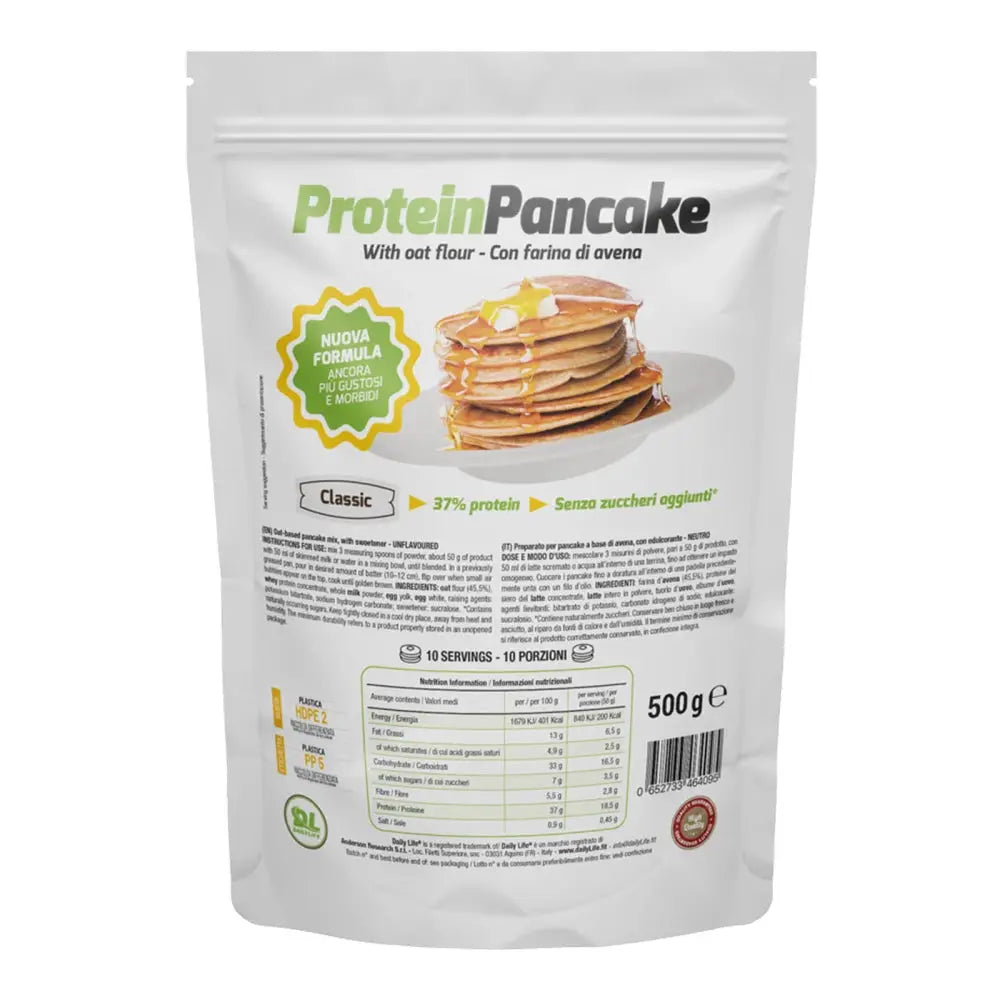
What is DailyLife Protein Pancake?
DailyLife Protein Pancake is a powdered pancake mix, to be blended with water or milk and cooked in a frying pan. A 50 g serving provides 19.5 g of protein, i.e. 39% of the powder, and is built on 45% oat flour. The manufacturer states a net weight of 500 g, which works out at ten servings per pack.
The composition comes down to two blocks: oat flour for the carbohydrate base, and a protein blend combining whey concentrate, egg albumin and hydrolysed whey peptides. To these are added waxy maize starch and medium-chain triglycerides derived from coconut oil.
The versions in the range: Chocolate, Vanilla and Natural. The base is identical in all three; only the flavouring, the cocoa and the colouring change. The Natural version additionally contains whey isolate in its protein blend. The rest of the brand can be browsed in our DailyLife section, and the other mixes in our protein pancakes section.
What does a serving of Protein Pancake contain?
| Composition | Per 50 g serving | Per 100 g of powder |
|---|---|---|
| Protein | 19.5 g | 39 g |
| Oat flour | 45% of the recipe | |
| Energy, carbohydrate, fat | not disclosed by the manufacturer | |
| Liquid for preparation | 100 ml of skimmed milk or water per 50 g | |
| Pack size | 500 g stated, i.e. 10 servings | |
19.5 g of protein in a plate of pancakes is what you get from three eggs. That is the useful benchmark. This is a genuine protein breakfast, not a side dish: for comparison, an ordinary supermarket pancake mix tops out at around 8 to 10% protein, against 39% here.
The protein blend is more interesting than it looks. Whey concentrate, egg albumin, hydrolysed peptides: this is not a decorative choice. Egg albumin holds up to cooking better than whey alone, which tends to turn rubbery when heated. That is the technical reason these mixes exist instead of simply stirring whey into flour, and it is what makes the difference in the pan.
What the manufacturer does not publish has to be said: the energy values, the carbohydrate and the fat do not appear in the data available to us. On a product sold as a breakfast base, that is a gap, and we are not going to fill the box with an approximate figure. Refer to the table printed on the packaging. What we do know is that the base is 45% oats, so complex carbohydrates, and that the only added fats are medium-chain triglycerides derived from coconut oil.
On the regulatory side, one authorised claim can be quoted word for word: protein contributes to a growth in and the maintenance of muscle mass, and to the maintenance of normal bones. That is the official European wording, and it is justified here by the content. For the oats, the MCTs or the hydrolysed peptides, no claim is authorised: we are describing a composition, not an effect.
Ingredients list
Chocolate: OAT flour 45%, protein blend [WHEY protein concentrate, powdered albumin (from EGG), hydrolysed WHEY peptides], fat-reduced cocoa powder, waxy maize starch, medium-chain triglycerides (from coconut oil), flavourings, emulsifier: sodium carboxymethyl cellulose, sweetener: sucralose.
Vanilla: the same base, with the addition of a colouring (beta-carotene).
Natural: OAT flour 45%, protein blend [WHEY protein concentrate, powdered albumin (from EGG), WHEY protein isolate, hydrolysed WHEY peptides], waxy maize starch, vegetable oil [medium-chain triglycerides (from coconut oil)], emulsifier: sodium carboxymethyl cellulose, sweetener: sucralose.
Allergens: EGG, MILK PROTEIN, GLUTEN. Made in a factory that also handles soya, peanuts and crustacean-based ingredients. Excessive consumption may have a laxative effect.
How do you make Protein Pancake?
Dose: 2 scoops, i.e. 50 g of powder. Liquid: 100 ml of skimmed milk or water. Cooking: lightly oiled non-stick pan over medium heat; flip when bubbles appear on the surface. Time: under five minutes. Timing: breakfast, after a session, or as a snack.
The 50 g to 100 ml ratio gives a thick batter, and that is deliberate. A batter that is too runny spreads across the pan and gives thin pancakes that tear when you flip them. If you want tall, fluffy pancakes, stick to that 100 ml; add another 10 to 20 ml only if the powder is not hydrating fully.
Let the batter rest for two or three minutes before cooking. The oats and the carboxymethyl cellulose need that time to absorb the liquid, and the texture changes completely. This is the tip that turns a disappointing first attempt into a decent result, and nobody ever writes it on the packaging.
Medium heat, never high. High-protein mixes burn on the surface before they are cooked through if the pan is too hot. Allow two to three minutes on each side and wait for the bubbles before flipping. Skimmed milk gives a fluffier result than water, for a slightly higher protein intake.
As for toppings, anything goes: fresh fruit, quark, a spoonful of nut butter from our peanut butter section, or a zero-sugar jam if you want to keep the plate low in sugar.
Who is Protein Pancake for, and who is it not for?
It is aimed at someone who wants a substantial protein breakfast without counting grams or getting out three ingredients. The honest comparison is this: you can achieve the same thing with porridge oats, whey and an egg white, for less money. What you are buying here is the fact that the blend is already made and that it holds up to cooking.
It is not suitable for anyone allergic to egg or milk protein, both of which are present. It contains gluten, the oats being declared as such: it must therefore be ruled out in cases of coeliac disease. The manufacturer states that it is made in a factory that also handles soya, peanuts and crustacean-based ingredients — worth knowing if your allergy is severe.
Nor is it suitable for vegan diets, with whey and egg albumin in the recipe. And it contains sucralose: if you avoid artificial sweeteners, this is not the product for you.
What not to expect from it. It is not a meal replacement, as the manufacturer states itself, and it is not a slimming product. Excessive consumption may have a laxative effect. It does not build muscle on its own: it is a convenient, well-composed breakfast, which is already a good reason to buy it.
Pancake mix, or oat flour and protein bought separately?
This is the question any reasonably discerning customer asks, and it deserves a straight answer.
Buying separately costs less, no argument. A bag of oat flour and a tub of protein let you put together exactly the same kind of mix, adjusting the ratio to your taste, and serve ten other purposes with the same products. If you already cook, that is the more rational route.
The ready-made mix wins on one technical point and on consistency. The technical point is the egg albumin and the emulsifier: they hold up to cooking where a home-made blend of whey and flour often turns out dry or rubbery. Consistency is more mundane: two scoops and 100 ml, there is nothing to think about at 7:00 in the morning, and a breakfast you actually make beats a perfect recipe you skip.
And if what you are after is instead a neutral carbohydrate base to combine freely with your protein, cream of rice answers that need better: it is prepared without cooking and digests more easily before a training session.
Frequently asked questions
How much protein per serving?
19.5 g per 50 g of powder, i.e. 39% of the mix. That is the equivalent of three eggs. The blend combines whey concentrate, egg albumin and hydrolysed whey peptides, with the Natural version additionally containing isolate.
Which versions are available?
In the range: Chocolate, Vanilla and Natural. The base is identical, only the flavouring, the cocoa and the colouring change from one version to the next. The Natural version lends itself well to savoury or sweet toppings, the other two are already flavoured.
Water or milk for the batter?
Both work, with 100 ml per 50 g of powder. Skimmed milk gives fluffier pancakes and a little more protein; water gives a lighter result with a more neutral taste. It is a matter of preference, not of technical success.
Does the product contain gluten?
Yes, the oats are declared as a source of gluten and account for 45% of the recipe. The product must therefore be ruled out in cases of coeliac disease. The other declared allergens are egg and milk protein.
Why do my pancakes tear?
Almost always for two reasons: the batter is too runny, or the pan is too hot. Stick to the 100 ml per 50 g, let the batter rest for two to three minutes before cooking, and work over medium heat. Only flip when bubbles appear on the surface.
How many servings in a pack?
The manufacturer states a net weight of 500 g, which amounts to ten 50 g servings. The full nutrition table — energy, carbohydrate, fat — does not appear in the data available to us: refer to the packaging you receive.
Can the batter be made the night before?
There is nothing against it overnight, in the fridge and in a sealed container: the batter will thicken, and you simply add a little liquid. The product contains milk protein and egg, so do not leave it at room temperature and cook it the following morning.
Where to buy DailyLife Protein Pancake
The mix can be ordered from this page in the versions available, and we ship throughout France and Europe. At the Vendargues shop, about ten minutes from Montpellier, this is the product we reach for when someone tells us they eat nothing in the morning: a breakfast that takes five minutes to make and delivers 19.5 g of protein solves the problem better than yet another shake. The rest of the selection can be browsed in the protein snack section.
Retrait au magasin sous 2 h
À Vendargues, près de Montpellier. Vous êtes prévenu dès que la commande est prête.
Commandé avant 14 h, expédié le jour même
Du lundi au samedi. Le délai d'acheminement appartient ensuite au transporteur.
Livraison offerte dès 50 €
En France métropolitaine, et dès 100 € en Europe. Modes et délais.
Une question avant de commander ?
Écrivez-nous ou passez au magasin : on connaît les produits qu'on vend.
What is sports nutrition?
Sports nutrition refers to all the foods and supplements designed to meet the demands created by training: more protein to repair muscles, more carbohydrates to fuel effort, and sometimes certain micronutrients that a restricted diet might miss.
Two common misconceptions should be dismissed immediately. First: these products are not medicines. Protein powder is a dehydrated food, creatine is a molecule found in meat. None contain active ingredients in the pharmacological sense. Second: they don't replace anything. Without regular training, adequate sleep, and a proper diet, no supplement will yield results—and an entire aisle of products won't change that.
Therefore, this page is not trying to sell you anything: it serves as a catalog guide. Each category is summarized in a few lines, explaining its purpose and directing you to the relevant page for more details. If you're new to this and the list seems long, skip directly to the section on in what order to add supplements: it approaches the problem from a different angle.
How is the section organized?
Proteins
This is the broadest and most useful category. Protein powders are sorted by digestive tolerance and use, not by quality hierarchy: whey concentrate is the default choice, whey isolate addresses difficult digestion with lactose, casein for slow digestion, and plant-based proteins for a dairy-free diet. Egg or beef-based versions are also available for those who exclude dairy but not animal products.
Carbohydrates
They provide energy, not structure. Two unrelated uses. Around the workout: maltodextrin and its fast-absorbing cousins, cyclic dextrin and waxy maize. Daily use: oat flour and rice cream, which turn a shaker into a real snack. If the problem is reaching calorie targets, mass gainers include options from the most caloric to the most moderate.
Creatine
The most well-documented supplement in the aisle, and one of the cheapest. Creatine monohydrate remains the standard, possibly using the German raw material Creapure®. Alternative forms—HCL, Kre-Alkalyn—cost more without clearly established advantages over monohydrate. Three grams per day, every day, including rest days.
Amino Acids
EAAs cover all nine essential amino acids; BCAAs only provide three and lose most of their relevance once your total protein intake is met. Additionally, isolated amino acids address specific uses: citrulline for pumps, beta-alanine for repeated intense efforts, glutamine, arginine, and taurine for narrower niches.
Pre-workout
Boosters generally combine a stimulant and a pump matrix. They are primarily chosen by their caffeine dose, and nothing else. Two variations cover special cases: caffeine-free boosters, useful in the evening, and creatine-free formulas for those who manage their creatine separately. For long sessions or in hot weather, electrolytes are more important than any stimulant.
Fat Burners and Weight Loss
Let's be clear: no product in this category causes weight loss on its own. A calorie deficit is what does it. Fat burners, whether in capsules, powder, or caffeine-free versions, have a marginal effect. The weight loss section gathers all these, including proteins—because high protein intake limits muscle loss during a diet.
Vitamins, Minerals, and Health
This category supports overall health, not performance directly. Multivitamins offer broad coverage; isolated forms address identified needs, foremost among them vitamin D, magnesium, and omega-3s. Joint comfort benefits from collagen and glucosamine, digestive comfort from probiotics and enzymes. A deficiency is detected by a blood test, not by how you feel: ask your doctor for a check-up before blindly supplementing.
Plants and Isolated Actives
Ashwagandha, turmeric, maca, spirulina, melatonin: these products address various expectations, with highly unequal levels of evidence from one plant to another. Each page indicates what European regulations allow to be said about them, and nothing more.
Grocery and Snacks
The least technical part, and often the most useful daily: protein bars, snacks, cookies, pancakes, and peanut butter. Also includes items to make dieting more bearable—zero sauces, no-added-sugar jams, cooking sprays, flavorings, and sugar-free drinks.
Accessories
Shakers, water bottles, and preparation equipment are found under accessories. Not spectacular, but a leaky or smelly shaker can ruin an entire tub of protein.
What should be sorted out before buying any supplement?
Four things, and they cost nothing.
Consistency. Three workouts a week consistently for six months beats any perfect program abandoned in three weeks. Until this point is established, no powder will compensate.
Sleep. Muscles rebuild at night. Chronic sleep deprivation negates a significant portion of your workout benefits, and no product can make up for that.
Protein from food. Track what you actually eat for three or four days. Most beginners discover they are far from meeting their needs, not because they lack powder, but because their breakfast provides almost nothing and their lunch is a sandwich. Correcting this costs less than a tub of supplements.
Calories. To build muscle, you need a slight surplus; to lose fat, a deficit. You cannot do both at once, and no supplement makes this rule negotiable.
If these four points are in place and your protein intake is still difficult to achieve, only then does the supplement aisle become useful.
In what order should you add supplements?
Step 1: Protein powder, if and only if you have a gap to fill
Typical bodybuilding guidelines suggest protein needs between 1.6 and 2.2 g of protein per kilogram of body weight per day, compared to 0.83 g for a sedentary adult according to ANSES. If your diet already provides enough, powder won't add anything.
If there's a gap, choose the simplest product: whey concentrate. It offers the best price per gram of protein, and there's nothing wrong with it as long as you digest it well. Only pay for an isolate if lactose genuinely bothers you, and a plant-based protein only if you exclude dairy products. The full protein section details each case.
Step 2: Creatine monohydrate
This is the only supplement we almost systematically recommend, and it's very inexpensive. Three grams per day, every day, including non-training days, at any time. It works by progressively saturating muscle over several weeks: there's no "window" or cycle to respect. Stick to classic creatine monohydrate and nothing else—exotic forms cost more without established benefits.
Step 3: A micronutrient, if a check-up justifies it
Not before. A deficiency is detected by a blood test prescribed by your doctor, never by how you feel. In our latitudes, vitamin D deficiency is most common in winter; magnesium and omega-3s are discussed depending on what your diet already provides. A multivitamin can serve as a safety net if your meals are very repetitive, but it doesn't replace a proper medical evaluation.
Step 4: Comfort, when everything else is in place
Protein bars for days without cooking, electrolytes for long summer workouts, oat flour to turn a shaker into a snack. These are solutions to real practical problems, not accelerators of results.
Where to start based on your goal?
Gain mass. The limiting factor is caloric. First ensure your protein intake, then your carbohydrates: whey concentrate, oat flour, and a mass gainer only if you genuinely struggle to eat enough. Add creatine, the best result-to-price ratio in the section.
Lose fat. The limiting factor is the deficit, and satiety to maintain it. High protein intake, bars for difficult late days, and light grocery items to keep meals enjoyable. Fat burners come far behind, if at all.
Increase strength. Daily creatine, sufficient protein, and possibly a booster on heavy lifting days. The rest is accessory.
Endurance and long efforts. Electrolytes and intra-workout carbohydrates take precedence over everything else, especially from May to September in our region.
Feel better daily. A blood test first, then possibly vitamin D, magnesium, or omega-3s, depending on what the test reveals and what your diet already provides.
What should you not buy first?
This part of the page will save you the most money.
A fat burner. No product in this category causes weight loss on its own: it's the caloric deficit that does it, and the effect of fat burners remains marginal. Bought before having addressed your diet, a burner is useless.
BCAAs. They provide only three of the nine essential amino acids. Once your total protein intake is covered, their benefit plummets. If you insist on drinking something during your workout, EAAs are more logical—but not a priority for a beginner.
A gainer. A mass gainer product is mostly composed of carbohydrates. It's useful for those who genuinely cannot eat enough, and expensive for everyone else. First try adding rice, pasta, and olive oil to your meals.
A pre-workout. Boosters are enjoyable and can help with a heavy session. They also build caffeine tolerance, disrupt sleep if taken too late, and mask an energy deficit often caused by short nights. Not a first purchase.
Glutamine, "testosterone boosters," and all-in-one packs. Many promises, few proven results for a healthy adult eating properly. Packs, in particular, make you buy five products to use two.
How many supplements do you really need?
Fewer than this section might suggest. For the vast majority of practitioners, two products are sufficient: a protein, if the diet doesn't meet needs, and creatine. A third might be justified sometimes, based on an identified need—a confirmed vitamin D deficiency, or magnesium supplied too sparingly by meals.
Beyond that, you enter the realm of diminishing returns, where each additional euro buys very little effect. A supplement budget spent on good quality food often produces more. We prefer to sell two useful products than six where four will end up at the back of a cupboard.
How to allocate a limited budget?
In this order, without exception. First euro: food. Eggs, meat, fish, legumes, dairy products, starches. Second euro: creatine, by far the best result-to-price ratio in the section. Third euro: protein powder, to cover the actual gap between your needs and your meals. Fourth euro: a micronutrient identified by a blood test.
What pitfalls should you be aware of?
Comparing prices by powder weight. What matters is the price per kilo of protein: divide the price of the tub by its weight in kilos, then by the protein content per 100g. Two products that seem twenty euros apart often end up costing the same.
Reading the "per serving" column. Scoops range from 25 to 40g depending on the brand. Only the "per 100g" column allows for an honest comparison.
Ignoring the order of ingredients. Isolated amino acids placed high on the list inflate the displayed protein content without providing the complete profile of a whole protein. The word "blend," similarly, sometimes hides un-detailed proportions.
Believing promises of results. A dietary supplement does not cure, heal, or replace treatment. Health claims authorized in Europe are regulated and verifiable with EFSA; anything beyond that is advertising hype.
Forgetting doping control. If you are subject to it, no product can be considered safe by default: verify batch by batch with the manufacturer and refer to the list of prohibited substances published by the AFLD.
Taking three shakes a day. If you're doing that, your meals are providing too little protein. Rebalancing a plate costs less than a tub.
Loading everything into one meal. A 25-30g protein intake fully stimulates protein synthesis; beyond that, the supplement doesn't add stimulus. Three to four spread out intakes are better than one enormous dinner.
Changing products every month. No supplement can be judged in three weeks. Creatine takes several weeks to saturate the muscle; protein is only judged by the regularity of intake.
Frequently Asked Questions
Which supplement should I start with?
With a protein powder if your diet doesn't meet your needs, and with creatine monohydrate in almost all cases. These are the two most well-documented and cheapest products in the section. The rest can wait several months.
When should I take my protein powder?
Much less important than commonly believed. What matters is the total daily protein intake, spread over three to five servings; the famous "anabolic window" of thirty minutes after a workout has been largely relativized by recent research, which speaks more of several hours. So, take your shaker when you're lacking protein: at breakfast if your mornings are low, as a snack if the afternoon is long, after your workout if that's most convenient. One useful nuance: a slower-digesting casein is better suited for evening intake.
Are protein powders bad for the kidneys?
In healthy adults, there's no data to show that high protein intake damages healthy kidneys. The idea comes from a simplification: in people who already have kidney insufficiency, protein intake is limited—which says nothing about the risk in someone whose kidneys function normally. Two honest clarifications, however: if you have known kidney damage, diabetes, or treated hypertension, the question genuinely arises and should be addressed by your doctor, not a store page. And protein powder is nothing more than concentrated food: the same amount in meat, eggs, or legumes would pose exactly the same questions.
Does creatine cause bloating or water retention?
Partially, and it depends on what kind of water we're talking about. Creatine attracts water inside the muscle cell: you might see the scale go up by one to two kilograms in the first few weeks, but the muscle appears fuller, not bloated. This isn't subcutaneous water retention, which causes a puffy face, and it's not fat. The phenomenon stabilizes and disappears when you stop. There's no need for cycles or breaks: 3 to 5 g per day, continuously. Drinking normally is sufficient; no special hydration is required.
Are supplements dangerous?
For a healthy adult, basic products—proteins, creatine, vitamins at recommended doses—pose no documented risk with reasonable use. Caution is advised with highly dosed stimulants, unintentional cumulation of several products, and specific situations: pregnancy, breastfeeding, ongoing treatment, kidney or liver failure. In these cases, medical advice is essential.
Should they be taken on non-training days?
For proteins and creatine, yes: muscle rebuilding occurs outside of workouts, and creatine works by progressively saturating the muscle. For pre-workouts and intra-workout products, no: there's no reason to take them on a rest day.
How much protein per day for an athlete?
Typical bodybuilding guidelines suggest protein needs between 1.6 and 2.2 g per kilogram of body weight per day, compared to 0.83 g for a sedentary adult according to ANSES. This total includes all food consumed throughout the day, not just powders.
Can everything be obtained through diet?
Almost always, yes. Supplements solve problems of convenience, budget, or appetite, rarely physiological issues. Vitamin D is a seasonal exception in our latitudes, and this can be verified by a blood test.
How to recognize a reputable product?
Legible label with quantities per ingredient, protein content displayed per 100 g, short list, no proprietary blends, stated origin. A brand that details its dosages has nothing to hide; a brand that doesn't usually has a reason.
Are new products better than classic ones?
Rarely. The most established products in the aisle are also the oldest. Our new arrivals fill gaps in the catalog rather than revolutionize anything.
Does whey make you gain weight?
Not in itself. One dose generally provides between 100 and 130 kcal, less than a banana and a yogurt: it's just another food, which only leads to weight gain if it adds to an already surplus daily intake. The trap lies when the shake is consumed in addition to meals instead of replacing a snack, or when prepared with whole milk, a banana, and peanut butter—which can easily reach 400 kcal. Taken with water, replacing a snack, whey is, on the contrary, one of the most calorie-efficient ways to meet protein needs.
Can you take protein without exercising?
Yes, without particular risk for a healthy adult: it's a food, just like powdered chicken breast. The real question is what purpose it serves. Without resistance training, extra protein intake won't build muscle—there's no stimulus to nourish. However, it can make sense in a few cases: very low-protein meals, reduced appetite, or for an elderly person for whom daily intake is difficult to achieve. Outside these situations, money is better spent on whole foods.
How much whey per day?
One to two servings are sufficient for almost all users, and the right amount isn't an absolute number: it's the difference between your needs and what your meals already provide. Specifically, calculate your protein target (1.6 to 2.2 g per kilo), count what you eat, and fill the difference. If the difference exceeds two servings per day, you need to re-evaluate your meals, not your order. An intake of 25 to 30 g of protein is enough to fully stimulate protein synthesis; consuming 60 g at once provides no additional benefit.
Is creatine risky for beginners?
For healthy adults, creatine monohydrate is one of the most studied supplements, and its consumption at usual doses has shown no documented harmful effects. Precautions apply to individuals with known kidney or liver impairment, pregnancy, and breastfeeding: in these cases, medical advice is essential.
Is a creatine loading phase necessary?
No, it's not necessary. Three grams per day will saturate muscle in three to four weeks, without the digestive discomfort sometimes caused by loading phases.
At what age can supplements be taken?
Sports nutrition supplements are formulated and labeled for adults, and a significant portion of them—all caffeinated products in particular—are expressly not recommended for minors. For a teenager starting weightlifting, the useful answer isn't in a tub anyway: at that age, protein and energy needs can largely be met through diet, and it's training and sleep that drive progress. If the question still arises—special diet, intensive sport, difficult appetite—it falls under the purview of a general practitioner or dietitian, not a salesperson.
How long before seeing results?
Initial strength changes appear within a few weeks, while visible changes take several months. This is precisely why buying six products in the first month is a bad idea: you'll never know which one did what.
Vegetarian or vegan, should things be done differently?
The principle remains the same, but reaching the total protein intake requires more organization, and certain micronutrients deserve special attention—vitamin B12 first and foremost. Plant-based proteins generally combine pea and rice to complete the amino acid profile. For everything else, talk to your doctor.
Where to find a sports nutrition store near Montpellier?
Our store is located in Vendargues, about ten minutes from Montpellier, and it's the best place to make a decision when browsing such a wide selection feels overwhelming. You can handle the tubs, compare nutrition labels side-by-side, and calculate the price per kilo of protein at the counter. It's also the only place where you'll be told that two products are enough when you had six noted down. We also ship everywhere in France and Europe.
Sources: ANSES for nutritional references and advice on supplements for athletes, Ciqual for food composition, EFSA for authorized claims. This information does not replace medical advice. Food supplements should be integrated into a varied and balanced diet and a healthy lifestyle.
Questions fréquentes — Sports Nutrition
Par quel complément commencer ?
Par une protéine en poudre si votre alimentation ne couvre pas vos besoins, et par la créatine monohydrate dans presque tous les cas. Ce sont les deux produits les mieux documentés et les moins chers du rayon. Le reste peut attendre plusieurs mois.
Quand prendre sa protéine en poudre ?
Beaucoup moins important qu'on ne le croit. Ce qui compte, c'est le total de protéines de la journée, réparti sur trois à cinq prises ; la fameuse « fenêtre anabolique » de trente minutes après la séance a été largement relativisée par les travaux récents, qui parlent plutôt de plusieurs heures. Prenez donc votre shaker là où il vous manque des protéines : au petit-déjeuner si vos matins sont pauvres, en collation si l'après-midi est long, après la séance si c'est le plus pratique. Une seule nuance utile : une caséine, plus lente, se prête mieux à la prise du soir.
Les protéines en poudre sont-elles mauvaises pour les reins ?
Chez l'adulte en bonne santé, aucune donnée ne montre qu'un apport élevé en protéines abîme des reins sains. L'idée vient d'un raccourci : chez des personnes ayant déjà une insuffisance rénale, on limite les protéines — ce qui ne dit rien du risque chez quelqu'un dont les reins fonctionnent normalement. Deux précisions honnêtes tout de même : si vous avez une atteinte rénale connue, un diabète ou une hypertension traitée, la question se pose réellement et relève de votre médecin, pas d'une page de boutique. Et une protéine en poudre n'est rien d'autre qu'un aliment concentré : la même quantité en viande, œufs ou légumineuses poserait exactement les mêmes questions.
La créatine fait-elle gonfler ou prendre de l'eau ?
En partie, et il faut savoir de quelle eau on parle. La créatine attire de l'eau à l'intérieur de la cellule musculaire : on peut voir la balance monter d'un à deux kilos les premières semaines, mais le muscle paraît plus plein, pas boursouflé. Ce n'est pas de la rétention sous-cutanée, celle qui donne un aspect gonflé du visage, et ce n'est pas de la graisse. Le phénomène se stabilise et disparaît à l'arrêt. Il n'y a ni besoin de cure ni de fenêtre d'arrêt : 3 à 5 g par jour, en continu. Boire normalement suffit, aucune hydratation spéciale n'est requise.
Les compléments sont-ils dangereux ?
Chez un adulte en bonne santé, les produits de base — protéines, créatine, vitamines aux doses recommandées — ne présentent pas de risque documenté à usage raisonnable. La prudence porte sur les stimulants fortement dosés, sur les cumuls involontaires entre plusieurs produits, et sur les situations particulières : grossesse, allaitement, traitement en cours, insuffisance rénale ou hépatique. Dans ces cas, l'avis d'un médecin s'impose.
Faut-il en prendre les jours sans entraînement ?
Pour les protéines et la créatine, oui : la reconstruction se déroule en dehors de la séance, et la créatine agit par saturation progressive du muscle. Pour les pré-entraînements et les produits d'effort, non : ils n'ont aucune raison d'être pris un jour de repos.
Combien de protéines par jour pour un sportif ?
Les repères usuels en musculation situent les besoins entre 1,6 et 2,2 g par kilogramme de poids corporel et par jour, contre 0,83 g pour un adulte sédentaire selon l'ANSES. Ce total inclut tous les aliments de la journée, pas seulement les poudres.
Peut-on tout obtenir par l'alimentation ?
Presque toujours, oui. Les compléments règlent des problèmes de praticité, de budget ou d'appétit, rarement des problèmes physiologiques. La vitamine D fait figure d'exception saisonnière sous nos latitudes, et cela se vérifie par une prise de sang.
Comment reconnaître un produit sérieux ?
Étiquette lisible avec les quantités par ingrédient, taux protéique affiché pour 100 g, liste courte, pas de mélange propriétaire, origine indiquée. Une marque qui détaille ses dosages n'a rien à cacher ; une marque qui ne les détaille pas a généralement une raison.
Les nouveautés valent-elles mieux que les produits classiques ?
Rarement. Les produits les mieux établis du rayon sont aussi les plus anciens. Nos nouveautés comblent des manques du catalogue plus qu'elles ne révolutionnent quoi que ce soit.
La whey fait-elle grossir ?
Pas en elle-même. Une dose apporte généralement entre 100 et 130 kcal, soit moins qu'une banane et un yaourt : c'est un aliment parmi d'autres, qui ne fait grossir que s'il s'ajoute à une journée déjà excédentaire. Là où le piège existe, c'est quand le shaker vient en plus des repas au lieu de remplacer une collation, ou quand on le prépare au lait entier avec une banane et du beurre de cacahuète — on arrive alors facilement à 400 kcal. Prise à l'eau, en remplaçant un en-cas, une whey est au contraire un des moyens les plus économes en calories d'atteindre ses protéines.
Peut-on prendre des protéines sans faire de sport ?
Oui, sans risque particulier chez un adulte en bonne santé : c'est un aliment, au même titre qu'un blanc de poulet en poudre. La vraie question est à quoi cela sert. Sans entraînement en résistance, un apport supplémentaire en protéines ne construit pas de muscle — il n'y a pas de stimulus à nourrir. Cela peut néanmoins avoir du sens dans quelques cas : des repas très pauvres en protéines, un appétit réduit, ou une personne âgée chez qui l'apport quotidien est difficile à atteindre. En dehors de ces situations, l'argent est mieux placé dans l'assiette.
Quelle quantité de whey par jour ?
Une à deux doses suffisent à la quasi-totalité des pratiquants, et la bonne quantité n'est pas un chiffre absolu : c'est l'écart entre vos besoins et ce que vos repas apportent déjà. Concrètement, calculez votre cible en protéines (1,6 à 2,2 g par kilo), comptez ce que vous mangez, et comblez la différence. Si l'écart dépasse deux doses par jour, ce sont vos repas qu'il faut revoir, pas votre commande. Une prise de 25 à 30 g de protéines suffit à stimuler pleinement la synthèse protéique ; en avaler 60 d'un coup n'apporte rien de plus.
La créatine est-elle risquée pour un débutant ?
Chez l'adulte en bonne santé, la créatine monohydrate est l'un des compléments les plus étudiés, et sa consommation aux doses usuelles n'a pas montré d'effet délétère documenté. Les précautions concernent les personnes ayant une atteinte rénale ou hépatique connue, la grossesse et l'allaitement : dans ces cas, l'avis d'un médecin s'impose.
Faut-il faire une phase de charge en créatine ?
Non, ce n'est pas nécessaire. Trois grammes par jour saturent le muscle en trois à quatre semaines, sans les inconforts digestifs que provoquent parfois les phases de charge.
À partir de quel âge peut-on prendre des compléments ?
Les compléments alimentaires pour sportifs sont formulés et étiquetés pour des adultes, et une bonne partie d'entre eux — tous les produits caféinés en particulier — sont expressément déconseillés aux mineurs. Pour un adolescent qui commence la musculation, la réponse utile n'est de toute façon pas dans un pot : à cet âge, les besoins en protéines et en énergie sont largement couvrables par l'alimentation, et c'est l'entraînement et le sommeil qui font les progrès. Si la question se pose quand même — régime particulier, sport intensif, appétit difficile — elle relève du médecin traitant ou d'un diététicien, pas d'un vendeur.
Combien de temps avant de voir des résultats ?
Les premiers changements de force apparaissent en quelques semaines, les changements visibles demandent plusieurs mois. C'est précisément pourquoi acheter six produits le premier mois est une mauvaise idée : vous ne saurez jamais lequel a servi à quoi.
Végétarien ou végétalien, faut-il faire différemment ?
Le principe reste identique, mais atteindre le total protéique demande plus d'organisation, et certains micronutriments méritent une attention particulière — la vitamine B12 en premier lieu. Les protéines végétales associent en général pois et riz pour compléter le profil en acides aminés. Pour le reste, parlez-en à votre médecin.
